
Quick Read
- EU Blue Card 2026 salary threshold: Rs.55,79,000 (€50,700) for standard roles
- Shortage occupation Blue Card threshold is Rs.50,55,000 (€45,934.20) for IT, engineering, healthcare.
- The Opportunity Card lets Indians search for jobs in Germany without a prior offer.
- Germany has over 400,000 unfilled skilled-worker vacancies as of 2026.
- The Job Seeker Visa allows a 6-month job search stay with no job offer required
- IELTS is not required for any German work or job-seeker visa route
💬 What Indian students are saying right now: on how to get a job in Germany without Masters
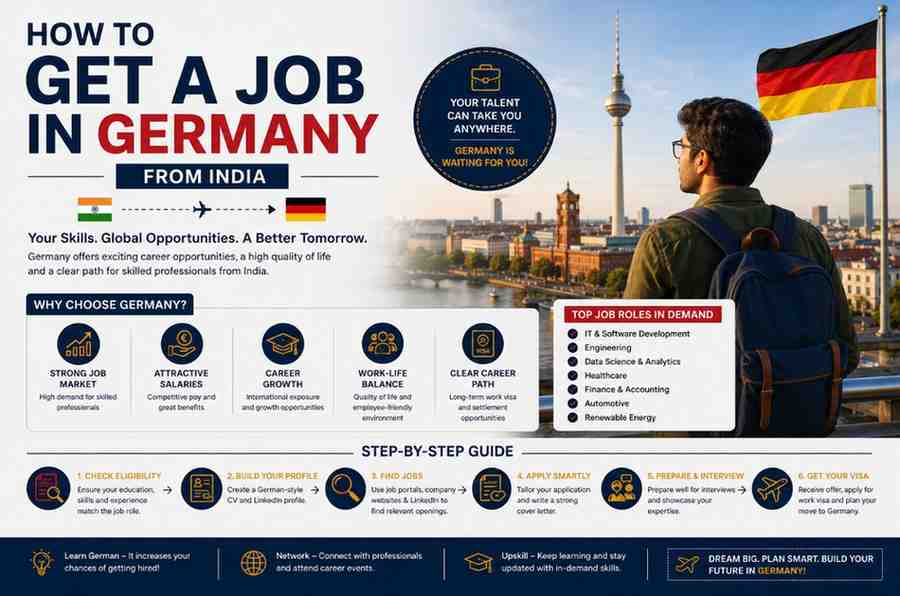
Germany’s skilled-worker shortage has crossed 400,000 unfilled vacancies in 2026, concentrated in IT, engineering, healthcare, and skilled trades. For Indian professionals, the situation has opened up three distinct legal routes into the country: the Job Seeker Visa, the EU Blue Card, and the newer Opportunity Card (Chancenkarte). Each has a different salary bar, a different document list, and suits a different stage of your career. This guide walks through all three, tells you exactly which one fits your profile, and lays out the month-by-month process to get there.
Why Indian Professionals Are Getting Hired in Germany in 2026
Germany’s Federal Employment Agency (Bundesagentur für Arbeit) classifies IT, engineering, healthcare, and skilled trades as bottleneck professions, meaning employer demand significantly exceeds domestic supply. The official shortage list also names roles like mechatronic technicians and train drivers, so it’s worth checking the full list rather than assuming only the usual IT and engineering titles qualify. This shortage, combined with 2024-2026 reforms to the Skilled Immigration Act, has made Germany one of the more accessible European job markets for Indian applicants right now.

Choose your dream country
 UK
UK
 USA
USA
 Germany
 Australia
 Ireland
 Canada
 UAE
UAE
 France
 Sweden
 Italy
Italy
 Other
Other
When do you want to study abroad?
What's your highest level of education?
Have you completed Class 12th?
What was your Class 12 CGPA/percentage?
Are you a student or a parent/guardian?
What do you want to study?
Select your current city
How Leap will help you

Personalised University Shortlist

Express Applications with Quicker Admits

End-to-End Application Support
Germany's labour market looks tighter than it is on paper: the Federal Employment Agency put the seasonally adjusted unemployment rate at 6.3% in June 2026, the highest annual average since 2010, while the internationally comparable ILO measure puts it at 3.9%, among the lowest in the EU. The two aren't contradictory; the Federal Employment Agency separately identifies over 160 occupations with qualified-worker bottlenecks going into 2026, which is exactly where the opening for Indian applicants sits.
Before applying anywhere, run the free Quick Check tool on the Make it in Germany portal: enter your qualification and experience, and it tells you within minutes which visa route you're likely eligible for.
| Sector | Entry-Level Salary (INR / EUR) | Mid-Level Salary (INR / EUR) | Language Requirement |
|---|---|---|---|
| IT and Software | Rs.55.02L–66.02L (€50,000–60,000) | Rs.71.53L–86.38L (€65,000–78,500) | English usually sufficient |
| Automotive Engineering | Rs.44.02L–60.52L (€40,000–55,000) | Rs.60.52L–82.53L (€55,000–75,000) | German A2-B1 recommended |
| SAP Consulting (incl. Basis) | Rs.60.52L–77.03L (€55,000–70,000) | Rs.77.03L–104.54L (€70,000–95,000) | English often sufficient at MNCs |
| Accounting and Finance | Rs.44.02L–55.02L (€40,000–50,000) | Rs.60.52L–82.53L (€55,000–75,000) | German B1-B2 for client-facing roles |
| Healthcare (nursing, medtech) | Rs.44.02L–49.52L (€40,000–45,000) | Rs.55.02L–60.52L (€50,000–55,000) | German B2-C1 mandatory for patient contact |
| Skilled Trades | Rs.38.51L–44.02L (€35,000–40,000) | Rs.49.52L–55.02L (€45,000–50,000) | German recommended, often mandatory |
Counselor insight: The salary a candidate is offered matters more than the sector label when it comes to visa eligibility. An IT professional offered Rs.50.55L (€45,934) qualifies for the shortage-occupation Blue Card, regardless of whether their degree is in computer science or a related field, as long as the role's day-to-day content matches the occupation code assigned to it by the Federal Employment Agency.
How to Get a Job in Germany from India: The Three Routes
Most Indian applicants confuse these three routes, or assume you always need a job offer before you can even begin. You don't, and knowing which route applies to your situation from the outset saves months of wasted preparation.
| Feature | Job Seeker Visa | EU Blue Card | Opportunity Card (Chancenkarte) |
|---|---|---|---|
| Job offer required before applying | No | Yes | No |
| 2026 salary threshold | Not applicable (search visa) | Rs.55.79L (€50,700) standard; Rs.50.55L (€45,934.20) shortage occupations | Not applicable (search visa) |
| Duration | Up to 6 months | Up to 4 years, renewable | Up to 12 months, extendable |
| Qualification requirement | Recognised degree | Recognised degree (or 3+ years IT experience without one) | Recognised degree, OR 6 points on the Chancenkarte points grid |
| Work allowed while searching | No: search only | N/A (already employed) | Yes: up to 20 hrs/week plus trial jobs |
| Financial proof required | Rs.7.20L (€6,546) for 6 months, roughly Rs.1.20L (€1,091) per month | Salary itself is the proof | Rs.14.41L (€13,092) for 12 months |
| Fast-track to PR | No (until you convert to a work visa) | Yes: 21 months with B1 German, 33 without | No (until you convert to a work permit) |
| Best for | Experienced professionals confident of landing interviews from India | Candidates who already have a qualifying job offer in hand | Recent graduates or professionals whose degree isn't yet formally recognised in Germany |
Counselor insight: Applicants often default to the Job Seeker Visa because it's the most talked-about route in India, without checking whether they already qualify for the Blue Card. If you have a confirmed offer above the relevant threshold, apply directly for the Blue Card. It skips the uncertainty of a time-limited search visa entirely.
Two reasons the Blue Card is worth prioritising beyond speed: reaching B1 German rather than stopping at A1 saves roughly six months on the settlement-permit clock alone, and once earned, a German Blue Card isn't just a bet on one country; it functions closer to a foothold in the EU labour market generally, provided you've held it long enough to trigger the mobility provisions.
Explore the full Germany Opportunity Card guides for the complete document checklists for each route.
Which Route Should You Apply For? A Decision Framework for Indian Job Seekers
If you are a final-year BTech student graduating in 2026 with no job offer yet: Your degree isn't in German employers' hands, and you have no Indian work experience to lean on. The Opportunity Card is usually the stronger fit here: Check whether your BTech is Anabin-recognized, and if it scores below the 6-point threshold, count age, language level, and any internship experience toward the points grid before applying.
If you are asking how to get a job in Germany after an MBA from India: An MBA alone doesn't automatically clear the Blue Card's standard Rs.55.79L (€50,700) threshold in every sector, but management-track roles in finance, consulting, and operations in cities like Frankfurt often do. Target roles explicitly, not generic "management trainee" postings, and confirm the offered salary against the current threshold before signing.
Are you an IT Professional or SAP Basis Consultant with 3+ years experience: IT is one of the very few sectors where Germany considers Blue Card eligibility without a formal degree if you have 3 years of relevant experience in the last 7 years. SAP Basis, ABAP and S/4HANA consultants regularly earn between Rs.71.53L-1.21Cr (€65,000-110,000) easily surpassing the shortage occupation threshold, and the skill area of SAP is explicitly listed as a shortage skill.
If you work in automotive or mechanical engineering: Automotive is officially listed under Germany's engineering shortage occupations, and entry-level roles at Rs.44.02L (€40,000) already clear the shortage-occupation Blue Card bar. Munich and Stuttgart, home to BMW, Porsche, and Bosch, pay a premium over the national average for this profile.
If you are an accountant or finance professional: Indian CA and ACCA qualifications are not automatically recognized for senior German audit roles; you would need Wirtschaftsprüfer certification to practice as an auditor. However, industry-side roles like Financial Controller, Group Accountant, or FP&A Analyst don't require this certification and regularly clear the Blue Card shortage threshold with a recognized bachelor's degree in accounting or finance.
If you're exploring medical coding jobs in Germany from India: This is a smaller, more language-dependent niche than the BPO-scale medical coding industry in India. German healthcare uses its own coding systems (ICD-10-GM, OPS), and almost all roles require German at a B2 or C1 level, since documentation and client interaction are in German. Build German proficiency first if this is your target, rather than applying on English-only CPC credentials.
That language gap is exactly what trips people up in practice. As Mriganka Das, a Mechanical Engineering graduate who's worked in Germany since 2019, describes it: "Language fluency presented the biggest challenge during early job hunting, leading to initial interview rejections before fluency improved over time."
Documents You Need to Apply for a Job in Germany from India
| Document | Purpose | India-Specific Detail |
|---|---|---|
| Anabin/ZAB degree recognition | Confirms your Indian degree's German equivalence | Check anabin.kmk.org before applying; some private university degrees need a ZAB statement |
| Recognition in Germany certificate | Confirms regulated professional or vocational qualifications, separate from academic degree equivalence | Needed for nursing, engineering licensure, and other regulated professions |
| APS Certificate | Verifies academic documents for German visa purposes | Mandatory for Indian applicants applying through APS India |
| Attested marksheets and degree certificates | Academic proof | Notarised English or German translations required |
| German-format CV (Lebenslauf) | Application screening | Chronological, 1-2 pages, photo optional |
| Motivation and fit | Written for the specific employer, not templated | |
| Language certificate (where required) | Proves German or English proficiency | Goethe-Institut or TestDaF for German; no IELTS requirement for any route |
| Blocked account confirmation (Sperrkonto) | Proof of funds for Job Seeker Visa or Opportunity Card | Fintiba or Expatrio accounts are widely accepted by Indian missions |
| Health insurance proof | Mandatory for all German visas | Travel insurance for the search phase; statutory insurance once employed |
| Passport-size photographs and valid passport | Standard visa documentation | Minimum 6 months' validity beyond intended stay |
Counselor insight: APS certificate processing and Anabin degree checks are the two steps Indian applicants most often leave too late. Both can take several weeks, and neither can be rushed once you're inside your visa's application window.
Month-by-Month Plan to Land a Job in Germany from India
| Month | Action |
|---|---|
| Month 1-2 | Get your degree checked on Anabin; start German language classes if targeting B1+ roles |
| Month 2-3 | Build your German-format CV and cover letter templates; identify your target route (Job Seeker Visa, Blue Card, or Opportunity Card) |
| Month 3-4 | Apply for your APS Certificate; begin applying on StepStone, Indeed Germany, Monster, LinkedIn, and the Federal Employment Agency's own portal |
| Month 4-5 | Open your blocked account if applying for the Job Seeker Visa or Opportunity Card; attend virtual job fairs like Make it in Germany Fairs |
| Month 5-6 | Book your visa appointment at the German Consulate in India; if you have an offer, begin Blue Card documentation instead |
| Month 6-7 | Attend your visa interview; processing typically takes 6-12 weeks depending on route and consulate |
| Month 7-8 onward | Relocate, activate your blocked account, register your address (Anmeldung), and begin active job interviews if on a search visa |
This calendar assumes you're starting from India with no existing German ties. If you graduated from a German university, several of these steps (Anabin check, APS Certificate) don't apply, and you move straight to the Job Seeker Visa or Blue Card stage.
The Post Study Work Visa Germany guide covers that path in detail.
What to Do If Your Germany Job Application or Visa Gets Rejected
Visa refusals and stalled applications happen more often than most guides admit. Here's what actually helps:
- Visa rejected for insufficient funds: Consulates most commonly reject due to documentation gaps, not genuine ineligibility. Re-verify that your blocked account provider is one accepted by your specific consulate, and then reapply with the corrected confirmation letter.
- Degree not recognized on Anabin: Apply through the Opportunity Card's points system instead of waiting for recognition, since work experience and language points can substitute.
- Low interview conversion despite applying widely: This scenario is frequently a CV formatting issue, not a qualification issue. German employers expect the Lebenslauf format specifically; an Indian-style resume with objective statements and personal details will often be filtered out before a human reads it.
- Job Seeker Visa expiring without an offer: You cannot extend a job seeker visa. If your 6 months are running out, focus the remaining weeks on trial employment arrangements and roles explicitly open to visa sponsorship, since a signed offer just before expiry can still support a Blue Card conversion.
- Salary offer below the Blue Card threshold: Negotiate before signing. German employers routinely have room to adjust base salary to clear the threshold, since it benefits them too by securing your ability to work legally.
CV format aside, a stalled search isn't always a red flag on the candidate. As Ram Kartik Rajendran, a Design Engineer turned CE Representative at ASMPT, puts it: "Heavy industry slowdowns have driven widespread headcount freezes over the last two years. Referrals help secure interviews, but final hiring is strictly merit-based."
3 Takeaways on Working in Germany
- Pick your route based on your offer status and qualification recognition, not on which visa is most talked about. If you have a qualifying offer, go straight for the Blue Card; if you don't, choose between the Job Seeker Visa and Opportunity Card based on whether your degree is Anabin-recognized.
- Meet the exact 2026 salary threshold for your route: Rs.55.79L (€50,700) for standard occupations or Rs.50.55L (€45,934.20) for shortage occupations, and negotiate before signing if you are close but below it.
- Start your documents 3-4 months before your target move, since Anabin checks, APS certification, and blocked account setup all take longer than most applicants expect.
Verified by: LeapScholar's Germany counseling team, with hands-on experience guiding Indian students and professionals through the job-seeker visa, EU Blue Card, and Opportunity Card processes.
Have questions about working in Germany? Book a free session with a LeapScholar counselor.
Exchange rate used throughout: 1 Euro = Rs.110.04. Verify the current rate before finalizing your budget.
Frequently Asked Questions on Getting a Job in Germany
-
Can I get a job in Germany from India without visiting the country first?
Yes. You can apply directly to companies through job portals and LinkedIn, interview over video call, and receive an offer entirely from India. Many IT and engineering roles are filled this way before an applicant ever sets foot in Germany.
-
How to get a job in Germany from India without German language skills?
IT, research, and many international-facing corporate roles hire on English alone, particularly in Berlin, Munich, and Frankfurt. Where it does bite is engineering, healthcare, and client-facing finance, roles where German B1 or higher gets asked for no matter how strong your technical background is.
-
Is it easy to get a job in Germany from India in 2026?
"Realistic" is the fairer word than easy. Over 400,000 skilled positions sit unfilled right now, so the demand is genuinely there, but a CV that doesn't follow German formatting norms, confusion over which visa route to pick, or zero German at all will each slow down an otherwise strong candidate.
-
How to get a job in Germany remotely from India?
Go straight to the source: company career pages, StepStone, Indeed Germany, Monster, LinkedIn, and the Federal Employment Agency's own portal. The official Make it in Germany job board is worth bookmarking too, since every listing there comes from a vetted employer.
-
How to get a job in Germany from India as a fresher with no experience?
No experience doesn't mean no route in. Internships (Praktikum) and entry-level roles are the practical starting point rather than aiming straight for a Blue Card-level salary. Vocational training (Ausbildung) and the Opportunity Card's points system, which rewards language ability and qualifications even without a work history, both work well for freshers.
-
How to get a job in Germany after BTech from India?
Start with your degree, not your job search. Get your BTech checked on Anabin, since whether it's recognized decides if you go straight for the Blue Card or need the Opportunity Card's points route instead. IT, engineering, and manufacturing hire BTech graduates fastest, particularly in roles Germany already classifies as shortage occupations.
-
How to get a job in Germany after MBA from India?
An MBA opens doors, but it doesn't automatically clear the Blue Card threshold on its own. Look for finance, consulting, and operations roles specifically rather than generic 'management trainee' listings, and check the salary being offered against Rs.55.79L (€50,700) before you sign. At this stage, alumni networks and LinkedIn/Xing groups tend to turn into interviews faster than cold applications.
-
What is the EU Blue Card salary requirement for Indians in 2026?
Germany is asking for Rs.55.79L (€50,700) gross a year for standard roles, which drops to Rs.50.55L (€45,934.20) for shortage occupations like IT, engineering, and healthcare since January 1, 2026. One caveat to note: this figure only applies to your base contract salary, not bonuses and variable pay.
-
What happens if my Germany work visa application gets rejected?
It usually isn't your eligibility that's the problem; it's the paperwork. An unrecognized blocked account provider or a salary offer that falls just short of the threshold are the two most common culprits. Ask the consulate for the specific rejection reason in writing, fix that one thing, and reapply instead of starting over.









Have Questions? Get Guidance to reach your Dream University
Connect with India's finest counsellors and biggest study abroad community.
Get Guidance