Blogs
Blogs  Leap Digest
  Events
  About Us
 Expert Insights
Japan vs South Korea for Indian Students in 2026: A Full Comparison
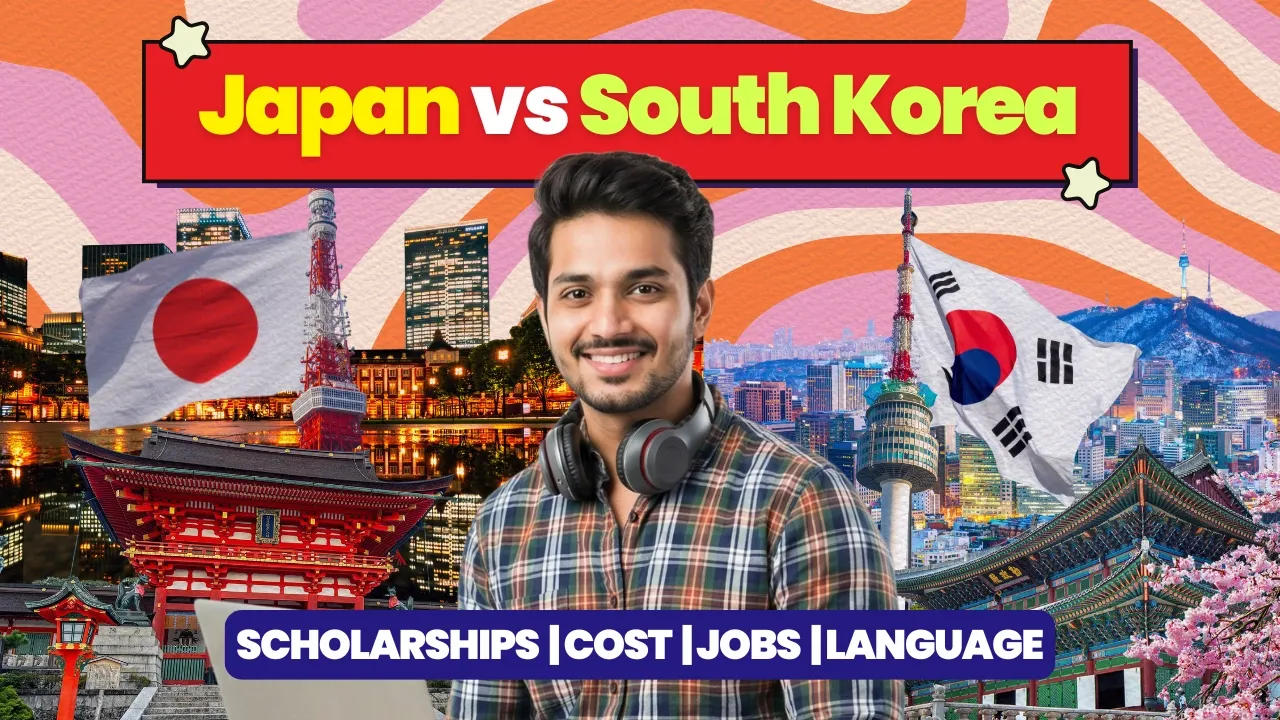
Japan and South Korea are both technology powerhouses, both offer government scholarships that cover full tuition and a monthly stipend, and both produce graduates who work at companies Indian students actively target. On paper they look almost identical. In practice they are not.
Currency note: 1 JPY = Rs.0.6037 | 1 KRW = Rs.0.0654 as of May 29, 2026. Always verify the current rate before making financial decisions.
At a Glance
Factor | Japan | South Korea |
| Top scholarship | MEXT (fully funded) | GKS (fully funded) |
| Scholarship stipend | JPY 143,000/month (Rs.86,329) | KRW 900,000/month (Rs.58,860) |
| Average annual tuition (public) | JPY 535,800 (Rs.3,23,377) | KRW 7M-10M (Rs.4,57,800-Rs.6,54,000) |
| Monthly living costs | JPY 80,000-120,000 (Rs.48,296-Rs.72,444) | KRW 800K-1.8M (Rs.52,320-Rs.1,17,720) |
| Language of instruction | Mostly Japanese | Mostly Korean |
| English programmes | Growing, still limited | More widely available |
| Post-study work | Designated Activities Visa (up to 1 year) | D-10-1 Job Seeker Visa (up to 1 year) |
| Indian student community | Small but growing | Small but growing |
Scholarships: Where the Real Difference Is
The scholarship mechanics in both countries differ in ways that directly affect your chances of getting funded.
Japan: MEXT Scholarship
The MEXT scholarship (Monbukagakusho) is Japan's flagship government scholarship from the Ministry of Education and one of the most comprehensive government awards available to Indian students globally.
What it covers:
- Full tuition fee waiver for the entire program
- Monthly stipend of JPY 143,000 (approximately Rs.86,329) for master's students
- Return economy airfare from India to Japan
- Free Japanese language training before the program begins
- Subsidised accommodation and health insurance
How to apply:
- Embassy Recommendation route: applications typically open April to May for the following year's entry, through the Embassy of Japan in India
- University Recommendation route: contact Japanese universities directly and apply through their recommendation process
Selection rate: 5 to 10 percent of applicants globally. One of the most competitive government scholarships in Asia.
JASSO Scholarship (secondary option): For students already enrolled in a Japanese university on self-funding, JASSO offers a monthly living allowance of approximately JPY 48,000 (Rs.28,978). It does not cover tuition. It is a supplement, not a primary funding route.
South Korea: Global Korea Scholarship (GKS)
The GKS is South Korea's government scholarship, administered by the National Institute for International Education (NIIED).
What it covers:
- Full tuition fee waiver
- Monthly stipend of KRW 900,000 (approximately Rs.58,860) for master's students
- Return economy airfare from India to South Korea
- One year of Korean language training before the program begins
- Medical insurance and a settlement allowance on arrival
How to apply:
- Applications open every February through the Korean Embassy in New Delhi
- India is one of the largest GKS applicant pools globally, so the competition is real but the process is more structured than MEXT
Corporate scholarships worth combining:
- Samsung Global Hope Scholarship: full tuition plus KRW 3,000,000 per semester (Rs.1,96,200) for eligible students in business and engineering
- POSCO Asia Fellowships: full tuition plus KRW 1,000,000/month (Rs.65,400) for postgraduate students in relevant fields
Tuition and Living Costs Without a Scholarship
Worth knowing for students who plan to self-fund while applying for scholarships in parallel.
Japan
- National university tuition: JPY 535,800 per year (approximately Rs.3,23,377). Standard rate at University of Tokyo, Kyoto, Osaka, and most national universities
- Private university tuition: JPY 700,000 to JPY 1,500,000 per year (approximately Rs.4,22,590 to Rs.9,05,550)
- Monthly living costs: JPY 80,000 to JPY 120,000 (approximately Rs.48,296 to Rs.72,444), covering dormitory, food, transport, and personal expenses
- Where it is cheaper: Sendai, Nagoya, and Kyoto are meaningfully more affordable than Tokyo
South Korea
- Public university tuition (STEM): KRW 7,000,000 to KRW 10,000,000 per year (approximately Rs.4,57,800 to Rs.6,54,000)
- Private university tuition (Yonsei, Ewha): KRW 10,000,000 to KRW 16,000,000 per year (approximately Rs.6,54,000 to Rs.10,46,400)
- Monthly living costs: KRW 800,000 to KRW 1,800,000 (approximately Rs.52,320 to Rs.1,17,720)
- Where it is cheaper: Busan, Daejeon, and Gwangju are 30 to 40 percent cheaper than Seoul
Language: The Factor Most Students Underestimate
Both countries require serious language investment if you want to fully participate in academic and professional life. The difference is in how far English gets you.
Japan
- Most programs at national universities are taught in Japanese.
- English-medium options exist at the University of Tokyo's PEAK program, Tohoku University, and the University of Tsukuba, but they are a small fraction of total offerings.
- The MEXT scholarship includes Japanese language training before your program starts, but academic fluency is expected by the time courses begin.
- Most students find that reaching functional academic Japanese proficiency takes around 18 months or more of consistent study, though timelines vary significantly.
South Korea
- Universities like KAIST, POSTECH, SNU's Graduate School, Yonsei, and Korea University all offer substantial English-medium postgraduate programs.
- The GKS scholarship includes one year of Korean language training.
- English is genuinely viable for academic study at more programs than in Japan.
- Functional Korean improves daily life and significantly expands job access after graduation.
Post-Study Work and Career Pathways
Both countries offer a 1-year post-graduation job search period. The industries and language requirements differ.
Japan
- Visa: Designated Activities Visa, 1 to 2 years after graduation
- Strong sectors: Technology, robotics, automotive, electronics, healthcare
- Key employers: Toyota, Sony, Fujitsu, Hitachi, Panasonic
- Language requirement: JLPT N2 or above opens significantly more roles. Without it, options are largely limited to international-facing positions
- Direction of travel: Japan's J-MIRAI initiative formally connects international education to Japan's workforce needs. The pathway is improving but is not yet as structured as Canada or Australia
South Korea
- Visa: D-10-1 Job Seeker Visa, up to 1 year after graduation
- Strong sectors: Semiconductors, technology, automotive, entertainment, healthcare
- Key employers: Samsung, LG, SK Hynix, Hyundai, Kakao
- Language requirement: TOPIK Level 4 or above meaningfully expands job access. International-facing roles are possible without it
- Corporate pipeline: POSCO and Samsung fellowship pathways within university programs sometimes lead directly to employment conversations for STEM graduates
University Rankings and Research Quality
Both countries have multiple globally top-100 institutions. The research traditions differ in character.
Japan (QS 2026)
- University of Tokyo: 28th globally
- Kyoto University: 46th
- Osaka University: 80th
- Tohoku University: 111th
Japan's universities have older, deeper research traditions in basic sciences, engineering, and humanities. Nobel Prize outputs in chemistry and physics reflect decades of investment in fundamental research.
South Korea (QS 2026)
- Seoul National University: 31st
- KAIST: 47th
- Korea University: 74th
- Yonsei University: 85th
- POSTECH: 91st
South Korea's universities are younger but have risen faster in rankings over the last decade. They are more applied-research focused, with strong industry-university linkages in semiconductors, displays, and digital technology.
Which One Is Right for You
Choose Japan if:
- Your field is basic sciences, physics, engineering, robotics, or materials science
- You are committed to learning Japanese seriously and see that as an investment, not a burden
- You are applying for MEXT and have a strong research profile to match the selection rate
- A longer-term Japan career is genuinely part of your plan, not just a post-graduation option
Choose South Korea if:
- Your field is computer science, semiconductor engineering, business, design, or the creative industries
- English-medium instruction is essential for your program
- GKS is your primary scholarship target and you want a more accessible application route
- Samsung, Hyundai, POSCO, and Korea's tech industry are the employers you are actually targeting
Book a free session with a Leap Scholar counselor to understand which country fits your academic profile, which scholarship you are most competitive for, and what a realistic career pathway looks like from either destination.
Sources: QS World University Rankings 2026 | BookMyForex, JPY and KRW to INR Rates May 29, 2026 | Official Embassy of Japan India MEXT page | NIIED | Official Samsung scholarship page | Official POSCO page for POSCO Asia Fellowships | Japan Immigration Services Agency for Designated Activities Visa | Korean Immigration Service for D-10-1 visa

Kirti Singhal
Kirti is an experienced content writer with 4 years in the study abroad industry, dedicated to helping students navigate their journey to international education. With a deep understanding of global education systems and the application process, Kirti creates informative and inspiring content that empowers students to achieve their dreams of studying abroad.
Users also read

Top 10 Industries That Create the Most Billionaires in 2026: Guide for Indian Students

Stanford MBA Career Diversity: Industries, Salaries and What Indian Students Need to Know

Anthropic Academy: 16 Free AI Courses With Certificates in 2026 That Indian Students Cannot Afford to Ignore