
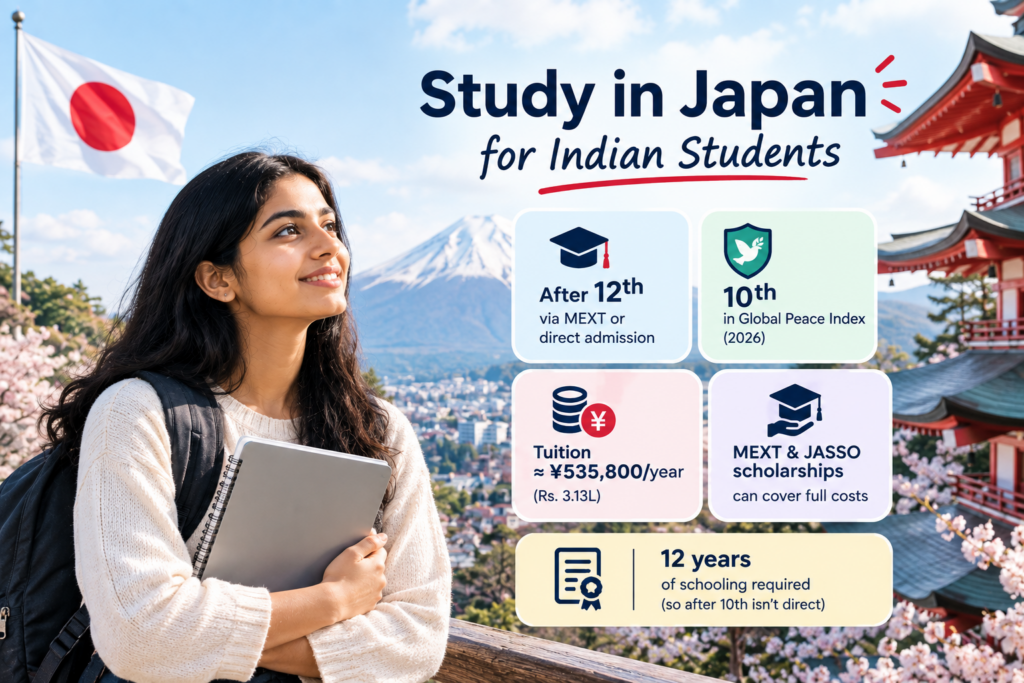
Quick Read
- Indian students can study in Japan after 12th via MEXT or direct admission.
- Japan ranks 10th globally on the 2026 Global Peace Index.
- National university tuition runs about ¥535,800/year (Rs.3.13L) a year.
- MEXT and JASSO scholarships can cover tuition, stipend, and airfare in full.
- Japan’s undergraduate route requires 12 years of schooling, so study after 10th isn’t direct.
Can Indian Students Study in Japan? Eligibility by Stage
Short answer: yes, you can. The longer answer depends on where you are right now in school or college, because Japan doesn’t have one single entry point the way some countries do.
| Your Current Stage | Can You Apply Directly? | Realistic Pathway |
|---|---|---|
| After 10th (Class 10) | No | Complete Class 12 first; a few exchange programs accept Class 11 students separately |
| After 12th (Class 12) | Yes | Direct undergraduate admission or the MEXT Undergraduate Scholarship |
| After graduation (Bachelor’s) | Yes | Master’s admission, MEXT Research/Graduate Scholarship, or JASSO-affiliated programs |

Choose your dream country
 UK
UK
 USA
USA
 Germany
 Australia
 Ireland
 Canada
 UAE
UAE
 France
 Sweden
 Italy
Italy
 Other
Other
When do you want to study abroad?
What's your highest level of education?
Have you completed Class 12th?
What was your Class 12 CGPA/percentage?
Are you a student or a parent/guardian?
What do you want to study?
Select your current city
How Leap will help you

Personalised University Shortlist

Express Applications with Quicker Admits

End-to-End Application Support
Many students ask about studying in Japan for Indian students after 10th, specifically hoping to skip a couple of years. That's not really an option. Japanese undergraduate programs ask for 12 years of schooling, the same as most Western systems, so Class 12 completion is where things actually start. From there you've got two real doors in: a Bachelor's after 12th, or a Master's or research seat after your degree.
My insight: A few students try to shortcut this with a diploma or vocational certificate instead of a standard Class 12, hoping it counts toward the 12-years rule. It usually doesn't, unless the diploma is formally recognised as equivalent, so check this with the specific university before you build a whole application around it.
Study in Japan for Indian Students After 12th: Choosing Your Stream
Finishing Class 12 soon? What you studied matters more than most students expect when it comes to picking a Japanese program.
- Science stream: This is where Japan genuinely shines. National universities like the University of Tokyo and the Institute of Science Tokyo offer engineering, robotics, and computer science programs specifically designed for this profile.
- Commerce stream: Don't count yourself out. Waseda and Keio run business and economics programs in English, though as private universities they cost more than the national ones. If you're looking to study in Japan for Indian students after 12th commerce, these two are usually where that search ends up.
- Any stream: Even in English-taught courses, picking up some JLPT-level Japanese helps a lot, since everyday life and part-time jobs still run in Japanese.
My insight: Commerce students sometimes assume Japanese business programmes will be easier on math than engineering. They're not. Economics and finance courses at Waseda and Keio lean heavily on statistics and quantitative modules, so a weak math background will show up fast, regardless of stream.
Is Japan Safe for Indian Students?
Every parent asks this question, usually before anything else. The good news is you can see for yourself.
- Japan ranks 10th out of 163 countries in the 2026 Global Peace Index, up three places from 2025.
- It scores well on low crime, political stability, and almost no domestic conflict.
- Tokyo is one of the most crowded cities on Earth, and yet it is still often described as one of the safest places to walk around late at night or use public transport.
There's also a practical safety net most people overlook: Japan's National Health Insurance covers 70% of medical costs for registered international students, and the remaining premium works out to around ¥2,000 (Rs.1,170) a month.
Exchange rate note: 1 JPY = INR 0.585 (18 September 2026). Verify the current rate before finalizing your budget.
Source: Global Peace Index 2026, Institute for Economics and Peace
Top Universities and Courses in Japan
One thing to know before you dive into rankings: Tokyo Institute of Technology and Tokyo Medical and Dental University merged in 2024 to become the Institute of Science Tokyo. If you spot the old name somewhere, that's why.
| University | QS World Rank 2027 | Popular Courses | Annual Tuition (JPY/INR) | Typical Entry Requirement |
|---|---|---|---|---|
| University of Tokyo | 39 | Engineering, Natural Sciences, Law | ¥535,800 (Rs.3.13L) | IELTS 6.5+ or JLPT N1 for Japanese-medium courses |
| Kyoto University | 64 | Biotechnology, Physics, Economics | ¥535,800 (Rs.3.13L) | IELTS 6.0-6.5 or JLPT N1 for Japanese-medium courses |
| Osaka University | 95 | Medicine, Chemistry, IT | ¥535,800 (Rs.3.13L) | IELTS 6.0-6.5 or JLPT N1 for Japanese-medium courses |
| Institute of Science Tokyo | 97 | Engineering, Architecture | ¥535,800 (Rs.3.13L) | IELTS 6.0-6.5, EJU for some undergraduate tracks |
| Tohoku University | 102 | Materials Science, Engineering | ¥535,800 (Rs.3.13L) | IELTS 6.0+ or JLPT N1 for Japanese-medium courses |
| Nagoya University | 156 | Engineering, Computer Science | ¥535,800 (Rs.3.13L) | IELTS 6.0+ or JLPT N2 for Japanese-medium courses |
| Kyushu University | 171 | Science, Mechanical Engineering | ¥535,800 (Rs.3.13L) | IELTS 6.0+ or JLPT N2 for Japanese-medium courses |
| Hokkaido University | 179 | Agriculture, Environmental Studies | ¥535,800 (Rs.3.13L) | IELTS 6.0+ or JLPT N2 for Japanese-medium courses |
| Waseda University | 201 | Business, Political Science, Literature | ¥1,200,000 (Rs.7.02L) | IELTS 6.5-7.0 for English-taught business programs |
| Keio University | 213 | Economics, Medicine, Law | ¥1,180,000 (Rs.6.90L) | IELTS 6.5-7.0 for English-taught business programs |
Sources: QS World University Rankings 2027 (rankings) | Study in Japan, JASSO (entry requirement norms)
Want the course-by-course detail for each of these? Our top universities in Japan guide goes deeper.
Cost of Studying in Japan for Indian Students
Ask anyone who's compared notes across countries, and cost is where Japan actually wins, not just where the brochures say it wins.
| Cost Component | Amount (JPY) | Amount (INR) |
|---|---|---|
| National university tuition (annual) | ¥535,800 | Rs.3.13L |
| Public university tuition (annual) | ¥535,800 - ¥600,000 | Rs.3.13L - Rs.3.51L |
| Private university tuition (annual) | ¥900,000 - ¥1,200,000 | Rs.5.27L - Rs.7.02L |
| Admission fee (one-time) | ¥282,000 | Rs.1.65L |
| Facility and activity fees (one-time, year 1) | ¥100,000 - ¥150,000 | Rs.58,500 - Rs.87,750 |
Source: Study in Japan, JASSO
Keep in mind this table only covers tuition. Living expenses sit on top of it, typically another ¥90,000-150,000 (Rs.52,650-87,750) a month depending on your city and lifestyle.
Our cost of living in Japan guide has the city-by-city breakdown, and our accommodation in Japan guide covers how much a university dorm can save you over private housing.
Can You Study in Japan for Free? Scholarships for Indian Students
Free education in Japan on its own is rare. A fully funded scholarship, though, gets you pretty close, and MEXT is the one worth building your plan around if you're chasing study in Japan for Indian students after 12th for free. It's also the main study in Japan for Indian students after the 12th scholarship route. If you've already graduated, you'll find more options waiting for you.
| Scholarship | Coverage |
|---|---|
| MEXT (Monbukagakusho) Scholarship | Full tuition, monthly stipend of ¥117,000-145,000 (Rs.68,445-84,825), round-trip airfare |
| JASSO Scholarship | Monthly stipend of around ¥48,000 (Rs.28,080) |
| University-specific scholarships | Tuition waivers or monthly stipends, varies by institution, such as UTokyo, Kyoto, or Waseda |
Our MEXT Scholarship guide covers eligibility and deadlines in full, and the broader scholarships in Japan for Indian students guide is worth a look if MEXT isn't the right fit for you.
My insight: The MEXT Embassy Recommendation route selects candidates roughly a year before the actual intake, not a few months before. Students who start preparing documents in the same year they want to join are almost always too late; this is one to plan for well in advance.
Admission Process and Student Visa for Japan
Here's something that trips people up: getting admitted and getting your visa are separate processes, handled by different people. Your university deals with the first part. The Japanese Embassy or Consulate handles the second part, and they won't even look at your visa application until the university has done its part.
How the admission side usually goes:
| Step | What Happens |
|---|---|
| Check the medium of instruction | Confirm whether your target program is taught in English or Japanese, since that changes almost everything else about your application |
| Confirm eligibility | 12 years of schooling for undergrad, a relevant Bachelor's for a Master's |
| Prepare your documents | Transcripts, SOP, LORs, and whichever test score you need, IELTS, TOEFL or JLPT |
| Apply | Submit through the university's own international admissions portal |
| Receive your COE | The university issues your Letter of Acceptance along with the Certificate of Eligibility, the document that unlocks the visa stage |
From there, take the COE to the embassy, apply for your student visa, and once you land in Japan, sort out your residence registration and health insurance before classes start.
What the visa office will ask you for:
| Requirement | Detail |
|---|---|
| Certificate of Eligibility (COE) | Issued by your Japanese institution, confirms your admission |
| Proof of financial stability | Bank statements or sponsor letters, typically Rs.11.7L-17.6L (¥2,000,000-3,000,000) |
| Educational documents | Transcripts, certificates, admission letter |
| Visa application form and photographs | Available from the Japanese Embassy or Consulate |
| Processing time | Typically 2-4 weeks once the COE is issued |
For more details on the visa eligibility, check our blog on the Japan student visa.
Application Calendar for Japan (Upcoming Intake)
April is still where most of Japan's academic year starts, and it's the intake most Indian students end up targeting. That said, more English-taught programs are opening up September and October slots too.
Not sure which fits your plans better? Our Fall vs Spring intake guide lays out the trade-offs.
| Month | What to Do |
|---|---|
| October-November 2026 | Shortlist universities and programs for the April 2027 intake |
| December 2026 | Take IELTS, TOEFL, or JLPT if your target program requires it |
| January-February 2027 | Submit university applications; most April-intake deadlines fall in this window |
| February-March 2027 | Entrance exams or interviews where required; admission decisions issued |
| March 2027 | Receive your Certificate of Eligibility and apply for your student visa |
| April 2027 | The program begins |
Targeting September or October instead? Keep in mind MEXT's Embassy Recommendation window for Indian students usually opens around April, well ahead of most university deadlines, so get that piece moving early.
Life After Graduation: Jobs and Salaries in Japan
Software engineering, mechanical and electrical engineering, business analysis and R&D, these are the roles Indian graduates keep landing in, largely because Japan's shrinking workforce genuinely needs the skills. If you're in engineering or IT, expect your offers to sit at the higher end.
You can work up to 28 hours a week during term time and full-time on breaks.
Our part-time jobs in Japan guide has the specifics. Once you graduate, a Designated Activities Visa buys you up to a year to job hunt before you need a work visa.
| Field | Average Annual Salary (JPY) | Average Annual Salary (INR) |
|---|---|---|
| Engineering | ¥4,800,000 | Rs.28.08L |
| Information Technology | ¥5,000,000 | Rs.29.25L |
| Business and Management | ¥4,200,000 | Rs.24.57L |
| Healthcare | ¥4,500,000 | Rs.26.33L |
| Research and Development | ¥5,500,000 | Rs.32.18L |
Source: Japan External Trade Organization (JETRO)
Curious how these break down further by role? Our average salary in Japan guide has the details.
3 Key Takeaways on Study in Japan For Indian Students
- There are really only two doors into Japan: after 12th for a Bachelor's, or after your degree for a Master's or research seat. After 10th, it just isn't one of them, however often it comes up in searches.
- Cost is where Japan quietly beats the usual Western options. Rs.3.13 lakh a year at a national university is a fraction of what you'd pay elsewhere, and a MEXT award can knock that down to nothing if you're strong enough on paper.
- The safety reputation isn't just talk. A 10th-place finish on the 2026 Global Peace Index comes from an outside body, not from Japan's own tourism board.
Verified by: LeapScholar's counseling team, who've walked Indian students through MEXT applications, university shortlisting, and visa paperwork for Japan specifically.
Thinking about Japan for your next intake? Book a free session with a LeapScholar counselor and get a shortlist built around your stream, budget, and target intake.
Frequently Asked Questions About Study in Japan for Indian Students
-
Can Indian students study in Japan?
They absolutely can. The route just depends on where you are in your education: undergraduate after Class 12 or a Master's after your Bachelor's, either straight through a university or riding in on the MEXT scholarship.
-
Can Indian students study in Japan after 10th?
Not in any direct way. Japan's undergraduate system is built around 12 years of schooling, so Class 12 is genuinely the earliest point you can step in for a degree.
-
Can you study in Japan for free?
Free-as-in-no-scholarship isn't really a thing, but a MEXT award comes close: full tuition, a monthly stipend, and airfare if you're competitive enough to land it.
-
What is the cost of studying in Japan for Indian students?
Expect around Rs.3.13 lakh a year at a national university, Rs.5.27-7.02 lakh at a private one, plus Rs.52,650-87,750 a month to live. Even at the higher end, that's still cheaper than most comparable degrees in the US, UK or Australia.
-
Is Japan safe for Indian students?
It really is, and you don't have to just trust that claim. Japan sits 10th out of 163 countries on the 2026 Global Peace Index, and its national health insurance covers 70% of medical costs for registered students.
-
What is the fees to study in Japan for Indian students after 12th?
At national or public universities, the fees range from Rs. 3.13 lakh to Rs. 3.51 lakh per year, while private universities like Waseda or Keio charge between Rs. 5.27 lakh and Rs. 7.02 lakh. Add about Rs.1.65 lakh once, upfront, for the admission fee.
-
Which stream is best for studying in Japan after 12th, commerce or science?
Science students have the natural advantage here, given how strong Japan is in engineering and technology. Commerce isn't shut out, though; Waseda and Keio both run English-taught business programs worth looking at.
-
Can I study in Japan after graduation without knowing Japanese?
You can, particularly for Master's and research programs at the national universities. That said, even a little Japanese makes daily life and part-time work noticeably easier.











Have Questions? Get Guidance to reach your Dream University
Connect with India's finest counsellors and biggest study abroad community.
Get Guidance