
Quick Read
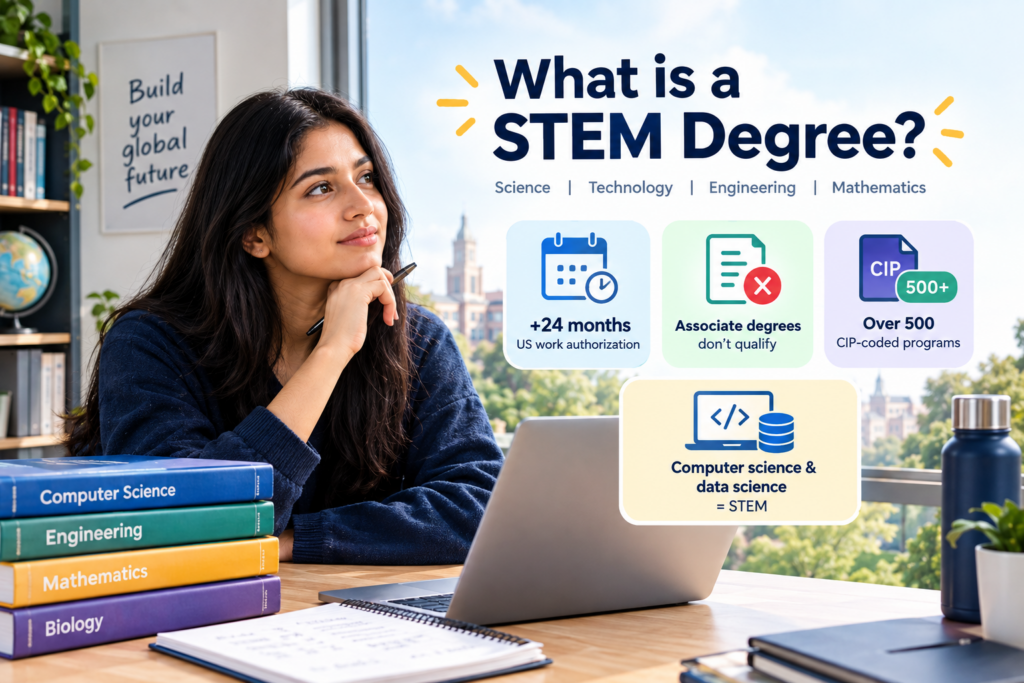
- STEM stands for Science, Technology, Engineering, and Mathematics.
- A STEM degree can add 24 extra months to US work authorization.
- Associate degrees don’t qualify for the STEM OPT extension at all.
- The official STEM degree list covers over 500 specific CIP-coded programs.
- Political science sits in a genuine grey zone, not clearly STEM.
- Computer science and data science are unambiguous STEM courses.
STEM Degree Meaning, Duration, and Popular Specializations
STEM stands for Science, Technology, Engineering, and Mathematics. A STEM degree is a program in one of these fields, officially defined in the US by the DHS STEM Designated Degree Program List, which assigns every recognized field a CIP (Classification of Instructional Programs) code. Only programs with a code on that list count as STEM for immigration purposes, regardless of how technical the subject sounds.
Answering “what is a STEM degree” comes down to two things: the acronym itself and the CIP-code definition that makes it enforceable for visa purposes.

Choose your dream country
 UK
 USA
 Germany
 Australia
 Ireland
 Canada
 UAE
 France
 Sweden
 Italy
 Other
When do you want to study abroad?
What's your highest level of education?
Have you completed Class 12th?
What was your Class 12 CGPA/percentage?
Are you a student or a parent/guardian?
What do you want to study?
Select your current city
How Leap will help you

Personalised University Shortlist

Express Applications with Quicker Admits

End-to-End Application Support
Typical duration:
- Bachelor's degree: 3 to 4 years
- Master's degree: 1 to 2 years, similar to most non-STEM postgraduate programs
Popular specializations:
- Computer science and data science
- Mechanical and electrical engineering
- Biotechnology and biomedical sciences
- Mathematics and statistics
- Physics and applied sciences
Top countries for STEM degrees:
- United States: most globally ranked STEM universities, plus the OPT advantage
- United Kingdom: strong engineering and computing, including Imperial College London
- Germany: low-cost or tuition-free public universities with solid engineering
- Canada: strong STEM offerings paired with a post-study work permit
- Switzerland: home to ETH Zurich and a research-heavy STEM culture
- Singapore: a fast-growing STEM hub in Asia with strong industry ties
The actual list runs far wider than this shortlist, as the next few sections show.
Why students choose a STEM degree:
- Stronger salary outcomes, covered later in this guide
- Eligibility for extended US work authorization after graduation
This second reason is what most Indian applicants are actually trying to confirm when they search this term, so knowing the acronym is only step one.
My insight: In counseling sessions, students almost never ask what the letters stand for. They ask whether their specific course counts, which comes down to a CIP code on the I-20, not the subject's name or department.
Top Universities Across the World Offering STEM Degrees
Once you know what is a STEM degree and which fields qualify, the next step is choosing where to study. Not every STEM college with a strong course carries the same entry bar, cost, or scholarship access. Here's a snapshot of well-established options across different regions and budgets.
| University (QS Rank 2027) | Entry Requirement | Tuition Fee | Scholarships |
|---|---|---|---|
| Massachusetts Institute of Technology (QS 1) | Strong math/science profile, TOEFL 100+ or IELTS 7.0+ | USD 64,310/year, approx. Rs.61.67 lakh (2025-26) | The need-based MIT Scholarship meets full demonstrated need |
| Imperial College London (QS = 2) | AAA at A-level or IB 40 with HL7 in Maths, IELTS 6.5-7.0 | GBP 40,940/year, approx. Rs.52.55 lakh, for engineering (2025-26) | Imperial scholarships for eligible international undergraduates |
| Stanford University (QS = 2) | Strong academic record, TOEFL 100+ or IELTS 7.0+ | USD 62,484/year, approx. Rs.59.92 lakh (2025-26, tuition only) | Need-based Stanford financial aid, no separate merit scholarship |
| ETH Zurich (QS 8) | Recognized higher secondary qualification plus strong math/physics grades | CHF 2,190/semester, approx. Rs.2.55 lakh, for students who qualified outside Switzerland (from Autumn 2025) | ETH scholarships, mainly at master's level |
| California Institute of Technology (QS = 7) | Rigorous math/science coursework, TOEFL 100+ or IELTS 7.0+ | USD 65,622/year, approx. Rs.62.93 lakh (2025-26) | Need-based Caltech financial aid, no merit scholarships offered |
Sources: QS World University Rankings 2027, MIT cost of attendance, Imperial College London engineering fees, ETH Zurich tuition fees, Caltech cost of attendance, Stanford Financial Aid
Read more:MIT Scholarships for Indian students, Stanford University Scholarship, ETH Zurich Excellence Scholarship.
My insight: ETH Zurich's fee jump is recent and easy to miss if you're reading an older blog post. Tuition tripled for international entrants starting Autumn 2025, so any STEM college comparison still quoting the old CHF 730 figure for non-Swiss applicants is out of date.
What the Official STEM Degree List Actually Includes
Most people picture engineering, computer science, and physics when they hear "STEM courses." The real list is broader than that, and it's the full answer to “what is a STEMdegree” straight from the source that decides it.
| CIP Series Type | Examples |
|---|---|
| Four core series (automatic inclusion) | Engineering, Biological and Biomedical Sciences, Mathematics and Statistics, Physical Sciences |
| Related series (specific programs only) | Agriculture, Architecture, Communication Technologies, and select Psychology and Health Professions programs |
| Notable recent additions (2023) | Landscape Architecture, Geospatial Intelligence, Developmental and Adolescent Psychology, Demography, and Population Studies |
Demography and Population Studies is a useful example of how this list actually moves. It joined the list alongside seven other fields in 2023, based on public nominations, so this isn't a static list frozen since 2016.
My insight: Students sometimes assume a course is STEM just because it has "science" or "technology" in the title. The program name means nothing here. What matters is the CIP code printed on the I-20, assigned by the university based on the actual curriculum.
Computer Science and Data Science: Confirmed STEM Degrees
Computer science and data science both sit inside the Computer and Information Sciences CIP series, one of the STEM list's core categories. For these two fields, “what is a STEM degree” has an unambiguous answer: yes.
If you're weighing a computer science route specifically, it's worth understanding how it differs from computer engineering before you commit, since the two get confused constantly despite leading to fairly different day-to-day work.
Our comparison of computer science and computer engineering breaks that down.
If data science is the direction you're leaning toward instead, the MS in Data Science in USA guide covers universities and costs specifically for that path.
My insight: Students rarely ask me whether CS or data science counts. They already know. What they actually need help with is choosing between the two, which usually comes down to whether you want to build systems or extract insight from them.
Political Science and Health Science: Where STEM Status Gets Complicated
Political science and health science don't have a simple yes-or-no answer. This is exactly where “what is a STEM degree” stops being a straightforward question.
Political science:
- Generally not on the STEM Designated Degree Program List
- The closest overlap is Demography and Population Studies, a narrow, quantitative field
- Political science broadly stays outside the list
Health science:
- Health Professions appears as one of the STEM list's related CIP series
- Only specific, named programs within it qualify, not the whole category
- A health informatics or health information management degree may be STEM-designated
- A general health science or public health degree often is not
Sources: DHS STEM Designated Degree Program List
My insight: This is the single most common mix-up we untangle. A student hears "health science is STEM" from a friend and assumes their specific program automatically qualifies. It doesn't work that way. Always confirm the exact CIP code with your intended university before assuming anything.
Associate Degrees and the STEM OPT Extension
Here's the part worth being blunt about. What is a STEM degree worth if the credential itself is only two years long? Less than most students assume. The 24-month STEM OPT extension requires a bachelor's, master's, or doctoral degree.
- A 2-year associate degree does not qualify for the extension at all
- This holds even if the credential is called an "Associate of Applied Science"
- This holds even if the subject itself is a listed STEM field
- The degree level matters just as much as the subject
This finding directly addresses a genuinely confused search pattern. Students who've heard "STEM gets you extra work time" sometimes assume any STEM-labeled two-year credential carries the same benefit. It doesn't.
My insight: This trips up more students than the political science question does, precisely because it feels like it shouldn't matter; the subject is genuinely STEM, so the degree-level exception feels like a technicality. Immigration doesn't treat it that way.
STEM Degree and the OPT Advantage for Fall 2027 Applicants
Fall intake (starting August or September) remains the primary, largest intake at most US universities, with Spring intake in USA in January serving as a smaller secondary option at far fewer institutions.
Since it's currently mid-September 2026, Fall 2026 has already begun, so the intake worth actively planning around right now is Fall 2027. Knowing what is a STEM degree matters most right here, where it starts paying off.
| Timeline (from today) | What Happens |
|---|---|
| Now through November 2026 | Exams (GRE/TOEFL/IELTS), university shortlisting, and CIP code verification |
| November 2026 to January 2027 | Application deadlines (Early Action and Regular Decision) |
| January to March 2027 | Admission decisions released |
| March to May 2027 | I-20 issued, visa interview scheduled and completed |
| August/September 2027 | Fall 2027 intake begins |
Once enrolled, a STEM-designated degree adds real, concrete value: Standard Optional Practical Training (OPT) gives F-1 graduates 12 months of US work authorization, and a STEM-designated degree adds a 24-month extension on top of that, for a total of 36 months.
Understanding how OPT differs from CPT is worth doing early, since the STEM extension applies after standard OPT, not instead of it.
Our breakdown of how the US added new STEM fields for OPT covers how these list updates actually happen.
My insight: August through November is when "is my course STEM" questions spike every year, right as Fall applicants finalize their shortlists. If you're in that window now, verify the CIP code before you submit, not after the I-20 arrives.
STEM Degree Salaries and Job Outlook
STEM occupations continue to out-earn non-STEM roles by a wide margin, which is why confirming what is a STEM degree before committing to a course matters. The figures below come from the US Bureau of Labor Statistics' most recent STEM employment report, published in December 2025, which remains the latest official comparison of its kind.
Computer and IT roles alone are expected to open up around 317,700 positions a year through 2034, and STEM occupations already make up close to a quarter of the entire US workforce in 2024.
| Occupation Category | Median Annual Salary (USD) | Median Annual Salary (INR, approx.) |
|---|---|---|
| All STEM occupations | $103,580 | Rs.99.33 lakh |
| Computer and IT occupations | $105,990 | Rs.1.02 crore |
| Operations research analysts | $91,290 | Rs.87.55 lakh |
| All non-STEM occupations | $48,000 | Rs.46.03 lakh |
Sources: US Bureau of Labor Statistics: STEM employment, BLS: computer and IT occupational outlook, National Science Foundation: State of the Science and Engineering 2026
My insight: Take these numbers as a starting point, not a promise. What a graduate actually ends up earning depends far more on the specific course, the university's reputation in that field, and the city they land in than on any national median.
3 Key Takeaways on What Is a STEM Degree
1. The CIP code decides, not the course name. A degree is only a STEM degree if its specific CIP code appears on the official list. Check the code, not the title.
2. Degree level matters as much as the subject. Associate degrees don't unlock the STEM OPT extension, no matter how STEM-sounding the subject is. A bachelor's degree or higher is required.
3. Some fields are genuinely contested, and it's fine to say so. Political science and general health science do not have clear yes-or-no answers. Verify your assumption before planning your OPT timeline.
Verified by: LeapScholar's US counseling team, who help Fall-intake applicants confirm CIP codes and STEM eligibility before finalizing their shortlist.
Not sure if your shortlisted course actually qualifies? Talk to a LeapScholar counselor before you apply.
Frequently Asked Questions About What Is a STEM Degree
-
What is a STEM degree in simple terms?
It's a degree in a field officially designated as Science, Technology, Engineering, or Mathematics, based on the program's CIP code rather than its subject matter or department name. This designation is what unlocks the 24-month OPT extension for F-1 students in the US.
-
Is a data science degree a STEM degree?
Yes. Data science sits within the Computer and Information Sciences CIP series, a core category on the official STEM list, so it qualifies without ambiguity.
-
Is a computer science degree considered STEM?
Definitely. Computer science is one of the clearest, least contested STEM courses on the list, alongside its close relative, computer engineering.
-
What is a political science degree about, and does it count as STEM?
Political science studies government, policy, and political behavior, and it generally sits outside the official STEM list. Treat any claim that it's automatically STEM with real caution, and check the exact program's CIP code if you're unsure.
-
What is a health science degree about, and is it STEM?
It depends entirely on the specific program. Health Professions has some CIP codes on the list and plenty that aren't, so a health informatics degree might qualify while a general health science degree might not.
-
What is an applied science associate degree, and does it help with OPT?
It's typically a two-year, career-focused credential, often called an Associate of Applied Science. For the STEM OPT extension specifically, it doesn't help at all, since that extension requires a bachelor's degree or higher, regardless of subject.
-
What is STEM as a major, versus just a subject you study?
Nobody actually majors in "STEM" itself. It's a category, not a standalone program. Students major in a specific field, computer science, mechanical engineering, or biology, and that field either carries a STEM degree designation or it doesn't.
-
How many STEM courses are on the official list?
Over 500 individual, CIP-coded programs as of the July 2024 update span more categories than most students expect, including agriculture, architecture, and select psychology and communication fields.









Have Questions? Get Guidance to reach your Dream University
Connect with India's finest counsellors and biggest study abroad community.
Get Guidance