Blogs
Blogs  Leap Digest
  Events
  About Us
 Expert Insights
Germany vs France: The Complete Study Abroad Guide for Indian Students in 2026-27
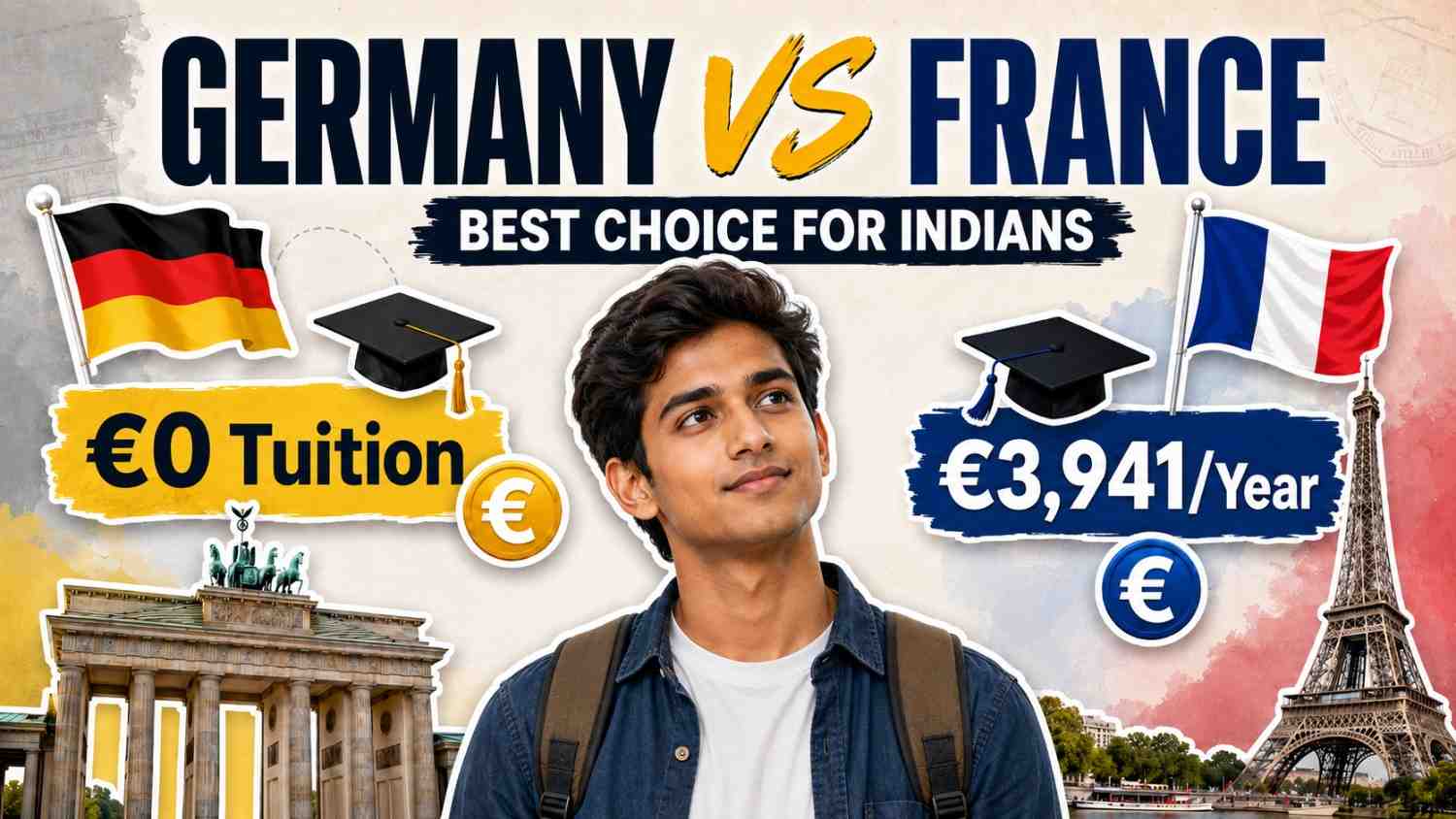
Two of Europe's strongest academic systems. Near-zero public university tuition in both. Genuine post-study work pathways. And there is a combined community of over 65,000 Indian students already studying there in 2026.
Germany and France are frequently mentioned as affordable European alternatives to the US and UK, but they are fundamentally different destinations in culture, language, academic structure, scholarship landscape, and post-study career pathways. Choosing between them is not just a cost calculation. It is a career decision.
Currency note: 1 EUR = Rs. 110.37 as of July 23, 2026 (BookMyForex live rate). All tuition and salary figures are approximate. Always verify current rates before financial planning.
At a Glance
Factor | Germany | France |
| Public university tuition (master's) | EUR 0 in 14 of 16 states | EUR 3,941/year for non-EU students |
| English-taught master's programs | 800+ | 1,600+ |
| Indian students (2025) | 59,000+ | 9,100 |
| Post-study work | 18-month Job Seeker Visa | 24 months (APS route) |
| Monthly living cost | EUR 800 to EUR 1,100 | EUR 800 to EUR 1,400 |
| Primary language | German (English at scale-ups) | French (English programs at master's) |
| Top scholarships for Indians | DAAD, Deutschlandstipendium | Charpak, Eiffel |
| 2027 QS top university | TU Munich #25 | PSL Research University #34 |
The Universities
Germany
Germany's most prestigious tech universities sit within the TU9 alliance, nine institutions that together educate the majority of Germany's engineering and CS graduates.
Top German universities (QS 2027):
- Technical University of Munich (TUM): #25 globally.
- Ludwig-Maximilians-Universität München (LMU): #61 globally.
- RWTH Aachen: #104 globally, Germany's largest technical university.
- Karlsruhe Institute of Technology (KIT): #110 globally, top-ranked for informatics.
- University of Heidelberg: #86 globally, strong in life sciences.
- TU Berlin: strong in AI, computer science, and smart systems.
Germany has 6 universities in the QS global top 150. Strength concentrates in engineering, computer science, and natural sciences.
France
France's higher education system is split between public universities (research-focused, affordable) and Grandes Écoles (elite professional schools, more selective, often more expensive).
Top French universities (QS 2027):
- PSL Research University (Paris): #34 globally.
- HEC Paris: global top 5 for business and management.
- Institut Polytechnique de Paris: #44 globally for engineering and technology.
- Sorbonne University: #73 globally.
- INSEAD (Fontainebleau): World leader in MBA and executive leadership.
- Sciences Po Paris: Global leader in political science and public policy.
- École Polytechnique and CentraleSupélec: top engineering Grandes Écoles.
France has 3 universities in the global QS top 100. Strength concentrates in business, policy, luxury management, and humanities.
Tuition Fees
Germany
Zero tuition at public universities in 14 of 16 states. Students pay only a semester contribution of EUR 150 to EUR 430 (approximately Rs. 16,556 to Rs. 47,459) per semester.
Exceptions:
- Baden-Württemberg: EUR 1,500/semester (approximately Rs. 1,65,555) for non-EU students.
- TU Munich: EUR 2,000 to EUR 6,000/semester for most international master's (a few programs, including Software Engineering, remain free).
France
Non-EU international students pay a differentiated fee at public universities.
Non-EU fees:
- Bachelor's (Licence): EUR 2,770/year (approximately Rs. 3.06 lakh).
- Master's: EUR 3,941/year (approximately Rs. 4.35 lakh).
Grandes Écoles and business schools: EUR 10,000 to EUR 95,000 total depending on program. HEC Paris MBA: EUR 85,000. Mid-tier business schools: EUR 10,000 to EUR 30,000/year.
France's public university master's tuition (EUR 3,941) is more than Germany's in most states (EUR 0) but still under 20% of UK equivalent programs.
Living Costs
Germany: EUR 800 to EUR 1,100/month (approximately Rs. 88,296 to Rs. 1,21,407). Munich is the most expensive German city; cities like Leipzig, Dresden, and Jena are significantly cheaper.
France: EUR 800 to EUR 1,400/month (approximately Rs. 88,296 to Rs. 1,54,518). Paris runs EUR 1,200 to EUR 1,800/month. Lyon, Toulouse, and Bordeaux are EUR 800 to EUR 1,100/month. The CROUS subsidized housing system offers EUR 200 to EUR 400/month rooms; apply early.
Scholarships for Indian Students
Germany
DAAD General Study Scholarship: EUR 992/month (master's) or EUR 1,400/month (PhD). Open year-round, primary deadline October 15, 2026. Apply now.
Deutschlandstipendium: EUR 300/month, available at public and private German universities. No separate application is required; the scholarship is awarded through your enrolled university.
dMAT exam (mandatory from 2026): The dMAT is mandatory for Indian graduates in Engineering, Commerce, Accounting, Finance, Economics, Business, and Management applying for master's programs in Germany from Summer Semester 2027.
The first exam will be held on September 26, 2026. Registration for the same closes on September 15, 2026. Fee: EUR 150 (approximately Rs. 16,556). Applies from Summer Semester 2027.
Note: Students who completed APS online registration or submitted complete APS applications before June 29, 2026, are exempt from dMAT under transitional arrangements.
France
Charpak Scholarship (exclusive to Indian students): Full tuition waiver, monthly living stipend, visa fee coverage, and health insurance. The only scholarship globally designed exclusively for Indian students in France. Next cycle: July 2027.
Eiffel Excellence Scholarship: EUR 1,181/month (master's), EUR 1,400/month (doctoral). Highly competitive. Apply through the host French institution.
The Visa Process
Germany
Apply for a national visa (Type D) at the German consulate in India.
Key requirements:
- University admission letter.
- Blocked account (Sperrkonto): EUR 11,904 deposited before visa issuance, released at EUR 992/month after arrival.
- APS certificate: EUR 175, 3 to 10 weeks for processing. Mandatory for all Indian applicants since November 2022.
- Health insurance and financial proof.
Processing time: 4 to 12 weeks. Apply at least 3 months before departure.
France
All Indian applicants must complete the Études en France (EEF) Campus France process before applying for a visa.
The EEF process: Register online, pay the EUR 115 interview fee, attend a Campus France interview at your nearest French embassy campus in India (Delhi, Mumbai, Chennai, Kolkata, Bengaluru, Hyderabad, or Pune), and then receive validation before applying for the student visa.
Financial proof required: Approximately EUR 615/month available (approximately Rs. 67,878/month).
Processing time: 8 to 12 weeks, including the EEF process.
Post-Study Work
Germany
- 18-month job seeker visa after graduation, no employer sponsor required.
- Switch to an EU Blue Card or Skilled Worker Visa once a qualifying role is secured.
- EU Blue Card leads to PR in 21 months (with B1 German) or 27 months (standard).
- Software engineer salaries: EUR 45,000 to EUR 75,000/year (approximately Rs. 49.67 lakh to Rs. 82.78 lakh).
France
- 24-month Autorisation Provisoire de Séjour (APS) for master's graduates under the India-France bilateral agreement.
- Work in any field during the 24 months. 30,000 Indian students target by 2030, reaffirmed by President Macron in February 2026.
- Paris tech and business salaries: EUR 35,000 to EUR 60,000/year (approximately Rs. 38.63 lakh to Rs. 66.22 lakh).
France's 24-month APS window is longer than Germany's 18-month job seeker visa. For permanent settlement, Germany's PR route (21 months on the EU Blue Card) is structurally faster. For the initial job-search window, France offers more time.
Language: The Factor Most Students Underestimate
Germany: Most engineering and CS master's programs are English-medium. Scale-ups and global tech firms in Berlin and Munich operate in English. B1 German unlocks PR in 21 months vs. 27 and is important for daily life and corporate employers.
France: Over 1,600 master's programs are English-medium. Job searching without French is genuinely difficult. Most French employers, even multinationals in Paris, prefer French-speaking candidates. Post-study employment in France requires at least B2 French unless you are targeting specifically international companies.
Which Student Should Choose Which Country
Choose Germany if:
- You are targeting engineering, computer science, data science, or STEM.
- You want near-zero tuition, the most financially efficient choice in Europe.
- You want a clear, structured PR pathway in 21 to 27 months.
- You are willing to reach B1 German for daily life and PR.
Choose France if:
- You are targeting business, luxury management, policy, humanities, or finance.
- You want the HEC Paris, INSEAD, or Sciences Po brand and network.
- You are interested in the French startup ecosystem or European policy roles.
- You are willing to invest in French to reach B2 for career success.
For a complete guide to software engineering in Germany, including the EU Blue Card, PR in 21 months, Werkstudent strategy, and a month-by-month planning timeline, read the LeapScholar Software Engineer Germany Guide.
Talk to a Leap Scholar counselor to understand which country fits your academic profile, career goals, and budget and to get a personalized breakdown of costs, scholarships, and visa timelines for your September 2026 or 2027 application.
Sources: DAAD Official, Scholarships Overview | Campus France, Statistics 2025 | BookMyForex, EUR to INR July 23, 2026 | QS 2027 Rankings | dMAT mandatory fields and deadlines | DAAD master's EUR 992, PhD EUR 1,400 | PSL Research University QS 2027, #34

Kirti Singhal
Kirti is an experienced content writer with 4 years in the study abroad industry, dedicated to helping students navigate their journey to international education. With a deep understanding of global education systems and the application process, Kirti creates informative and inspiring content that empowers students to achieve their dreams of studying abroad.
Users also read

Top 10 Industries That Create the Most Billionaires in 2026: Guide for Indian Students

Stanford MBA Career Diversity: Industries, Salaries and What Indian Students Need to Know

Anthropic Academy: 16 Free AI Courses With Certificates in 2026 That Indian Students Cannot Afford to Ignore