Blogs
Blogs  Leap Digest
  Events
  About Us
 Expert Insights
TU vs. FH in Germany: Which Degree Actually Lands You a Tech Job Faster in 2026?
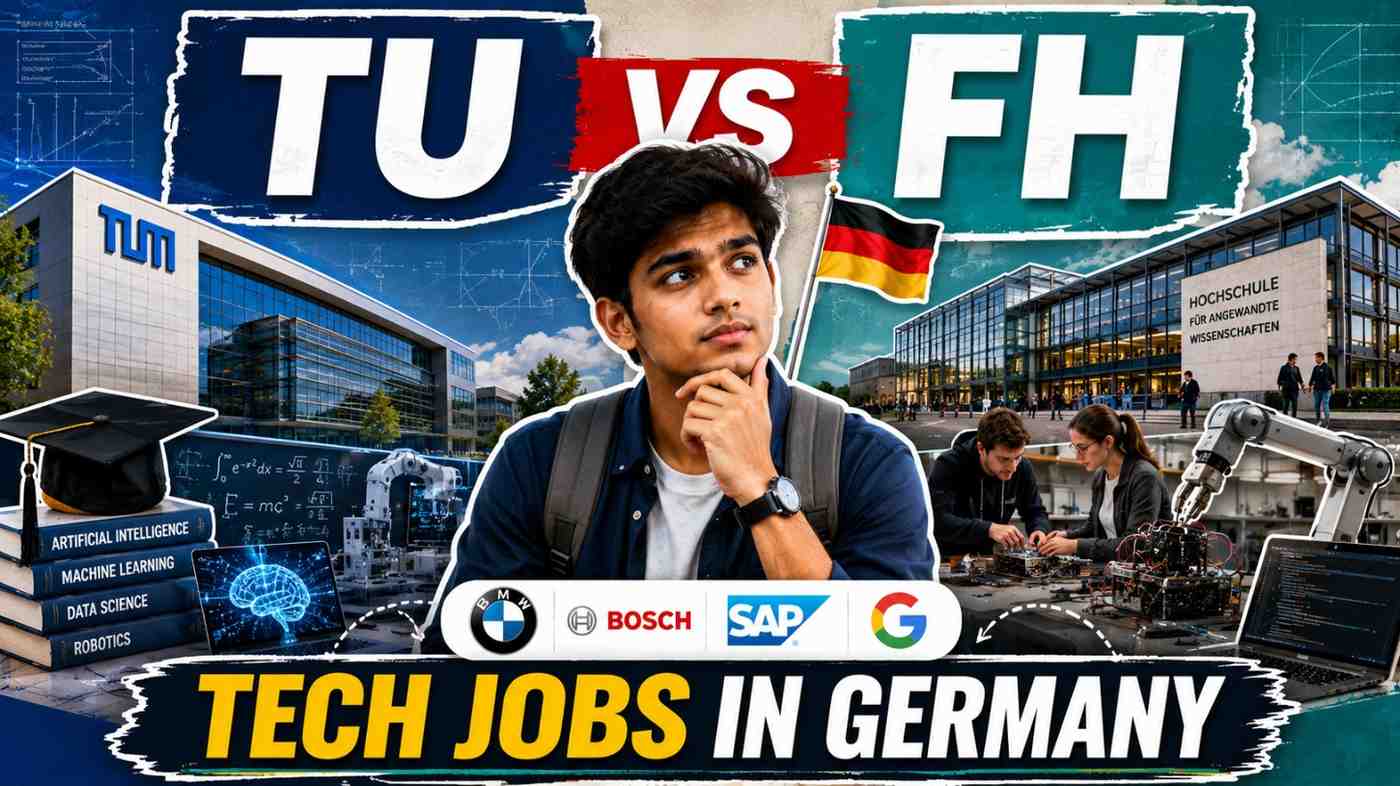
You are shortlisting German universities for a master's in computer science or software engineering. You keep seeing two types of institutions on every list: Technische Universitäten (TUs), which are research-heavy, prestigious, and competitive, and Fachhochschulen (FHs), translated as Universities of Applied Sciences, which are practical, industry-linked, and considerably easier to get into.
For a tech job in Germany, does it matter which type you attended?
The answer is more nuanced than either "TUs are better" or "it doesn't matter." Both are right in different contexts.
The Fundamental Difference
A Technische Universität (TU) is a full research university with the right to award doctoral degrees. It emphasizes theoretical foundations, independent research, and academic rigor. Exam questions are harder. Programs run longer (typically 2 years). Faculty are active researchers.
A Fachhochschule (FH), or University of Applied Sciences, emerged from Germany's tradition of engineering and professional schools. It emphasizes practical, industry-ready education: smaller classes, mandatory industry internships baked into the curriculum, and direct company partnerships. Programs typically run 1.5 to 2 years. Faculty are often industry practitioners.
Since the Bologna Process, both types legally award the same M.Sc. degree. An FH master's carries the same legal status as a TU master's in Germany and across Europe. The distinction matters in specific contexts, primarily PhD admissions and certain academic roles, but not broadly in the German tech industry.
What German Tech Employers Care About
German employers prioritize demonstrated practical experience over university brand. The Werkstudent role, a formal working-student employment of up to 20 hours per week during the semester, is the single biggest predictor of who gets hired after graduation. Where you study matters less than where you worked while studying.
That said, three employer perceptions persist in the German market:
Perception 1: TU graduates start at slightly higher average salaries. TU graduates tend to command slightly higher entry-level salaries at global tech firms and in research-adjacent roles. The difference is real but not dramatic, typically EUR 2,000 to EUR 4,000 at the entry level.
Perception 2: FH graduates are hired faster. FH programs have direct industry pipelines that TU programs do not replicate at the same structured level. Conversion rates from FH mandatory internships to full-time offers are high. When an FH student completes a mandatory 6-month internship at Siemens in Year 2, that internship is effectively a 6-month job interview.
Perception 3: Employers at scale-ups and global tech don't distinguish. At Zalando, N26, Trade Republic, Google Munich, and Meta Berlin, the TU vs. FH distinction is largely irrelevant. These employers screen on GitHub, system design, and technical interview performance.
The TU9 Alliance: Germany's Research Powerhouses
The TU9 alliance consists of Germany's nine most prestigious technical universities where DAX 40 companies, global consulting firms, and research labs specifically recruit.
The TU9 universities:
- Technical University of Munich (TUM): QS #25 globally (2027). The most selective German university for international students.
- RWTH Aachen: QS #104 globally. Germany's largest technical university. Strong automotive and manufacturing links.
- TU Berlin: Strong in AI, computer science, and smart systems. (QS #145)
- Karlsruhe Institute of Technology (KIT): Top-ranked for informatics and engineering. (QS #116)
- TU Dresden: Strong in microelectronics and embedded systems.
- TU Darmstadt: Excellent in cybersecurity and distributed systems.
- TU Braunschweig: Strong in automotive software and robotics.
- Leibniz University Hannover: Strong in applied computer science.
- University of Stuttgart: Strong in aerospace and robotics software.
CGPA requirement for TU9: The guide confirms 7.5 to 8.5 on a 10-point scale. TUM is the most selective; some programs additionally require GATE scores or aptitude tests.
What TU9 gives you:
- Access to research labs and publications that strengthen PhD applications globally.
- Strong alumni networks at SAP, BMW, Bosch, Siemens, and large German corporates.
- Slightly higher entry salary ceiling.
- Name recognition outside Germany, which matters if you plan to move after Germany.
What TU9 does not give you automatically:
- A Werkstudent role. You earn that yourself, regardless of institution.
- A faster time-to-job than a strong FH. FH mandatory internships often produce a job offer before the student has even graduated.
The FH Advantage: Where Practical Wins
Strong FHs for computer science, software engineering, and applied AI include HAW Hamburg, Hochschule München (Munich University of Applied Sciences), FH Aachen, Esslingen University, and Mannheim University of Applied Sciences.
CGPA requirement for FH: The guide confirms 6.5 and above on a 10-point scale, significantly more accessible than TU9.
Where FH genuinely outperforms TU:
1. Mandatory internship semester: Most FH master's programs include a Praxissemester, a mandatory industry placement of 4 to 6 months. Every FH master's graduate in Germany has a minimum of one formal German employer reference by the time they graduate. Given that German practical experience is the single biggest accelerant to a first full-time role, this built-in structure gives FH students a structural head start.
2. Direct automotive and Mittelstand pipelines: FHs in Stuttgart, Esslingen, Aachen, and Munich have formal relationships with BMW, Daimler, Bosch, Porsche, and ZF. These are institutionalized recruiting pipelines; the companies co-design course content, sponsor final-year projects, and hire from them annually.
3. Smaller cohort size: FH cohorts are typically 20 to 40 students in a master's program versus 100 to 200 at a large TU. Smaller cohorts mean more direct faculty access, more individual project work, and a higher chance of personal recommendation from a professor who knows your work, which matters in Germany's reference-driven hiring culture.
4. Faster graduation and entry into the job market: A 1.5-year FH master's versus a 2-year TU master's means a student who begins at the same time enters the German job market 6 months earlier. Combined with the Werkstudent system and mandatory internship, FH students often have a full-time role lined up before they technically graduate.
The Three Ecosystems: Which Institution Fits Which Employer
Germany's three tech ecosystems each have a different appetite for TU vs. FH graduates.
1. Global Tech Giants (Google Munich, Meta Berlin, Amazon, Microsoft, Stripe): These firms are largely institution-agnostic. They screen on LeetCode-style coding ability, system design skills, and portfolio quality. A strong FH graduate with a well-documented GitHub and internship experience at a German tech company competes directly with a TUM graduate for roles at these firms.
2. Scale-ups and Fintechs (Zalando, N26, Trade Republic, Celonis, and Personio): English-first, flat hierarchies, and modern stacks. Again, institution-agnostic. They care about what you can build, not where you studied.
3. Corporates and Automotive (BMW, Bosch, SAP, Siemens, Mittelstand): This is where the distinction is most meaningful but not how most students expect it. Both paths lead here. They lead to different role types: TU graduates for research and systems engineering; FH graduates for applied software, embedded systems, and engineering management.
The Salary Picture: Is There a Real Difference?
The BA Entgeltatlas median for software engineers in Germany is EUR 73,164. The estimated ranges by institution type:
Experience tier | TU graduates | FH graduates |
| Entry (0 to 2 yrs) | EUR 46,000 to EUR 55,000 | EUR 42,000 to EUR 52,000 |
| Mid-level (3 to 5 yrs) | EUR 60,000 to EUR 75,000 | EUR 56,000 to EUR 72,000 |
| Senior (5+ yrs) | EUR 72,000 to EUR 95,000 | EUR 68,000 to EUR 90,000 |
The salary gap narrows significantly with experience and specialization. An FH graduate who specializes in AI/ML, DevOps, or cybersecurity, the three highest-demand shortage tracks in Germany, will out-earn a TU generalist within 3 to 5 years.
Currency note: 1 EUR = ₹110.37 as of July 30, 2026 (BookMyForex live rate). Always verify current rates before financial planning.
The PhD Question
If you want to do a PhD in Germany, a TU is the correct choice. FH degrees are legally equivalent for industry purposes, but FH graduates cannot directly enroll in a PhD program in Germany. They must first apply for an upgrade assessment (Eignungsfeststellung) to verify their research capability, which involves completing a research-focused bridging period. TU graduates proceed directly.
For Indian students targeting a PhD at a German university, such as TU Berlin, TU Munich, RWTH Aachen, or KIT, followed by a career in research, academia, or deep technical leadership, the TU route is unambiguous.
Choosing the Right Path: A Profile-Based Decision
Choose a TU if:
- Your CGPA is 7.5 or above, and you can compete for TU9 admissions.
- You want to do a PhD in Germany or internationally.
- You are targeting research-heavy roles at SAP Labs, Siemens, BASF, or global tech research divisions.
- You are willing to invest more time in a 2-year program and build your Werkstudent experience yourself.
Choose an FH if:
- Your CGPA is in the 6.5 to 7.4 range, and TU9 admissions are not realistic.
- You want the fastest route into the German job market with a German employer reference already on your CV.
- You are targeting automotive, Mittelstand, or B2B software companies where FH pipelines are institutionalized.
- You want smaller classes, more individual mentorship, and a built-in industry internship.
Either works if
- You are targeting English-first scale-ups or global tech firms in Berlin or Munich.
- You plan to specialize deeply in AI/ML, DevOps, or cybersecurity tracks, where skills matter far more than institution type.
- You are prepared to pursue a Werkstudent role aggressively from your second semester regardless of institution.
The LeapScholar Software Engineer Germany Guide covers the complete picture beyond this comparison: salary tiers by experience, the EU Blue Card and PR in 21 months, the Werkstudent strategy, the APS certificate process, and a month-by-month planning timeline from university application to your first German tech role.
Talk to a Leap Scholar counselor to understand whether your CGPA and target ecosystem make a TU or FH the stronger choice, which specific universities in each category align with your background, and what your realistic admissions and job search timeline looks like for September 2026 or 2027 entry.
Sources: Collegedunia, FH vs TU Germany 2026: Key Differences for Indian Students, April 20, 2026 | NomadCredit, Types of Universities in Germany: Universität vs FH vs TH, April 22, 2026 | Deutschified, Technical University vs University of Applied Sciences Germany | Bharat in Germany, TU vs FH Germany | Wikipedia, Fachhochschule | Quora, TU vs FH Germany career comparison | BookMyForex, EUR to INR July 23, 2026 | TopUniversities, QS World University Rankings 2027

Kirti Singhal
Kirti is an experienced content writer with 4 years in the study abroad industry, dedicated to helping students navigate their journey to international education. With a deep understanding of global education systems and the application process, Kirti creates informative and inspiring content that empowers students to achieve their dreams of studying abroad.
Users also read

Top 10 Industries That Create the Most Billionaires in 2026: Guide for Indian Students

Stanford MBA Career Diversity: Industries, Salaries and What Indian Students Need to Know

Anthropic Academy: 16 Free AI Courses With Certificates in 2026 That Indian Students Cannot Afford to Ignore