Blogs
Blogs  Leap Digest
  Events
  About Us
 Student Reviews
From Startups in India to JPMorgan in Glasgow: How the University of Swansea Shaped Sumanth's Software Engineering Career
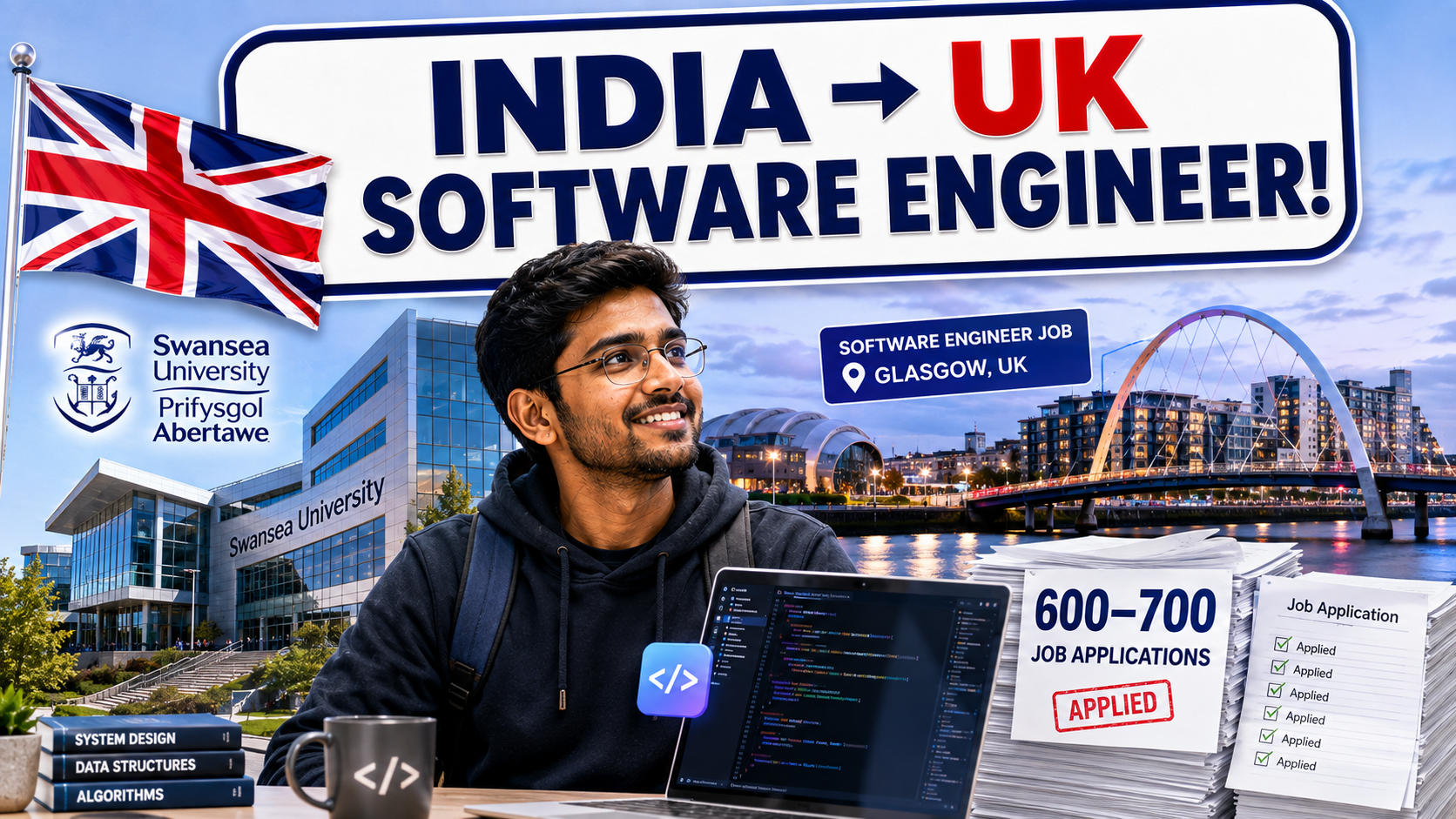
For Sumanth, studying abroad helped him strengthen his technical foundation and explore the possibilities for his software career. From moving away from the field he originally studied to rebuilding his life in a new country, his experience gave him the opportunity to grow both as a developer and as a professional.
Sumanth's Journey at a Glance
- From: India
- Background: Electrical and Electronics Engineering, followed by 3 years of software experience in Indian startups
- Course: Master's, Swansea University, Wales
- Turning Point: A project with a San Francisco-based client made him consider building his career abroad
- Challenge: Rebuilt his life in Wales and worked Burger King shifts during his early days in the UK
- Now: Software Engineer at JPMorgan, Glasgow
Here's Sumanth, in his own words.
Q. Tell us about your academic background and how you got into software.
I did my bachelor's in electrical and electronics engineering, with computer science as a minor. In my early years I was building IoT-based systems, Arduino robots, IR sensor projects, and that sort of thing. But over time I realized I was always the one loading code onto the boards, not handling the actual hardware, the soldering, the wiring, or the components. By second year I knew my soldering skills just weren't good enough. That's when I leaned into coding and picked up computer science as a minor in my third year. I met seniors who taught me about databases, frontend, and backend. It wasn't something I'd planned for going into my degree, but I discovered it along the way.
Q. What made you choose startups over bigger companies after graduating?
I graduated in 2018 and didn't want to join an MNC right away. The advice I got from seniors was that if you want a stable career over the next ten years, MNCs make sense, but as a fresher, you can afford to take risks. So I joined a startup called Let's Venture, a platform that connects founders and investors. Being in that ecosystem exposed me to a lot of entrepreneurs and angel investors, and that's really where my interest in building things myself started. I'll always be thankful to that company for that. After two years, I moved to Hyderabad for another startup and then joined Talentica in Pune, which was also a startup.
Q. What was the moment that made you think about studying abroad?
At Talentica, I worked on a project for a client in San Francisco, and the coding standards their developers followed were incredible, like reading a well-written poem. I had three plus years of experience by then and had never seen code structured that cleanly. It genuinely amused me, and it made me wonder if I was missing something by not experiencing that environment firsthand. That single realization is really what pushed me toward doing a master's abroad.
Q. Why did you choose the UK specifically?
A few reasons. It's close to home, a nine-hour direct flight, so I never felt too far from my parents. I was also drawn to the UK's financial and banking sector. At the time, UPI and Razorpay were growing rapidly in India, and I thought that if UPI-style payments ever gained traction in the UK, having that experience would give me an advantage over most developers there. On top of that, my undergrad was in electrical engineering, so a master's felt like the right way to properly learn the fundamentals I'd missed: digital logic, computer architecture, memory management, and the things that make you an efficient developer rather than just someone who can code.
Q. Why Swansea University over the bigger cities?
That was entirely my own decision. I didn't want a metropolitan city like Manchester, Birmingham, or London. I wanted to experience the actual roots of the country, and Swansea felt like that, close to nature, with a strong reputation within Wales. The course structure and timings also fit well with how I wanted to study.
Q. How did your parents react to the decision?
They weren't happy at all, honestly. I had a good package in India and a comfortable life, and they couldn't understand why I'd want to give that up. It reminded me of when I told my dad in my second year that I wanted to do computer science as a minor, and he asked why since I was already in electrical engineering. They didn't get it then either, but they came around, and now they're quietly proud, even if they don't say it directly.
Q. How did you fund your degree?
Through a loan. My father supported me, and I paid off half of it myself.
Q. What was it like when you actually landed in the UK?
It felt like being thrown into an entirely new forest. I landed in Swansea in February, right into a storm, which felt almost symbolic. I didn't have accommodation sorted, so I stayed in an Airbnb for a few days before finding a place through networking at university. I was homesick, nervous, and honestly cried a few times in that first stretch. Back home, I had everything taken care of for me. Suddenly I had to handle every chore myself. You realise pretty quickly that you need to be mentally strong for the role, and even if you think you are, you find out you have to grow into it.
Q. What was the biggest challenge in your application process?
Accommodation, without question. Everyone talks you through the CAS letter and tuition payments, but no one prepares you for finding a place to live in a country where you have no contacts. That took me about a month to sort out properly, and it was the one pitfall I really wish I'd planned for in advance.
Q. What part-time jobs did you take up, and what did they teach you?
I worked at Burger King, at Royal Mail, and as a teaching assistant at my university. Burger King actually turned out to be genuinely useful. I learned to make food from scratch, which helped me cook for myself, and I still remember the recipes. It also forced me to understand real, fast, heavily accented English in a way lectures never did. It wasn't glamorous work, with plenty of cuts and burns in the early days, but it taught me a lot about communication.
Q. How long did it take you to feel settled, and how did that change you?
It took a couple of years to really feel comfortable here. Somewhere along the way, I became a calmer version of myself. Back in India I was proud and always moving fast. Here, coming home after a part-time shift to an empty kitchen and having to cook before you can eat teaches you gratitude pretty quickly. You start appreciating things you used to take for granted.
Q. How did the job search go after your master's?
I applied to around 600 to 700 roles, which is honestly pretty normal for the UK and Germany from what I've heard. The hiring process here is much slower than in India, where you can interview in the morning and have an offer by evening. If I could go back, I'd start applying six months before graduation instead of waiting until afterward. Even so, I landed my first offer about two months after finishing my master's, which I'm told is a solid timeline given the market. I got three or four offers in the end and chose JPMorgan, where I still work today, in Glasgow.
Q. What's surprised you most about work culture in the UK?
A few things. Startups here run at a much calmer pace than in India, closer to nine to five, with no expectation of working after hours. Data privacy is also taken far more seriously; GDPR is enforced strictly, even at small startups, which wasn't something I saw much of back home. And I was genuinely surprised to meet developers in their forties, fifties, and even sixties who'd switched entirely from careers like plumbing or mechanics into software. I'd never seen that kind of career change in India.
Q. What do you do for fun now?
I hike a lot. Scotland has an enormous number of trails and peaks, and I've been steadily working through them, a handful down so far with plenty more to go. I also play badminton almost every weekend, which is basically therapy for me at this point. I've even started building a side project called PlaySport, a small community app for people to host and join local sports games, badminton in particular. It's not fully launched yet, but it's something I want to take further.
Q. Would you ever move back to India?
Eventually, yes. I don't want to grow old in a foreign country, and my parents are still there. Once I feel settled financially and mentally, I'll look at going back. But for now, I'm genuinely happier here. India will always be home, but I've grown used to a calmer, quieter way of living.
Q. Any regrets about the career switch from electrical to software?
None at all. If I had to choose only one path, hardware or software, I'd pick software every time. I tried hardware seriously for a few years, burned out a few chips along the way, and realized it just wasn't for me. My close friend had that intuition for choosing the right components that I never did, and I had the patience for code that he didn't. It worked out exactly the way it needed to.
Kirti Singhal
Kirti is an experienced content writer with 4 years in the study abroad industry, dedicated to helping students navigate their journey to international education. With a deep understanding of global education systems and the application process, Kirti creates informative and inspiring content that empowers students to achieve their dreams of studying abroad.
Users also read

From a Small City in India to Bavaria: How Arjun Patil Built a Career and an MBA Sponsorship in Germany
Leap Scholar Review: My Father Wanted Me in the Family Business. I Chose a Masters in the UK Instead.
Leap Scholar Review: Going Back to School After Fifteen Years in the Industry