Blogs
Blogs  Leap Digest
  Events
  About Us
 Student Reviews
From Nagpur to Phoenix: How Arizona State University Set Mihir Up for a Software Engineering Career in the US
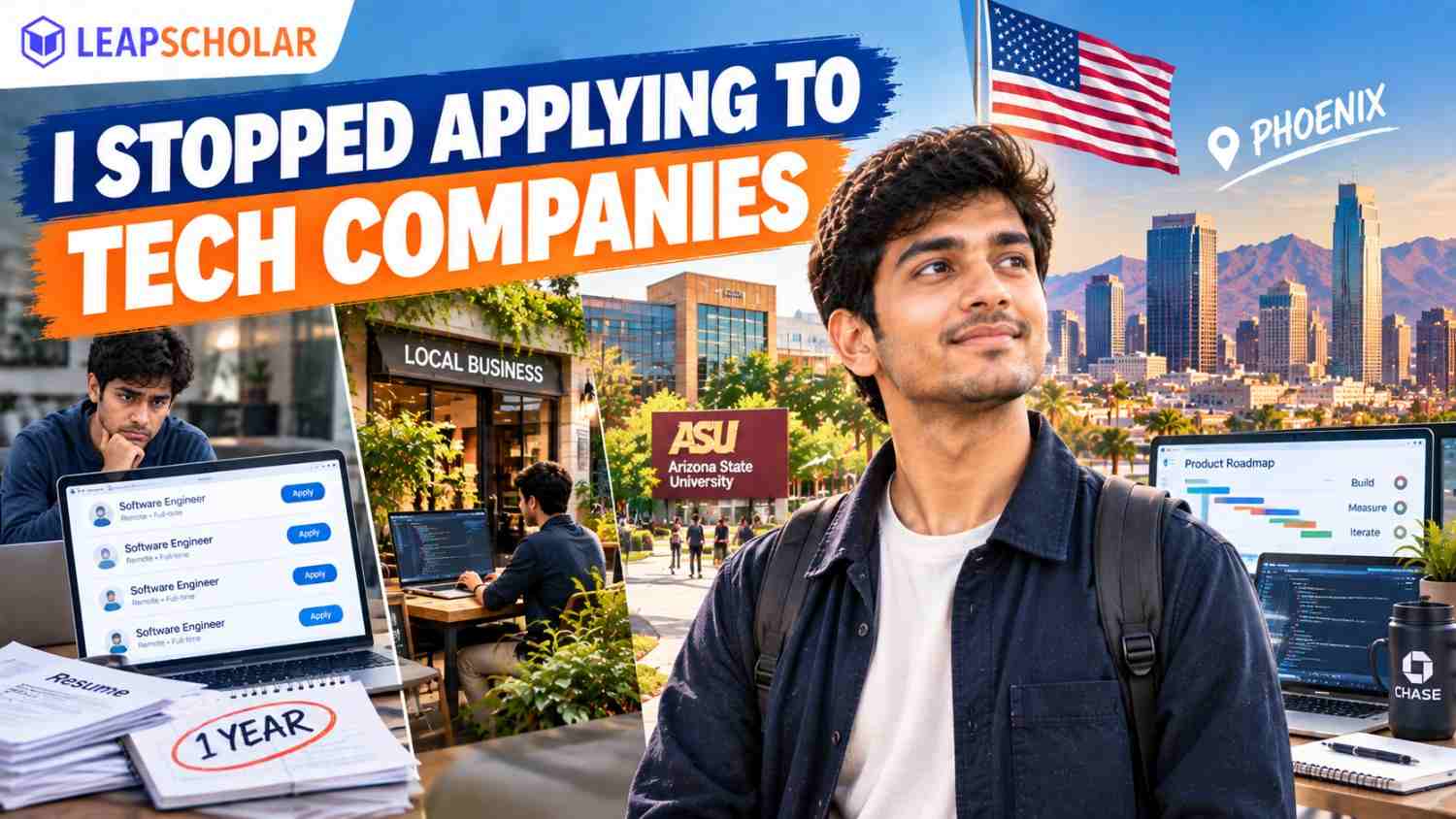
Mihir's journey from Nagpur to building his career as a software engineer in Phoenix began with a decision shaped largely by the path his relatives had already taken.
With no major push factor driving him out of India, he chose the US over Europe and Australia and moved to Phoenix in 2022 to pursue a Master's in Computer Science at Arizona State University. After graduating, however, finding a job proved far more difficult than he had expected. Mihir spent an entire year applying for roles before realizing that he needed to change his approach. Instead of looking only at tech companies, he started searching for small businesses in his area that needed software engineering skills, even if technology wasn't their primary business. That shift eventually led to his first full-time opportunity, where he became the company's first full-time hire. The business has since grown into a team of 5 under him. Today, Mihir works as a software engineer at a digital advertising firm in downtown Phoenix and is navigating the H-1B process while continuing to build his career in the US.
For Mihir, the transition from student to working professional came with a longer job search than expected and required him to rethink where software engineering opportunities could actually exist. His experience shows how looking beyond the usual list of tech employers can open up a different route into the US job market.
Mihir's Journey at a Glance
- From: Nagpur, India
- Course: Master's in Computer Science, Arizona State University
- Moved to the US: 2022
- Decision: Chose the US over Europe and Australia, influenced by relatives
- Challenge: Spent 1 year job hunting after graduation
- Turning Point: Expanded his search beyond tech companies to local small businesses
- First Opportunity: Became the first full-time hire at a small local business
- Now: Software Engineer at a digital advertising firm in Phoenix
- Current Focus: Navigating the H-1B process
“Here’s Mihir, in his own words.”
Q. What made you decide to move to the US for your master's?
I did my undergraduate in Computer Science and Engineering at Shri Ramdeobaba College of Engineering and Management in Nagpur, graduating in 2022. I had a few relatives already in the US who told me it was a good time to move for a career in software engineering, that it would give me a strong ladder up in the field. I did look briefly at Europe and Australia, but based on both my own research and what my relatives told me, the US was the clear choice for a tech career; nothing really compares to what Silicon Valley offers.
Q. Was there anything specifically pushing you to leave India, or was it purely the opportunity pulling you?
Purely the opportunity, honestly. I did a six-month remote internship in India during COVID, so there wasn't any dissatisfaction pushing me out. The opportunities in the US were genuinely good, and my family could afford to send me there.
Q. How did you end up at Arizona State University specifically?
I applied to around 10 or 11 universities; my GRE score gave me the confidence to aim fairly broadly. I ended up with admits from ASU and the University of Florida but got rejected everywhere else; I was aiming a bit too high with some of my choices. Florida actually offered me a scholarship, while ASU didn't; they typically extend scholarships automatically based on GPA, and mine didn't qualify. I chose ASU anyway, mainly for secondary factors, a strong Indian student community, lower overall costs, and being based in Phoenix.
Q. How much did the whole degree end up costing you?
Tuition across the two years came to roughly $50,000 to $55,000, and living expenses added around $10,000 a year, so about $20,000 total. All in, I'd estimate the full two-year program cost somewhere between $75,000 and $80,000.
Q. Did you handle the application process yourself or get outside help?
I did the initial research myself, figuring out what universities actually look for in applications, that sort of thing. But I also worked with a consultancy in Nagpur called Krishna Consultants, who helped guide the process. I didn't face any major hiccups along the way, and I was fortunate enough to get my visa approved on the first attempt.
Q. What was the part-time work situation like during your studies?
Tougher than I expected, at least initially. I started applying for on-campus jobs as soon as I landed but couldn't secure anything for a full year. 2022 was a particularly heavy year for international student influx; there were far more students than available campus jobs. I picked up a Starbucks job in 2023, stayed there for just two or three weeks, and then landed a Teaching Assistant role in the math department, which I held all the way through to graduation, about eight or nine months.
Q. How long did it take you to find a job after graduating?
Almost exactly a year. I graduated in May 2024 and didn't land my current role until April 2025. It's still a genuinely brutal market for new grads. I was applying constantly, on LinkedIn, on every job portal I could find, and reaching out for referrals, all of it.
Q. What eventually shifted things for you?
A portal called Handshake, which is popular among US students but not something everyone fully thinks to exploit. I started noticing listings from businesses that needed tech skills but weren't tech companies themselves. That's when I changed my whole strategy; instead of chasing tech companies exclusively, I started targeting small local businesses around my area that needed software engineering talent but weren't necessarily labelled as tech employers. Before landing my current role, that approach got me a part-time position as a STEM instructor at a local franchise of an ed-tech company called iCode. They'd offered 15 hours a week, but I needed 20 to maintain my visa status, so I asked if they'd extend the hours for slightly less pay, and they agreed.
Q. Tell us about your current role.
I work as a software engineer at a small digital advertising firm in downtown Phoenix. I was actually their first full-time hire; the business had been running for about ten years before that, and we've since grown to a team of five. I've been there about a year and a half now.
Q. Do you think you'd have reached this point staying in India?
Probably not, honestly. Different places come with genuinely different opportunities and circumstances. Indian students may find similar opportunities at a different scale in India, but considering what the US specifically offers them in this field, I don't think that same scale is attainable back home right now.
Q. What have you learned outside of your actual degree?
Honestly, most of the real learning has happened outside the classroom. Even something as simple as getting through tough coursework here teaches you to collaborate, to ask for help when you're stuck, and to actually build a network of people you can rely on. You need friends for the small, practical stuff too, someone to call when you're in trouble, and somewhere to crash when your lease runs out. It teaches you more real-life skills than the degree itself ever could.
Q. How did your parents feel about you making this move?
Honestly, if they hadn't pushed me, I probably wouldn't have gone through with it. My dad specifically pushed me to even sit for the GRE in the first place; I likely wouldn't have taken that step on my own.
Q. What does your life in Phoenix look like day to day?
Monday to Friday is work, and after hours I try to carve out time for personal projects or the gym. Every few months I'll take a road trip with friends; I've been to about four states so far. I also build side software tools to keep sharpening my skills, and one of them actually ended up being genuinely useful at my company; it's saved us a lot of manual effort. I even got a pilot's license recently, since we needed drone photography capability at work, so that became an unexpected addition to my skill set.
Q. What's one thing that might eventually pull you back to India?
The food, honestly. I'm not looking to move back permanently anytime soon, but if there's one thing that could tempt me, that's it.
Q. Where do things stand with your visa right now?
I got selected in this year's H-1B lottery, but the approval itself is still pending. If it comes through, it typically starts in October with the new financial year, though mine could take longer given it's still processing. If it doesn't get approved, I still have my STEM OPT work authorization from my F-1 visa, which is valid until next July, so I'd be able to keep working under that in the meantime.
Kirti Singhal
Kirti is an experienced content writer with 4 years in the study abroad industry, dedicated to helping students navigate their journey to international education. With a deep understanding of global education systems and the application process, Kirti creates informative and inspiring content that empowers students to achieve their dreams of studying abroad.
Users also read

Leap Scholar Review: Going Back to School After Fifteen Years in the Industry

From Pune to Coventry: How Warwick Business School Helped Gaurav Pivot from Software Engineering to Product Management at Chase

From HR in India to Quant Analyst in New York: How Carnegie Mellon Helped Tapasya Reinvent Her Career