Blogs
Blogs  Leap Digest
  Events
  About Us
 Student Reviews
From Bangalore to Exeter: How a Master's in Business Analytics at the University of Exeter Shaped Shivani's Career in Data
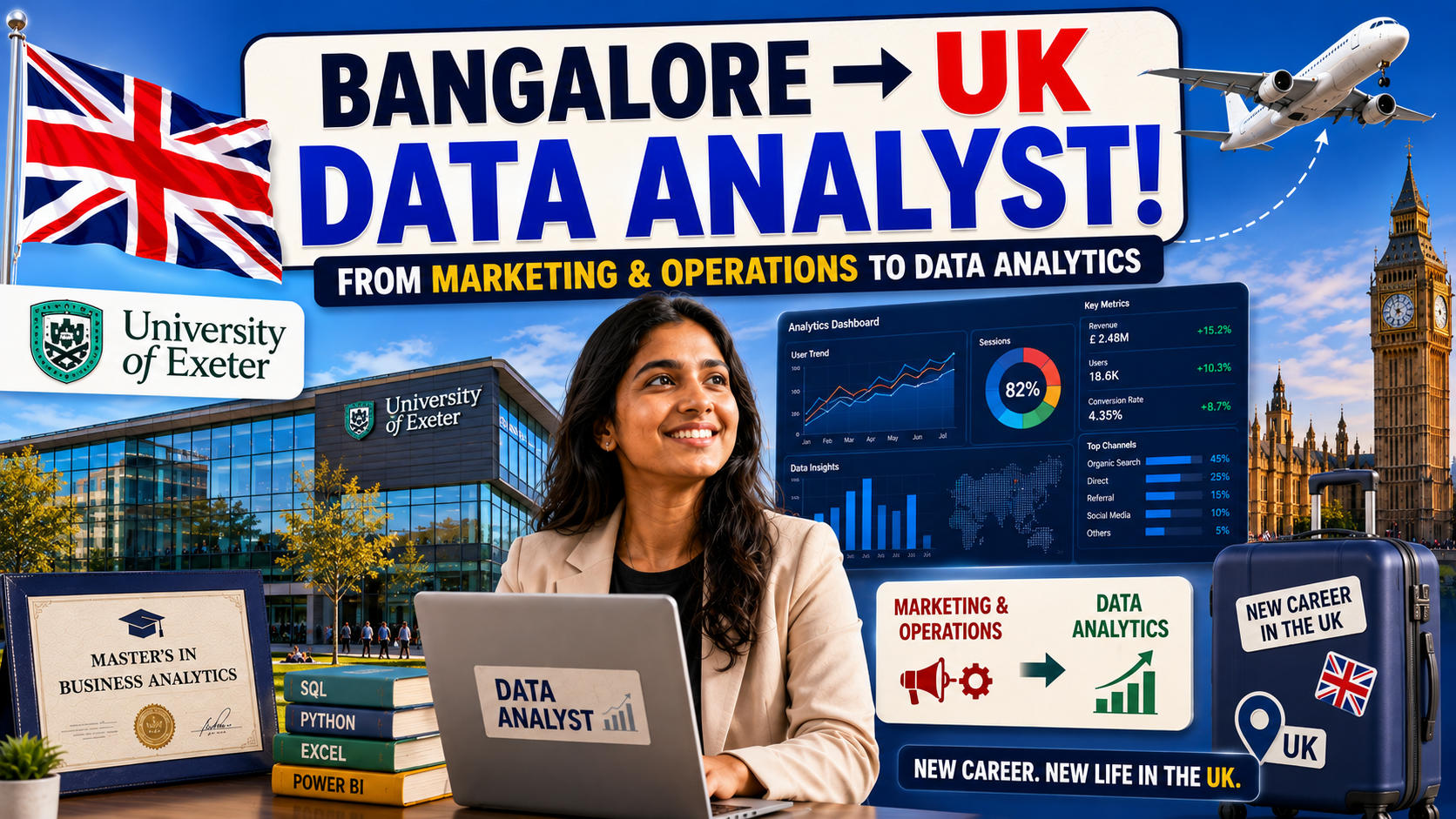
For Shivani, studying in the UK was an opportunity to move into a field she saw growing rapidly while experiencing life outside India for the first time. From making a career shift into data analytics to figuring out her next steps in a changing UK job market, her experience has shaped the way she thinks about opportunities, career choices, and planning for the future.
Shivani's Journey at a Glance
- From: Bangalore, India
- Background: 2.5 years of experience in marketing and operations
- Course: Master's in Business Analytics, University of Exeter
- Decision: Switched from marketing and operations to data analytics
- Move: Planned her application through Leap Scholar and moved to the UK alone
- Now: Data Analyst at Somerset Council, Exeter
- Visa: Working in the UK on a Graduate visa
Here's Shivani, in her own words.
Q. What made you want to move abroad in the first place?
I'd spent my entire life in Bangalore: all my schooling, my bachelor's, my first master's, all of it. At some point, I just wanted to try something new. Moving abroad felt like a genuine learning curve: different culture, different way of working. I already had one master's, so I specifically looked for a one-year program, which narrowed my country options considerably. That's how I ended up doing Business Analytics at the University of Exeter.
Q. What were you doing before you decided to switch to data analytics?
I did my bachelor's in commerce and my first master's during COVID, which honestly didn't feel like I learned much given the circumstances. After that, I worked for about two and a half years as a Key Account Analyst in Bangalore, more on the marketing and operations side, dealing with data but nothing particularly advanced. After a couple of years there, I realized tech and data were booming everywhere, in every domain, and that's genuinely where the money and the growth were. So I did my research and decided business analytics was the right pivot for me.
Q. Was there anyone who influenced that decision?
Not directly tied to the role itself, but I had a friend in my close circle who was going through the whole process of applying abroad. Watching him go through it made me think, why not do my own research and see if this makes sense for me too. Funnily enough, he never actually ended up going, but I did. A couple of my cousins had also moved to the US around a year before, though the US was never really where I wanted to go.
Q. Why the UK, and specifically Exeter?
I did consider Ireland as well since it also offers one-year programs, but the UK gave me a much wider range of universities to choose from, and the ability to move around the country for job opportunities afterward felt like a bigger advantage. In the end, I ended up applying only to the UK.
Q. How did you find out about Leap Scholar, and what was that experience like?
A friend of mine had used Leap Scholar, and even though she ultimately couldn't move for personal reasons, she recommended them, so I got in touch. Honestly, my whole journey with Leap Scholar was smooth, from choosing the university to sorting out the visa process.
Q. How much did the whole move end up costing you?
The program itself was around 27 lakh rupees. Once you added accommodation, flights, and everything else, it came closer to 30 lakh for the year. And the entire shift, visa included, worked out to around 30 to 31 lakh in total.
Q. Looking back, is there anything about the application process you'd do differently?
Definitely starting earlier. I was still going back and forth on whether I even wanted to work or study further, so I started my applications later than I should have. If you plan well in advance, you get access to a much broader set of universities and offers, and more scholarships too, since a lot of them close early. That limited scope really is the one thing I'd change if I went through the process again. One useful thing I did discover, though, is some banks maintain a list of universities where you don't need collateral for an education loan, so it's worth checking your bank's specific list before assuming you'll need to put something up.
Q. What was it like moving away from your parents for the first time?
I'd genuinely never lived away from home before this, not even within India. I really loved it. There's something about finally having your own room, organizing your own space, cooking for yourself, and having friends over whenever you want that feels completely new and freeing. It took me about a year to fully settle in, longer than some people I know who adjusted in six months, but I think that's just because this was my first time being away from my parents at all.
Q. Did you feel scared moving alone?
A little, yes. One thing that really helped was connecting with people heading to the same university before I even left India. I actually flew part of my journey with someone going to Exeter, so by the time we landed in London, we already had some familiarity with how to take the tube and how to get around. Having even one familiar face makes the whole thing feel a lot less overwhelming.
Q. Did you experience loneliness at any point?
Yes, though I'd describe it as something that comes and goes rather than a constant feeling. There were definitely low days, especially early on, but it's not something you feel every single day. It has its own cycle, and you learn to work through it.
Q. Walk us through your career since graduating.
I graduated in 2024 and started my first job that September, a fixed-term full-time contract that ran until around April. After that there was about a six-month gap where I picked up some part-time work, and then I landed my current role in November as a Data Analyst with Somerset Council. I'm still based in Exeter since I have friends here and know the city well, and the role itself is fully remote, so the half-hour distance to Somerset doesn't really matter.
Q. How did you approach the job search itself?
I've never believed in sheer volume. I know people who've done seven or eight hundred applications, but that just doesn't work for me. I put real time into tailoring each application, so quality worked better for me personally, though I know it varies from person to person. I'd actually secured a job just before graduating, and that made the whole transition from student to working professional a lot smoother.
Q. What's the visa situation like for you currently?
I'm currently on a post-study work visa. My employer does hold a sponsor license, but the rules have tightened considerably even in the last year. A lot of councils now apply stricter internal policies; if they don't consider a role genuinely hard to recruit for locally, they won't sponsor it, even if it technically falls under the shortage occupation list. So I'm still figuring out my path to a sponsored role, but I'm hopeful.
Q. How does life in the UK compare to what you had in India?
The work-life balance here is significantly better than what I experienced in India. Salary-wise, there's no comparison; it's a major reason people move abroad in the first place. That said, Exeter isn't a cheap city; it's in the south, and it's a popular student city, so accommodation costs eat into that advantage. Still, the overall quality of life and purchasing power here is noticeably better, and I'm able to save and send money home when needed.
Q. How did your parents react to the move, and how do they feel about it now?
They're fairly easygoing people, not strict at all, so convincing them wasn't a huge struggle; the finances were really the only serious discussion point. Even now, they'll occasionally bring up wanting me to come back, mostly around safety or the tightening rules for immigrants, but they're equally quick to point out that India has plenty of good opportunities too. It's less pressure and more just checking in.
Q. What's one thing this whole experience has taught you, outside of your degree?
A newfound respect for my parents, honestly. Managing a household, finances, everything, I don't know how they did it all these years, and I only really understood that once I had to do it myself. I could cook a little before moving, just occasionally; nothing regular. Being vegetarian here and simply needing to feed myself turned that into a near-daily habit.
Q. Do you think you could have achieved the same things staying in India?
I genuinely think it's more about mindset than about the country. The opportunities in India are real; they're just different, particularly around salary and specific kinds of tech roles. Opportunities exist everywhere, just shaped differently depending on where you are.
Q. What's next for you, do you see the UK as home?
It does feel like home now, yes. If everything works out and I get a sponsored role, I'd like to stay for at least the next five years. It genuinely offers better opportunities across the board right now. Beyond that, I'll figure it out as it comes.

Kirti Singhal
Kirti is an experienced content writer with 4 years in the study abroad industry, dedicated to helping students navigate their journey to international education. With a deep understanding of global education systems and the application process, Kirti creates informative and inspiring content that empowers students to achieve their dreams of studying abroad.
Users also read

From a Small City in India to Bavaria: How Arjun Patil Built a Career and an MBA Sponsorship in Germany

Leap Scholar Review: My Father Wanted Me in the Family Business. I Chose a Masters in the UK Instead.

Leap Scholar Review: Going Back to School After Fifteen Years in the Industry