Blogs
Blogs  Leap Digest
  Events
  About Us
 Student Reviews
From Delhi to Leeds: How a Master's in Data Science Took Himanshu from THG to Goldman Sachs
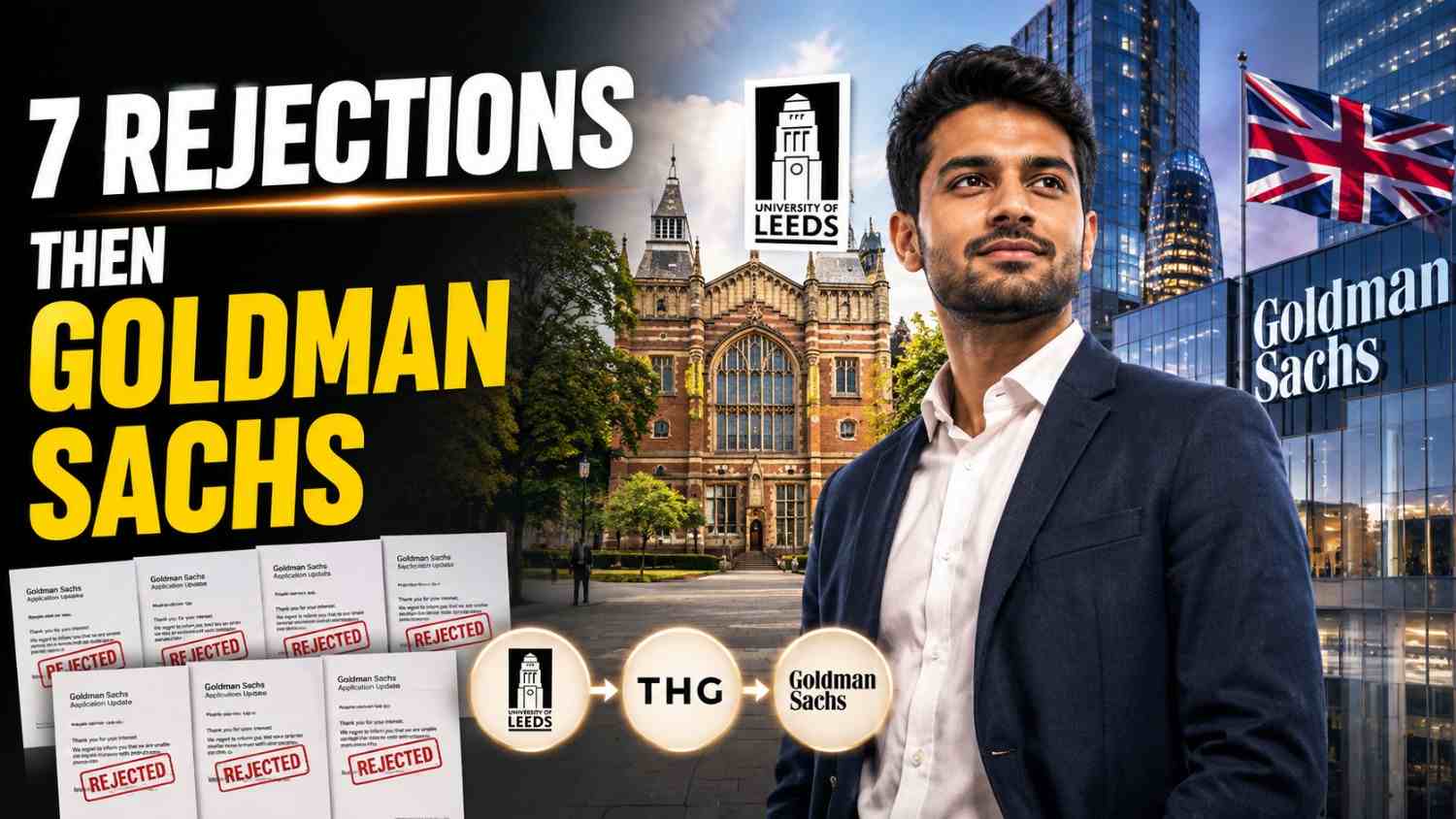
Himanshu's journey from a Delhi University graduate with plans to study in Canada to working as an Associate at Goldman Sachs in Birmingham took an unexpected turn when he realized his three-year bachelor's degree wasn't eligible for his original plan. Rather than putting his study-abroad plans on hold, he shifted his focus to the UK and chose a one-year Master's in Data Science and Analytics at the University of Leeds. His first major career break came even before he graduated, when he secured a graduate role at THG (The Hut Group) in Manchester six months before completing his Master's. After gaining experience there, he focused on Goldman Sachs, but it took seven unsuccessful applications before he finally secured the opportunity. Today, he works on the Marcus team at Goldman Sachs in Birmingham and has built his UK career largely through his research, persistence, and LinkedIn outreach.
For Himanshu, moving to the UK was only the beginning of the career he wanted to build. Himanshu's experience taught him to look beyond the obvious routes and keep actively searching for the right opportunities, starting from changing his entire study-abroad plan due to his degree eligibility, to finding his first job before graduation, and continuing to pursue Goldman Sachs after repeated rejections.
Himanshu's Journey at a Glance
- From: Delhi, India
- Background: Bachelor's from Delhi University
- Course: Master's in Data Science and Analytics, University of Leeds
- Decision: Switched his study-abroad plan from Canada to the UK
- First Career Break: Graduate role at THG in Manchester, secured six months before graduation
- Challenge: Faced seven rejections before landing his Goldman Sachs role
- Now: Associate, Marcus team, Goldman Sachs, Birmingham
Here's Himanshu, in his own words.
Q. You originally planned to move to Canada. What changed?
Going abroad was always the plan, and since 12th grade I was set on Canada. I gave my IELTS in my second year of college and was working with IDP, an agency in Delhi, to figure out my options. The problem was my degree. I'd done a three-year bachelor's, and Canada typically requires 16 years of total education, 12 in school plus four in your undergrad, for a master's. I only had 15. My counselor suggested the UK instead, partly because the tech job market was opening up again post-COVID and partly because a UK master's takes just one year instead of two, saving both time and money.
Q. How did you end up choosing the University of Leeds specifically?
I applied to several universities right after COVID and received a few offers, though my parents asked me to defer a year until things settled down. I ended up with an offer from Leeds for MSc Data Science and Analytics in 2021, along with offers from other universities. I chose Leeds after comparing the actual modules each course offered rather than going purely on university ranking, and it felt like the strongest fit for where I wanted my career to go.
Q. How did you fund the degree?
Through an education loan from InCred, an NBFC. I deliberately went unsecured, no collateral, even though the interest rate was higher for that. The one frustration was that the rate kept climbing every few months after the first year, which pushed me to prioritize repaying it as quickly as I could. I managed to clear it fully within two years of graduating.
Q. What was it like moving to Leeds, and how did you support yourself there?
I landed in September 2021, still COVID times, so I had to quarantine for about a month and lived off my savings initially. By the end of October, I'd found part-time work in a pub kitchen in Leeds, essentially a sous chef role, which covered my rent. Since it was an education loan, I didn't have any real repayment pressure in those first two years beyond a small minimum amount, so my part-time income went almost entirely toward day-to-day living.
Q. When did homesickness actually catch up with you?
Not immediately, honestly. The first few months were busy: new friends, assignments, and exploring the city, so it didn't really register. The moment it hit me was when I was working alone in the pub kitchen the night before Diwali, knowing that my friends back home were with family and that other friends abroad were out celebrating together. That was the first time I really understood that this was something I would have to get used to for years to come. It gets easier over time, but that particular night stuck with me.
Q. How did you land your first job in the UK?
I met someone on a trip in November 2021 who told me graduate roles get snapped up fast, so I should start applying immediately. I began my search that December, while still mid-course, which I'd genuinely recommend to anyone in the same position. By February I'd secured an offer from THG in Manchester, the parent company of MyProtein, for a graduate role starting that September, once my course finished. I'd had an offer in hand a full six months before I actually graduated.
Q. How did your visa situation work out after graduation?
I worked on my student visa for about four months after finishing, and just as it was nearing expiry, THG agreed to sponsor me directly onto a Skilled Worker visa. I never went through the Graduate visa route at all. I spent around two and a half years there working on the fraud detection team.
Q. What made you decide to leave THG for something new?
I reached a point where I felt I'd hit a plateau, both in terms of growth and in terms of daily experience. My role there was fully remote, which meant almost no in-person human interaction during the working week; weekends were really the only social time I got. That isolation, combined with wanting a stronger next step for my career, pushed me to start preparing for interviews about four to five months before I actually made the switch.
Q. Tell us about the move to Goldman Sachs.
I wasn't fixed on a specific company or even a specific city; I was open to relocating anywhere for the right offer and sponsorship. I applied to JPMorgan, got referrals into Google and Amazon that didn't convert, and applied to Goldman Sachs itself six or seven times before it finally worked. On what turned out to be my seventh or eighth attempt, I noticed a recruiter had posted the role directly on LinkedIn, so I messaged him, explained why I thought I'd be a strong fit, and sent my resume, tailored specifically to that job description. That direct outreach seems to have made the difference. He set up an initial screening, then a first coding round I gave from Manchester, followed by an in-person round in Birmingham. I got the result the same day. I started as an Associate on the Marcus team in May 2025.
Q. Any advice on the interview prep itself?
I wasn't preparing for Goldman Sachs specifically, more for switching roles in general. A lot of it was DSA practice on LeetCode and following resources like Hello Interview's YouTube content, which anyone preparing for technical interviews abroad has probably come across.
Q. What role has LinkedIn played across your career?
A bigger one than I expected going in. Both my roles, THG originally and Goldman Sachs now, came through recruiters reaching out to me or me reaching out to them directly on LinkedIn, not through traditional job portals. I'd genuinely say having a strong, well-maintained LinkedIn profile matters a lot more abroad than it typically does back in India.
Q. What drew you to computer science and tech in the first place?
Honestly, good money was the primary reason. I was in a peer group of high scorers in school who all went into science and then computer science, and I followed that path partly to keep up with them. I do enjoy the work itself now, but if I'm being fully honest, the financial upside is what got me into the field to begin with.
Q. How did your parents react when you first brought up moving abroad?
I first mentioned it back in 12th grade, and at the time they didn't take it seriously at all; they assumed I was just talking and told me to focus on my board exams instead. Gradually, as I kept researching and preparing over the following years, they realized I was genuinely serious, and by the time I actually had to make the decision, they'd already come around. I didn't have to convince them much at all.
Q. Do you think you would have achieved the same things if you had stayed in India?
Probably not in the same way. I have friends from school and college doing well in tech in Bangalore and Gurgaon too, and if I'd stayed, I likely would have ended up in a similar role in one of those cities. But the lifestyle here, the travel, the access to the rest of Europe, and following sports the way I do, I don't think that version of my life would have existed in India.
Q. What are your plans going forward regarding citizenship and staying long-term?
For now, the plan is to stay in the UK and work toward my ILR, which I'm about a year to a year and a half away from. There's been talk of extending the qualifying period from five to ten years, but based on what I've checked, that shouldn't apply to me given my current salary level. It's still pending government approval either way, so I'll just have to see how it plays out.
Q. What do you miss most about India?
Family, friends, and food, the three Fs, and my dog.
Kirti Singhal
Kirti is an experienced content writer with 4 years in the study abroad industry, dedicated to helping students navigate their journey to international education. With a deep understanding of global education systems and the application process, Kirti creates informative and inspiring content that empowers students to achieve their dreams of studying abroad.
Users also read

From a Small City in India to Bavaria: How Arjun Patil Built a Career and an MBA Sponsorship in Germany
Leap Scholar Review: My Father Wanted Me in the Family Business. I Chose a Masters in the UK Instead.

Leap Scholar Review: Going Back to School After Fifteen Years in the Industry