Blogs
Blogs  Leap Digest
  Events
  About Us
 Student Reviews
From Mysore to London: How the University of East London Shaped Divya Byregowda's Career Journey
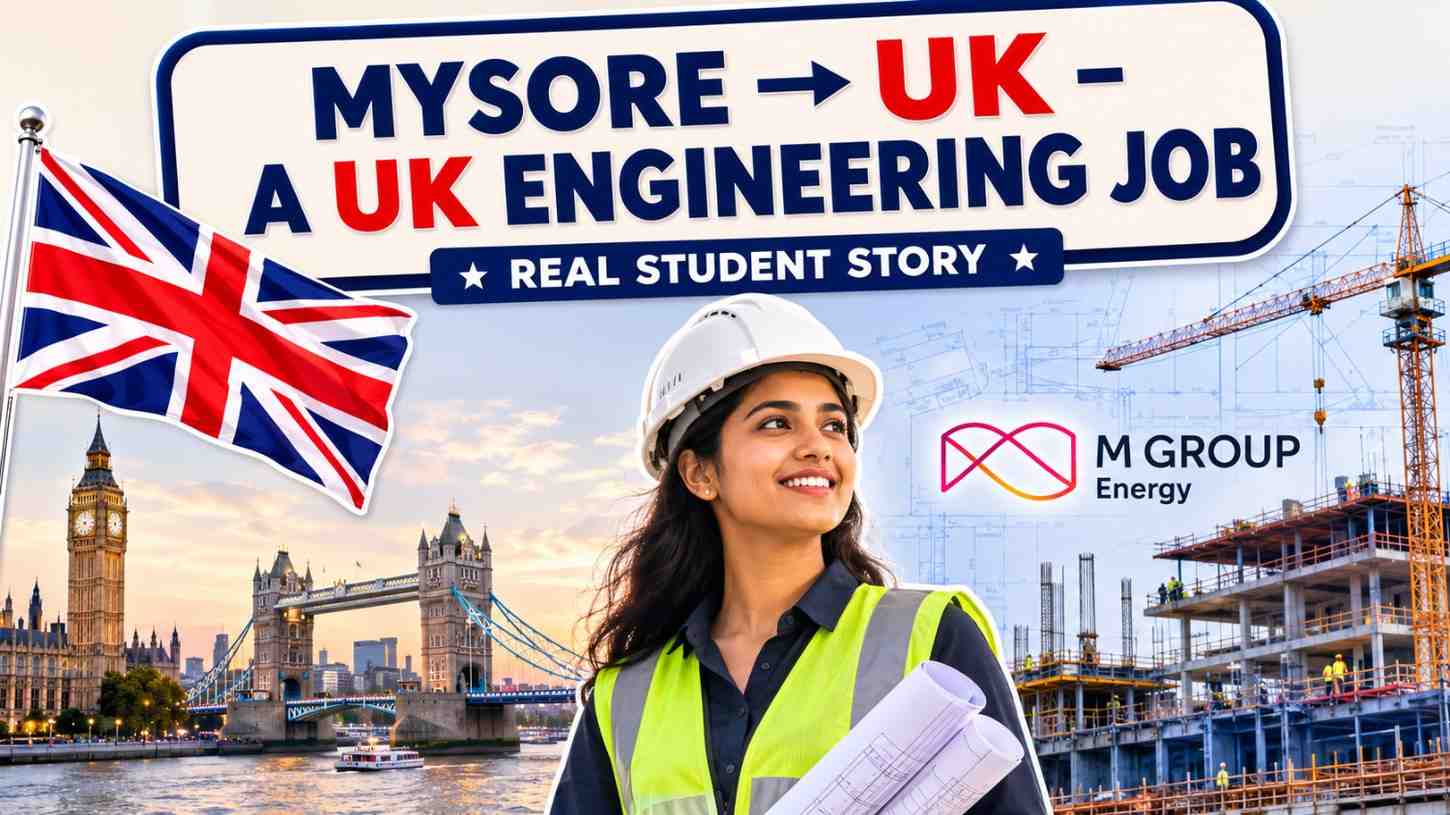
For Divya, studying abroad wasn't just about earning another degree; it was about choosing a career path that offered better long-term opportunities than the options she had at home. From navigating life in a new country on her own to balancing work and academics, every experience helped her become more independent, confident, and prepared for a career in the UK's engineering sector.
Divya's Journey at a Glance
- From: Bengaluru, India
- Course: MSc in Structural Engineering, University of East London
- Challenge: Managed her visa, education loan, and move to the UK independently
- Now: Civil/Structural Substation Design Engineer at M Group Energy
- Timeline: Civil Engineering (India) → UK (MSc) → Full-time role at M Group Energy
Here's Divya, in her own words.
Q. Tell us about your background.
I'm from Mysore, in Karnataka. I come from a civil engineering background, and around my third or fourth year of engineering, I actually considered preparing for competitive exams like KAS and IAS, since I wanted to do something different from everyone else. I also looked at a specialized institute for a master's in construction management, but between the coaching costs and the course fees, everything was adding up to twelve to fifteen lakhs, which felt like a lot right after I'd already spent so much on my engineering degree.
Q. Why did you decide to look abroad instead?
I was scrolling through Instagram one day and came across an ad about studying in Europe for under fifteen lakhs. That stuck with me. I started researching seriously in my fourth year, and a consultancy that visited my college gave a session on studying abroad that got me genuinely interested. I went from Mysore to Bangalore in a single day and visited five or six consultancies to understand my options across Australia, Canada, the US, and Europe.
Q. Why the UK specifically over other countries?
Initially, I was actually leaning toward Europe, since education in some countries there was free, and I'd applied to and gotten offers from Politecnico di Milano and a couple of universities in Frankfurt for civil engineering. But a close friend was applying through a platform called Shiksha.com for universities in the US, Canada, Australia, and the UK, and once I looked into it, I realized the UK meant no language barrier, and the price point worked out to be reasonable too. I ended up leaving the four consultancies I'd already paid for and moved my entire application process online through Shiksha instead.
Q. How did you end up at the University of East London?
Through Shiksha, I got responses from a few UK universities, and I was leaning toward London specifically, so I chose the University of East London for my MSc in Structural Engineering. That part of the process was smooth. What wasn't covered was everything that came after: the loan process, the visa application, and all of it fell entirely on me.
Q. What was that like, handling the visa and loan process on your own?
Genuinely stressful. I didn't know how the UK education system worked, I didn't know how to fill out a visa application, and I remember spending hours at a stretch in a computer cafe just trying to get through my student visa paperwork. Getting my CAS letter was a real struggle, and the loan came with formats and requirements I had no prior knowledge of. In the forty-five days before I actually moved, I was juggling all of these tasks while also trying to mentally prepare for an entirely new life. If I'd had proper guidance through that part, I think I could have actually enjoyed the process instead of just surviving it.
Q. What did the actual cost of your move and degree look like?
My first year cost around fifteen and a half to sixteen thousand pounds in tuition, plus close to twelve thousand pounds a year for living expenses, so my first year came to roughly twenty-eight to thirty lakhs at the exchange rate back then. My second year was mostly a dissertation year, so tuition dropped to about two thousand pounds, with living costs still applying. I used my education loan for my first year's amount, then relied on part-time work once I found a job about two months after arriving.
Q. What was your experience like once you actually landed in the UK?
I knew absolutely nobody here. It turned out I had one distant relative living in the UK who helped me settle in, and I also had a friend from my bachelor's who was joining the same university, so we navigated things together. My parents were genuinely scared to send me, since I'd never lived away from my hometown before, but once I moved, it allowed my brother and two of my cousins to study abroad too.
Q. Tell us about your part-time jobs while studying.
My first job was at Poundland, and I also worked event management gigs as a bartender during the Christmas season. After that I moved to Costa Coffee as a barista for about a year and a half and then to an easier role at the betting company Ladbrooks Coral. Once I landed my first proper civil engineering job, I actually kept doing this part-time job on weekends too, working close to twenty hours a week alongside my main role, right up until my Tier 2 visa came through and I had to drop everything except my sponsored job.
Q. How long did it take you to land your first graduate role?
About three months after I graduated, which felt stressful at the time, though I later learned some people didn't get a job at all before their post-study work visa ran out and had to return home. Looking back, the one thing I'd have done differently is started looking for a stronger internship much earlier, ideally at the start of my second semester, instead of waiting until a month before it began.
Q. What does your life and career look like now?
This December marks five years in my career, and I've moved through three or four companies to get to where I am now as a Civil/Structural Substation Design Engineer at M Group Energy, working in the power sector. I've paid off my entire education loan; I recently got married; my husband was already living in the UK around the same time I moved; and my brother is doing his master's here too, living with us. Beyond my career, I also picked up cooking properly, since eating out constantly isn't sustainable, and I've dabbled in YouTube and Instagram content, even running informal one-on-one sessions for people wanting guidance on moving abroad.
Q. What would you tell students planning to study abroad today?
Get two to three years of work experience in India first if you can, ideally at an MNC, so you walk in with strong fundamentals rather than starting from scratch. The market has become far more competitive since I moved, and companies sponsoring visas want to see real experience. Don't chase part-time earnings as your first priority either; take your education loan, use it wisely across tuition installments and your first few months of living costs, and focus on settling in and studying properly first. The job, and the money, will follow once you understand the country and the people around you.
Q. Finally, what's the one thing that might still bring you back to India?
My parents and the food. I've learned to cook Indian food well enough here that I don't miss it as much as I thought I would, but nothing quite replaces being close to my parents.

Kirti Singhal
Kirti is an experienced content writer with 4 years in the study abroad industry, dedicated to helping students navigate their journey to international education. With a deep understanding of global education systems and the application process, Kirti creates informative and inspiring content that empowers students to achieve their dreams of studying abroad.
Users also read

Leap Scholar Review: My Visa Got Rejected Once. This Time, I Chose My Counselor Carefully
Leap Scholar Review: My Visa Got Rejected Once. This Time, I Chose My Counselor Carefully
Leap Scholar Review: I Was the Only Minor in the Exam Room, and My Dad Almost Missed the Signature