Blogs
Blogs  Leap Digest
  Events
  About Us
 Student Reviews
Leap Scholar Review: I Applied to My Masters From Somewhere in the Red Sea
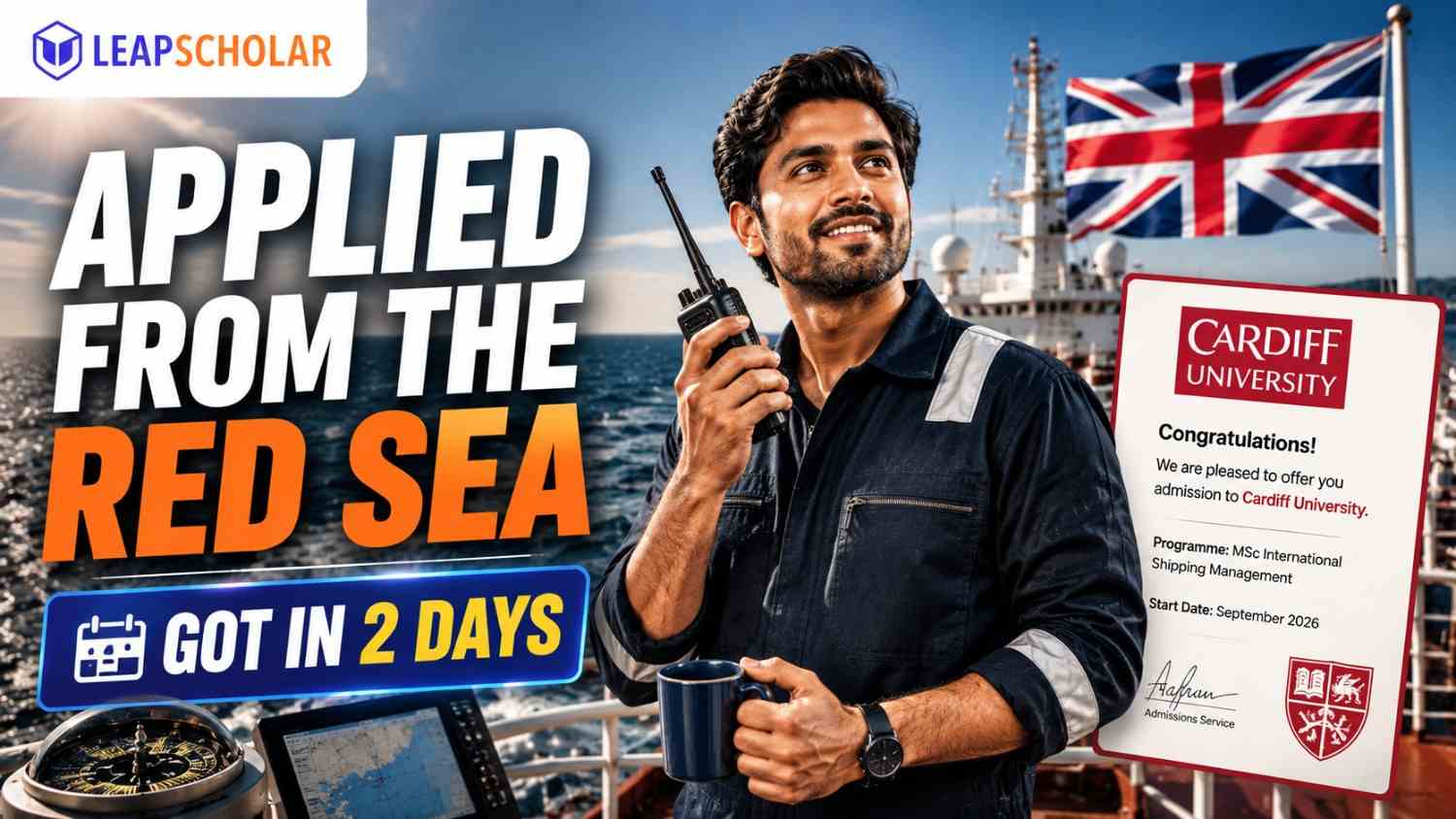
Most people apply for their masters from a laptop at home. I applied from onboard a ship, with almost no internet, while my sister managed my account and my counselor took my calls at midnight India time because he knew that was the only window I had. Here's my Leap Scholar review, in my own words, on landing a conditional offer from Cardiff University in just two days, entirely over WhatsApp.
Q1. Tell me a bit about yourself.
My name is Anubhav Verma, and I'll be pursuing my MS in Maritime Business and International Trade at Cardiff University. Before this, I was working as a maritime professional, a marine engineer with a Class 4 COC. I've sailed on four ships in my career so far, professionally working on board throughout.
Q2. When did you first start thinking about studying abroad?
The first time this thought actually came to me was back in 2022, right after COVID. I thought about opting for a masters then, but once lockdowns lifted, I decided to resume my shipping career instead and went back to sailing. It was while I was actually on a ship more recently that I realized, if I ever wanted to do a masters, it would be better to do it before turning 30, since studying apparently gets a lot harder after that.
Q3. Which country and university did you choose?
I chose the United Kingdom, specifically Cardiff University.
Q4. Why that specific country and university?
I had two options: World Maritime University in Sweden or Cardiff University in the UK. There was also Bayes Business School at City University London, but their alumni network is largely concentrated in London, whereas Cardiff has a genuinely global network. Cardiff also hosts the Institute of Chartered Shipbrokers. My field is fairly niche; not every university offers a shipping-focused course, and Cardiff has a strong reputation specifically for business management courses built around shipping, unlike general finance programs that plenty of universities offer.
Q5. How did your parents react?
Honestly, my parents have always been the type to say, do whatever you want; it's your life. They've never objected to anything, whether I wanted to keep sailing or pursue a masters. Whatever decision I make, they're fully supportive.
Q6. How important do you think choosing the right degree is, and how much research did you do?
Choosing the right degree matters enormously. It's not really about chasing the most reputed college for its own sake, the college should be decently reputed, sure, not something rock bottom, but if you have to choose between a five-star college without your desired course and a four-star college that actually offers exactly what you're interested in, I'd say go with your area of interest every time. Cardiff worked out well for me because it genuinely offered both a strong reputation and the exact course I wanted. I spent around a month actively researching, weighing multiple colleges.
Q7. What did that research process actually look like?
Leap Scholar had shortlisted a few options for me too: Southampton, Solent University, Liverpool John Moores. I already knew these wouldn't really serve my goals given how niche my field is. My own top picks were Cardiff and Bayes in the UK and World Maritime University in Sweden. Since so few colleges globally actually offer maritime-specific MSc programs, the research itself wasn't especially difficult; a quick Google search for top maritime MSc colleges gets you most of the way there. I also leaned heavily on industry contacts, people already working in the field who genuinely know which colleges' graduates are performing well and getting hired, and that's how Cardiff kept coming up.
Q8. How did you actually begin this process while you were at sea?
When I started, I had very limited connectivity; normal calls and everything were genuinely difficult. So I contacted my sister, and she's the one who actually reached out to Leap Scholar first. That's also why my account username shows up as Anubhav in brackets with her name, since she set the whole thing up. My assigned counselor, Anant Manikandan, then reached out to me directly over WhatsApp, and honestly, the entire process, document sharing, shortlisting discussions, everything, happened over WhatsApp because that was the only channel that reliably worked for me.
Q9. How fast did everything actually move?
Remarkably fast. I got a conditional offer from Cardiff within just two days of applying. The full process, from my initial contact to receiving an Excel sheet of shortlisted universities to actually choosing and getting my conditional offer, took about ten days total. I looked at the shortlist, immediately ruled out four universities I wasn't interested in, and told them Cardiff was my top choice, followed by Bayes. Cardiff came through first, so I went with them. After that came the unconditional offer, then the visa process, and by now everything's done; I'm just relaxing and waiting to join.
Q10. How did your sister first find Leap Scholar?
Through a family referral, actually. My brother-in-law's cousin had used Leap Scholar back in 2021 to study in Canada and recommended them to us. I honestly don't know how he originally found them.
Q11. How did the university shortlisting process actually go?
I largely handled that part myself. I told them directly that Cardiff was my top priority and Bayes was second, since I'd already done my research while onboard before I even reached out to them. They did suggest a few additional shipping-relevant options I hadn't fully considered, but I'd already ruled most of those out through my research. For me, honestly, it was always Cardiff and only Cardiff.
Q12. Did you get a scholarship, and how did you manage your finances?
Marine engineering is a genuinely well-paying job, so finances weren't a major concern for me. I did get a scholarship of £6,000, though I'll be upfront that this specific one is available broadly to Indian students generally, not something awarded to me exclusively.
Q13. What challenges came up, and how did Leap Scholar help you through them?
Honestly, I didn't have many doubts; the whole process was smooth enough that challenges rarely came up. What I do want to highlight is how they handled my very specific situation. Most platforms, IDP and Leverage Edu included, expect you to personally manage everything through an app. That simply wasn't possible for me; I couldn't even reliably receive an OTP while in the middle of the sea. But Leap Scholar accommodated that completely, letting my sister manage a lot of the communication while still directly engaging with me whenever I was available. At times, my father also wanted more detailed information, and when I wasn't around to explain things myself, they handled that conversation with him directly too.
Q14. Was there a specific moment where Leap Scholar's support genuinely stood out?
Definitely the way my counselor, Anant Manikandan, handled our communication. My schedule sailing through the Red Sea, near Saudi Arabia, and on to Singapore and Japan involved wildly shifting time zones and very limited internet, sometimes none at all for days. He used to take my calls whenever I actually got spare time, even if that meant 11 pm or midnight India time, because he understood I might not get another window for two or three more days. He handled that entire initial stretch really well. Around February or March, he moved on from Leap Scholar, and Vishnu Priyanka took over, particularly through the visa process. The transition was smooth; I didn't have to explain my situation all over again. She already had the full picture, which made everything genuinely straightforward from my side.
Q15. Would you recommend Leap Scholar to your friends?
Yes, definitely. I actually attended a seminar in Mumbai for incoming Cardiff University students from India, and I'd estimate around 60 percent of the people there were already using Leap Scholar themselves.
From applying while sailing through the Red Sea with barely any internet to a conditional offer in two days and a counselor handover that never once slowed things down, this journey is a reminder that the right support can adapt to genuinely unusual circumstances rather than expecting you to adapt to them. For anyone applying to a niche field or managing this process from somewhere with limited connectivity, this Leap Scholar review is worth reading closely.
Kirti Singhal
Kirti is an experienced content writer with 4 years in the study abroad industry, dedicated to helping students navigate their journey to international education. With a deep understanding of global education systems and the application process, Kirti creates informative and inspiring content that empowers students to achieve their dreams of studying abroad.
Users also read

From a Small City in India to Bavaria: How Arjun Patil Built a Career and an MBA Sponsorship in Germany

Leap Scholar Review: My Father Wanted Me in the Family Business. I Chose a Masters in the UK Instead.

Leap Scholar Review: Going Back to School After Fifteen Years in the Industry