Blogs
Blogs  Leap Digest
  Events
  About Us
 Student Reviews
Leap Scholar Review: My IELTS Score Expired, So I Retook It. This Time I Scored a Full Band Higher.
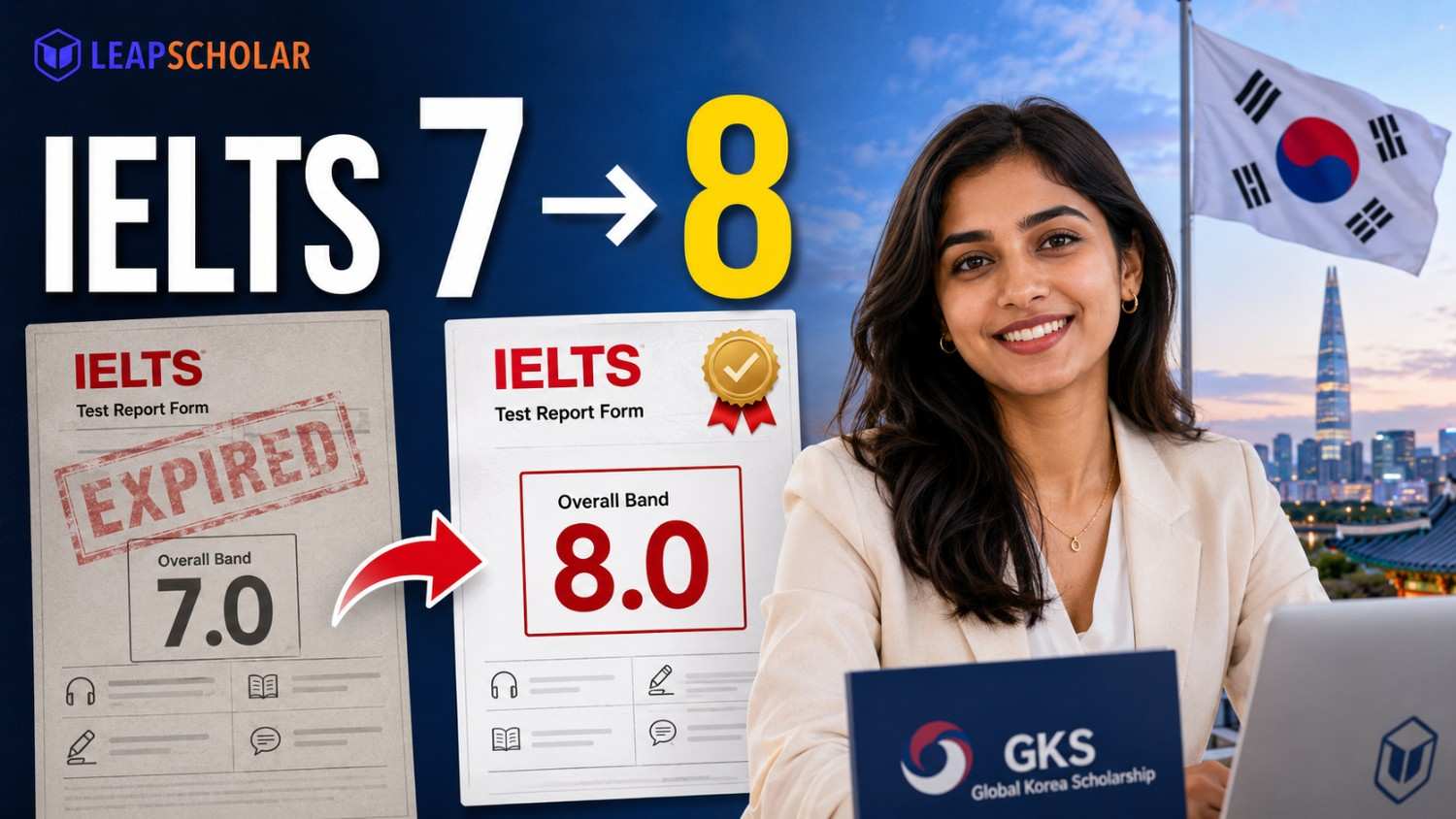
I didn't know IELTS scores could even expire until mine did. Here's my Leap Scholar review, in my own words, on why I had to sit for IELTS a second time, how my second attempt jumped a full band over my first, and why I'm now chasing one of the toughest scholarships in the world.
Q1. Tell me a bit about yourself.
Hi everyone, I'm Dhara. I graduated in 2023 with a bachelor's in hotel management, and in 2024 I went to Canada for my postgraduate studies. I came back at the end of 2025, honestly, because after actually living in a western country, I realized it wasn't the best fit for me long-term, and I wanted to try a different route instead. Once I was back, I started working and also began looking into IELTS coaching again, since my score from my previous intake had expired and I needed to retake the exam. That's how I came across Leap Scholar online.
Q2. Wait, IELTS scores actually expire?
Yes, and I don't think a lot of people realise this. From the date you take your exam, your score stays valid for two years. If you're reapplying for a student visa, extending one, or converting to and extending a work visa, you'll need a valid IELTS score for that: academic IELTS for a student visa and general IELTS for a work visa. Either way, once your score expires, you have to retake the exam.
Q3. How did you decide to go with Leap Scholar for your second attempt?
While searching online for IELTS classes or lectures, I came across Leap Scholar, and I saw several testimonials on their website too. I registered for their free masterclass first, just to see if it was genuinely a good fit for me before committing to anything further. Once I started attending classes properly, I noticed how many small tips and tricks their educators highlighted that I'd have completely missed otherwise, and that genuinely boosted my confidence between my first and second attempts. I'd say IELTS is technical, sure, but it becomes a lot easier once you're actually confident in yourself.
Q4. Did you take the free band prediction test?
Yes, and it was genuinely useful. I needed to know where my band score stood at that point and what I was actually aiming for. It helped me figure out exactly what to focus on. If I were already strong in listening, I wouldn't need to over-practice it, but if reading were weaker, that's where I would need to put in extra time.
Q5. How was your experience with the classes themselves?
Genuinely interactive and informative. Personally, I struggled with reading the most, mostly because of time constraints affecting my score. But the tips and tricks my educator gave me helped me manage my time much better and hit the score I was aiming for.
Q6. Were the counselors helpful?
Very much so. They genuinely listened and offered real solutions. If I missed a class, they'd send recordings and let me know about alternative sessions I could join instead. It wasn't a rigid one-class-only setup either; there were plenty of extra resources on the app and website too, vocabulary lessons, listening practice, and more.
Q7. Which modules were hardest for you, and did you pick up any specific tips?
Reading and writing were genuinely the most time-consuming and difficult sections for me. Listening and speaking were easier for me; I had also done well in those sections on my first attempt. For writing, one tip I still remember clearly is to paraphrase the question at the start of your paragraph and to use synonyms instead of repeating the same word, alternating between things like "therefore" and "for instance" to keep it from sounding repetitive. It also shows the examiner your actual command of the language. For reading, especially with headline or title-based questions, I learned to read just the first line and the last line of a paragraph, right up to the full stop. Usually, the answer is hidden in exactly those two lines; you don't need to read the whole passage.
Q8. How did this preparation compare to your first attempt, back when you were preparing for Canada?
My first round of prep was fairly beginner-friendly, not very in-depth. This second time, it went noticeably deeper, and my score reflected that, along with a genuine boost in confidence. That's really the key difference, a more thorough, more advanced level of preparation the second time around.
Q9. Were you nervous on exam day this time, compared to your first attempt?
No, honestly, I was pretty confident this time. My exam was scheduled about a month or two after my Leap Scholar classes wrapped up, and I didn't do any intensive prep right before it; the day before, I just briefly went through some tips and rewatched a few recorded class videos. That was really it. I wasn't scared going in.
Q10. What were your scores, first attempt versus this one?
My first attempt, for Canada, gave me an overall band of 7. This time, with Leap Scholar, I scored an overall band of 8, a full one-band jump.
Q11. What are you targeting now, and how's that process going?
I'm aiming for South Korea, specifically through the GKS scholarship, their Global Korea Scholarship, which opens every February for graduate applicants and September for undergraduates. It's genuinely cutthroat; there are about 1,500 seats globally each year, combined across master's, PhD, and research tracks, and for India specifically, that's just 70 seats total, again combined across all three tracks. I applied in 2026, got selected for the interview round, but didn't clear that stage. I'm planning to reapply in 2027 with a different strategy, sharper tactics, and additional certifications to strengthen my profile. As backups, I'm also looking at the Erasmus Mundus program in Europe, plus scholarships in China and Japan, though GKS remains my main focus. I haven't applied to any specific university directly yet; my current priority is securing the scholarship first.
Q12. Would you recommend Leap Scholar to your friends?
Definitely, and I already have. A friend of mine is still in Canada on a work permit; we used to live together, and she's now planning to apply for PR once her work permit process wraps up. I told her to reach out to Leap Scholar directly; my own one-band jump is a genuinely positive proof point, and I think it would help her the same way it helped me.
From an expired score she didn't even know could expire to a full band jump on her second attempt, this journey is a reminder that preparing again isn't the same as starting over, especially with sharper tools the second time around. For anyone facing an IELTS retake or chasing a scholarship as competitive as GKS, this Leap Scholar review is worth reading in full.

Kirti Singhal
Kirti is an experienced content writer with 4 years in the study abroad industry, dedicated to helping students navigate their journey to international education. With a deep understanding of global education systems and the application process, Kirti creates informative and inspiring content that empowers students to achieve their dreams of studying abroad.
Users also read

From a Small City in India to Bavaria: How Arjun Patil Built a Career and an MBA Sponsorship in Germany

Leap Scholar Review: My Father Wanted Me in the Family Business. I Chose a Masters in the UK Instead.

Leap Scholar Review: Going Back to School After Fifteen Years in the Industry