Blogs
Blogs  Leap Digest
  Events
  About Us
 Student Reviews
Leap Scholar Review: I Skipped the Free Resources, and I Genuinely Regret It
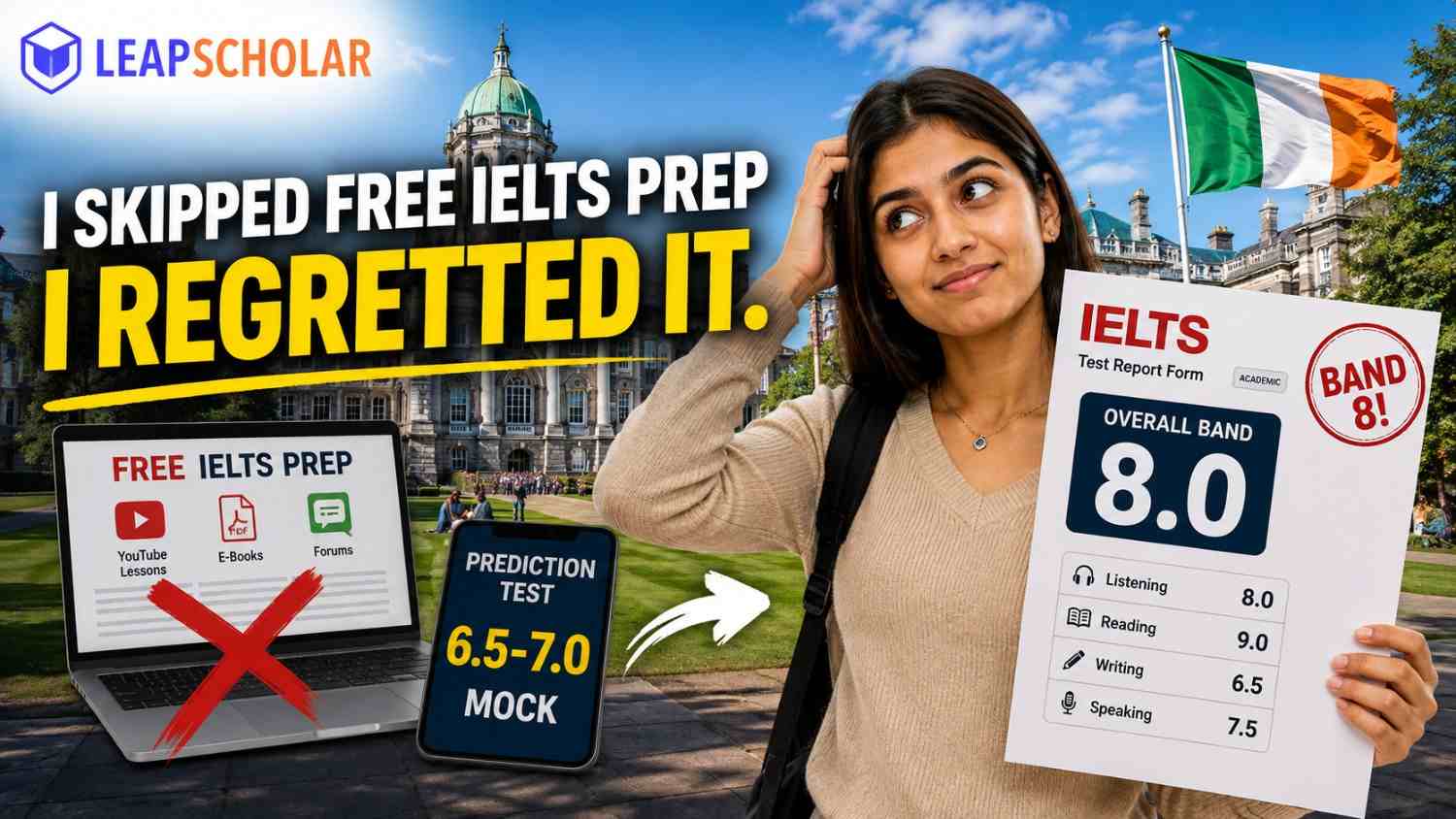
As a single child, I found it particularly difficult to tell my parents I wanted to move abroad. Here's my Leap Scholar review, in my own words, on the one mistake I made in my IELTS prep that I'd tell anyone else not to repeat and how I still walked away with a Band 8 and two offers from Dublin.
Q1. Tell me a bit about yourself.
Hi, my name is Shefali Mathur. I live in Bhopal, India, and I prepared for my IELTS exam through Leap Scholar. I'm currently in the process of moving to Ireland.
Q2. What was your biggest fear about the IELTS exam when you decided to study abroad?
Once I actually decided to move abroad and started preparing for IELTS, I felt genuinely overwhelmed. The exam tests four different skills, and I was particularly nervous about some of the sections. I also felt underprepared, since there really isn't much quality material out there to practice against for an exam like this.
Q3. How did you first discover Leap Scholar?
I was actually already in touch with Leap Scholar mentors while selecting my master's course. Their mentors guided me toward the IELTS preparation platform as well. Since I already trusted them for helping me choose my master's program, I was confident they'd give me the kind of support I needed for IELTS too, so I opted in.
Q4. Why did you decide to move abroad for your higher studies?
I'd always wanted to pursue my master's abroad. I graduated in 2021, and I felt it was genuinely valuable to gain some work experience first before making that move. I wanted to explore a more global environment, build a circle of people from different backgrounds and cultures, and gain a broader perspective on life and on my career too.
Q5. Was this desire for diverse exposure something you'd had since college, or did it come later?
Honestly, it's something I realized fairly recently. I won't pretend I felt this way back in college. What actually shaped it were friends of mine who'd already moved abroad; I noticed a genuinely positive shift in their personalities, more responsibility, and more openness toward different kinds of people. I admired that, and I wanted that same growth for myself.
Q6. How did your parents react when you told them?
I should mention I'm a single child, so it was genuinely difficult for my parents to accept the idea of me moving abroad. To my surprise, they were incredibly supportive. My father told me something that stuck with me, that you only get one life, and if you don't go where you want to go, you'll regret it in your 30s and 40s, wondering what could have been if you'd just had the confidence to pursue it. He encouraged me to apply to universities and sit for IELTS, even though I'd been genuinely hesitant earlier, worried about leaving them behind and worried about what others might think of a single child moving abroad. I'm deeply grateful for how supportive he was.
Q7. Did you use the free resources before starting the full IELTS course?
Honestly, no, and I genuinely regret that decision. Once I finally explored what was actually available for free, I realized that the variety of questions and passages, especially for writing and reading, was genuinely at the IELTS level. If anyone's about to enroll, I'd strongly suggest using every free resource available first. It builds a much stronger foundation before you even start your actual classes.
Q8. Did you take the free Band prediction test or attend a masterclass?
Yes to both. I attended the free masterclass and took the prediction test, and I scored somewhere around 6.5 to 7 there, notably lower than what I eventually achieved on the real exam. I think that's actually a good sign; the practice curriculum on the platform is intentionally tougher than the real exam, so once you're comfortable handling harder questions, the actual test feels easier as a result.
Q9. What was your live class experience like?
Wonderful, honestly. My coach encouraged active participation and gave equal attention to every student, which kept the sessions genuinely engaging rather than monotonous. My typical day involved attending class, participating actively, completing homework like writing reports or reading assigned chapters, and then practicing further using the materials available on the portal. I followed the natural rhythm of the class throughout, and I'd say the live classes were the most valuable part of my entire preparation, since we got fresh content every single day.
Q10. Which module gave you the most trouble?
Writing, without question. It's genuinely the most time-sensitive section; you have to complete two tasks, a report and an essay, within a strict time limit. Organizing your thoughts, structuring an answer, and developing it fully in that window was genuinely challenging for me.
Q11. Did your coach give you any specific tips for writing?
Yes, and this one made a real difference. He taught us to break a report down into four clear sections, with specific guidance on exactly what content belongs in each paragraph. Before writing in full, you'd prepare a rough outline first, noting what goes into paragraph two, three, and four ahead of time. Once you have that skeleton ready, actually writing the exam becomes significantly easier. He also pushed us to build vocabulary, learning synonyms for everyday words, since including them makes your writing sound more formal and read more smoothly overall.
Q12. How did you feel after completing the exam compared to when you started?
When I began my prep, I genuinely had no idea what I was signing up for. I knew the exam tested listening, writing, and speaking broadly, but I had no sense of the actual question types, like the report-writing task, or how tightly timed everything would be. By exam day, thanks to my preparation, I felt genuinely confident. Speaking, reading, and listening all went wonderfully. Writing remained a little challenging, mostly because you can be handed any I had to come up with a topic on the spot, but having a clear structure already worked out in my head made even that feel manageable. I genuinely credit my coach and the mock materials on the portal for that confidence.
Q13. What was your final IELTS score, and how did it compare to your prediction test?
I scored an overall Band of 8. Broken down, that was a 9 in reading, an 8 in listening, 6.5 in writing, and 7.5 in speaking. My prediction test score had been around 6.5 to 7 overall, with writing specifically sitting between 5 and 6 and speaking somewhere around 6 to 7. The gap comes down to exactly what I mentioned earlier: the platform's practice curriculum is deliberately tougher than the actual exam, so by the time exam day arrived, everything felt genuinely familiar and manageable.
Q14. Which universities did you apply to, and what came of it?
I was targeting Ireland specifically and applied to both Trinity College Dublin and University College Dublin. At UCD, I applied to two separate courses, MSc Finance and MSc Business Analytics, and got accepted into both. I chose to go with MSc Business Analytics.
Q15. How much did your IELTS score actually help your applications?
My target course required a minimum Band of 7, and I scored an 8, comfortably clearing that requirement. I think my particularly strong scores in reading and listening also helped reinforce the overall strength of my application beyond just meeting the minimum bar.
Q16. Would you recommend Leap Scholar's IELTS program to others?
I'd highly recommend it to anyone preparing for IELTS, for two specific reasons. First, the content on the platform genuinely mirrors the actual exam closely, with real variety across questions and passages to practice against. Second, the coaches are genuinely supportive, and I really appreciated that they offered one-on-one sessions too, so if you're not comfortable asking a question in front of the whole class, you're actively encouraged to reach out personally instead. That kind of individualized support is genuinely commendable, especially for an exam that decides so much about your entire application abroad.
From a single child's difficult conversation with her parents to a Band 8 score and two offers from Dublin, this journey is a reminder that the one shortcut you skip, even something as small as free practice resources, can be the thing you wish you'd done differently in hindsight. For anyone weighing whether the free tools are actually worth their time or bracing for the writing section specifically, this Leap Scholar review is worth reading in full.

Kirti Singhal
Kirti is an experienced content writer with 4 years in the study abroad industry, dedicated to helping students navigate their journey to international education. With a deep understanding of global education systems and the application process, Kirti creates informative and inspiring content that empowers students to achieve their dreams of studying abroad.
Users also read

From Pune to Coventry: How Warwick Business School Helped Gaurav Pivot from Software Engineering to Product Management at Chase

From HR in India to Quant Analyst in New York: How Carnegie Mellon Helped Tapasya Reinvent Her Career

Leap Scholar Review: A Rejection First, Then Eight Offers Out of Eleven Applications