Blogs
Blogs  Leap Digest
  Events
  About Us
 Student Reviews
Leap Scholar Review: From a 6.5 Mock Score to an IELTS Band 8
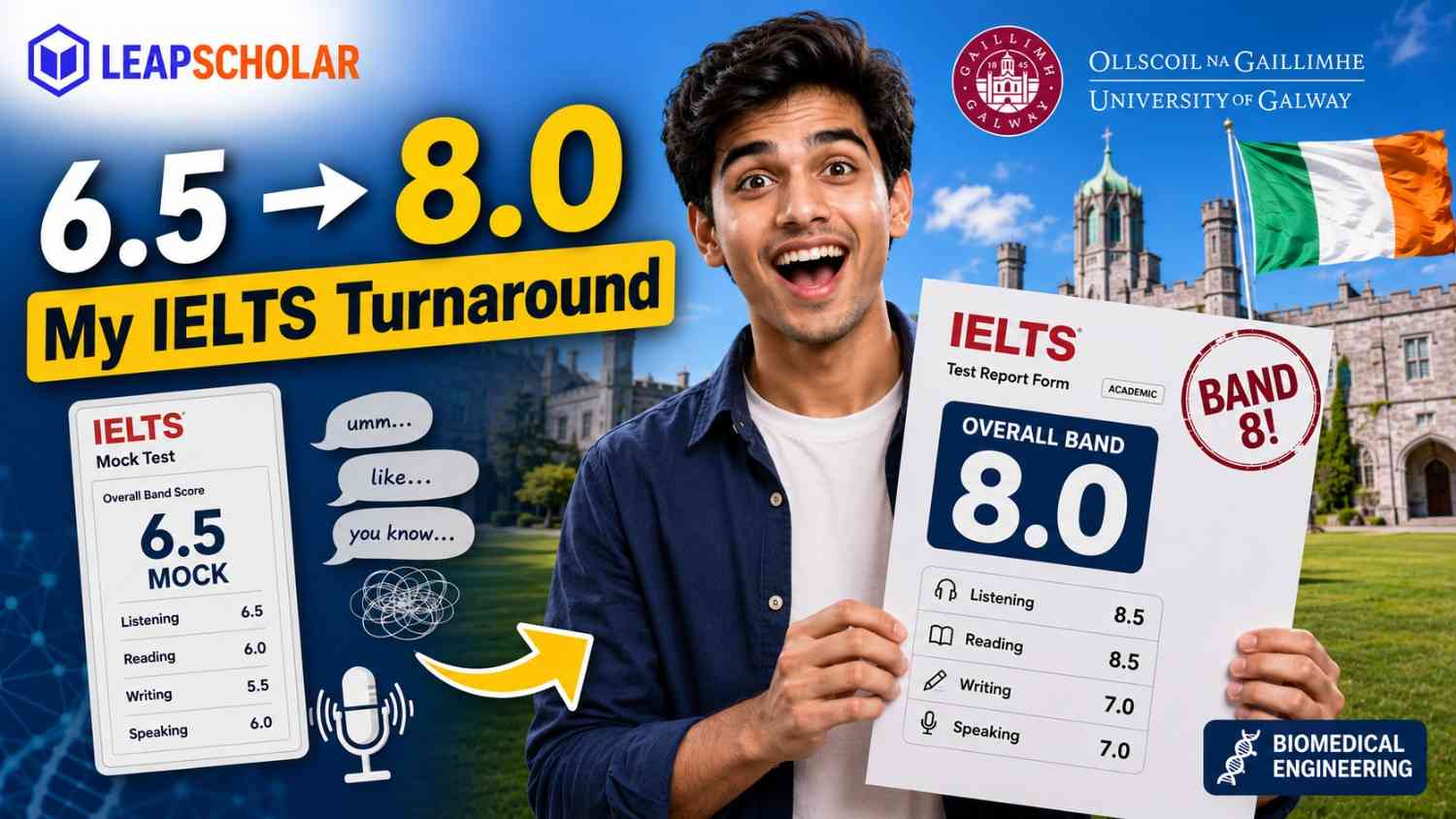
I'm a naturally talkative person, but my IELTS tutor's very first feedback on my speaking was that I had no structure, no coherence, and too many filler words. Here's my Leap Scholar review, in my own words, on turning that exact weakness into my strongest improvement and landing a biomedical engineering offer at University of Galway along the way.
Q1. Tell me a bit about yourself.
Hi everyone, I'm Rajnarayan Pai. I just finished my graduation last June from MIT Pune, where I did my B.Tech in bioengineering. I'm genuinely fascinated by engineering and human biology and medicine, which is why I chose a master's at University of Galway, an MSc in biomedical engineering. Outside of that, I'm a big reader, I love movies, and I play music, harmonium included, in my free time.
Q2. What was your biggest fear about the IELTS exam when you decided to study abroad?
Going abroad wasn't a hugely planned decision at first, but once I looked into the actual requirements, IELTS stood out as a near-universal necessity across universities. I was mainly afraid of the speaking section, since I genuinely worried I'd get nervous and end up speaking without any coherence or lean too heavily on filler words. Listening worried me too, mainly because of the range of accents involved and how tricky it can be to comprehend and answer correctly in real time.
Q3. How did your family react to your decision?
My parents supported me, though it was a genuinely mixed reaction. My father was a little skeptical, understandably, since this trip is my first time traveling somewhere and living away from them entirely. My mother, on the other hand, felt genuinely proud; she saw it as a chance for me to learn, gain a global perspective, and build real independence. So, mixed but supportive overall.
Q4. How did you first discover Leap Scholar?
I just googled study abroad and universities abroad, and Leap Scholar was the very first result. I went through their website and looked into how they actually structure IELTS teaching, and I was genuinely drawn in. The site made IELTS feel a lot more approachable, and their resources looked very close to what the real exam actually involves. Once I spoke to their counselors, the reassurance they gave me was exactly the confidence boost I needed to commit.
Q5. Did you use the free band prediction test or attend a free masterclass?
Yes to both. I attended their free IELTS masterclass and took the band prediction test, where I scored somewhere around 6.5 to 7. I knew that wouldn't be enough to really make an impact, so I decided to take the full classes and aim for an 8 or 9 band instead.
Q6. What other free resources did you use before joining the full course?
I used quite a few, but the one I genuinely loved was the daily vocabulary builder in Leap Scholar's IELTS app. Every day, I would get three to four new words along with their synonyms, and that alone made my preparation noticeably easier.
Q7. How was your experience with the AI speaking evaluation tool?
Immensely helpful, honestly. When you're nervous about speaking to a real person, knowing you're talking to an AI instead takes a lot of that pressure off, while still giving you accurate, specific feedback. I used it continuously for close to two weeks before my exam, and it's genuinely one of the more useful tools I've come across, since you can practice comfortably without feeling like you're being judged.
Q8. What made you move from the free resources to the full paid course?
The deciding factor was Leap Scholar's mock papers, which closely mirror the actual IELTS exam, including the sequence. Once you genuinely know what to expect and you've practiced against something that close to the real thing, you can perform noticeably better, and that level of preparation was really only available through the paid course.
Q9. What was your experience with the live classes like?
This was also my last semester of college, so flexibility mattered a lot to me, and I got exactly that. I took one-hour classes from 7 to 8 pm, and they were genuinely valuable; my tutor gave real one-on-one attention to each student. We covered one module per week, speaking one week and reading the next, so there was never any rush, and I had proper time to actually absorb and practice each skill.
Q10. Which IELTS section was the most challenging for you?
Speaking, honestly, despite the fact that I genuinely love talking. My tutor's feedback was direct: my sentences lacked structure, my thoughts lacked coherence, and I used far too many filler words. I was worried that exact pattern would show up on exam day and hurt my score. But between the constant coaching and feedback, exam day itself turned into a genuinely smooth experience.
Q11. Was there a specific tip from your coach that made a real difference?
There wasn't just one; honestly, several things helped. But the best advice she gave me was to watch many English movies and read as many books as possible. I'm already an avid reader, and I genuinely believe that once you build that habit, a lot of the fear around IELTS just disappears.
Q12. How did you feel after the exam compared to when you started preparing?
It's a genuinely mixed answer. The last two weeks before the exam were intense: lots of reading, lots of listening, the usual hectic pre-exam grind, especially since I tend to prepare closer to the deadline the way many engineers do. I was nervous on the actual day too. But during the exam itself, I noticed something important: the paper's pattern matched Leap Scholar's mock tests almost exactly, and that gave me a genuine edge. If you prepare properly with their support, I don't think there's much reason left to be nervous. It ended up being a genuinely positive experience.
Q13. What was your final IELTS score, and how did it compare to your prediction test?
My final score was an overall band of 8, with 8.5 in both reading and listening, and 7 in both writing and speaking. During my prep, my speaking mocks were sitting around 6 to 6.5, and the AI coach kept telling me exactly what to improve. I also had live speaking sessions with a coach who simulated the real IELTS speaking format, complete with direct feedback. I took all of that seriously and applied it, and I think that's exactly why my speaking band improved so significantly by the actual exam.
Q14. Which universities did you apply to, and what came of it?
I applied to Trinity College Dublin, University College Dublin, and University of Galway, all in Ireland. I got my admission from University of Galway and accepted their MSc in Biomedical Engineering offer. Their minimum IELTS requirement was around 6.5 to 7, and I think getting an 8 really helped my application.
Q15. How much did your IELTS score actually help with your admissions?
Quite a lot, honestly. A strong IELTS score gives the university real confidence that you can handle instruction in the language they teach in. Beyond admissions, I think it also signals to recruiters later that you're genuinely well-rounded across all four aspects of English communication, which reflects well on what you can bring to a team. And practically speaking, once you clear the minimum score a university sets, the whole admission process becomes noticeably smoother.
Q16. Would you recommend Leap Scholar's IELTS program to others?
Completely, and I have three specific reasons why. First, the mock tests are genuinely excellent; sitting for my real IELTS exam felt exactly like sitting for one of their mocks. Second, the class timing was completely flexible and never once clashed with my coursework. Third, the tutors gave real one-on-one attention and consistently encouraged active participation, which is exactly the kind of motivation students actually need. Because of all of that, I'd recommend Leap Scholar to anyone prepping for IELTS or planning to study abroad.
From a 6.5 mock score and a genuine fear of rambling through the speaking section to an overall band of 8 and a biomedical engineering offer in Ireland, this journey is proof that your biggest weakness going in can become your strongest section by exam day, with the right coaching behind it. For anyone nervous about speaking specifically or weighing Ireland for their masters, this Leap Scholar review is worth reading in full.

Kirti Singhal
Kirti is an experienced content writer with 4 years in the study abroad industry, dedicated to helping students navigate their journey to international education. With a deep understanding of global education systems and the application process, Kirti creates informative and inspiring content that empowers students to achieve their dreams of studying abroad.
Users also read

From Pune to Coventry: How Warwick Business School Helped Gaurav Pivot from Software Engineering to Product Management at Chase

From HR in India to Quant Analyst in New York: How Carnegie Mellon Helped Tapasya Reinvent Her Career

Leap Scholar Review: A Rejection First, Then Eight Offers Out of Eleven Applications