Blogs
Blogs  Leap Digest
  Events
  About Us
 Student Reviews
Leap Scholar Review: Rejected by One Agency, Admitted to My Dream University With Another
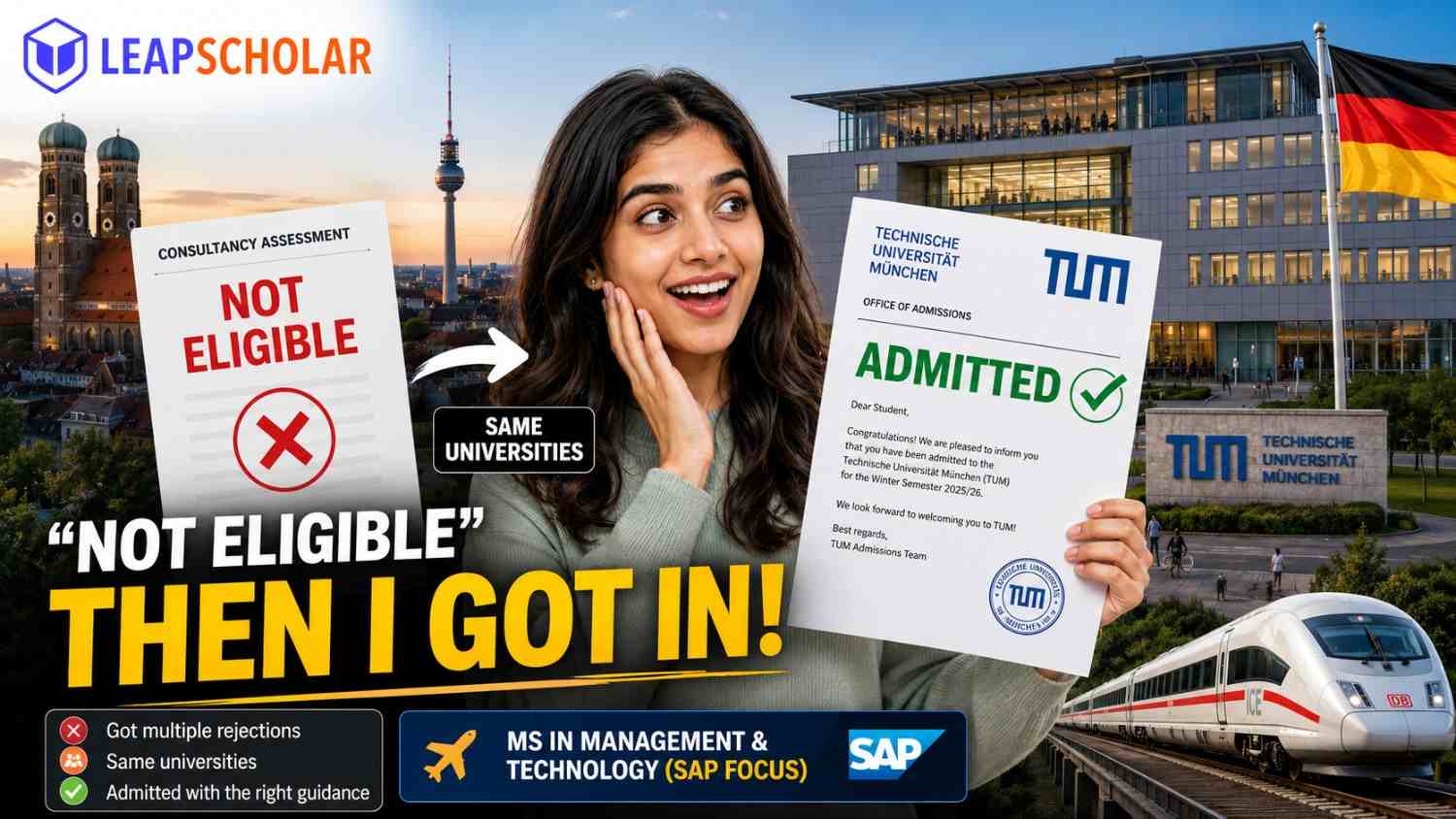
Before I ever spoke to Leap Scholar, another consultancy told me flatly that I wasn't eligible for a single one of the five or six German universities I'd shortlisted. Today I'm admitted to one of those exact universities. Here's my Leap Scholar review, in my own words, about shifting away from a US dream and how the right agency can really help.
Q1. Tell me a bit about yourself.
Hi everyone, good morning. I'm Yashaswini R. I did my bachelor's in computer science and engineering, and right after graduation I was shortlisted for Deloitte Consulting. I've got around three years of work experience there in the SAP project management domain, and I'm currently pursuing my masters in business consulting at a public university in Germany.
Q2. How did this whole journey actually begin?
It really started once I began working professionally. I was with Deloitte US India, supporting US clients directly, and the exposure I got there was genuinely invaluable, seeing how they worked and the kind of projects involved. Once I got tagged onto consulting projects, working through two or three of them, I was able to figure out exactly where I wanted to take my career. That's when I decided I needed to pursue my masters in a specific technical domain that would add real value to my future profile.
Q3. Which country and university did you end up choosing?
Initially I was targeting US universities as my first priority. But given the market slowdown and the visa issues happening there right now, I had to weigh things very carefully. Germany was my second priority, and after going through every pro and con I could think of, it was a genuinely hard decision to settle for that second choice. I'm in Germany now, pursuing my masters there.
Q4. How did you land on your specific course?
The project exposure I got at Deloitte was the main reason. I was tagged onto supply chain and SAP-based software projects, and Germany is essentially the origin country for SAP itself, so that became the deciding factor. I made the call myself that I wanted to build my career specifically in supply chain and SAP, on a more functional consultant path. My bachelor's was a pure computer science technical degree, but once I started working on real implementation projects, I realized I needed industry-relevant skills specifically in supply chain and SAP modules. That's why I specifically targeted public universities in Germany offering those courses.
Q5. How did you first come across Leap Scholar?
Honestly, I was already working full time, so I knew managing my job alongside this entire process would be genuinely difficult without some kind of agency support. I first went with a local consultancy in my hometown. I had already shortlisted five or six German public universities, but the first thing they told me was that I wasn't eligible for any of them. Today, I'm actually admitted to one of those exact universities, and that happened because of Leap Scholar. What struck me most was how differently they worked. I told them exactly which universities I wanted, and I just needed help pushing my applications forward with those specific choices. They never once told me to target different universities; instead, they just supported the goals I already had.
Q6. Walk me through the application process itself.
The very first requirement was APS certification, which is compulsory if you're applying to European countries for a masters. Once I had that sorted, I had to prepare for IELTS, and I actually took Leap Scholar's own IELTS coaching for it, which genuinely helped me crack the exam. Their consultants also gave me a set of structured questionnaires specifically to help draft my professional and academic letters of recommendation. Once I filled those out, they turned them into properly polished LORs. After my IELTS results came in, I started actually applying to German public universities. So really, it's APS, IELTS, and strong personal and professional LORs; that's the core of it.
[Editor's note: Germany's APS process has recently been updated. From the Summer 2027 intake onward, selected Master's applicants from India in certain fields, including engineering, may need to complete the new Digital Master Test (dMAT) as part of their APS documentation. Students should check the latest APS India requirements before applying.]
Q7. How do you feel about Germany's free public university system?
The quality of education here is genuinely excellent, and I heard the same thing from seniors before I even arrived. Germany is particularly impressive, especially when compared to countries with high tuition fees. Public universities here offer free education, which is a huge advantage, though the competition to actually get a seat is intense. I applied to a public university and managed to get a free seat, which honestly reminded me of how competitive our engineering and medical entrance exams used to feel back home. Beyond that, Germany's economy is genuinely strong too, second in the world after the US in terms of revenue and overall economic standing, from what I understand.
Q8. What were the biggest challenges you faced, and how did Leap Scholar help?
The language barrier was definitely a challenge, especially early on. A lot of university websites exist in both German and English, and as a beginner, it's genuinely confusing figuring out which page is leading you where. Beyond that, Germany expects every single document in your application to be exact, down to the format. Miss one document, or get the format even slightly wrong, and you genuinely risk rejection without much warning. I actually had to send physical, postal copies of my documents, my grade sheets, and my LORs directly to the university, a requirement that varies from one university to the next. I initially missed that requirement entirely, and if Leap Scholar's consultants hadn't caught it and told me directly, I genuinely don't think I would have gotten admitted here at all.
Q9. Did that delay cause other problems?
It did, actually. Because my physical documents went out late, my results were also delayed. Some programs start as early as March, with results coming out around January, so the timeline is genuinely tight. On top of that, the visa process itself has changed in just the last year or so; it used to be a fairly direct application, but now it goes through a specific portal with very strict formatting requirements. Without someone who genuinely knows the exact process from end to end, that part alone is difficult to get right.
Q10. What was the toughest part of your application, and what was your strongest point?
A lot of programs here, especially the more managerial or techno-functional ones rather than purely technical degrees, require a minimum of one to two years of work experience, which I had covered thanks to my time at Deloitte. Drafting my SOP was genuinely new territory for me, weaving together everything from my 10th grade marks through my bachelor's, plus all my professional experience, into one cohesive story. But the single most challenging moment was that postal document requirement I nearly missed entirely. If Leap Scholar's consultants hadn't flagged it in time, I wouldn't be here.
Q11. How did you manage your finances, especially with accommodation?
My advice to anyone targeting German universities is to apply for student dorms early; they're genuinely much cheaper than searching for private accommodation. There's also something called a block account here, where you deposit a full year's living expenses upfront, but you can only withdraw up to 1,000 euros a month from it. Rent ends up being the biggest expense. But if you plan your regular spending carefully, groceries and everything else included, you can actually save up to 400 euros a month, and that adds up month over month.
Q12. Would you recommend Leap Scholar to others?
Absolutely, without hesitation. Since I'd already been through that rejection from a different local agency, and their very first response was basically that my educational background didn't match any of my target degrees, Leap Scholar genuinely stood out. I never once heard a negative or discouraging comment from them. The other thing I really noticed is that many consultancies tend to push students toward pricier private universities, but Leap Scholar never once tried to redirect me away from my goal of a public university seat, even though that would have been the easier or more profitable path for them to push. Their response times were genuinely fast too, though I did have to follow up myself on some things, like tracking exact application deadlines, since those vary a lot by university and intake; some only take summer intakes, some only winter, and some both. Overall, from the moment I started shortlisting universities right through to the day I actually received my visa, Leap Scholar stayed in contact with me, and it was a genuinely smooth experience.
From a rejection that closed every door to a public university seat she got into for free, this journey is a reminder that the agency you choose can matter just as much as the profile you bring to the table. This Leap Scholar review is worth reading in full for anyone considering Germany instead of a US plan that has become more difficult or feeling anxious about a previous rejection.

Kirti Singhal
Kirti is an experienced content writer with 4 years in the study abroad industry, dedicated to helping students navigate their journey to international education. With a deep understanding of global education systems and the application process, Kirti creates informative and inspiring content that empowers students to achieve their dreams of studying abroad.
Users also read

From a Small City in India to Bavaria: How Arjun Patil Built a Career and an MBA Sponsorship in Germany

Leap Scholar Review: My Father Wanted Me in the Family Business. I Chose a Masters in the UK Instead.

Leap Scholar Review: Going Back to School After Fifteen Years in the Industry