Blogs
Blogs  Leap Digest
  Events
  About Us
 Student Reviews
Leap Scholar Review: We Applied to Four Universities on Purpose, Not by Accident
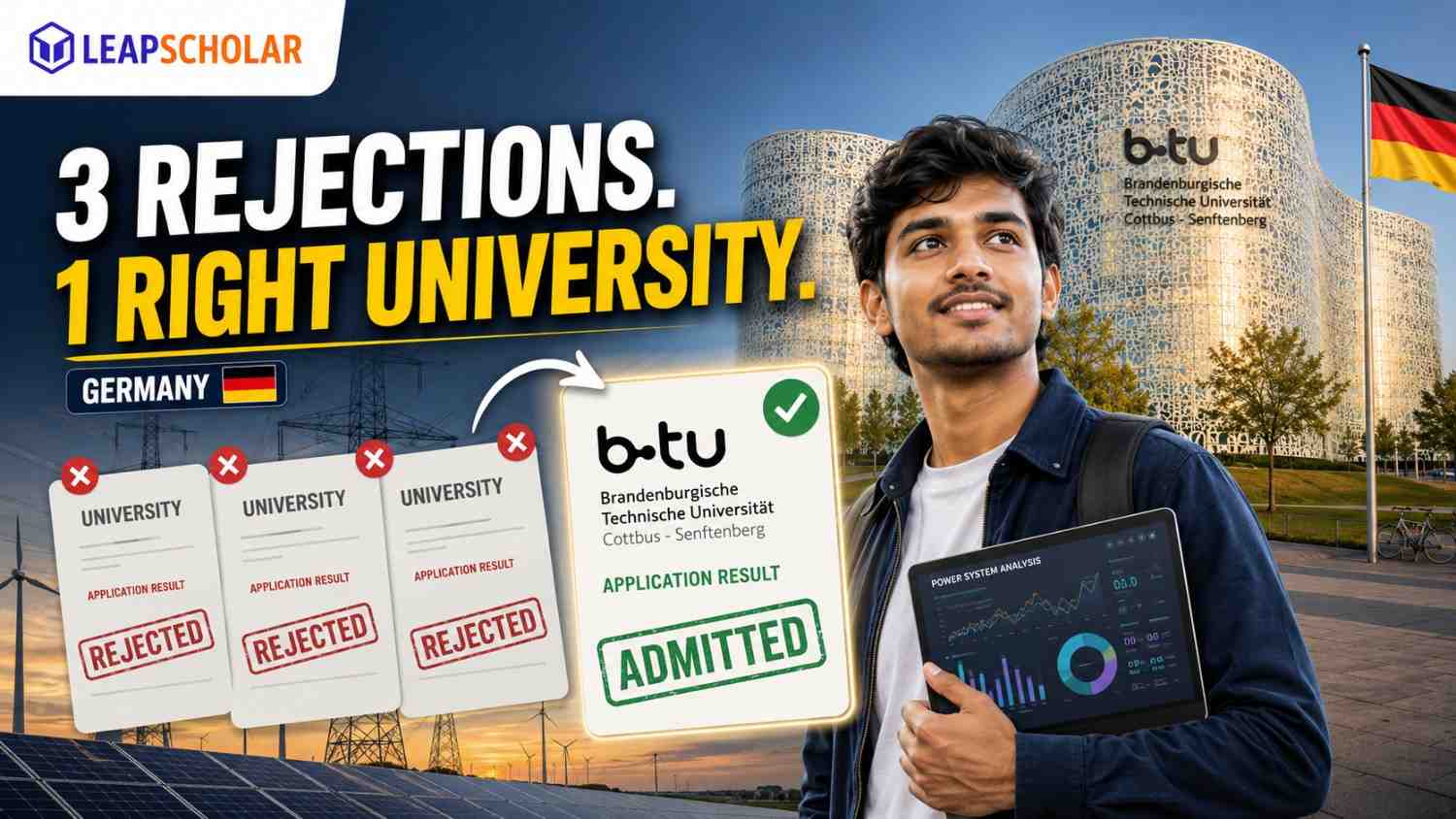
I never actually planned to move abroad. Here's my Leap Scholar review, in my own words, on how a conversation with classmates about India's limited scope for electrical engineers turned into a deliberate, focused application strategy that got me into a technical university in Germany after three rejections from the same set of applications.
Q1. Tell me a bit about yourself.
Sure. I'm Guru Rishi, from Nellore in Andhra Pradesh. I completed my graduation in 2024 in Electrical and Electronics Engineering from Narayana Engineering College. Beyond engineering, I've always wanted to move into power engineering and renewable energy specifically, though I'm equally passionate about entrepreneurship, and I've worked as a co-founder and business associate with a couple of EdTech platforms alongside that.
Q2. When did the idea of going abroad actually start for you?
Honestly, I was never that person planning to move to Germany or anywhere else internationally. But while I was studying electrical engineering, some genuinely important conversations came up with my colleagues and faculty. The scope for electrical engineering, specifically in India, is quite limited; many people from the same course end up as software developers instead of staying in the field they actually studied. Around that time, a friend and I started discussing how countries like Germany, Japan, and the USA had much stronger policies around this specific field. That's really where the idea took root, back at the graduation level itself.
Q3. Did you consider countries other than Germany?
Yes, I had four options in mind initially: Japan, Germany, USA, and UK. Through my own research, I ruled out the US and UK fairly quickly, since their focus areas felt inconsistent with what I wanted. The US is closely tied to Silicon Valley and tech, and the UK leans heavily toward finance, commercialization, and management rather than power engineering. Germany, Japan, Sweden, and Norway, on the other hand, have been deeply invested in the automobile industry, power engineering, and advanced technical systems since the 1990s. That history is exactly why I settled on Germany.
Q4. Why a public university specifically?
Mostly for economic reasons. I'm not someone who was chasing international studies for the sake of it, and cost genuinely matters a lot for Indian students weighing this decision. Once I calculated everything, Germany and Japan stood out as the most sensible choices, and I chose a public university, Brandenburg Technical University, for a two-year power engineering course.
Q5. Why do you think choosing the right degree matters so much?
Looking back at my own life, a lot of it has actually been fairly linear. You make a real choice after 10th grade, another after that in engineering, and from there your options narrow considerably. I have some computer science exposure through my engineering coursework, but the actual career scope there is completely different from my core domain. Choosing the right degree genuinely shapes your entire life, since you're constantly balancing your personal space and your professional space, and neither is easy to predict, especially now, with so much uncertainty around AI reshaping entire job markets. If I, as an electrical engineer, had picked a purely computer-science-focused master's, I'd genuinely fall behind people who specialized in that from the start. It makes more sense to integrate new technology into your existing domain than to abandon that domain entirely.
Q6. How did you first come across Leap Scholar?
I'm not particularly active on social media, but while researching countries online, an ad came up for a Leap Scholar course priced at just 99 rupees. That price alone made it an easy decision to enroll. After finishing that, their team briefed me on their full IELTS training program, and I decided to take their premium IELTS package. Later, a different person from Leap Scholar reached out specifically about which country I was targeting, and that's when I moved into their complete package, covering language, SOP, university selection, and end-to-end support, rather than just one isolated product. I've been with them continuously since around November 2025.
Q7. How did your university shortlisting actually go, and why Germany's public system specifically?
While researching, I learned Germany has three distinct categories of universities: Technical Universities, Hochschule, and Applied Sciences institutions, and these aren't just naming differences; they carry genuinely different academic weight. Get that mismatch wrong, and you can lose a significant amount of time. My counselor, Sarita, and I researched together and deliberately narrowed things down to just four universities. I genuinely appreciated that Leap Scholar didn't push me to apply to ten or twenty universities the way some other consultancies reportedly do, each additional application costs somewhere between 30 and 35 euros in fees, plus real time. Of our four, three were Applied Sciences universities and one was a Technical University, BTU. BTU accepted me. All three Applied Sciences applications were rejected.
Q8. Why do you think the Applied Sciences applications got rejected?
I actually asked Sarita that directly. She explained that Germany's admissions process has genuinely tightened recently, degree title requirements have shifted, and profile scrutiny has gotten stricter overall compared to how things used to work. In my case, the Applied Sciences universities seemed to reject me largely based on my degree title alone, without digging deeper into my full profile. BTU, the Technical University, went through my entire profile carefully, and it actually took them two to three months just to reach a decision. Looking back, I think Leap Scholar genuinely got me the one application that fit my actual profile well, even with the other three rejections along the way.
Q9. Can you walk me through the broader application process, step by step?
There were really five stages I went through. First, German language training, since Germany isn't an English-speaking country, and I started that around February or March, right after my IELTS prep. Second, IELTS training itself. Third, APS certification, a mandatory academic verification step for Indian students applying to Germany. Fourth, the university applications themselves, running in parallel with the above. And fifth, the visa process and college enrollment. Along the way, Leap Scholar also guided me through financial assistance since I took an education loan and supported me with SOPs, LORs, and my resume at multiple distinct points: for APS certification, for the university applications, and again for the bank and loan process.
Q10. What was the most difficult part of this whole process?
Honestly, patience, more than anything specific to Leap Scholar itself. Once you're actually in the country or you've picked your college, the harder part is behind you, but getting there is a different story. As someone going abroad for the first time, every step genuinely felt tense, and I couldn't afford to fall behind on anything. The real challenge is that Germany's timeline moves nothing like the US or UK, where you often hear back within weeks. In Germany, it can take weeks and months, and from my own research and from other people going through similar processes, some wait close to a year for a single decision. What Leap Scholar genuinely helped with was making sure my applications and SOPs were done correctly the first time, avoiding the kind of self-inflicted delays that come from a poorly prepared application. That's the one part of the timeline they could actually influence.
Q11. Did Leap Scholar keep you updated throughout?
Yes, consistently, through emails and notifications. I had a dedicated relationship manager along with my counselor, and different people supported me across different segments of the process, financial, application, and visa, each feeding me the relevant updates for their specific piece.
From four universities chosen with genuine intention rather than a scattershot approach to three rejections that turned out to be about profile fit rather than personal failure, this journey is a reminder that a focused, well-researched application strategy can matter as much as the application itself. For anyone weighing Germany's academic tiers or bracing for a longer wait than they expected, this Leap Scholar review is worth reading closely.

Kirti Singhal
Kirti is an experienced content writer with 4 years in the study abroad industry, dedicated to helping students navigate their journey to international education. With a deep understanding of global education systems and the application process, Kirti creates informative and inspiring content that empowers students to achieve their dreams of studying abroad.
Users also read

From a Small City in India to Bavaria: How Arjun Patil Built a Career and an MBA Sponsorship in Germany

Leap Scholar Review: My Father Wanted Me in the Family Business. I Chose a Masters in the UK Instead.

Leap Scholar Review: Going Back to School After Fifteen Years in the Industry