


 Blogs
Blogs  Leap Digest
  Events
  About Us
 Student Reviews
Leap Scholar Review: I Didn't Even Know IELTS Cost 18,000 Rupees Until I Started
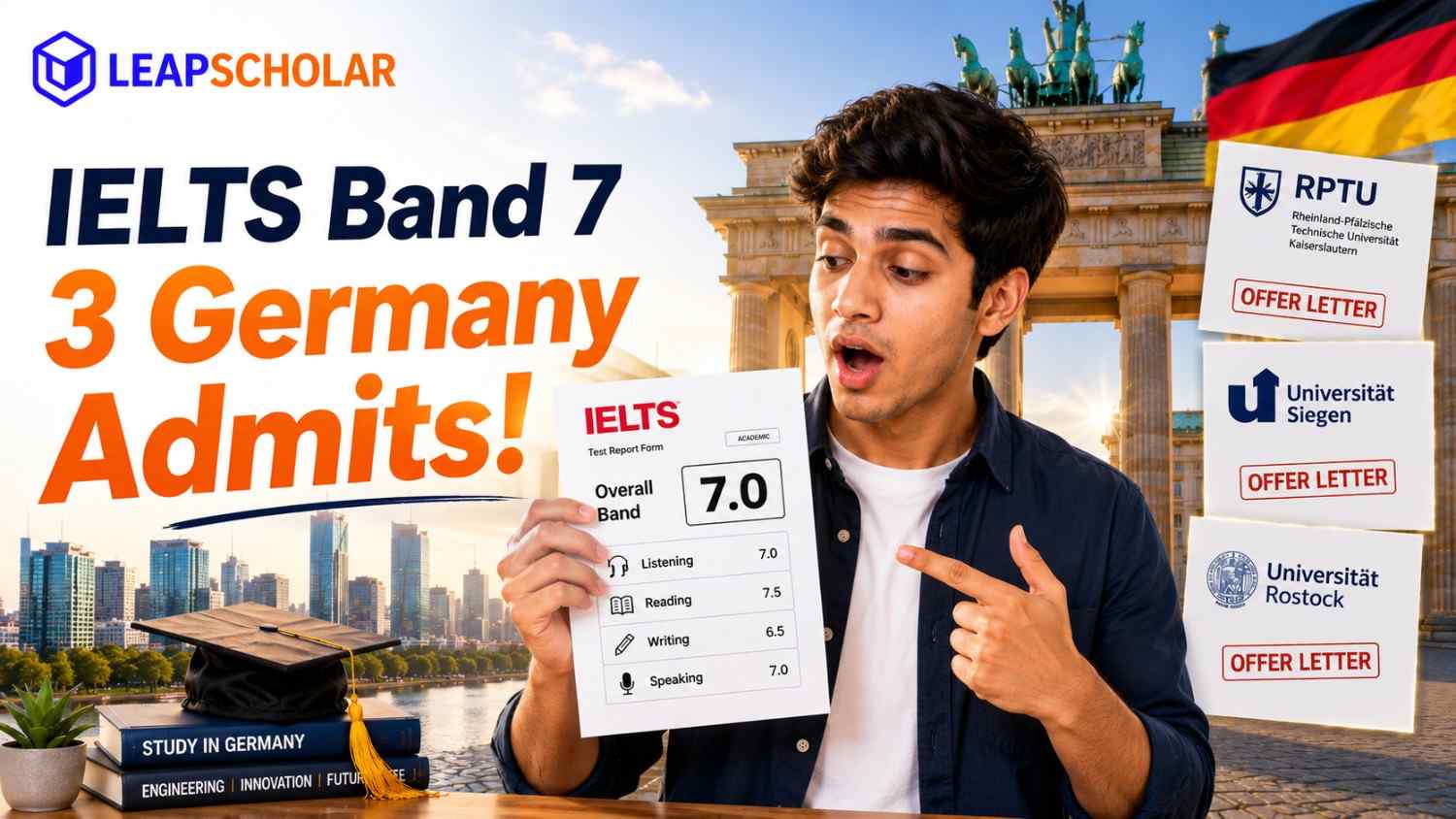
I finished my computer science degree in 2025, wanting to do hardcore research, and the first real shock of this whole journey wasn't the exam itself; it was finding out what it cost. Here's my Leap Scholar review, in my own words, on going from that surprise to an IELTS band of 7 and three offer letters from Germany.
Q1. Tell me a bit about yourself.
My name is Aman Kumar Singh. I'm 23, and I completed my bachelor's in computer science and engineering from Guru Gobind Singh Indraprastha University. I currently live in Great Noida, in Uttar Pradesh.
Q2. Why did you decide to go abroad for your studies instead of staying in India?
I finished my graduation last year, in 2025, and right after that I started looking into masters options. I specifically wanted to get into hardcore research, and through that search I learned that foreign universities are genuinely better suited for research, especially in computer science and artificial intelligence.
Q3. What were your expectations going into IELTS preparation?
Honestly, I had zero experience and no real idea how any of this worked. The first real shock came when I found out the exam itself costs around ₹18,000. I genuinely didn't know an exam could cost that much. But I prepared for it anyway, and the rest is history at this point.
Q4. How did you first hear about Leap Scholar?
I was looking for consultation services while planning to go abroad, and I first came across a company called Yocket. I enrolled with them, and they're actually the ones who told me about Leap Scholar and their IELTS preparation services. That's how I ended up opting for Leap Scholar's course.
Q5. Did you use any free tools before actually purchasing the course?
Yes, both before and after buying the course, actually. There's a free app on the Google Play Store and iOS specifically for IELTS prep, and I used it a lot for writing practice.
Q6. How did the free AI tools compare to what Leap Scholar offered?
Honestly, some free AI features exist out there, but they weren't nearly as accurate, and the predictions definitely weren't as reliable as what Leap Scholar gave me.
Q7. What did the actual paid course include?
I got a dashboard with free speaking evaluations built in. The course itself ran for a month, split into four weeks, with each week dedicated to one module: speaking, reading, writing, and listening. Beyond that, there were section-wise tests, module-wise tests, full replica tests, and face-to-face speaking sessions. All of it genuinely helped.
Q8. What was the class experience like?
One of the best parts for me was the class size, never more than 15 students. That meant the teachers could actually give us personal attention, interact with each of us individually, and guide us on our own specific habits and weak points. The whole experience was genuinely engaging.
Q9. Which module gave you the most trouble?
At the start of my prep, listening was the tough one; the audio felt really fast at first. But as I practiced more and went through more modules, it got noticeably easier. On the actual exam day, though, writing is where I felt I underperformed, mostly because it came last in the exam and I was genuinely exhausted by that point.
Q10. Any specific tips for listening?
Two things, really. Practice is everything, and you need full, undivided attention on the words being spoken. If you can, practice in a quiet space away from distractions, since that's exactly the kind of environment you'll actually be tested in.
Q11. How were you feeling on the actual exam day?
I was genuinely confident going in. I got there about an hour to an hour and a half early, but there's a strict rule that you can't be let in before your scheduled time. That waiting period made me anxious, more than I expected it to.
Q12. Walk me through what actually happens inside the exam center.
You wait in the lobby first, then someone comes to take your biometrics and do a face recognition check. After that, you're moved to a waiting room for about 10 to 15 minutes while your speaking session gets set up. Once called in, you're given clear instructions on what to do and what not to do for the speaking round. After speaking, there's a break of anywhere from 20 minutes to an hour, and then you go back in and complete the remaining sections, reading, writing, and listening, all in one sitting.
Q13. How did your family react to your decision to study abroad?
They were very supportive. My father specifically comes from a similar background, a Bachelor of Computer Applications, so he understood exactly why research-oriented studies abroad would genuinely benefit me.
Q14. What score did you end up getting?
My overall band score was 7.
Q15. Which country are you targeting, and why?
Germany, specifically. There are two or three real reasons for that. First, the quality of education there is genuinely strong. Second, Germany has public universities that offer tuition-free education to all students.
Q16. Did you apply to universities, and how did that go?
Yes, I applied to somewhere between seven and ten universities in Germany, and I've received offer letters from three so far: RPTU Kaiserslautern, University of Siegen, and University of Rostock.
Q17. Did you apply before or after your IELTS exam?
After, definitely. Most universities around the world require proof of English proficiency, and in my case, nearly every university I applied to specifically demanded an IELTS or TOEFL certificate. There's another catch: most require that certificate to be no older than one year at the time of application.
Q18. What's the one thing you'd tell anyone planning to study abroad?
From my experience, language is the one thing students commonly overlook. In Germany specifically, universities accept IELTS for English proficiency, but almost all of them also require you to get a German language certificate, usually within one year of starting your program. That requirement can be met either through official language exams or through language teaching programs offered directly by the university itself.
Q19. Would you recommend Leap Scholar to others?
Absolutely, I already am. I've told two or three of my friends who are planning to move to Germany or other countries in 2027 that I used Leap Scholar and that their services are genuinely good.
From being shocked by an exam fee he didn't expect to holding three university offers from Germany, this journey is a reminder that the biggest surprises in this process aren't always academic; sometimes it's the practical details, cost, timing, and language requirements that catch people off guard. For anyone eyeing Germany or nervous about their weakest IELTS module, this Leap Scholar review is worth reading closely.

Kirti Singhal
Kirti is an experienced content writer with 4 years in the study abroad industry, dedicated to helping students navigate their journey to international education. With a deep understanding of global education systems and the application process, Kirti creates informative and inspiring content that empowers students to achieve their dreams of studying abroad.
Users also read

Leap Scholar Review: Choosing Dubai for an AI Masters, No Backup Plan Needed

Leap Scholar Review: Five Offers, Two Confused Course Choices, and a 40 Percent Scholarship I Didn't Expect

Leap Scholar Review: My Visa Got Rejected Once. This Time, I Chose My Counselor Carefully