Blogs
Blogs  Leap Digest
  Events
  About Us
 Student Reviews
From West Bengal to Bavaria: How FAU Erlangen-Nürnberg Turned Abhik Sarkar's Germany Dream into a Career at Siemens
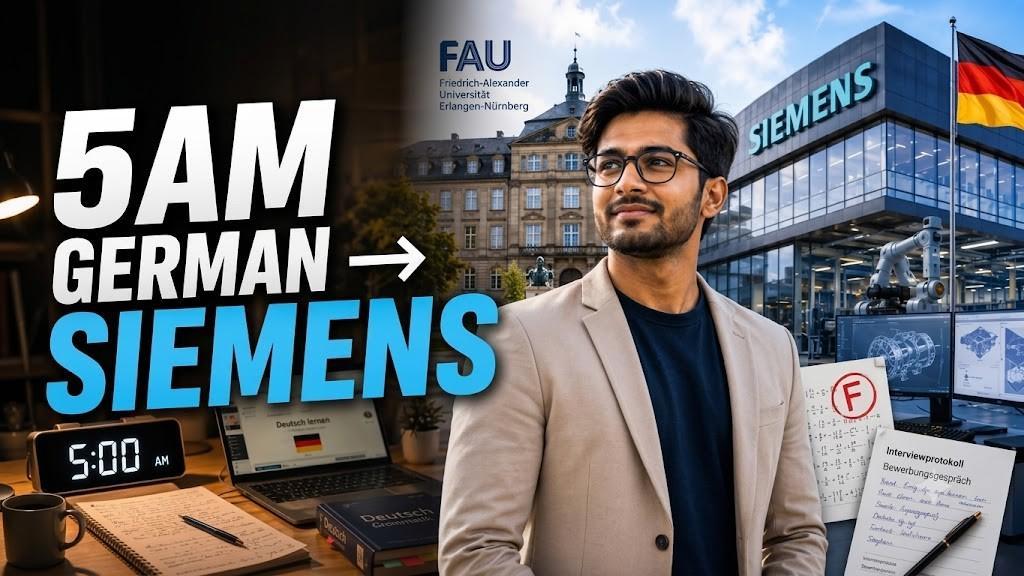
Abhik Sarkar's journey from a mechanical engineer in India to an engineer at Siemens in Erlangen, Germany, started with a goal he had already set for himself before moving abroad. After completing his engineering degree and gaining two years of work experience in India, along with an internship at Siemens, he decided to pursue a Master's in Computational Engineering at Friedrich-Alexander-Universität Erlangen-Nürnberg (FAU). Germany was his only choice, and he self-funded the entire move without taking a loan. His path wasn't without setbacks: a Siemens job offer he had secured was rescinded during COVID, and during his Master's, he failed a mathematics course along with around 90% of his class in the first semester. He eventually adapted to the German way of studying and made learning the language a priority, waking up at 5am for nearly nine months to prepare for interviews. That effort paid off when he secured his current role at Siemens, where he interviewed entirely in German and now works in the same city where the company has several of its global headquarters.
For Abhik, studying in Germany was closely tied to the career he had wanted to build from the beginning. From dealing with the academic differences he encountered at FAU to learning German well enough to interview for a job, his experience showed him that settling into life in Germany required more than just completing a degree.
Abhik's Journey at a Glance
- From: India
- Background: Mechanical Engineer with 2 years of work experience + Siemens internship
- Course: Master's in Computational Engineering, FAU Erlangen-Nürnberg
- Decision: Chose Germany as his only study-abroad destination and self-funded the move
- Setback: Siemens job offer was rescinded during COVID; failed a mathematics course in his first semester
- Language: Learned German through a disciplined 5am routine for nearly nine months
- Now: Engineer at Siemens, Erlangen
Here's Abhik, in his own words.
Q. What made you want to study abroad in the first place?
It started back in my second or third year of my bachelor's. I kept watching lectures and content from students studying outside India, and I noticed something I was missing in my education, actually understanding the reasoning behind what I was learning, not just doing the calculations. I was studying mathematics but never really grasping where or why I'd apply it. Watching how people studied abroad genuinely fascinated me, and that curiosity slowly turned into a real intention to go explore it myself.
Q. Why did you choose Germany specifically, with no other countries on your list?
Honestly, there wasn't much of a decision process. I did my bachelor's in mechanical engineering, and for a mechanical engineer, Germany is something of a dream destination. There was also a very practical reason: Germany doesn't charge significant tuition; you set up a blocked account and study, which made it financially very stable for me. I'd worked for two years before moving, so I funded the entire move myself. I never took a single loan and never had to ask my parents for money.
Q. What pulled you toward FAU and the city of Erlangen in particular?
Erlangen is the birthplace of Siemens Healthineers, and Siemens' headquarters for a few of its divisions sit right there too. Eighteen kilometers away is Herzogenaurach, headquarters to Adidas and Puma. I'd done an internship at Siemens in India and had even received a job offer from them, but it got rescinded during COVID layoffs. That stayed with me. When I came to Germany, my first real goal was to eventually work at Siemens, so choosing a university in the same city as their offices was a deliberate decision.
Q. How did the application process go?
I applied to five universities and got into three or four of them; one was a rejection, which happened to be my actual first choice. What helped, I think, was how I approached my statement of purpose. I shared drafts with professors, relatives who'd studied abroad, and anyone who could give me honest feedback; took it all in; and kept refining it until the version I submitted was one everyone genuinely liked. I remember the night I got my FAU acceptance clearly. I actually called in sick to work that day just to celebrate properly with a lovely dinner with my parents.
Q. What was it like landing in Germany for the first time?
Genuinely disorienting. I landed in Frankfurt and spent my first night near the main railway station, Frankfurt Hauptbahnhof, which has a reputation of its own; a lot of people are just visibly out of it in that area. It was such a strange first impression that I remember thinking, maybe this wasn't the right decision. The next day I traveled to the Erlangen and Nuremberg region in Bavaria, and it was the complete opposite, dead silent. The silence in Bavaria was genuinely hard to process for the first few days, especially coming from India, where there is always some noise, like a horn, a fan, or something.
Q. Your first semester sounds like it was rough academically.
It really was. Ninety percent of my class failed one of the maths courses, myself included, which had never happened to me before. The issue was the style. Indian maths education leans heavily on numerical calculation, while German exams asked purely theoretical proof questions, like "Define a unitary matrix" or "Prove this equals that," nothing like what I was used to. I started that first semester just following the crowd into courses everyone else was taking, without really thinking about whether they suited me. From the second semester onward, I moved away from that, picked subjects I actually cared about, especially visual computing, which is what I eventually did my thesis in, and things improved from there. I ended up extending the program by two semesters overall, which is fairly normal here and actually gives you more time to gain real work experience alongside your studies.
Q. How did you land your working student role at Siemens?
I applied to multiple positions across different departments and eventually got an interview for a role in a completely different department than the one I'd originally imagined myself in. It was still Siemens, though, which was the goal. What made the interview memorable is that I did it entirely in German. The interviewer wasn't fully comfortable speaking English herself, so being able to hold the conversation in German genuinely worked in my favor; I think it earned me some real credit going in.
Q. How did you get your German to a level good enough to interview in it?
That took real discipline. In 2025 I set myself a goal, mainly because I'd joined a volleyball club and most of my teammates didn't speak much English, to reach B2-level German within six months. I took an online German course through India since it was cheaper, and because my days were already packed with my thesis and coursework, I woke up at 5am Germany time, which is around 8 or 9am in India, and studied for two hours every single day. I kept that up for about eight or nine months. It completely changed things for me. Once you can actually speak the language and do sports or social activities with German people, everything shifts; before that, conversations around you just sound like noise.
Q. Were there other habits like that goal-setting routine?
Yes, it's something I've kept up consistently. Every six months I write down a few things I want to achieve, not just academically, on a board I still have at home. Learning to swim is one example; I couldn't swim at the start of one such cycle and was swimming properly within about three months of joining a course. If I hit the goal, I reward myself; if I don't, I just carry it forward. The German B2 goal was one of the biggest ones I've completed this way.
Q. How did you find accommodation and community when you first arrived?
Getting student housing as a master's student in Bavaria is genuinely difficult; I applied hundreds of times before securing a spot, which even my peers were envious of, partly because it's affordable too. Before that, I spent my first five days in an Airbnb with no fixed place to stay. What really helped was a platform called Yocket, where I connected with other students heading to the same program even before I left India. I found several close friends and eventually flatmates through it.
Q. What's the biggest cultural difference you've noticed in how people work?
The recognition and the pressure, mostly. In India, I remember constantly dreading the next workday, always under deadline pressure, rarely getting credit for anything genuinely new or innovative. Here, even small achievements get acknowledged, sometimes by my manager's manager directly, and that recognition makes us want to put in more, not less. I now work long hours sometimes simply because I enjoy the work, not because anyone is pushing me to. My managers here have actively told me to take holidays I hadn't used, and one even encourages working remotely from a different country for a month if I want to.
Q. What's something you had to learn the hard way after moving?
Cooking, mainly. I survived almost entirely on pasta and oats for six to eight months, not out of laziness; I was just coming back from the library too late most nights to cook properly. On that note, I'd genuinely recommend anyone moving to Germany to make use of the libraries here; they're excellent, and they end up being the real social hub. Most of my closest friendships came from studying together in the library, not from sitting in lectures, which very few people actually attend once the semester gets going.
Q. How did your parents react to your decision to move abroad?
They were uncertain at first and asked the usual questions about what would happen next, whether I would come back, and that sort of thing. But they supported me fully through the entire process; they even helped me prepare for my GRE. Once I got my offer, they were genuinely thrilled; we celebrated with a proper family dinner that night.
Q. Do you see yourself moving back to India eventually?
Honestly, the only thing that would bring me back is my parents. I'm their only child, so that's really the one variable that matters. They're happy because I'm happy here, so it isn't a pressing conversation right now, but I know it's something that could shift the calculation down the line.
Q. Looking back, what's the best decision you've made in this whole journey?
Coming to Germany, without question. I'd actually lost momentum on the plan after COVID hit during my final year, until a relative going through his frustrations with work happened to ask me one evening why I wasn't pursuing it anymore. That conversation reignited something I'd already been thinking about quietly, and I picked the plan back up from there. I'm genuinely grateful I did; both the master's and the career that followed have worked out better than I expected.
Kirti Singhal
Kirti is an experienced content writer with 4 years in the study abroad industry, dedicated to helping students navigate their journey to international education. With a deep understanding of global education systems and the application process, Kirti creates informative and inspiring content that empowers students to achieve their dreams of studying abroad.
Users also read

From a Small City in India to Bavaria: How Arjun Patil Built a Career and an MBA Sponsorship in Germany

Leap Scholar Review: My Father Wanted Me in the Family Business. I Chose a Masters in the UK Instead.

Leap Scholar Review: Going Back to School After Fifteen Years in the Industry