


 Blogs
Blogs  Leap Digest
  Events
  About Us
 Student Reviews
Leap Scholar Review: When Plan A Doesn't Work, Plan B Was Already Waiting
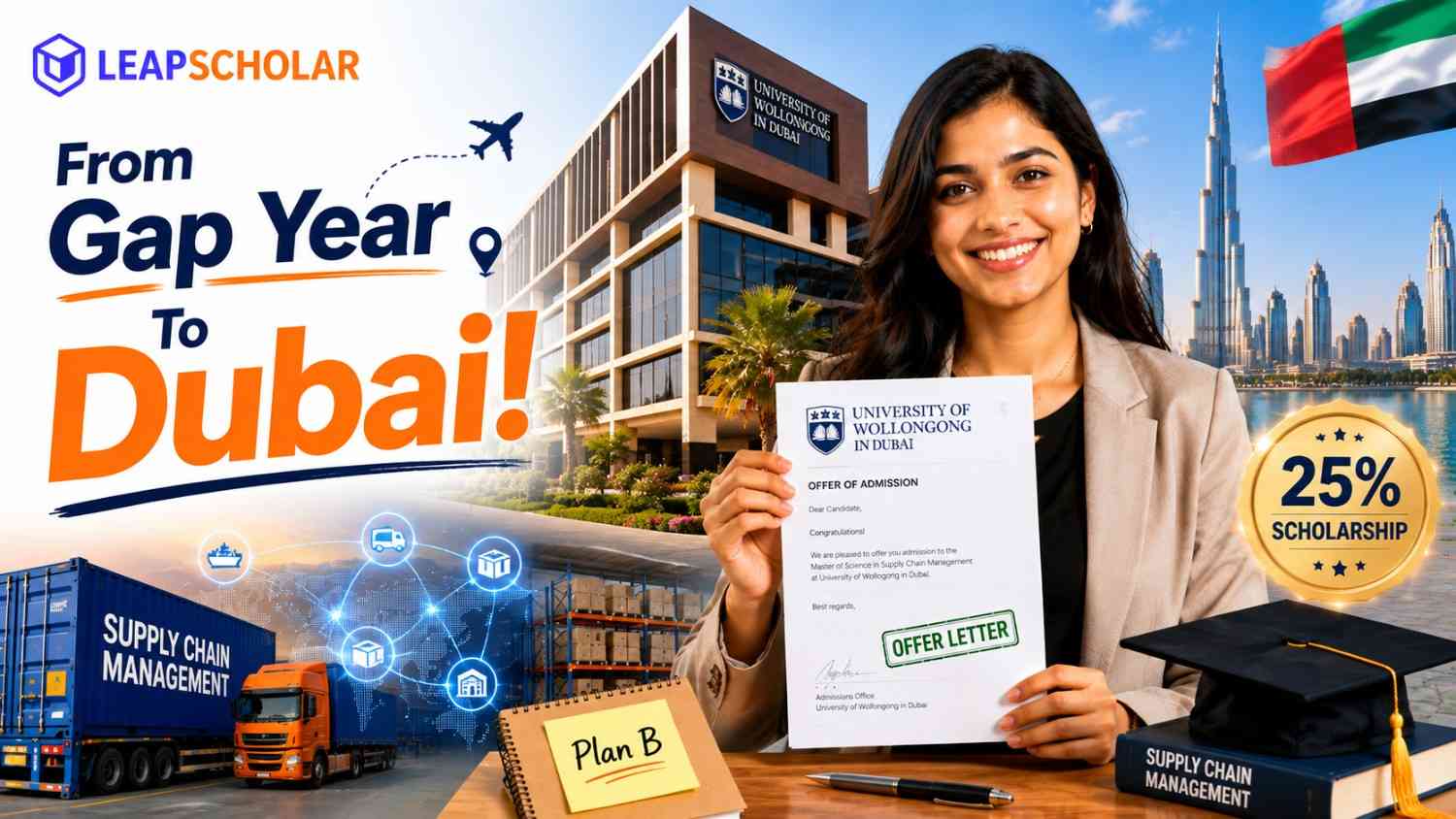
I took a full-year gap after my bachelor's to prepare for civil services. When that didn't work out, I didn't have to start from zero, because I'd already had a backup plan sitting in my mind since before I even graduated. Here's my Leap Scholar review, in my own words, on turning that backup plan into a master's in Supply Chain Management in Dubai.
Q1. Tell me a bit about yourself and what you're studying now.
A) I'm Shreya Vasanth, and I'm currently doing my Master's in Supply Chain Management at the University of Wollongong in Dubai.
Q2. When did you first start thinking about studying abroad?
A) Honestly, it was planned before my bachelor's even finished. I had two things in mind at that point, and this master's was always meant to be my backup plan in case my first option didn't work out after graduation. I took a year's gap after my bachelor's, and when that first plan didn't work out, I went with the option I'd already been holding onto.
Q3. What was that first plan, if you don't mind sharing?
A) It was civil services, actually. That's what the gap year went toward. I wasn't able to clear it, and once that became clear, I opted for the other option I'd already had in mind since my bachelor's days.
Q4. Why this specific country, university, and course?
A) The subject I chose, logistics, is heavily tied to Dubai specifically, since it's such a major hub for the logistics industry. That connection is really what led me to choose both the country and the university.
Q5. How did your parents react when you told them?
A) They were supportive, but they had real concerns too, mostly because of everything happening in the region at that time. Once I explained the benefits of this specific degree, they said that if I was willing to risk it all and go, it was fine with them. So overall, supportive, but with genuine worry mixed in.
Q6. How much research went into choosing this specific course and university?
A) For me, choosing the exact degree is actually secondary. What matters most is deciding which subject or field you actually want to pursue; that decision has to come first. Once that's clear, picking the specific degree and college becomes the next, more manageable step. When I did look into the university itself, I checked its overall ranking, the curriculum it teaches, and reviews from alumni before finalizing anything.
Q7. How did you first hear about Leap Scholar?
A) Through my sister, actually. She'd used Leap Scholar herself to go to the UK for her own master's, and she told me it would make the whole process a lot smoother for me too.
Q8. Walk me through how you actually started your abroad journey.
A) I was very fortunate to have Leap Scholar's support, because honestly, I had no idea how to actually go about studying abroad or choosing a university. I only had a rough sense of which universities were good, which were average, and which weren't great fits. The journey started with selecting the university, then figuring out exactly what documents I'd need, and then the financial piece, understanding the total tuition amount I'd actually be paying. Everything else, especially the visa process and the SOP, I leaned entirely on Leap Scholar's guidance.
Q9. Did you get a scholarship?
A) Yes, I got a 25 percent scholarship, and it genuinely helped, since the tuition fee was quite high; even a smaller percentage made a real difference.
Q10. How does the scholarship process actually work?
A) From what I understood, my university bases the scholarship on your bachelor's marks. I had around a 7.83 to 7.84 CGPA, and that got me 25 percent. If your marks are higher than mine, you'd likely qualify for an even bigger percentage.
Q11. What were the biggest doubts or challenges you had, and how did Leap Scholar help clear them?
A) I'll be completely honest: I was completely blank the moment I decided to go abroad. I knew nothing about any of it. Leap Scholar walked me through it step by step, telling me exactly what documentation I'd need beyond my bachelor's degree. They also helped me with my SOP, since I genuinely didn't know how to write one professionally. I gave them a rough brief of what I wanted to say, and they polished it into something properly professional before it went in. Whenever I had doubts about emails to send the university or anything like that, they stepped in as the go-between and handled the conversation for me.
Q12. What would you call the strongest part of your application?
A) The visa, without question, because of everything happening in the region at that time. I arrived here in April, and getting a UAE visa during that period was genuinely difficult given the conflict happening then. I was worried, but I kept checking in with my assigned guide, who helped me with every doubt I had: when it would arrive, how to apply, all of it.
Q13. How was your university shortlisting process?
A) Pretty easy, actually, mainly because my guidance counselor gave me several solid options. I had four in total, with one being my priority, and she made clear that the other three were strong backups in case my top choice didn't come through, all well-ranked, reputable universities. Every student has their own preference in the end, and fortunately, I got into the one I actually wanted.
From a year lost to civil services prep to a master's offer at the exact university she'd already had in mind, this journey is a reminder that a backup plan is only as good as the support you have when it's time to actually execute it. For anyone weighing a Plan B abroad or nervous about visa timing in a tense moment, this Leap Scholar review is worth sitting with.

Kirti Singhal
Kirti is an experienced content writer with 4 years in the study abroad industry, dedicated to helping students navigate their journey to international education. With a deep understanding of global education systems and the application process, Kirti creates informative and inspiring content that empowers students to achieve their dreams of studying abroad.
Users also read

Leap Scholar Review: Choosing Dubai for an AI Masters, No Backup Plan Needed

Leap Scholar Review: Five Offers, Two Confused Course Choices, and a 40 Percent Scholarship I Didn't Expect

Leap Scholar Review: My Visa Got Rejected Once. This Time, I Chose My Counselor Carefully