Blogs
Blogs  Leap Digest
  Events
  About Us
 Trending News
Summer Programs for College Admissions in 2026: Which Ones Actually Matter for Indian Students
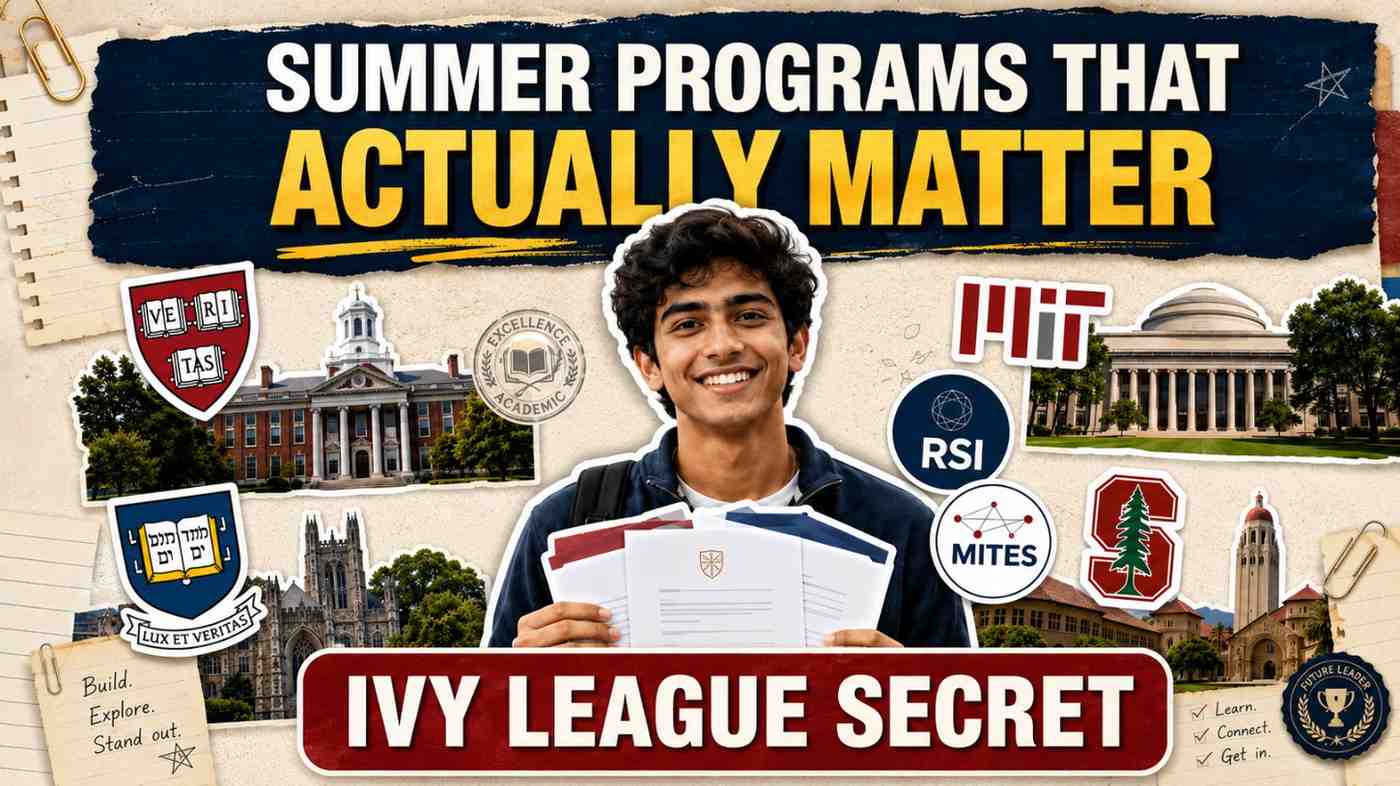
Summer programs are one of the most misunderstood elements of the college admissions process. Many students spend Rs. 3 to Rs. 10 lakh attending a branded pre-college program at Harvard, Yale, or Oxford and walk away believing that acceptance is the same thing as selectivity. It is not.
There is a clear and well-documented distinction between programs that admissions officers at top universities consider genuine signals of academic ability and programs that are, in the words of the college admissions industry, "pay-to-play" experiences. A 2024 NACAC survey of admissions officers found that fewer than 9% consider participation in paid pre-college programs as having "considerable importance" in admissions decisions.
The programs that do matter are merit-selective. They are free or need-blind. They accept 2% to 5% of applicants. And getting in sends a signal to Princeton, Yale, MIT, and Stanford that a student has been independently vetted against the most rigorous standards in pre-college education.
Why Selectivity Is the Most Important Variable
Admissions officers read applications. They know which summer programs are selective and which admit anyone who pays the fee. A student who attended Harvard Summer School on a paid basis has demonstrated financial means. A student who was accepted to RSI has demonstrated independent academic vetting at the highest pre-college standard.
10/10: Research Science Institute (RSI) at MIT
The most prestigious summer program in the world for STEM-focused students.
RSI is a six-week residential program run by the Center for Excellence in Education at MIT, accepting approximately 100 students globally each year from a competitive applicant pool of thousands. The acceptance rate is under 5%, making it more selective than every Ivy League university.
What happens at RSI:
- Students work directly in MIT faculty labs on publishable-quality individual research projects.
- Daily advanced STEM lectures from MIT professors and industry leaders.
- Participants present their research publicly by the end of the six weeks.
- The program is fully funded. Tuition, housing, meals, and materials are covered at no cost.
Why it matters for admissions: A single RSI acceptance signals to any admissions reader that this student has been independently verified as exceptional. It is not purchased. It cannot be gamed. Former RSI participants include Intel Science Talent Search finalists, Siemens Competition award winners, and graduates who have gone on to win major scientific honors.
For Indian students specifically: RSI runs an edition in collaboration with IISc Bangalore, which avoids the US F-1 student visa process entirely. F-1 interview wait times at US consulates in India can run several weeks to months depending on the consulate and the time of year, particularly during peak summer admission season. The IISc edition runs the same research model and carries the same RSI name and credentials.
Application requirements:
- PSAT: Math 740+ and EBRW 700+ or ACT: Math 33+, English/Science/Reading 34+.
- Outstanding academic record.
- Two to three strong recommendations from mathematics or science teachers or research supervisors.
- Essays demonstrating research interest and leadership potential.
2026 deadline status: CLOSED (December 2025 for Summer 2026). 2027 deadline: Expected December 2026. Monitor cee.org from October 2026.
9/10: MITES (MIT Introduction to Technology, Engineering, and Science)
A rigorous, fully funded STEM program at MIT with one of the lowest acceptance rates of any pre-college program.
MITES Summer is a six-week residential program at MIT targeting rising seniors, particularly from underrepresented or underserved backgrounds. Acceptance rates are reported as low as 1.5% to 4%. Students who complete MITES go on to attend top universities, including MIT itself, at unusually high rates.
What happens at MITES:
- Rigorous STEM coursework across multiple disciplines in MIT classrooms.
- Hands-on projects covering areas from robotics to genomics.
- Direct mentorship from MIT faculty and graduate students.
- Exposure to MIT's research and academic culture over six weeks.
- Fully funded: tuition, housing, meals, and materials at no cost.
Why it matters for admissions: The selectivity, MIT affiliation, and focus on underrepresented students make MITES one of the most powerful signals an aspiring engineer or scientist can put on a college application. The mentorship relationships formed often become the source of strong recommendations.
Important note for Indian students: MITES primarily targets US-based students from underrepresented or first-generation college-going backgrounds. Indian international students should verify current eligibility for international applicants directly at mites.mit.edu before applying. Eligibility requirements may limit or define the applicant pool for students based outside the US.
2026 deadline status: CLOSED (February 1, 2026, for Summer 2026). 2027 deadline: Expected February 2027. Monitor mites.mit.edu from December 2026.
9/10: Stanford Pre-Collegiate Summer Institutes
University-level courses taught by Stanford instructors. The value is in the work you produce, not just attendance.
Stanford Pre-Collegiate Summer Institutes offer high school students the chance to take genuinely rigorous, university-level coursework taught by Stanford faculty and doctoral students. The programs are competitive in admissions but not at the RSI or MITES level.
Why it matters for admissions: Attending Stanford Pre-Collegiate is not itself the signal. What matters is what you do with it. Students who use the experience to produce a meaningful piece of academic work, a paper, a project, or a body of research and then discuss that work substantively in essays and interviews create a genuine admissions asset. Students who attend and produce nothing distinctive are largely indistinguishable from students who attended any other paid university summer program.
Cost: Paid program. Financial aid is available for eligible students.
2027 deadlines: Multiple sessions with different deadlines. Applications typically open in December and run through February/March. Monitor spcs.stanford.edu from November 2026.
8/10: YYGS (Yale Young Global Scholars)
Globally recognized, intellectually rich, and valuable for students who can demonstrate something beyond attendance.
Yale Young Global Scholars brings together high-achieving students from around the world for two-week intensive academic sessions covering topics from biotechnology to international affairs. The program is globally recognized, and applications are need-blind, with over USD 3 million in financial aid distributed annually.
Why it matters for admissions: YYGS is intellectually substantive, and the international cohort is genuinely diverse and high-achieving. It is less selective than RSI or MITES, so the admissions signal is primarily about what you do during and after the program. Students who produce meaningful research, make intellectual connections that show up in essays, or build networks that lead to further academic work and get real value from YYGS.
Cost: Paid program. Financial aid available. Apply to the financial aid track simultaneously with admission.
2027 deadlines: Applications typically open in November/December and close in January/February. Multiple sessions in June and July. Monitor globalscholars.yale.edu from October 2026.
8/10: LaunchX
The strongest pre-college choice for students targeting business, entrepreneurship, or product-focused careers.
LaunchX is a four-week entrepreneurship program where participants build and launch real companies, not simulated ones. By the end of the program, students have a business plan and a prototype or MVP and have pitched their company to investors. It is conducted at multiple US campuses.
Why it matters for admissions: For students applying to business, economics, or interdisciplinary programs at top universities, LaunchX is the most credible pre-college entrepreneurship program available. The tangible outcomes, a real product, real customers or users, and a real pitch are the kind of specific, verifiable evidence admissions essays can use. The admissions impact depends heavily on what students actually build and how they articulate its value.
Cost: Paid program. Limited scholarship funding available.
2027 deadlines: Applications typically open in November/December. Monitor launchx.com from October 2026.
7/10: UC Berkeley Pre-College Scholars
Real Berkeley coursework, high flexibility, but the admissions impact depends entirely on what you do with it.
UC Berkeley Pre-College Scholars allows high school students to enroll directly in university courses alongside UC Berkeley undergraduates. The flexibility in course selection across disciplines is a genuine advantage, and the academic exposure to a major research university is real.
Why it matters for admissions: The program is not competitive in admissions, which limits how much it signals to selective universities. Its value is entirely downstream: students who use Berkeley coursework to confirm a genuine academic direction, produce strong work, and then articulate that experience specifically in their applications get meaningful returns. Students who attend without producing anything notable get limited returns regardless of the Berkeley brand.
Cost: Paid program. Financial aid is limited.
2027 deadlines: Applications typically open in March/April for summer sessions. Monitor summer.berkeley.edu from February 2027.
The Pay-to-Play Distinction: What Admissions Officers Actually See
The honest version of the summer program conversation is this: Harvard Summer School, Oxford Scholastica, Yale Summer Session, and most branded university pre-college programs admit students without significant selectivity. They are educational products, not admissions signals.
This does not mean they have no value. They can be intellectually stimulating, socially formative, and useful for exploring a field. But they do not function as independent verification of academic ability, which is what selective universities are looking for when they read summer program participation on an application.
The programs that function as genuine signals: RSI (under 5% acceptance), MITES (1.5% to 4%), PROMYS (approximately 10%), SSP (Summer Science Program, approximately 5%), and TASS (Telluride Association Summer Seminar, approximately 5%).
For Indian students spending Rs. 3 to Rs. 10 lakh on a summer program abroad, the priority order is straightforward: free merit-selective programs first, paid programs with demonstrated academic output second, and branded paid programs with no distinctive work produced last.
2027 Application Deadline Summary
Program | Selectivity | Cost | 2027 Deadline (Expected) |
| RSI at MIT / IISc | Under 5% | Free | December 2026 |
| MITES at MIT | 1.5 to 4% | Free | February 2027 |
| Stanford Pre-Collegiate | Competitive | Paid | February/March 2027 |
| YYGS Yale | Moderate | Paid (aid available) | January/February 2027 |
| LaunchX | Competitive | Paid (limited aid) | November/December 2026 |
| UC Berkeley Pre-College | Non-selective | Paid | March/April 2027 |
Book a free session with a Leap Scholar counselor to understand which summer programs align with your academic profile and target universities, how to use summer program participation effectively in your college application essays, and what your full profile-building strategy should look like for US and UK admissions.
Sources: Oriel Admissions, Most Prestigious Summer Programs 2026 Guide, May 25, 2026 | Empowerly, Top STEM Summer Programs For High School Students, April 27, 2026 | Inomi, Best Global Summer Programs for High School Students 2026, January 4, 2026 | Inomi, Best Summer Research Programs for High School Students 2026, February 23, 2026 | Top Tier Admissions, Top Summer Programs for High School Students | Rustic Pathways, Best Summer Programs for High School Students 2026 | The Red Pen, 16 Most Competitive US Summer Programmes For International Students | EZScholar, Best Summer Programs 2026 for Highschoolers, March 30, 2026
Kirti Singhal
Kirti is an experienced content writer with 4 years in the study abroad industry, dedicated to helping students navigate their journey to international education. With a deep understanding of global education systems and the application process, Kirti creates informative and inspiring content that empowers students to achieve their dreams of studying abroad.
Users also read
Vietnam Steps Into the Global Academic Spotlight at APAIE 2026: And Indian Students Should Pay Attention
Vietnam Steps Into the Global Academic Spotlight at APAIE 2026: And Indian Students Should Pay Attention
Indian Passport Fees Rise From July 1, 2026. Here Is What It Means If You Plan to Study Abroad.