Blogs
Blogs  Leap Digest
  Events
  About Us
 Trending News
KOICA Scholarship 2027 for Indian Students: Study in South Korea With a Fully Funded Master's or PhD
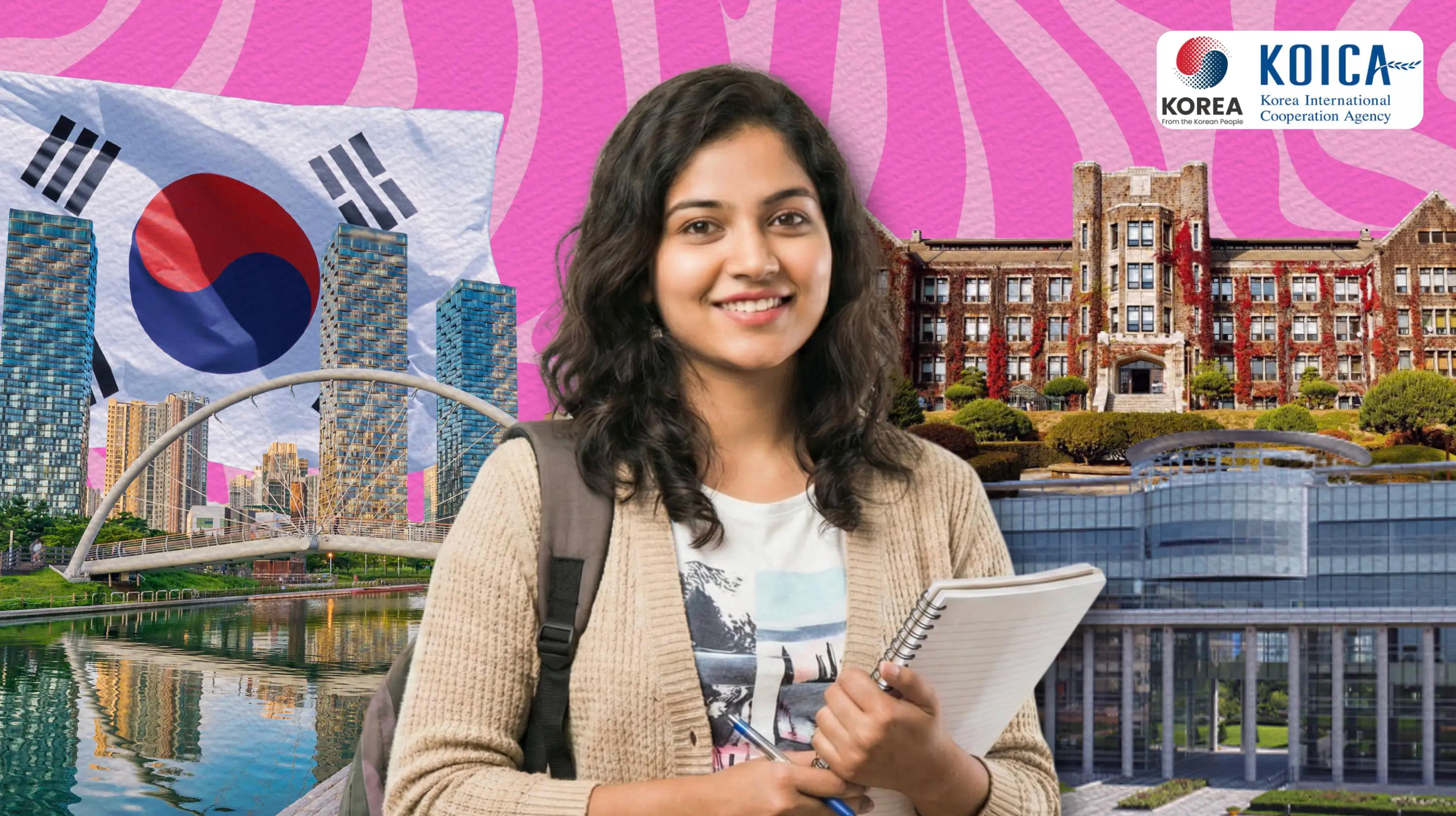
South Korea has quietly become one of the most attractive study abroad destinations for Indian students. Between its booming AI industry, world-class universities, cutting-edge research, and global companies like Samsung, Hyundai, and LG, it has plenty to offer beyond K-dramas and K-pop.
But here's something many Indian students don't know.
The Korean government itself is offering a fully funded scholarship that covers almost everything, from tuition and flights to accommodation and a monthly living allowance.
The catch? This is not a scholarship for everyone.
If you work in government or a government-linked institution, this is one of the most generous scholarships you can apply for.
Here's everything you need to know.
What is the KOICA Scholarship Programme?
The Korea International Cooperation Agency (KOICA) is the South Korean government's international development agency.
Since 1991, KOICA has been helping partner countries strengthen their public institutions by funding higher education, technical training, and leadership programmes.
One of its flagship initiatives is the CIAT Scholarship Programme (Capacity Improvement and Advancement for Tomorrow), which brings talented government officials from partner countries to South Korea for graduate education.
The idea is simple.
Instead of simply funding a degree, KOICA invests in professionals who can return home and help improve governance, healthcare, agriculture, digital transformation, environmental policy, and economic development.
For Indian applicants working in the public sector, it can be an incredible opportunity to gain international education without worrying about tuition fees or living costs.
Which universities and programmes are available?
The scholarship includes Master's and Doctoral programmes at some of South Korea's leading universities. Here's a quick overview.
University | Programme | Degree |
| Handong Global University | e-Government and Public Management | Master's |
| Incheon National University | Climate Change and Environment Management | Master's |
| KDI School of Public Policy and Management | Economic Development Policy | Master's |
| Sungkyunkwan University | e-Government and Public Management | Master's |
| Yonsei University | Health Policy and Financing | Master's |
| Kyungpook National University | High Value-added Agriculture | Master's & PhD |
| Pukyong National University | Global Fisheries Development | Master's & PhD |
| University of Seoul | AI Digital Innovation | Master's & PhD |
| Yonsei University | Control of Infectious Disease | Master's & PhD |
| Yonsei University (Mirae Campus) | Digital Health | Master's |
| Yonsei University (Mirae Campus) | Social Economy | Master's |
Applicants can choose only one programme, so selecting the right course is important.
What does the scholarship cover?
The scholarship includes:
- Full tuition fees
- Economy class airfare to and from South Korea
- Monthly living allowance of KRW 1.2 million
- Settlement allowance upon arrival
- KRW 600,000 for Master's students
- KRW 1.2 million for PhD students
- University accommodation (generally dormitories)
- National Health Insurance
- Private medical insurance
- Korean language classes
- Funding for workshops, study visits, and extracurricular academic activities
- Completion grant before returning home
Apart from personal expenses such as visa fees, local transportation, or optional travel, most major study costs are covered.
Who can apply?
- Be an Indian citizen
- Be officially nominated by the Government of India or the relevant government department
- Be employed as a government official or public servant
- Preferably be under 40 years of age
- Hold a Bachelor's degree for Master's programmes
- Hold a Master's degree for PhD programmes
- Have relevant work experience
- Around two years for Master's applicants
- Around three years after completing a Master's for PhD applicants
- Be in good physical and mental health
- Have strong English communication skills
English proficiency test scores are generally not required during the KOICA application stage, although some universities may ask for them later during admissions.
Who cannot apply?
The programme also has a few important restrictions.
You are generally not eligible if:
- You have already completed a KOICA-funded degree.
- You previously received certain Korean government degree scholarships.
- Your earlier KOICA scholarship was cancelled after enrolment.
- You do not receive an official government nomination.
This last requirement is what makes the scholarship quite different from regular university scholarships.
How does the selection process work?
The application process happens in multiple stages, and applicants must clear each one before moving to the next.
The journey looks something like this:
- Submit your application through the KOICA Country Office or the Korean Embassy.
- Attend an interview conducted locally by KOICA or the Korean Embassy.
- If shortlisted, your chosen university evaluates your academic documents.
- Complete a medical examination and university interview (some universities may also conduct tests or essays).
- Receive final admission.
- Obtain your student visa and travel to South Korea.
- Complete another health check after arrival before beginning your programme.
It is a fairly detailed process, but that's expected for a government-funded scholarship.
What documents will you need?
The exact document list depends on the university, but applicants should expect to prepare:
- KOICA application forms
- Government nomination letter
- Valid passport
- University application form
- Academic certificates and transcripts
- Work experience certificates
- Recommendation letters
- Medical documents
- Any additional documents requested by the university
One thing to remember is that many academic documents need Apostille or consular authentication, so it is worth preparing these well in advance.
When should you apply?
The scholarship follows a multi-stage timeline.
- Application period: July 2026 (exact deadlines vary by the KOICA Country Office or Korean Embassy)
- University selection: Around October 2026
- Final admission: November 2026
- Arrival in South Korea: February 2027
Since timelines differ slightly depending on your country office and chosen university, applicants should regularly monitor the official announcements.
A few things applicants often overlook
Many applicants focus only on academics, but KOICA is looking for something much broader.
The programme is designed to develop future public leaders, so your work experience, career goals, and commitment to public service matter just as much as your grades.
Another common mistake is assuming every expense is covered. While the scholarship is generous, applicants are still responsible for costs such as document authentication, visa fees, medical check-ups during the application stage, and courier charges.
Finally, once you voluntarily withdraw from the selection process, that decision cannot be reversed. It is worth applying only if you are genuinely prepared to relocate to South Korea for the full duration of the programme.
Final thoughts
Most Indian students searching for scholarships look at countries like the UK, Canada, Australia, or Germany.
South Korea often flies under the radar, especially when it comes to government-funded opportunities.
The KOICA Scholarship Programme is different because it isn't just paying for a degree. It is investing in professionals who can take what they learn in South Korea and use it to strengthen institutions back home.
It is competitive, yes. But for the right candidate, it could be a career-defining opportunity that combines international education, leadership development, and a chance to study at some of South Korea's top universities without the financial burden.

Kirti Singhal
Kirti is an experienced content writer with 4 years in the study abroad industry, dedicated to helping students navigate their journey to international education. With a deep understanding of global education systems and the application process, Kirti creates informative and inspiring content that empowers students to achieve their dreams of studying abroad.
Users also read
Vietnam Steps Into the Global Academic Spotlight at APAIE 2026: And Indian Students Should Pay Attention
Vietnam Steps Into the Global Academic Spotlight at APAIE 2026: And Indian Students Should Pay Attention
Indian Passport Fees Rise From July 1, 2026. Here Is What It Means If You Plan to Study Abroad.