Blogs
Blogs  Leap Digest
  Events
  About Us
 Trending News
CERN Summer Student Programme 2026: Complete Guide for Indian Students
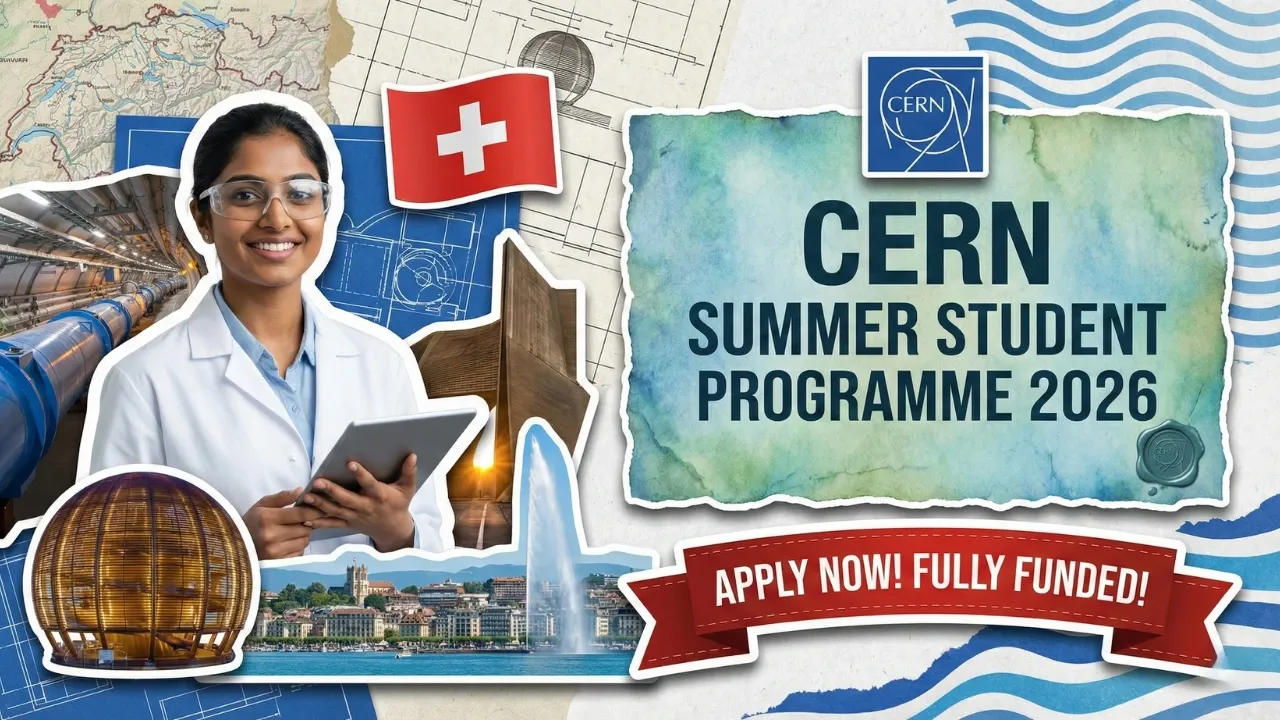
If you're a physics, engineering, or computer science student in India who's serious about research, you've probably heard about CERN, the European Organization for Nuclear Research in Geneva, where the World Wide Web was invented.
Here's what many students don't realize: CERN actively recruits undergraduate and Master's students for fully funded summer research positions. Not internships in the traditional sense actual research work on experiments that probe the fundamental structure of the universe.
For the 2026 cohort, applications close January 26, 2026. The program runs 8-13 weeks during summer 2026, covers all expenses, and provides a daily stipend of 93 CHF (approximately ₹9,200). More importantly, it gives you research experience and recommendation letters that open doors to top PhD programs globally.
Here's everything you need to know to build a competitive application.
Why 2026 is a Significant Year for CERN
Understanding CERN's current focus helps you position your application effectively. The laboratory is transitioning into the High-Luminosity LHC (HL-LHC) phase, scheduled to begin operations in the late 2020s.
What this means for 2026 interns: The facility is testing new superconducting magnets and developing machine learning systems that decide in real-time which particle collisions to record. This creates demand not just for physicists, but for mechanical engineers, IT specialists, electronics experts, and data scientists.
You won't just observe research, you'll contribute to building hardware and software systems that will operate for the next 20 years. If you have skills in optimization, simulation, data modeling, or AI, you're exactly what they need right now.
The Critical Timeline
Missing deadlines at CERN isn't recoverable; there are no extensions. Here's what you need to know about timing.
- Application Window: Typically opens November/December 2025
- Application Deadline: January 26, 2026
- Results Announcement: Late March to early April 2026
- Program Start: Most students begin on June 15 or June 22, 2026
- Important note about recommendations: CERN requires academic reference letters. Professors need time to write quality recommendations. Don't ask in mid-January; start that conversation in November or December.
Who's Actually Eligible
CERN has specific academic requirements, but since India is an Associate Member State, Indian students have a dedicated pathway, which is a significant advantage.
- Field of Study: Physics, Engineering, Computer Science, or Mathematics
- Academic Standing: Must have completed at least 6 semesters (3 years) of full-time university studies by June 2026. This targets final-year Bachelor's and all Master's students.
- Student Status: Must remain enrolled during your CERN stay. If you graduate in summer 2026, you're still eligible as long as you haven't started a PhD program yet.
- Language: English or French proficiency required. While Geneva is French-speaking, the working language at CERN is overwhelmingly English.
What You Actually Get: The Financial Package
Geneva is one of the world's most expensive cities. CERN ensures that financial barriers don't prevent qualified students from participating. The program is fully funded.
- Daily Stipend: 93 CHF per day (tax-free), approximately ₹9,200. This comfortably covers accommodation in the CERN hostel and meals.
- Travel Allowance: Lump sum covering flights from India to Geneva and return
- Health Insurance: Comprehensive coverage through CERN's scheme (essential in Switzerland)
- What this means practically: You can focus entirely on research without financial stress. The stipend covers living costs with room for weekend travel to nearby France or the Swiss Alps.
Two Pathways: Summer Student vs. CERN Openlab
CERN offers two distinct summer programs. Understanding the difference helps you apply to the right one.
Feature | Summer Student Programme | CERN Openlab Programme |
| Primary Audience | Physics & Engineering Students | Computer Science & IT Students |
| Focus Area | Experimental/Theoretical Physics, Robotics | AI, Cloud Computing, Quantum Computing |
| Duration | 8-13 weeks | Fixed 9 weeks |
| Project Type | Lab-based or hardware-focused | Software-heavy, data-centric |
| Stipend | 93 CHF per day | 93 CHF per day |
| Best For | "Classic" CERN research experience | High-Performance Computing focus |
Choose based on your background and interests. If you're primarily interested in computational challenges related to particle physics data, Openlab might be the better fit.
Building an Application That Stands Out
With thousands of global applicants, your materials need to demonstrate specific technical capabilities and genuine research interest. Here's what actually works:
1. The Project-Focused CV:
CERN supervisors look for hands-on technical skills, not just coursework completion. Highlight specific projects:
- Python data analysis work
- Circuit design for robotics projects
- Simulation software you've developed
- Any experience with optimization, calibration, or data modeling
Use technical keywords naturally: optimization, calibration, simulation, data modeling, and algorithm development. These align with what CERN projects actually require.
2. The Motivation Letter (Statement of Purpose):
Generic statements about childhood fascination with science fail immediately. Instead:
3. What doesn't work: "I have been passionate about physics since childhood and dream of working at CERN."
4. What works: "My undergraduate project analyzing noise patterns in sensor data directly relates to the challenge of identifying rare particle events in LHC detector systems. I'm particularly interested in contributing to the HL-LHC trigger system development, specifically the machine learning algorithms being tested for 2026-2027 implementation."
Demonstrate you understand CERN's current research focus by mentioning specific experiments (CMS, ATLAS, ALICE) or the High-Luminosity LHC upgrades planned for this period.
5. The Reference Letter:
A generic letter confirming you're a good student won't help. Ask professors who have seen you solve difficult problems or work effectively in team settings. The strongest letters address:
- Your technical problem-solving ability
- How you handle challenges and setbacks
- Your curiosity and initiative beyond coursework
- Specific examples of your work
Give recommenders plenty of time and provide them with your CV and motivation letter draft so they can write specific, detailed letters.
Life at CERN: Beyond the Laboratory
While research is the primary focus, CERN offers a unique summer experience. You'll work alongside students from over 80 countries, creating an intensely international environment.
- Weekends: Many interns explore neighboring France, take train trips to the Swiss Alps, or hike Mount Salève. Lake Geneva offers swimming during the summer months.
- Community: You'll live in CERN hostel alongside other students and potentially eat at "Restaurant 1," where you might find yourself sitting near senior scientists whose papers you've read in coursework.
- Professional Development: Beyond your specific project, CERN organizes lectures, workshops, and facility tours. It's immersive exposure to how large-scale scientific collaboration actually works.
The Bottom Line
The CERN Summer Student Programme 2026 isn't just a resume line; it's a genuine research experience at one of the world's premier scientific facilities, resulting in strong recommendation letters, potential publications, and network connections that shape entire careers.
If you're feeling intimidated or experiencing imposter syndrome, remember: every CERN scientist started exactly where you are. The program is designed for students, not established researchers. They're looking for curiosity, technical capability, and willingness to tackle challenging problems, qualities you've demonstrated through your coursework and projects.
The January 26, 2026 deadline is firm. Start your application preparation now, research specific CERN experiments, connect with professors about recommendation letters, and draft your motivation letter showing you understand CERN's current research priorities.
Need Help With Your CERN Application?
Confused about which CERN experiments align with your technical background? Not sure how to frame your undergraduate projects for particle physics research? Need guidance on securing strong academic recommendations?
Get expert support from Leap Scholar. We can help you identify which CERN experiments match your skills, structure your motivation letter to demonstrate research fit, highlight relevant technical experiences in your CV, and plan your application timeline to meet the January deadline.Start preparing now.

Kirti Singhal
Kirti is an experienced content writer with 4 years in the study abroad industry, dedicated to helping students navigate their journey to international education. With a deep understanding of global education systems and the application process, Kirti creates informative and inspiring content that empowers students to achieve their dreams of studying abroad.
Users also read
University of Sheffield Opens BEng (Hons) CSE Admissions: Scholarships Up to £7,500 for Indian Students

Australia Has Moved Indian Students to EL3, the Highest Visa Scrutiny Tier. Here’s What That Means.

The Summer Internship Conversion Strategy for UK Freshers in Software Engineering