Blogs
Blogs  Leap Digest
  Events
  About Us
 Expert Insights
German for Software Engineers in Germany: What Indian Developers Actually Need in 2026
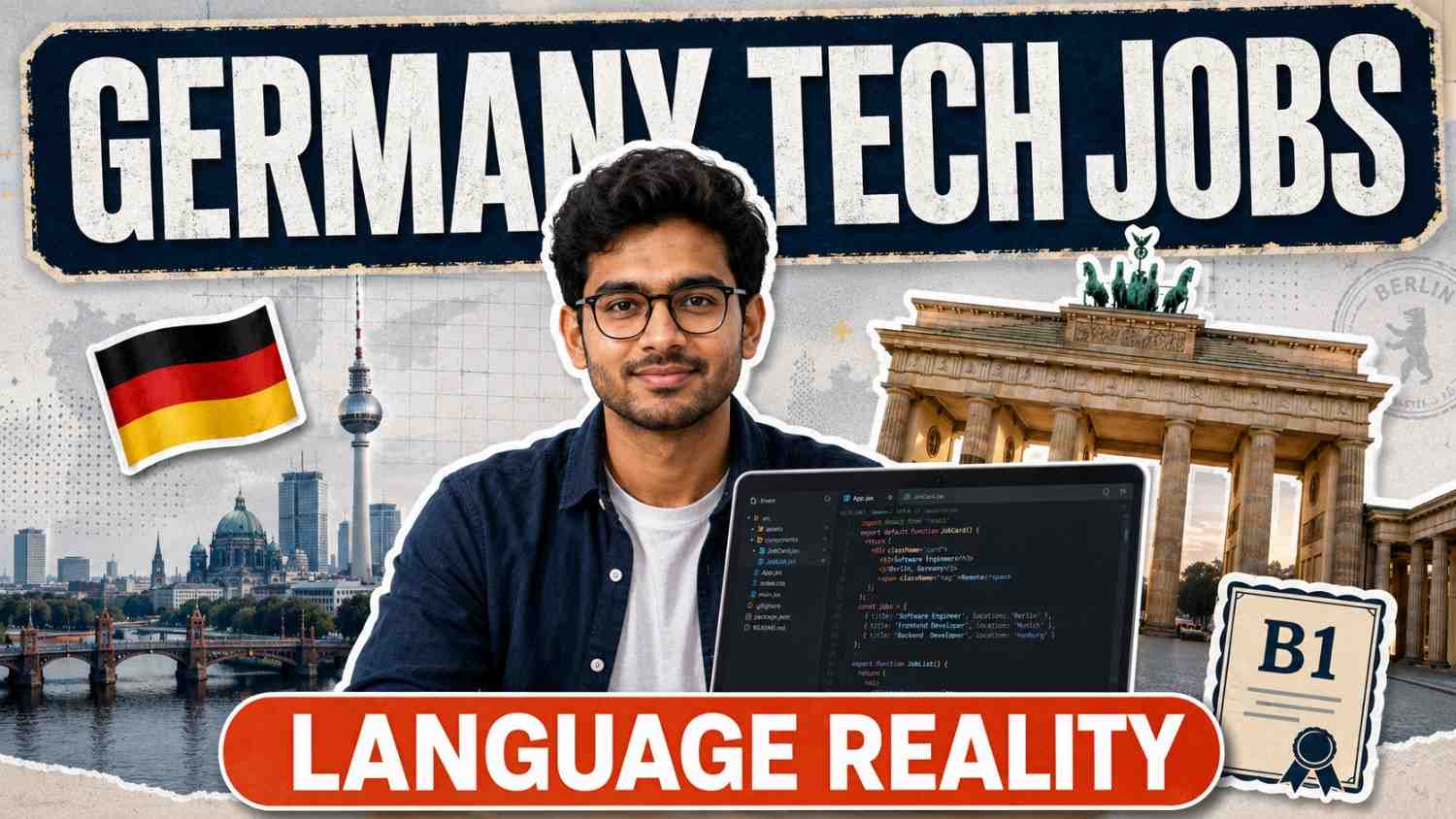
You do not need fluent German to get a software engineering job in Germany. But the fuller answer, the one that actually helps you plan, depends on which city, which employer, and how far you want to go in your career.
German language ability is one of the most commonly cited concerns among Indian software engineers considering Germany. The reality in 2026 is that hundreds of engineering teams across Berlin and Munich run entirely in English, code bases use English variable names and comments by default, and a significant proportion of Indian engineers have spent years in Germany without ever becoming conversational in German.
Currency note: 1 EUR = Rs. 110.35 as of July 20, 2026 (BookMyForex/Wise mid-market rate). All salary figures are gross annual amounts before tax.
The Legal Reality: No Private Employer Can Require German
There is no law in Germany that requires private-sector employers to conduct business in German. The German Language Act applies to public authorities and official communications, not to private companies. A Berlin startup or a Munich tech firm can legally hire, onboard, promote, and conduct all engineering work in English.
This is not a loophole. It is routine. Google Munich, Zalando, N26, Trade Republic, Celonis, Personio, HelloFresh, and hundreds of other German tech employers explicitly advertise English-language roles and build English-first engineering cultures. The job postings say "business English required," and they mean it.
The Berlin Reality: English-First Is the Default
Berlin is where the "you don't need German" statement is most true. The city's startup and scale-up ecosystem is genuinely multilingual, dominated by teams where no single nationality holds a majority and where the working language is English by functional necessity.
At English-first scale-ups, English is sufficient for the job. The Berlin tech scene skews heavily toward this ecosystem. Flat hierarchies, English standup meetings, English code reviews, English Slack channels, and English engineering documentation, this is standard operating procedure at Zalando, N26, Trade Republic, and the deep bench of well-funded Berlin startups.
Where German still matters in Berlin:
- At the Ausländerbehörde (immigration office) for your Anmeldung (residence registration) and visa renewals is where German still matters in Berlin.
- In daily life: supermarkets, doctors, landlords, Finanzamt (tax office), and most service interactions outside your employer's campus.
- For tax returns: Germany's Steuererklärung forms are complex, and most Indian engineers in Berlin hire a Steuerberater (tax adviser) who may or may not work in English.
- In interviews at Berlin corporations or public-sector-adjacent employers.
You can build a full software engineering career in Berlin for the first 2 to 3 years without knowing German. After that, German becomes a meaningful career accelerator rather than a strict requirement.
The Munich Reality: German Matters Earlier
Munich tells a different story. BMW, MAN, Siemens, Allianz, MunichRe, and the broader Bavarian Mittelstand dominate the city's economy. These are German institutions with German leadership, German client bases, and German as the default internal communication language.
At BMW or MAN, German is effectively required for team meetings, technical design reviews, manager conversations, and client-facing work. Engineers who remain in English-only silos at these companies find career progression limited at around the senior engineer level, because the roles above, tech lead, engineering manager, and principal engineer, involve cross-team communication in German.
Where Munich is closer to Berlin:
- The global tech presence in Munich (Google Munich, Microsoft, Apple, Dyson) is genuinely English-first. These offices operate closer to the Silicon Valley model.
- The growing Munich fintech and deep-tech startup scene runs in English.
- Academic and research roles at TU Munich (QS #25 globally in 2027, Germany's #1 university) and LMU Munich increasingly accept English for STEM research work.
If you are targeting the automotive or Mittelstand sector in Munich, start learning German from day one of your arrival. If you are targeting global tech or the Munich startup scene, the same English-first rules as Berlin apply.
When German Actually Becomes Important: A Timeline
Most Indian engineers in Germany describe the same progression regardless of city:
Months 1 to 6: English is entirely sufficient. Onboarding, code reviews, architecture discussions, and sprint ceremonies are all in English at most tech employers. The challenge is bureaucracy, not work.
Months 6 to 18: German starts to matter at the edges. Landlord disputes, doctor appointments, tax returns, phone contracts, daily life is genuinely harder without basic German (A2 to B1). At corporate employers, meetings occasionally shift to German, and you become a passive participant.
Year 2 onwards: The career branching point. Engineers who want to stay in individual contributor roles at an English-first company continue to work entirely in English. Engineers who want to move into team lead, engineering manager, or client-facing roles at German companies need B2 to C1 German.
The PR threshold: B1 German unlocks permanent residency in 21 months instead of 27 on the EU Blue Card. This is the single most practically important German language milestone. B1 is achievable in 12 to 18 months of consistent study from zero if you start on arrival.
What Is Always in English, Regardless of City
One thing is certain regardless of city, employer type, or German language level: the code itself is always in English. This is not conventional. It is functional reality.
- Git commit messages: English.
- GitHub/GitLab pull request descriptions: English.
- Code comments and variable names: English.
- Stack Overflow, documentation, technical blogs: English.
- CI/CD pipeline configuration and infrastructure as code are in English.
- API documentation and technical specifications: English.
An engineer writing Python, Java, or TypeScript in Munich uses the same vocabulary as an engineer writing the same code in Bengaluru or San Francisco. The technical work is linguistically neutral. What is not neutral is everything around it: the meeting where the ticket was discussed, the Jira comment from the product manager, the performance review, and the promotion conversation.
The Three Ecosystems and Their Language Requirements
1. Global Tech Giants (Google Munich, Meta Berlin, Amazon, Microsoft, and Stripe): Fully English-speaking. Language is not a variable. Hiring, performance reviews, and promotions run in English. German is useful for daily life, not for career advancement within these offices.
2. Startups and Scale-ups (Zalando, N26, Trade Republic, Celonis, Personio, HelloFresh): English-first by design. Most have explicit policies of English as the working language. Some require German for senior roles where client contact increases. At the junior to mid-level, English is entirely sufficient.
3. Corporates and Automotive (BMW, Mercedes-Benz, SAP, Bosch, Siemens, Allianz, Mittelstand): German is functionally required above mid-level. Entry-level technical roles can be held in English at many of these employers, but career growth beyond senior engineer is consistently German-dependent.
The B1 Milestone: What It Actually Gets You
B1 German is not fluency, but it is intermediate proficiency. You can handle most situations in daily life, understand the main points of clear standard conversations, and express yourself on familiar topics with reasonable accuracy.
What B1 German gets you:
- Permanent residency in 21 months instead of 27 on the EU Blue Card.
- The ability to handle Behörde interactions (Ausländerbehörde, Finanzamt, Einwohnermeldeamt) independently.
- Access to roles at corporate and Mittelstand employers that require basic German.
- Significantly easier daily life: doctor appointments, landlord conversations, utility contracts.
Accepted B1 certificates: Goethe-Institut B1, TELC Deutsch B1, TestDaF at the appropriate level, and ÖSD Zertifikat B1. The Goethe-Institut has test centers across India (Mumbai, Delhi, Pune, Chennai, Bengaluru, Kolkata, and Hyderabad) for preparation before departure.
The Practical Answer by Profile
Targeting a Berlin scale-up or global tech giant: German is not required for the job. Budget time in your first year to go from A1 to A2 for daily life. B1 is your 18-month goal for PR and long-term flexibility.
Targeting BMW, Bosch, Siemens, or the Mittelstand: Begin German before you arrive. Aim for A2 on arrival and B2 within two years. Careers at German industrial employers are meaningfully limited without B2 German.
Indian student at TU Munich (QS #25), RWTH Aachen (QS #104), or KIT (QS #116): The Werkstudent role is your most important accelerant. Many Werkstudent roles at English-first scale-ups are accessible with strong English alone. German makes your job search faster and wider. Start German in semester one regardless. Check available DAAD scholarships and wider ones.
For city-by-city cost of living comparisons between Berlin, Munich, Frankfurt, and Hamburg, the LeapScholar Germany cost guide covers student and professional budgets in detail.
The LeapScholar Software Engineer Germany Guide covers the complete salary picture by tier and city, the EU Blue Card and PR in 21 months, the Werkstudent strategy, university options with near-zero tuition, and a month-by-month planning timeline from application to your first German role.
Talk to a Leap Scholar counselor to understand whether your target ecosystem and city match your language level, which universities and Werkstudent employers are most accessible for your profile, and what your realistic first-job timeline looks like in Germany.
Sources: Bitkom IT Labour Market Survey, August 2025 | Working in Germany, Do You Need to Speak German to Work in Germany? 2026 | Expatrio, Working in Germany Without Speaking German | Settle in Berlin, English-Language Jobs in Berlin 2026 | Handbook Germany, German Language at Work | Goethe-Institut, German Language Certificates | BookMyForex, EUR to INR July 20, 2026

Kirti Singhal
Kirti is an experienced content writer with 4 years in the study abroad industry, dedicated to helping students navigate their journey to international education. With a deep understanding of global education systems and the application process, Kirti creates informative and inspiring content that empowers students to achieve their dreams of studying abroad.
Users also read

Top 10 Industries That Create the Most Billionaires in 2026: Guide for Indian Students

Stanford MBA Career Diversity: Industries, Salaries and What Indian Students Need to Know

Anthropic Academy: 16 Free AI Courses With Certificates in 2026 That Indian Students Cannot Afford to Ignore