Blogs
Blogs  Leap Digest
  Events
  About Us
 Expert Insights
How to Format an ATS-Friendly Resume for German Tech Companies in 2026
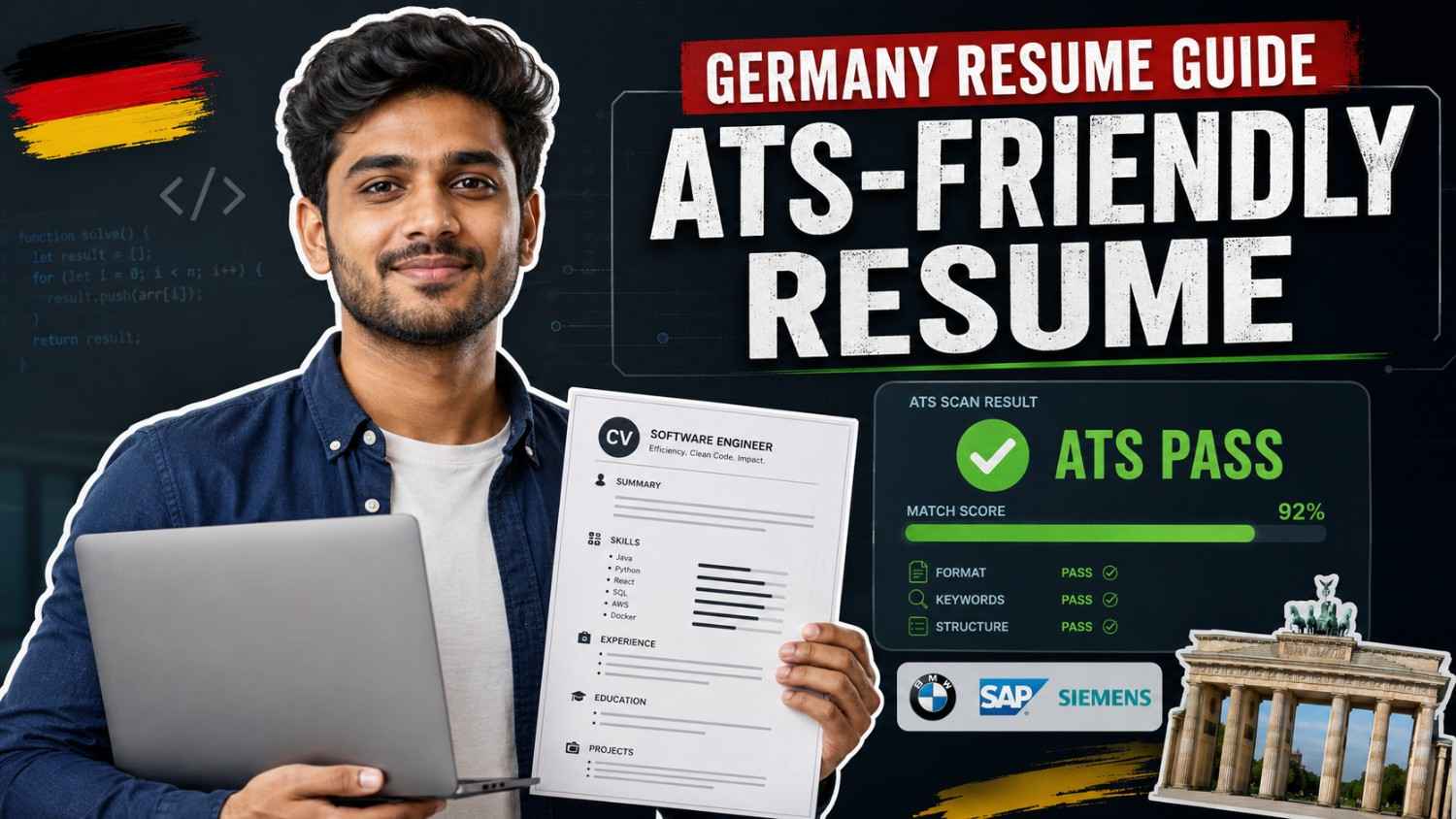
Before your Lebenslauf reaches a human recruiter at BMW, Zalando, or SAP, it passes through an Applicant Tracking System. In Germany, that typically means Workday, Taleo, or SAP SuccessFactors, the three ATS platforms most commonly used by large German employers, Mittelstand companies, and English-first scale-ups.
German ATS systems are not just keyword matchers. They evaluate structure and chronology, parse section headers, and struggle with complex formatting, tables, images, and non-standard fonts. A visually impressive resume that looks stunning in Microsoft Word can score zero in a German ATS if the formatting is wrong.
Currency note: 1 EUR = Rs. 110.37 as of July 27, 2026 (BookMyForex live rate).
The German Lebenslauf Is Not the Same as an Indian Resume
German Lebensläufe are tabular, strictly chronological, formally structured, and expected to include personal details that Indian resumes omit. Submitting an Indian-style resume with an objective statement, a summary box, or creative column layouts signals to a German recruiter that you have not worked on understanding the local market.
The Required Structure: Section by Section
A German Lebenslauf for tech roles in 2026 follows this sequence:
1. Personal Information (Persönliche Daten): Full name, address, phone number with country code, professional email, date of birth in DD.MM.YYYY format, nationality, LinkedIn URL (shortened), and GitHub URL. Do not include your passport number, visa status, or a personal biography.
2. Professional Profile (Berufliches Profil), Optional but Recommended: A 2- to 3-line summary of your specialization, years of experience, and primary tech stack. Keep it factual. German employers distrust marketing language. Write "Backend engineer with 3 years of Java/Spring Boot experience in fintech" rather than "passionate innovator driving digital transformation."
3. Work Experience (Berufserfahrung): Reverse chronological order, most recent first. For each role:
- Job title in German where possible. "Software Engineer" should appear as "Softwareentwickler." German ATS systems do exact or near-exact job title matching. If the job ad says "Senior Software Engineer," your title should match.
- Employer name and location (city, country).
- Dates in MM.YYYY format. German ATS systems specifically parse MM.YYYY. Do not write "2022-2024."
- Include 3 to 5 bullet points with quantifiable achievements, such as "Reduced API response time by 40% through query optimization," which is more effective than simply stating "worked on backend performance."
4. Education (Ausbildung): Reverse chronological order with degree name, university, city, dates in MM.YYYY format, and CGPA converted using the Bavarian formula: Grade = 1 + 3 × (10 − CGPA) ÷ (10 − 4). A CGPA of 9.0 converts to approximately 1.5, which reads as "Sehr gut" (Very Good).
5. Skills (Kenntnisse): Single column, plain text. List explicitly:
- Programming languages: Java (Spring Boot), Python (Django, FastAPI), TypeScript.
- Cloud and infrastructure: AWS, Docker, Kubernetes, Terraform.
- Databases: PostgreSQL, MySQL, Redis.
- Tools: Git, GitHub Actions, CI/CD, Agile, Scrum, JIRA.
- AI/ML if relevant: PyTorch, TensorFlow, LangChain.
6. Languages (Sprachkenntnisse): List every language with its CEFR level. Adding "Deutsch: A2, learning toward B1" measurably increases recruiter response rates in Germany. Do not omit your German level even if it is A1.
7. Certifications (Zeugnisse/Nachweise): AWS Certified Solutions Architect, Google Professional Cloud Engineer, CKA, etc. Include the issuing body and the year.
8. Signature (Unterschrift): German resumes end with a location, date, and signature. The signature is not optional at most traditional employers. Add "New Delhi, 23.07.2026" followed by a digital or scanned signature. This is one of the most common omissions from Indian applicants' German CVs.
The ATS Rules That Determine Whether Your CV Is Parsed
Rule 1: No tables in text sections. German ATS, particularly Workday, fails to parse content inside HTML or Word tables. The left-column/right-column layout many Indian resume templates use is an ATS failure point. Use a single-column layout throughout.
Rule 2: Standard section headings, in German. Workday Germany processes CVs more accurately when section headings match standard German terms: Berufserfahrung, Ausbildung, Kenntnisse, Sprachkenntnisse, and Zeugnisse. English headings work for English-first scale-ups but reduce accuracy at corporate and Mittelstand employers.
Rule 3: Keywords must match the job posting verbatim. German ATS systems do exact keyword matching. If the posting says "Spring Boot," your CV must say "Spring Boot," not "Spring Framework." If it says "Kubernetes," not "K8s." Pull exact technical terms from each posting and mirror them in your skills section and work experience bullets.
Rule 4: Save as PDF unless instructed otherwise. PDFs preserve formatting and are readable by all major German ATS. Word documents can shift formatting on different systems.
Rule 5: No photographs in the parseable body of the document. The professional photo is expected in the visual Lebenslauf (top right corner, business attire, neutral background, 3.5 to 4.5 cm). However, position it using a text box or header, not as an inline image in the narrative content.
The Photo Question: When to Include and When to Skip
Include a photo when applying to:
- DAX 40 companies (BMW, Siemens, SAP, Allianz, Deutsche Bank).
- Mittelstand employers.
- Banking, insurance, automotive, and manufacturing sectors.
Skip the photo when applying to:
- English-first Berlin scale-ups: N26, Trade Republic, Personio, Zalando, HelloFresh.
- Global tech firms: Google Munich, Meta Berlin, Amazon, Microsoft.
When in doubt, check the company's career page. Formal headshots and German-language content mean including it. Diverse informal teams and English content mean you can skip it.
The Three Ecosystems: How to Tailor Your CV
1. Global Tech Giants (Google Munich, Meta Berlin, Amazon, Microsoft, and Stripe): Write in English. Drop the photo. Lead with systems design, scale, and impact metrics. Quantify everything. Mirror exact keywords from the job posting.
2. Scale-ups (Zalando, N26, Trade Republic, Celonis, Personio, HelloFresh): English or German depending on the posting. Photo optional. Lead with ownership and real-world impact. Include links to deployed projects.
3. Corporates and Automotive (BMW, Mercedes-Benz, Volkswagen, Bosch, Siemens, and SAP): Write in German. Include the photo. Use standard German section headings. The Anschreiben (cover letter) is genuinely read and should be in German if you are A2 or above.
The GitHub Signal: Your Second CV
For German tech employers, GitHub is not an optional supplement. A GitHub profile that works for German employers has the following:
- 2 to 3 pinned repositories with comprehensive READMEs covering what the project does, the tech stack, and a live demo link.
- Consistent commit history over weeks or months, not 50 commits in one weekend.
- Tests in every repository. German engineering culture values TDD, and a project without test files is a warning sign.
- A Dockerfile or docker-compose. yml in at least one project.
- A GDPR compliance note in any project that handles personal data.
The Cover Letter (Anschreiben): Still Non-Negotiable
A Bewerbungsschreiben is expected by most German employers, particularly in engineering, finance, and the Mittelstand. It is one page, addressed to a named hiring contact ("Sehr geehrte Frau [Surname]" or "Sehr geehrter Herr [Surname]"), with four paragraphs: why this company specifically, what experience you bring, what you offer beyond the job description, and your earliest start date and German language level.
The CGPA Conversion Table
Indian CGPA (10-point scale) | German grade | German reading |
| 10.0 | 1.0 | Sehr gut (Excellent) |
| 9.0 | 1.5 | Sehr gut (Excellent) |
| 8.0 | 2.0 | Gut (Good) |
| 7.0 | 2.5 | Gut (Good) |
| 6.0 | 3.0 | Befriedigend (Satisfactory) |
Formula: Grade = 1 + 3 × (10 − CGPA) ÷ (10 − 4).
The ATS Pre-Submission Checklist
Before submitting any German tech application:
- Single-column layout throughout, no tables in text sections.
- All dates should be in MM.YYYY format.
- Section headings in German for corporate roles and English for English-first scale-ups.
- Job titles mirror the posting's exact language.
- Skills section lists all relevant tools, languages, and frameworks from the job description.
- German language level is listed under Sprachkenntnisse, even if it is A1.
- Include your LinkedIn and GitHub URLs in the personal information section.
- Photo included (for corporate/Mittelstand) or omitted (for scale-ups and global tech).
- Signature with location and date at the bottom.
- Saved and submitted as PDF.
The LeapScholar Software Engineer Germany Guide covers the complete picture: salary tiers by experience, the EU Blue Card and PR in 21 months, the Werkstudent strategy, the job search platforms that work best for Indian engineers, and a month-by-month planning timeline from university application to your first German job offer.
Talk to a Leap Scholar counselor to get a personalized review of your Lebenslauf, understand which keywords matter most for your target German employer, and build a complete application strategy for the September 2026 or 2027 intake.
Sources: Lifetimes Deutschland, How to Write a German Lebenslauf 2026, March 16, 2026 | GetGIS, German Resume Format for Jobs in Germany, February 5, 2026 | TopCV, CV for Germany 2026: Lebenslauf Format, Photo and ATS Checklist, June 16, 2026 | OphyAI, Free ATS Resume Tools Germany 2026, June 3, 2026 | HireFlow, Best Resume Format for Germany ATS-Safe Tips, March 24, 2026 | OphyAI, German CV Guide 2026, June 3, 2026 | BookMyForex, EUR to INR, July 27, 2026

Kirti Singhal
Kirti is an experienced content writer with 4 years in the study abroad industry, dedicated to helping students navigate their journey to international education. With a deep understanding of global education systems and the application process, Kirti creates informative and inspiring content that empowers students to achieve their dreams of studying abroad.
Users also read

Top 10 Industries That Create the Most Billionaires in 2026: Guide for Indian Students

Stanford MBA Career Diversity: Industries, Salaries and What Indian Students Need to Know

Anthropic Academy: 16 Free AI Courses With Certificates in 2026 That Indian Students Cannot Afford to Ignore