Blogs
Blogs  Leap Digest
  Events
  About Us
 Trending News
Dublin City University Opens Fully Funded PhD Scholarships in Theology, Philosophy, and Music for Indian Students in 2026-27
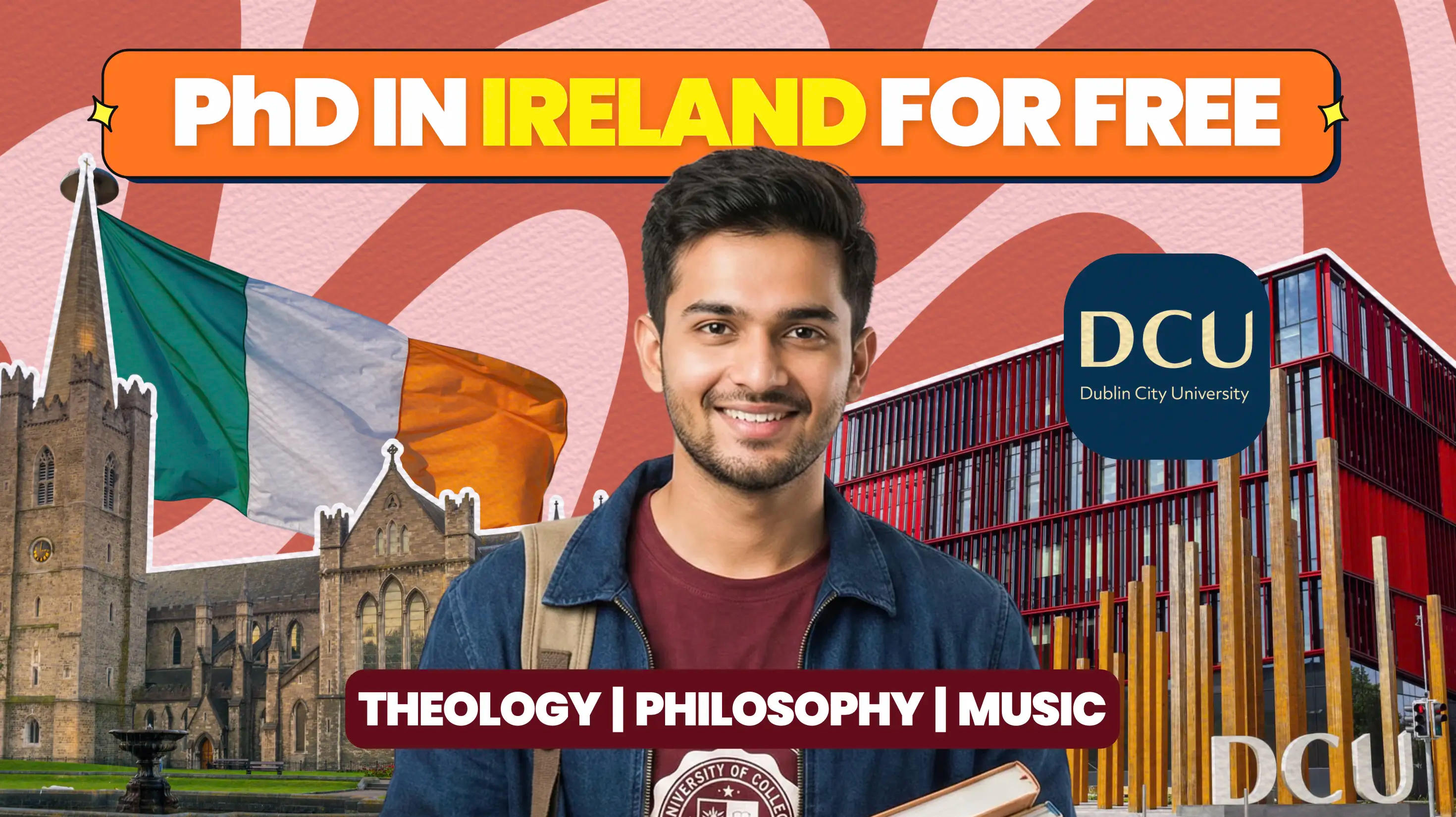
Fully funded PhD scholarships in the humanities are rare anywhere in the world. Most doctoral funding in Ireland, the UK, and across Europe flows toward STEM, engineering, and applied sciences. A fully funded four-year scholarship in theology, philosophy, or music, at a university ranked 410th globally and first in Ireland for research quality, is not something that comes along often.
Dublin City University's School of Theology, Philosophy, and Music offered two such scholarships for 2026. The March deadline has passed. But DCU runs this cycle annually, and the same program, the same funding structure, and the same research areas will return. If this is your field, now is the time to build your position for the next cycle.
Currency note: 1 EUR = Rs. 111.59 as of May 27, 2026. Always verify the current rate before making financial decisions.
What DCU Is
Dublin City University is a public research university founded in 1975, on an 85-acre campus in Glasnevin, about 10 minutes from Dublin city centre. It is not Ireland's oldest institution, but on the metrics that matter most for PhD researchers, it competes strongly.
- QS World University Rankings 2026: 410th globally
- Times Higher Education Young University Rankings: 59th globally, top 100 universities under 50 years old
- Research quality: Ranked 1st in Ireland in the Times Higher Education Rankings 2026
- Graduate employability: Ranked 1st in Ireland in the QS Graduate Employability Rankings
- International community: Over 22 percent of students from outside Ireland, from more than 100 countries
The School of Theology, Philosophy, and Music sits within DCU's Faculty of Humanities and Social Sciences. The faculty runs a dedicated FHSS Doctoral Research Hub, giving PhD students structured academic support, research development, mentoring toward publication, grant writing guidance, and a collaborative scholarly community, not just a desk and a supervisor.
What the Scholarship Covers
Two scholarships are awarded per cycle. Both are identical in structure and funding.
- Duration: 4 years, full-time
- Tuition fees: Fully covered for all 4 years. International PhD tuition at DCU typically runs EUR 13,500 to EUR 18,000 per year. This scholarship removes that cost entirely
- Annual stipend: EUR 25,000 per year (approximately Rs.27,89,750, or roughly Rs.2,32,479 per month)
- Research and training support: Up to EUR 1,000 per year (approximately Rs.1,11,590) for conference attendance, fieldwork travel, and training courses
- Total annual package: Approximately EUR 26,000 per year (approximately Rs.29,01,340) in direct support, on top of the tuition waiver
- Paid teaching: Opportunities for paid teaching within the School, adding income and strengthening your academic CV
What You Can Research
The scholarship is not open-topic. Your proposal must sit within the areas the school's faculty actively supervises. Research areas confirmed for this program:
Theology and Religious Studies:
- Systematic theology and doctrine
- Biblical studies and hermeneutics
- Ecumenism, interfaith dialogue, and religious pluralism
- Practical theology and pastoral studies
- Religion and culture in contemporary society
- GMH (Grant Me Hope) and UKME (UK Minority Ethnic) theological educator pathways, scholarships specifically supporting underrepresented theological voices
Philosophy:
- Continental and analytic philosophy
- Ethics, applied ethics, and bioethics
- Philosophy of religion
- Political philosophy and social theory
- Phenomenology
Music:
- Musicology across genres, practices, and stylistic periods
- Applied musicology
- Choral studies
- Practice-based research in music
- Music and cultural identity
Why Indian students have a genuine research advantage here: India's diverse religious traditions and philosophical schools, including Vedanta, Buddhist philosophy, Islamic philosophy, Jainism, and Sikhism, and their intersection with Western theology and ethics, represent research angles that are both original and underexplored in the Irish university system. A DCU supervisor in comparative theology or philosophy of religion would find an Indian student proposing this kind of cross-tradition research genuinely compelling.
Who Can Apply
Academic requirements:
- An undergraduate degree at first-class or upper second-class honours level (2:1 or above) in a relevant discipline
- For the music scholarship specifically: a master's degree in music or a related discipline is required
- International applicants are fully eligible. No nationality restriction applies
The step most applicants miss: DCU explicitly requires that you make informal contact with a faculty member whose research covers your proposed doctoral area before submitting a formal application. This is not optional in practice. It confirms supervisory capacity and gives you a clearer sense of whether your proposal is a good fit.
Contact only one staff member at a time. Do not email multiple supervisors simultaneously. For general questions, write to the School PhD Convenor: Dr. Miriam De Cock, miriamjane.decock@dcu.ie
What your application must include:
- A cover letter outlining your suitability for the scholarship
- A CV with names and contact details of two academic referees
- Copies of your undergraduate and postgraduate degree certificates
- Academic transcripts
- Your research proposal
Non-negotiable: DCU explicitly states that applications generated with AI or generative AI tools will be disqualified. Your research proposal and cover letter must be written by you. This is one of the few humanities PhD scholarship programs where this is a formal, stated disqualification criterion.
Living in Dublin
The EUR 25,000 annual stipend works out to approximately EUR 2,083 per month before tax. Here is how that sits against real Dublin costs for a PhD student in 2026.
Monthly living costs (approximate):
- Accommodation: EUR 900 to EUR 1,400 (Rs.1,00,431 to Rs.1,56,226), depending on university-affiliated housing versus private rental
- Food and groceries: EUR 250 to EUR 400 (Rs.27,898 to Rs.44,636)
- Transport: EUR 80 to EUR 120 (Rs.8,927 to Rs.13,391). DCU is accessible by Dublin Bus and the Luas tram
- Personal expenses: EUR 150 to EUR 200 (Rs.16,739 to Rs.22,318)
- Total monthly estimate: EUR 1,380 to EUR 2,120 (Rs.1,53,994 to Rs.2,36,571)
After Your PhD: Work Rights in Ireland
PhD graduates from DCU qualify for Ireland's Third Level Graduate Scheme (Stamp 1G):
- Duration: 2 years of full work rights after graduation
- Conditions: No job offer required to activate the permit
- Flexibility: Work for any employer in any sector, or start a business
How to Get Ready for the Next Cycle
The 2026 cycle closed in March. The next cycle is expected to open in January 2027 with a March 2027 deadline, following DCU's consistent annual pattern.
- Email Dr. Miriam De Cock at miriamjane.decock@dcu.ie now with a short introduction, your research area, and an expression of interest in the 2027 cycle. Building this contact before the cycle opens puts you meaningfully ahead of it.
- Identify your target supervisor in the School of Theology, Philosophy, and Music by reading recent faculty publications. Find the person whose work is closest to your proposed research area. Read two or three of their papers before making contact.
- Start drafting your research proposal. A competitive humanities PhD proposal takes months to develop. A proposal started in January 2027 when the portal opens will not be your best work.
- Monitor the official websites for any mid-year announcements, additional scholarship openings, or changes to the 2027 call.
Before You Apply
This scholarship suits an Indian student with a strong humanities background in theology, religious studies, philosophy, or music, who has a clearly defined research question, and who is ready to commit four years to doctoral research in Dublin.
It is not the right fit for STEM students, those whose research sits outside the school's supervisory areas, or those who need a major corporate employer base for networking during their PhD.
Book a free session with a Leap Scholar counselor to understand whether the DCU FHSS doctoral program fits your research background, how to develop a competitive humanities PhD proposal for an Irish university, and what other fully funded PhD opportunities are currently open for Indian students in your field.
Sources: jobs.ac.uk, DCU PhD Scholarships in Theology, Philosophy, and Music 2026 | EURAXESS, DCU PhD Scholarship Music | TopUniversities, DCU QS 2026 Ranking | The Mentors Circle, DCU India Profile | BookMyForex, EUR to INR Rate May 27, 2026 | DCU official scholarship page | DCU official fees page | Official DCU School of Theology, Philosophy, and Music | Stamp 1G page for post-study work rights | Young University and research quality rankings | UKRI for the doctoral stipend comparison | Numbeo Dublin or DCU student guide for living costs.

Kirti Singhal
Kirti is an experienced content writer with 4 years in the study abroad industry, dedicated to helping students navigate their journey to international education. With a deep understanding of global education systems and the application process, Kirti creates informative and inspiring content that empowers students to achieve their dreams of studying abroad.
Users also read

Vietnam Steps Into the Global Academic Spotlight at APAIE 2026: And Indian Students Should Pay Attention
Vietnam Steps Into the Global Academic Spotlight at APAIE 2026: And Indian Students Should Pay Attention

Indian Passport Fees Rise From July 1, 2026. Here Is What It Means If You Plan to Study Abroad.