
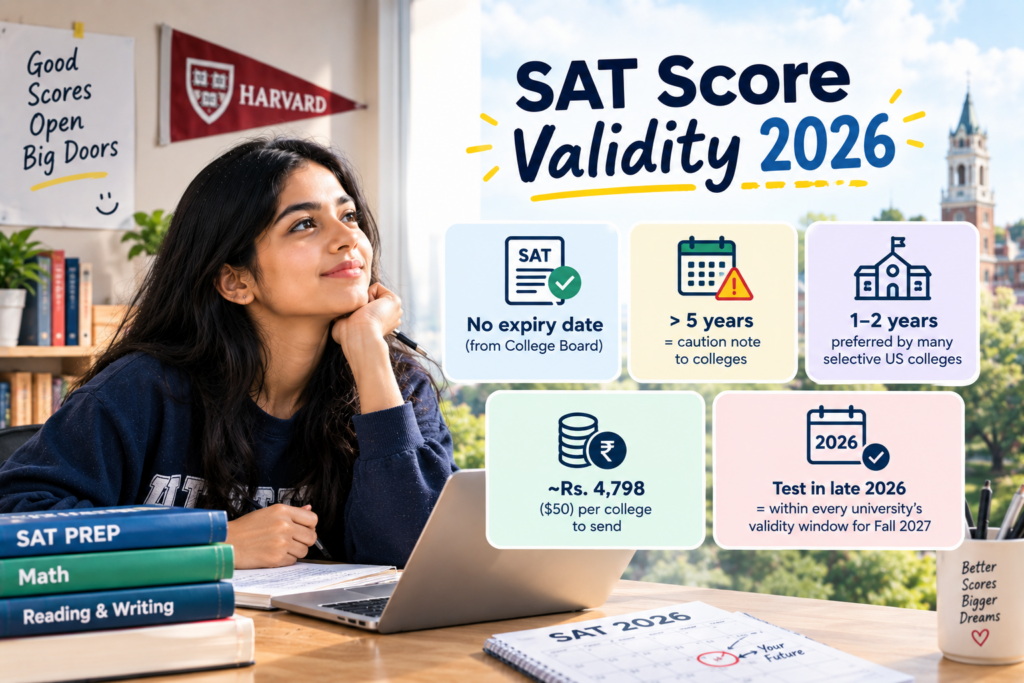
Quick Read
- SAT scores have no official expiry date from College Board.
- Scores older than 5 years are sent to colleges with a caution note.
- Many selective US colleges prefer scores from the last 1 to 2 years.
- Archived scores cost approximately Rs.4,798 ($50) per college to send.
- Testing in late 2026 keeps you safely within every university’s SAT score validity window for Fall 2027.

What Is SAT Score Validity, and Does the SAT Expire?
Many students come to this question after realising their SAT score is two or three years old and wonder whether it is still valid. The answer is not as simple as yes or no.
Technically, the SAT does not expire. The College Board keeps scores on file for many years. But here is the catch: College Board does not guarantee long-term storage; scores from before 2005 can no longer be retrieved, and scores older than five years arrive at universities with this note attached:
“Official score reports sent to colleges five or more years after a test date may be less valid predictors of college academic performance than more recent scores.”
That one line is what drives every university’s SAT score validity policy. The college reads it alongside your score and makes its own call. Some apply a hard five-year cutoff. Others just weigh recent scores more heavily. A few have no stated limit at all.
| Level | What It Means |
|---|---|
| Technical SAT score validity | College Board stores scores but does not guarantee indefinite access |
| Practical SAT exam validity | Many universities treat scores older than 5 years with caution |
| Selective college standard | Many prefer scores within 1 to 2 years |
Our Digital SAT 2026-27 guide covers test dates and format if you are planning your next sitting.
My insight: Every year, students hold onto a good score from Class 10, thinking it will serve them through their applications. For most US universities, five years is the window. Ivy League schools, however, expect scores to be much more recent.
How Long Are SAT Scores Valid? The Practical Reality for Indian Students
Your score has no expiry date, but each university decides how old a score it will accept. There is no universal rule. The same score that sails through at one university might raise questions at another.
| University Type | SAT Score Validity Window | Notes |
|---|---|---|
| Most public US universities | Up to 5 years | Scores arrive with a College Board caution note if older than 5 years |
| Private US universities | 2 to 5 years | Varies widely; check each university’s admissions page |
| Ivy League and top 25 programs | 1 to 2 years preferred | No hard cutoff published, but recent scores carry more weight |
| Indian private universities (Ashoka, Shiv Nadar, KREA) | No published limit; confirm with admissions | Policies are not stated online; contact the admissions office |
| Canada, Australia, and UK universities accepting SAT | No published limit; confirm with admissions | Policies vary by institution; verify before applying |

Why a pre-2023 score is worth flagging separately:
India moved to the Digital SAT in March 2023. If your score is from before then, it is from an entirely different version of the test. Here is what changed when the format shifted:
- Paper SAT had long passages (500 to 750 words) with 10 to 11 questions each; Digital SAT uses short passages of 25 to 150 words with one question each
- Digital SAT is adaptive: Module 2 adjusts based on how you did in Module 1
- Total time dropped from 3 hours to 2 hours 14 minutes
- The SAT Essay was removed in 2021
Some admissions offices treat an old paper SAT score as a score from a different exam entirely, not just an older one. If your score predates March 2023, it is worth contacting each target university before sending it.
Source: College Board, What Is on the Digital SAT
My insight: The 5-year window is the floor, not the ceiling. A three-year-old score that is 80 points below a university’s stated cutoff is a retake question, not a validity question.
SAT Score Validity by University: Named Examples for Indian Students
No two universities apply the same SAT score validity rules, and generic ranges can mislead. Below, we list named institutions with their actual testing policies linked directly, so you can verify before sending an old score. Where no official age limit is published, contact the admissions office before paying the retrieval fee.
| University | Requires SAT/ACT? | Published SAT Score Validity Limit | Admissions Page |
|---|---|---|---|
| Harvard University | Yes | Not published; recent scores strongly preferred | harvard.edu |
| MIT | Yes | Not published; scores should reflect current ability | mitadmissions.org |
| Yale University | Yes (reinstated 2026-27) | Not published; recent scores strongly preferred | admissions.yale.edu |
| University of Alabama | Yes, for merit scholarships | Annual scholarship grids; current-year score expected | afford.ua.edu |
| UC system (UCLA, UC Berkeley, UC San Diego) | Test-blind | Score not reviewed regardless of age | N/A |
| Ashoka University | Accepted for admissions | No published limit; confirm with admissions | ashoka.edu.in |
| Shiv Nadar University | Accepted for admissions | No published limit; confirm with admissions | snu.edu.in |
| KREA University | Accepted for admissions | No published limit; confirm with admissions | krea.edu.in |
One thing worth knowing before you send anything: The UC system (UCLA, UC Berkeley, UC San Diego and others) became permanently test-blind in 2021. At these universities, your SAT score will not be reviewed regardless of how recent or strong it is. Many other US universities are still test-optional. Always check the current policy before spending money on score retrieval.
College Board India Scholars Program: College Board’s India Scholars page does not state a score-age limit. Partner universities choose recipients through their admissions process. Confirm with each institution whether an older score will be considered. See our SAT score guide for qualifying score levels.
For a full list of universities that accept SAT scores, see our guide to SAT-accepting colleges worldwide.
What Happens to Old SAT Scores? Archived Scores Explained
Here is something that many students do not realise: once you leave school and stop testing, the College Board quietly archives your scores. They are not deleted. You can still retrieve them and send them to universities. But the process is different from sending an active score, and it costs more.
Archiving starts after you graduate high school and have not taken the SAT again for over a year. Even if your score is only 18 months old, it may already be archived.
How to get them back:
| Step | What to Do |
|---|---|
| Step | What to Do |
| 1. Check your account | Log in to your College Board account and go to your score history |
| 2. Look for archived scores | If visible, select them and choose the colleges to send to |
| 3. Not showing up? Call College Board | Phone (international): +1-212-713-7789 |
| 4. Keep these details handy | Your name and address at the time of testing; test date; registration number; recipient college codes |
| 5. Pay and submit | Choose standard or rush delivery; you get a confirmation by email |
What it costs in 2026:
| Service | Fee (USD) | Approx. Fee (INR) |
|---|---|---|
| Additional score report (per college) | $15 | Rs.1,439 |
| Archived score retrieval fee | $35 | Rs.3,358 |
| Total for standard delivery (per college) | $50 | Rs.4,798 |
| Rush delivery surcharge | +$31 | +Rs.2,974 |
| Total with rush delivery (per college) | $81 | Rs.7,772 |
Source: College Board, International Testing Fees
Standard delivery can take several weeks, so order at least six weeks before your deadline. Rush delivery arrives in 2 to 4 business days, but check with your target university first because some admissions portals process documents on their schedule regardless.
My insight: Before you spend Rs.4,798 on an archived score that is four or five years old, ask yourself honestly whether retaking makes more sense. If the score is strong and the university accepts it, go ahead. If it was borderline, a fresh attempt is almost always the better call.
Should You Retake the SAT or Submit Your Old Score?
This is what most people are actually trying to figure out when they search for SAT score validity. The answer is not the same for everyone, but here is a clear way to think about it.
The score is under 3 years old and above your target university’s cutoff:
Just send it. You are well within the SAT score validity window, and the score is competitive. Spend your energy on other parts of the application.
Score between 3 and 5 years old:
Check each university’s policy directly. For most US public universities, you are probably fine. For selective private schools, a retake is worth considering if your score could improve meaningfully and you have the time. For the India Scholars Program, contact the partner university to confirm.
Scores older than five years:
College Board will attach a caution note when sending it. Some universities will still look at it, but most selective ones will ignore it. A retake is the cleaner path unless a university explicitly tells you they will accept it.
For Fall 2027 applicants:
Any score from 2026 will be well within every university’s SAT score validity window. The November 7 and December 5, 2026, test dates both land comfortably within US scholarship deadlines.
If you are still deciding between tests, our guide on whether the SAT is easy for Indian students and the ACT vs SAT comparison can help.
SAT Score Validity and Superscoring
Many universities superscore, meaning they take your best Math score from one sitting and your best Reading and Writing score from another and combine them into one composite. It sounds straightforward, but there is a wrinkle when older scores are involved.
If you are superscoring across two test dates, both need to fall within the university’s SAT score validity window. A 1420 built from a Reading score taken in 2022 (paper SAT era) and a Math score from 2025 (Digital SAT) could raise questions about the age of one score and the format mismatch between the two. It’s worth having a direct conversation with the admissions office before you send your scores.
These are the three things to check before submitting scores from multiple sittings, since sat validity rules apply to every score date in a superscore:
- Whether the university superscores at all
- Whether both test dates fall within their SAT score validity window
- Whether they accept a mix of paper and digital SAT scores in a superscore
For a full walkthrough of sending scores, including how Score Choice works, see our guide on sending SAT scores to colleges.
What Indian Students Should Do Next About SAT Score Validity
- Score under 3 years old: You are within the SAT score validity window for all universities. The question to ask now is whether the score is high enough, not whether it is recent enough.
- Score between 3 and 5 years old: Accepted by most universities. For selective schools, call and confirm. If you need to send an archived score, the budget is Rs.4,798 per college and at least six weeks.
- Scores over 5 years old: College Board will flag them. Retaking is the cleaner option for selective institutions. For other institutions, please confirm before proceeding with the payment for retrieval.
- Testing late 2026 for Fall 2027: Your score will be valid for all applications for that cycle. Concentrate on getting the score right.
Verified by: LeapScholar’s SAT counselling team, who work with Indian students every year on Digital SAT preparation, score strategy and choosing the right test window for their target universities.
Have questions about your SAT score validity or when to retake? Book a free session with a LeapScholar counsellor.
Frequently Asked Questions About SAT Score Validity for Indian Students
-
Do SAT scores expire?
Not officially. College Board does not stamp an end date on your scores. They stay on file for many years. But once a score is older than 5 years, College Board flags it when sending it to universities, noting it may be a weaker indicator of current academic ability. Most universities treat that flag as a practical limit on SAT exam validity. One strict cutoff does exist, though: scores from before 2005 are gone entirely and cannot be retrieved.
-
How long are SAT scores valid for college admissions?
Depends entirely on where you are applying. Most US public universities are comfortable with SAT scores being valid for up to five years. Ivy League and top-25 schools expect much more recent scores, often within 1 to 2 years. No universal rule exists, so check each university’s admissions page before sending old scores.
-
SAT scores are valid for how many years at Indian universities?
Ashoka, Shiv Nadar and KREA do not publish a specific SAT score validity period anywhere on their sites. Your best move is to email the admissions office directly and ask whether your specific test year will be considered.
-
What is the validity of the SAT score for the India Scholars Program?
College Board’s own India Scholars page does not mention a score-age requirement. The partner universities pick recipients through their admissions decisions, so the score-age question needs to go directly to whichever institution you are applying to.
-
How long do SAT scores stay valid if I took the paper SAT before 2023?
The score itself does not expire. But since the paper and digital SAT are structurally different exams, some universities flag pre-2023 scores differently, on top of any age-based caution. The 5-year SAT score validity window still applies, and the format difference adds another reason to contact the admissions office before sending.
-
Does the ACT also have a validity window?
Yes. ACT, Inc. similarly recommends scores within 5 years, and selective schools apply the same logic they would for an old SAT score. If you are weighing which test to take or retake, our ACT vs SAT guide covers the full comparison for Indian students.
-
Can I use an SAT score from Class 9 or earlier?
College Board has historically removed scores taken before 9th grade unless the student specifically requested retention. More practically, a Class 9 score will already be 3 to 7 years old by the time most Indian students apply for undergraduate programmes. Factor in both the age and whether the score is strong enough for your target universities before deciding not to retake.
-
How do I retrieve archived SAT scores?
Start with your College Board account and check your score history for an archived scores section. If nothing shows up, call +1-212-713-7789, the international customer service number. Have your test date, registration number and the address you used at the time of testing ready. The fee is $35 (Rs.3,358) to retrieve plus $15 (Rs.1,439) per score report sent.
-
Can I send a 6-year-old SAT score to a university?
You can. College Board will send it with a note warning that it may be a less reliable predictor of academic performance. Whether the university acts on that note is their call. Highly selective schools almost certainly will. Less selective ones may look past it if the rest of your application is strong.
-
How long are SAT scores valid if I am taking a gap year?
Taking a gap year does not change how long your SAT scores are valid. If your gap year means you’ll be applying more than 5 years out from your test date, retake the SAT or check with your colleges to make sure they’ll still accept your scores.










Have Questions? Get Guidance to reach your Dream University
Connect with India's finest counsellors and biggest study abroad community.
Get Guidance