
Quick Read
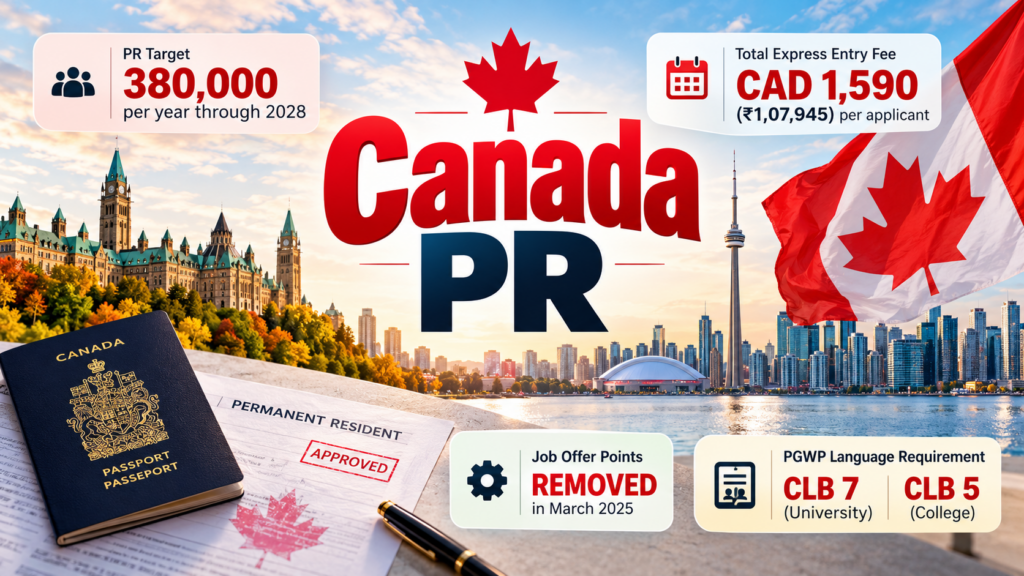
- Canada’s PR target is stable at 380,000/year through 2028, not rising to 500,000 as once planned
- CRS job-offer points were removed in March 2025; category-based draws now dominate
- Total Express Entry PR fee is CAD 1,590 (₹1,07,945) per applicant as of April 2026
- PGWP now requires CLB 7 (university) or CLB 5 (college) language proof, plus field-of-study rules for diplomas
Canada PR at a Glance 2026
Canada permanent residency isn’t a single visa category; it’s an outcome reached through several federal and provincial programs, all managed by Immigration, Refugees and Citizenship Canada (IRCC), the department formerly known as Citizenship and Immigration Canada.
| Metric | 2026 Figure |
| Annual PR admissions target (2026–2028) | 380,000, stable, not rising |
| Economic class share of admissions | 64% by 2027–28 |
| CRS cutoff, CEC draws (2026) | ~507–518 |
| CRS cutoff, French-language category draws | ~393–419 |
| Total Express Entry PR application fee | CAD 1,590 (₹1,07,945) |
| Typical Express Entry processing time | ~7 months |

Choose your dream country
 UK
UK
 USA
USA
 Germany
 Australia
 Ireland
 Canada
 UAE
UAE
 France
 Sweden
 Italy
Italy
 Other
Other
When do you want to study abroad?
What's your highest level of education?
Have you completed Class 12th?
What was your Class 12 CGPA/percentage?
Are you a student or a parent/guardian?
What do you want to study?
Select your current city
How Leap will help you

Personalised University Shortlist

Express Applications with Quicker Admits

End-to-End Application Support
Exchange rate note: All figures use 1 CAD = ₹67.89, fixed for this article as of October 2026. Verify current rates before budgeting.
What Is Canada PR, and How Immigration Levels Actually Work Now
A Canadian permanent resident can live, work, and study anywhere in the country, access most social benefits, including healthcare, and eventually apply for citizenship. It is distinct from citizenship itself and from a temporary visa like a study or work permit.
Note: Canada is not scaling immigration up toward half a million new permanent residents. Under the 2026–2028 Immigration Levels Plan, released in November 2025, IRCC stabilized PR admissions at 380,000 a year through 2028, a deliberate pullback from the 500,000 target set in earlier plans. This followed a similar reduction in the 2025–2027 plan, driven by housing and infrastructure capacity concerns. For Indian applicants, the practical effect is a more selective, more competitive Express Entry pool than a few years ago, not an expanding one.
If you're weighing whether to stay on after your degree at all, see what our counselors say about what your plans could look like for settling in Canada versus returning to India after a master's before you map out a specific PR route.
Source: IRCC, Supplementary Information for the 2026–2028 Immigration Levels Plan
Canada PR Requirements: Minimum Eligibility by Program
Before CRS ranks you, you first have to clear a baseline eligibility bar, and that bar is different for each of the three Express Entry programs.
| Requirement | FSWP | CEC | FSTP |
| Work experience | 1 year continuous (1,560 hours), foreign or Canadian, within last 10 years | 1 year, Canadian only, within last 3 years | Enough to meet a trade's certification requirement |
| Occupation classification | TEER 0, 1, 2, or 3 | TEER 0, 1, 2, or 3 | Specific skilled trade occupations |
| Language (all 4 abilities) | CLB 7 minimum | CLB 7 for TEER 0/1 roles; CLB 5 for TEER 2/3 roles | CLB 5 speaking/listening; CLB 4 reading/writing |
| Education | Assessed via ECA | No formal requirement | No formal requirement |
| Separate points grid | Must score 67+ on the FSWP selection grid | None | None |
| Proof of funds | Required (unless exempt) | Not required | Required (unless exempt) |
| Job offer or certificate | Not required | Not required | Valid job offer or a certificate of qualification in the trade |
Counselor insight: FSWP work experience can be foreign or Canadian, but CEC work experience must have been earned inside Canada; a foreign work history, however strong, doesn't count toward CEC eligibility at all. And unlike FSWP, neither CEC nor FSTP uses a separate points-grid pass mark; clearing the work experience and language bar is enough to enter the pool, after which your CRS score alone determines your invitation odds.
Canada PR Eligibility: What Determines Your Score
Once you clear the baseline eligibility bar for your program, Canada permanent resident eligibility within the Express Entry pool comes down to your CRS score, used to rank everyone who qualifies. CRS factors include:
- Age
- Education (assessed against Canadian standards via an Educational Credential Assessment)
- Official language proficiency (English and/or French)
- Canadian or foreign skilled work experience
- A provincial nomination, where applicable
- A spouse or common-law partner's factors, if accompanying
Note: CRS points for a job offer (arranged employment) were removed entirely, effective 25 March 2025. A valid job offer, LMIA-backed or not, no longer adds CRS points. If you're using an older CRS calculator or guide that still lists 50 or 200 bonus points for a job offer, that figure is now zero.
Source: IRCC, Express Entry: Comprehensive Ranking System
Canada Immigration’s Occupation Classification: TEER, Not NOC Skill Type
Canada immigration retired the old NOC skill-type system (0, A, B, C, D) in November 2022, replacing it with the TEER (Training, Education, Experience, and Responsibilities) structure, TEER 0 through 5. Most Express Entry pathways, including the Canadian Experience Class, require skilled work experience classified as TEER 0, 1, 2, or 3. If you're checking whether your occupation qualifies, look it up under its current TEER category rather than an old NOC skill type, since the classification system itself has changed, not just the codes within it.
Counselor Insight: We still see candidates self-assess using NOC 0/A/B language from older blogs and get their work-experience points wrong as a result. Always check your occupation's current TEER category directly on the NOC 2021 site before estimating your CRS score.
Express Entry Canada: How Draws Actually Work in 2026
Express Entry Canada manages three federal economic programs: the Federal Skilled Worker Program (FSWP), the Federal Skilled Trades Program (FSTP), and the Canadian Experience Class (CEC). Here's the part most guides miss: IRCC has not run a general, all-program draw since April 2024. Every invitation round since then has been either CEC-specific or category-based.
| Draw type | 2026 CRS cutoff range |
| Canadian Experience Class (CEC) | ~507–518 |
| French-language category draws | ~393–419 |
| Healthcare occupations category | ~462–476 |
For 2026, category-based selection runs across ten categories: five retained from prior years (French-language proficiency, healthcare, education, STEM occupations, and trades) and five new ones (physicians, researchers, senior managers, transport occupations, and military recruits). The agriculture and agri-food category was retired for 2026. Strong French proficiency remains the single highest-leverage way to lower your effective CRS bar, since French category cutoffs run roughly 90–120 points below CEC cutoffs.
Source: IRCC, Express Entry rounds of invitations
8 Routes to Permanent Resident Canada Status
There is no one procedure for Canada PR; the right route depends on your profile.
1. Express Entry System: manages FSWP, FSTP, and CEC. The dominant federal pathway for skilled workers and Canadian-experienced graduates.
2. Provincial Nominee Program (PNP): provinces nominate candidates matching local labor needs. An Express Entry-linked (enhanced) nomination adds 600 CRS points, effectively guaranteeing an invitation.
3. Family Sponsorship: Canadian citizens and PR holders can sponsor spouses, partners, dependent children, parents, and grandparents, subject to sponsor income requirements.
4. Business Immigration: includes the Start-Up Visa Program and Self-Employed Persons Program for entrepreneurs and those with relevant cultural or athletic experience.
5. Atlantic Immigration Program: for skilled workers and graduates with a job offer from a designated employer in Nova Scotia, New Brunswick, PEI, or Newfoundland and Labrador.
6. Rural and Francophone Community Immigration Pilots: replaced the earlier Rural and Northern Immigration Pilot, targeting smaller communities with a local job offer and settlement plan.
7. Home Care Worker Immigration Pilots: for caregivers, launched in 2025, with fees matching the standard economic-class schedule.
8. Quebec-Selected Skilled Workers: Quebec runs its own selection through the Programme de sélection des travailleurs qualifiés (PSTQ), applied for via Arrima. The PEQ ended in November 2025.
See what our counselors say about whether it's realistic to build a career and settle permanently in Canada as a skilled graduate before picking a route.
PGWP Eligibility: The Rules That Changed in 2024–25
If you're timing your studies around this pathway, our Fall Intake in Canada guide covers deadlines across universities before you get to the PGWP stage. For most international students, the Post-Graduation Work Permit (PGWP) is the bridge between graduation and Canada PR eligibility, most commonly through the CEC. Two rules introduced since November 2024 directly affect this bridge:
Language requirement (all PGWP applicants):
- University degree graduates: minimum CLB 7 in all four language areas (speaking, listening, reading, and writing)
- College or non-degree program graduates: minimum CLB 5 in all four areas
Field-of-study requirement:
- Bachelor's, master's, and doctoral degree graduates: no field-of-study restriction
- College diploma and non-degree program graduates: must have studied in a field tied to occupations in a long-term labor shortage, per IRCC's eligible fields list, last updated 25 June 2025
Counselor insight: This means a university degree protects you from the field-of-study restriction entirely, but not from the language requirement. Before choosing a Canadian program with PR in mind, confirm it's PGWP-eligible.
If computer science is on your shortlist, our guide to MSc in Computer Science programs in Canada breaks down which universities offer PGWP-eligible, degree-level options in the field; for schools outside the usual metro hubs, our rankings guides for Dalhousie University and University of Regina cover fees and placements at two PGWP-eligible options. Get expert answers on the PR options available once you've completed your studies in Canada and once you've locked in a program.
Official source: IRCC, Post-graduation work permit: Field of study and language requirements
Canada PR Visa Application Fee: 2026 Breakdown in CAD and INR
IRCC raised permanent residence fees across every category effective 30 April 2026. This is the current, confirmed schedule for the economic class (Express Entry, PNP, Atlantic Immigration, and most economic pilots), which covers the large majority of Indian applicants.
| Fee component | Amount (CAD) | INR equivalent |
| Processing fee, principal applicant | 990 | ₹67,211 |
| Processing fee, accompanying spouse/partner | 990 | ₹67,211 |
| Processing fee, dependent child | 270 | ₹18,330 |
| Right of Permanent Residence Fee (RPRF), principal applicant | 600 | ₹40,734 |
| Total, principal applicant (processing + RPRF) | 1,590 | ₹1,07,945 |
| Permit holders class, principal applicant (with RPRF) | 990 | ₹67,211 |
The RPRF can be paid upfront with your application or deferred until IRCC approves you in principle; it's the only fee component that's refunded if your application is refused or withdrawn. If you submitted your application before 30 April 2026 but deferred the RPRF, you're required to pay the new, higher rate when it comes due.
Source: IRCC, Fee changes for permanent residence applications
Funds Required for Canada PR (2026)
Proof of settlement funds applies to Federal Skilled Worker and Federal Skilled Trades applicants. Canadian Experience Class candidates are entirely exempt from this requirement, a distinction worth knowing before you assume every Express Entry applicant needs to show funds.
| Family size | Minimum funds (CAD) | INR equivalent |
| 1 | 15,263 | ₹10.36L |
| 2 | 19,001 | ₹12.90L |
| 3 | 23,360 | ₹15.86L |
| 4 | 28,362 | ₹19.25L |
| 5 | 32,168 | ₹21.84L |
| 6 | 36,280 | ₹24.63L |
| 7 | 40,392 | ₹27.42L |
| Each additional member beyond 7 | 4,112 | ₹2.79L |
Funds must be liquid, available, and unencumbered; equity in real property doesn't count. IRCC updates these figures annually based on 50% of the low-income cut-off, so confirm the live table before relying on a fixed number.
Source: IRCC, Proof of funds - Skilled immigrants (Express Entry)
Canada PR Visa Application Processing Time
| Pathway | Typical processing time |
| Express Entry (FSWP, FSTP, CEC) | ~7 months |
| PNP, Express Entry-enhanced stream | ~7 months |
| PNP, base (non-Express Entry) stream | ~13 months |
| Spousal sponsorship | ~12 months |
| Parent and Grandparent sponsorship | 20–24 months |
| Start-Up Visa Program | 12–16 months |
Completeness of application, background and security checks, and overall application volume all affect actual processing time beyond these published averages. These figures are drawn from aggregated reporting rather than a directly fetched IRCC processing-times page; confirm current timelines on IRCC's own processing times tool before relying on them for planning.
Documents Required for Canada PR
- Valid passport for each applicant and dependent
- Educational Credential Assessment (ECA) report
- Language test results (IELTS, CELPIP, PTE Core, or TEF, depending on your target language)
- Proof of funds documentation (where applicable; CEC applicants are exempt)
- Police clearance certificates
- Medical examination results
- Birth, marriage, and other civil status certificates, with certified translations if not in English or French
- Skills assessment report, for certain regulated professions (engineering, nursing, etc.)
If you're still earlier in the process and haven't applied to a Canadian program yet, our Canada entrance exams guide covers which tests each program actually requires, since your IELTS or similar score here is often the same one you'll later report for PGWP and Express Entry language points.
Canada Permanent Resident Process: Step by Step
- Get your ECA to confirm your foreign credentials meet Canadian standards
- Take a language test and ensure your results meet your target CLB/NCLC level
- Create your Express Entry profile with your CRS-relevant details
- Apply to PNPs if eligible, since a nomination adds 600 CRS points
- Watch for an Invitation to Apply (ITA) from a CEC, category-based, or PNP-linked draw
- Submit your complete application to IRCC within 60 days of the ITA
- Complete medical exams and police clearance certificates
- Pay biometrics and provide fingerprints
- Submit your passport for visa stamping once approved
- Receive your Confirmation of Permanent Residence (COPR)
If you're still choosing a program with this process in mind, read what our counselors recommend for getting PR faster after a master's in Canada. If you're still deciding whether to pursue this process at all, see what they say about whether you can settle in Canada or must return to India after studying abroad.
Canada PR Card Renewal and Citizenship
A PR card typically lasts five years. To renew it, you need to show at least 730 days of physical presence in Canada within the preceding five years.
People sometimes search for "permanent citizenship in Canada," conflating two different statuses. Permanent residency and citizenship are not the same thing: PR lets you live and work indefinitely but doesn't grant a Canadian passport or voting rights. After living in Canada as a PR holder for at least three of the last five years (1,095 days), you become eligible to apply for citizenship, which requires:
- Language proficiency in English or French (ages 18–54)
- Passing a citizenship test on Canadian history, values, and institutions
- Good character, with no serious criminal convictions or active removal order
Counselor Insight: Time on a study permit or PGWP before you become a PR counts as half a day, up to a maximum credit of 365 days, toward the 1,095 days you need in the last five years. Days after your COPR count in full. p
3 Takeaways on Canada PR for Indian Students
- Canada's immigration targets are stabilizing, not expanding: 380,000 PR admissions a year through 2028, not the 500,000 once planned.
- Job-offer CRS points have been removed since March 2025. Category-based draws (CEC, French, healthcare, STEM, and others) now matter more than the old general-draw model.
- Budget CAD 1,590 (₹1,07,945) for the Express Entry application fee alone, and check your PGWP's language and field-of-study eligibility before committing to a Canadian program.
Verified by: LeapScholar's Canada counseling team, drawing on direct experience guiding students and graduates through Express Entry profile building, PGWP eligibility, Provincial Nominee Program applications, and Canadian Experience Class transitions.
Have a specific question about Canada PR? Book a free session with a LeapScholar counselor.
Frequently Asked Questions About Canada PR
-
What are the basic Canada PR requirements?
Requirements differ by program. FSWP needs 1 year of skilled work experience (foreign or Canadian), CLB 7 language, and a 67+ selection grid score. CEC needs only 1 year of Canadian work experience, with no points grid. FSTP needs a trade job offer or certificate with CLB 5/4 language. All require proof of funds except CEC.
-
What determines eligibility for Canada permanent residency?
For points-tested pathways, the CRS score, calculated from age, education, language ability, and work experience, determines your rank in the Express Entry pool once you've cleared your program's baseline eligibility bar. Since March 2025, job offers no longer add CRS points, so category-based draws and provincial nominations have become more important routes for candidates without a strong core CRS score.
-
How do I apply for a Canada PR visa from India?
Determine your best-fit pathway (Express Entry, PNP, or family sponsorship), get an ECA, take a language test, build your Express Entry profile, and wait for an invitation through a CEC or category-based draw, since general all-program draws haven't run since April 2024.
-
What is the current Canada PR application fee?
As of 30 April 2026, the total fee for a principal applicant in the economic class is CAD 1,590 (₹1,07,945), made up of a CAD 990 processing fee and a CAD 600 Right of Permanent Residence Fee.
-
What are the rules for Canada PR for international students?
Most international students pursue PR through the Canadian Experience Class after completing a PGWP. Your PGWP's language and field-of-study eligibility, set under rules introduced in November 2024, directly determine whether this route is open to you.
-
Is Canada increasing or reducing its immigration targets?
Reducing, relative to earlier plans. The 2026–2028 Immigration Levels Plan stabilizes PR admissions at 380,000 a year through 2028, down from a previously planned 500,000, as part of a broader effort to ease housing and infrastructure pressure.
-
What's the difference between Canada PR and Canadian citizenship?
Canada PR, sometimes searched as "permanent citizenship in Canada," lets you live and work indefinitely but doesn't include a passport or voting rights. Citizenship, available after three of the last five years as a PR holder, grants both, along with a citizenship test and language requirement.
-
Do I need proof of funds for every Canada PR pathway?
No. Proof of funds applies to Federal Skilled Worker and Federal Skilled Trades applicants. Canadian Experience Class candidates, the most common route for international graduates, are exempt entirely.





Have Questions? Get Guidance to reach your Dream University
Connect with India's finest counsellors and biggest study abroad community.
Get Guidance