
Quick Read
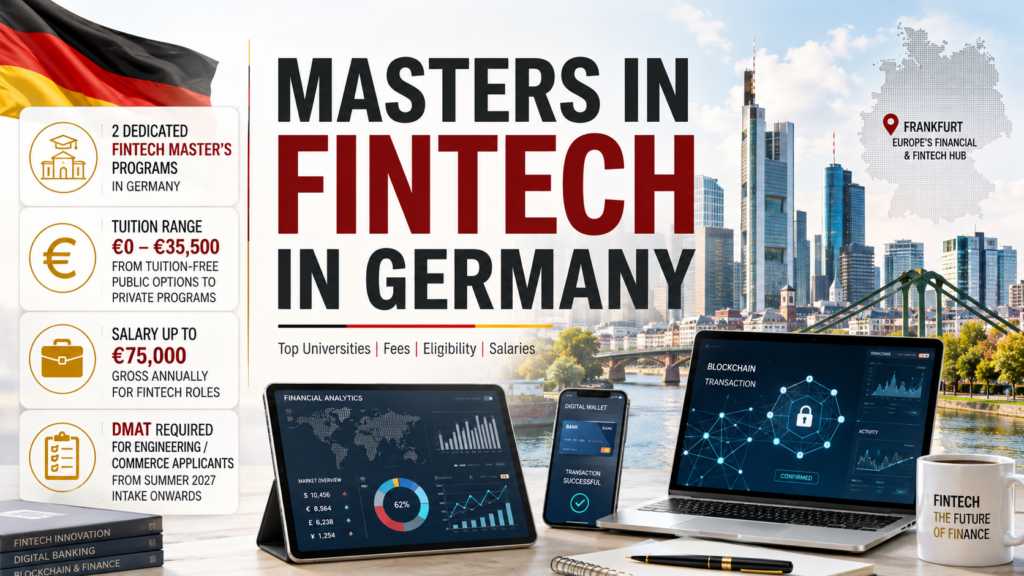
- Germany has only two universities offering a named Masters in FinTech.
- Frankfurt School’s program costs €35,500 (₹38,99,320) in tuition only.
- The dMAT exam now applies to engineering, commerce, and finance graduates.
- Public universities offer tuition-free adjacent Finance programs with FinTech modules.
Why Study a Masters in FinTech in Germany?
Germany pairs Europe’s largest banking sector with a fast-growing digital finance scene, which is exactly the combination a FinTech career needs. Here’s what makes it worth the shortlist:
- Industry demand: Frankfurt hosts the European Central Bank, Deutsche Bank, Commerzbank, and the Frankfurt Stock Exchange, alongside fintech names like N26 and Trade Republic actively hiring digital banking and blockchain talent.
- Affordability relative to outcome: Even the private, dedicated FinTech programs cost less than comparable UK or US degrees, and the adjacent public-university route is close to tuition-free.
- Research and faculty depth: Programs sit inside dedicated research centres, such as Frankfurt School’s Centre for Digital Economics, giving direct exposure to blockchain, AI in finance, and regulatory technology research.
- Global employer access: Recruiters across Europe, not just domestically, regard Germany’s TU9 and Frankfurt-based finance schools highly.
- A rule-based, predictable visa path: Unlike lottery-based systems elsewhere, Germany’s post-study work visa, EU Blue Card, and Opportunity Card all run on fixed, published criteria.

Choose your dream country
 UK
UK
 USA
USA
 Germany
 Australia
 Ireland
 Canada
 UAE
UAE
 France
 Sweden
 Italy
Italy
 Other
Other
When do you want to study abroad?
What's your highest level of education?
Have you completed Class 12th?
What was your Class 12 CGPA/percentage?
Are you a student or a parent/guardian?
What do you want to study?
Select your current city
How Leap will help you

Personalised University Shortlist

Express Applications with Quicker Admits

End-to-End Application Support
Counselor insight: Most Indian applicants search "Masters in FinTech in Germany" expecting a long university list, the way UK or US FinTech searches return. Germany's market is narrower and more specialized, which is precisely why getting your shortlist right early matters more here than in bigger markets.
Comparing Masters in FinTech Programs in Germany: Fees and Eligibility
Only two universities in Germany offer a degree formally titled a Masters in FinTech; a third offers a FinTech specialization inside a broader Finance degree, and a fourth is the tuition-free public alternative.
Here's how all four stack up, and see what our counselors say about whether GMAT is required for APS certification for a Masters in Germany if you're weighing a GMAT-mandatory program against a no-GMAT route.
| Programme | University | Type | Total Cost | Duration | Key Entry Requirement |
| Master in Financial Technology | Frankfurt School of Finance & Management | Private, dedicated | €35,500 (₹38,99,320) tuition + €400 (₹43,936) enrolment + €100 (₹10,984) application | 4 semesters (3 possible) | TOEFL 90 iBT / IELTS 7.0, GMAT/GRE, or Frankfurt School Admission Test |
| MSc Finance and FinTech | Gisma University of Applied Sciences | Private, dedicated | €25,100 (₹27,56,984) for 120 ECTS, or €16,250 (₹17,84,900) for 60 ECTS | 12 to 24 months | IELTS 6.0 / B2 English, no GMAT/GRE required |
| Master in Finance (FinTech Management track) | Goethe Business School | Private, specialisation | €23,500 (₹25,81,240) tuition + €1,000 (₹1,09,840) admission + €100 (₹10,984) application | Full-time or part-time | Relevant Bachelor's degree, English proficiency |
| MSc Money, Macro and Finance | Goethe University Frankfurt | Public, adjacent | Tuition-free; ~€350 (₹38,444) per semester admin fee | 4 semesters | Bachelor's in Economics/Finance, 180 ECTS |
Sources: Frankfurt School official programme page | Gisma University official programme page | Goethe Business School tuition page | Goethe University Frankfurt MMF programme page
Exchange rate used throughout: €1 = ₹109.84 (August 2026). Verify the current rate before finalizing your budget.
The Frankfurt School's fee is billed as a single program charge, not per year, and it is the only one of the four requiring a GMAT, GRE, or its own admission test. Gisma skips the standardized test requirement entirely, which matters if your undergraduate GPA is strong but you have not sat a GMAT.
Does the dMAT Apply to Your Masters in FinTech in Germany Application?
Since a Masters in FinTech in Germany draws applicants from exactly the backgrounds the dMAT targets, most of you will need to plan for it.
- Who it applies to: From Summer Semester 2027 onward, APS India requires a dMAT certificate if your Bachelor's is in engineering (including CS/IT), commerce, accounting, finance, economics, business, or management.
- Who is exempt: Bachelor's, PhD, or exchange-program applicants and anyone who started APS registration before 29 June 2026.
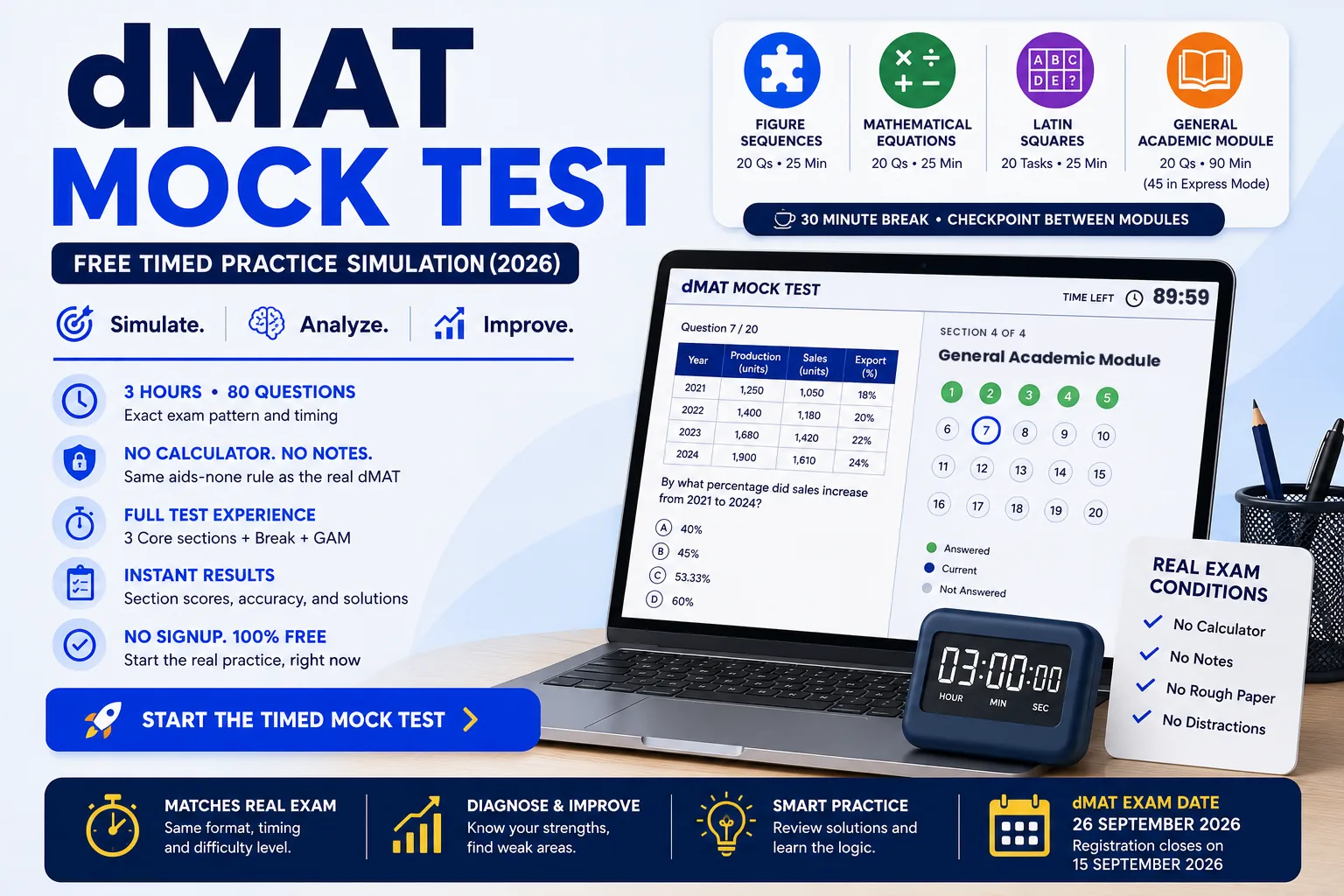
- Fee and format: €150 (₹16,476), 3.5 hours, computer-based, single-choice, in English. Developed by g.a.s.t. (the body behind TestDaF and TestAS), with DAAD support.
- Dates: The first sitting is on 26 September 2026, with results on 12 October 2026. The next confirmed sitting is Q1 2027, exact date still TBC on d-mat.de.
- How it fits your file: It sits inside your APS documentation, not your university application. Frankfurt School and Gisma both accept dMAT-affected profiles without extra restriction.
Counselor insight: Check your exact degree title against APS India's official affected-fields list before assuming you're exempt. A "B.Tech in Computer Science and Business Systems" reads as engineering and needs dMAT. A standalone BCA or B.Sc. in Computer Science often does not automatically qualify, but confirm rather than assume.
For the full APS process, see our APS Certificate Germany guide, and read expert answers on the documents and requirements for Germany’s APS and GMAT/BMAT exams if your program layers a test requirement on top of APS.
Sources: APS India official portal | g.a.s.t. dMAT portal
Documents Checklist for Your Masters in FinTech in Germany Application
| Document | Detail | India-Specific Note |
| APS Certificate | Mandatory academic verification | Fee ₹18,000; processing 3 to 10 weeks |
| dMAT Certificate | Only if your Bachelor's is in engineering, commerce, finance, economics or business, for Summer 2027 intake onward | Fee: €150 (₹16,476), separate from APS |
| Bachelor's transcripts and marksheets | Semester-wise academic record | CBSE, ICSE, and state board certificates accepted |
| English proficiency score | IELTS or TOEFL | Gisma accepts IELTS 6.0; Frankfurt School needs IELTS 7.0/TOEFL 90 |
| GMAT/GRE score | Mandatory at Frankfurt School; not required at Gisma or Goethe's public MMF | Confirm per programme before booking |
| Statement of Purpose | Programme-specific motivation letter | Mention your dMAT/APS timeline if relevant |
| Letters of recommendation | Typically two; academic preferred | From professors who taught finance/tech-relevant subjects |
| Blocked account confirmation | €11,904 (₹13,07,535) per year | Set up via Fintiba or Expatrio before your visa appointment |
| Valid passport | Minimum two blank pages | Renew early if expiring within a year |
Sources: German Federal Foreign Office
Masters in FinTech in Germany Cost: Tuition, Living and Blocked Account
Your total cost depends heavily on which of the four routes you choose. Here's the full monthly and annual breakdown beyond tuition:
| Cost Item | Amount (EUR) | Amount (INR) | Notes |
| Blocked account (annual) | €11,904 | ₹13,07,535 | Mandatory proof of funds; released monthly |
| Blocked account (monthly release) | €992 | ₹1,08,961 | Covers rent, food, day-to-day costs |
| Living costs (Frankfurt/Berlin/Potsdam) | €850-€1,200/month | ₹93,364-₹1,31,808/month | Rent, food, transport, insurance |
| Health insurance (under 30) | €120-€140/month | ₹13,181-₹15,378/month | Often forgotten in budgeting |
Counselor insight: Students almost always budget tuition and the blocked account, then forget the mandatory health insurance premium. Build it into your monthly number from day one rather than discovering the gap after landing in Germany.
For a fuller breakdown of what a fee-paying Masters actually costs month to month, see what our counselors say about the tentative total fee and payment structure for a Masters course in Germany.
Sources: German Federal Foreign Office visa financial requirements | DAAD cost of living guidance
Is the Cost Worth It? A Rough ROI Comparison
These are indicative estimates calculated from the official tuition figures above and typical fintech-specialized starting salaries in Germany (see Careers section below). They are not an officially published payback metric, so treat them as a planning tool, not a guarantee.
| Route | Total Cost (Tuition/Fees + ~2 Years Living) | Typical Starting Salary (Gross) | Indicative Payback Period |
| Frankfurt School (dedicated) | €60,000 (₹65,90,400) | €55,000-€65,000 (₹60.4L-₹71.4L) | About 1 year of gross salary |
| Gisma, 120 ECTS (dedicated) | €49,100 (₹53,93,164) | €50,000-€60,000 (₹54.9L-₹65.9L) | About 1 year of gross salary |
| Goethe Business School (specialisation) | €48,600 (₹53,38,224) | €50,000-€60,000 (₹54.9L-₹65.9L) | About 1 year of gross salary |
| Public MMF (adjacent, tuition-free) | €26,800 (₹29,43,712) | €45,000-€55,000 (₹49.4L-₹60.4L) | Well under 1 year of gross salary |
The public-university route wins on raw payback speed, but the private dedicated programs offer denser FinTech-specific networking and faster access to Frankfurt's banking and fintech employers, which can offset the higher upfront cost over a career.
Scholarships for a Masters in FinTech in Germany
Public university tuition savings aside, four scholarships specifically ease the cost of a Masters in FinTech in Germany:
| Scholarship | Type | Amount | Best For |
| GBS FinTech Scholarship | Program-specific | Assessed case by case | Self-funded candidates on Goethe Business School's FinTech Management track |
| DAAD Study Scholarships | Fully funded | €992/month (₹1,08,961) | Masters students, 2027-28 intake; deadline 15 October 2026 |
| Deutschlandstipendium | Merit-based | €300/month (₹32,952) | Students at Frankfurt School, Goethe University and most others |
| FIRM Scholarship | Program-specific | Up to 25% tuition | Goethe Business School's Risk Management & Regulation track |
For the broader scholarship landscape, see our complete scholarships for Masters in Germany guide and read what our counselors say about how scholarships affect your Masters application and fees if you're stacking multiple funding sources.
Sources: DAAD Study Scholarships official page | Goethe Business School scholarships page
Winter 2027-28 Intake: Planning Calendar for Masters in FinTech in Germany
The exact deadlines below combine each university's confirmed 2026 cycle pattern (repeated annually) with Goethe Business School's already-published 2027 deadlines. Always cross-check against the official page closer to your application, since private universities occasionally shift dates.
| Month | Action |
| August-September 2026 | Shortlist programmes; confirm whether your Bachelor's field triggers the dMAT |
| September 2026 | If dMAT applies and you're targeting Summer 2027, register before 15 September 2026 for the 26 September sitting |
| October-December 2026 | Goethe Business School early-bird deadlines: 1 October 2026 (€3,000/₹3,29,520 discount) and 1 December 2026 (€1,500/₹1,64,760 discount) |
| January 2027 | Goethe Business School final deadline (31 January 2027); watch for the next dMAT sitting announcement on d-mat.de |
| May 2027 | Goethe University Frankfurt's public MMF programme deadline (15 May) for its Winter Semester 2027-28 start |
| June 2027 | Frankfurt School's projected application deadline (following its confirmed 30 June annual pattern) for its Fall 2027 intake |
| July-August 2027 | Complete APS certification, finalise blocked account, book your visa appointment |
| September-October 2027 | Winter Semester 2027-28 / Fall 2027 intake begins |
Sources: Frankfurt School official program page | Goethe Business School tuition page | APS India official portal
Counselor insight: Don't wait for your dMAT certificate before submitting the rest of your APS paperwork. APS India can verify your other documents in advance; only the final certificate waits on the dMAT result.
Is a Masters in FinTech in Germany Worth It? Careers and Salaries
Graduates with technical specialization (blockchain, machine learning in finance) typically command a 15% to 30% salary premium over general finance Masters holders, and Frankfurt's concentration of banks, the European Central Bank, and fintech firms like Trade Republic and N26 give graduates unusually direct access to employers.
| Industry Segment | Top Employers | Average Gross Salary | Common Roles |
| Digital Banking & Neobanks | N26, Trade Republic, C24 Bank | €50,000-€65,000 (₹54.9L-₹71.4L) | FinTech Analyst, Digital Banking Associate |
| Traditional Banking & Central Finance | Deutsche Bank, Commerzbank, European Central Bank | €55,000-€70,000 (₹60.4L-₹76.9L) | Financial Software Engineer, Risk Analyst |
| Consulting & Advisory | KPMG, BCG, Big 4 fintech practices | €55,000-€75,000 (₹60.4L-₹82.4L) | Strategy & Innovation Consultant |
| Blockchain & Crypto | Regulated crypto exchanges, blockchain start-ups | €50,000-€70,000 (₹54.9L-₹76.9L) | Blockchain & Crypto Specialist |
Read what our counselors say about whether European Masters courses are genuinely strong for job prospects in Germany for more context on how this program compares with other European destinations.
Note: After graduation, Indian students can use the 18-month post-study Job Seeker Visa or the newer Opportunity Card (Chancenkarte) if entering from India without a prior offer, requiring proof of €1,091 (₹1,19,835) per month. Once employed, the EU Blue Card requires a gross annual salary of at least €50,700 (₹55,68,888) for standard roles, or €45,934.20 (₹50,45,412) for shortage occupations and recent graduates, per the latest official 2026 thresholds; 2027 figures had not yet been published at the time of writing.
Counselor insight: Most FinTech-specific roles in Germany (blockchain analyst, digital banking associate, financial software engineer) qualify under the shortage-occupation Blue Card threshold rather than the standard one, since IT and engineering-adjacent roles are explicitly listed as shortage occupations.
Our Software Engineering in Germany guide covers the same EU Blue Card, Opportunity Card, and permanent-residency pipeline in far more depth, including the exact 21-versus-27-month PR timeline based on your German level.
Read more on the Germany Job Seeker Visa and the Germany Opportunity Card for the full post-study pathway.
Sources: Make it in Germany, official EU Blue Card page
Decision Framework: Which Path Fits Your Background
- Final-year B.Tech or B.E. graduate targeting Summer 2027: Confirm the dMAT applies to you first, then weigh the Frankfurt School's GMAT-based program against Gisma's no-GMAT option; your engineering background suits both.
- B.Com, BBA, or Economics graduate: The dMAT almost certainly applies too. Gisma's lower entry bar (IELTS 6.0, no GMAT) and flexible 60 to 120 ECTS tracks often suit commerce backgrounds better than Frankfurt School's GMAT/GRE requirement.
- Computer Science or BCA graduate: Don't assume you're automatically exempt from dMAT just because your degree isn't labeled "engineering." Confirm your exact classification with APS India first. If exempt, Goethe University Frankfurt's tuition-free public MMF program (if your undergraduate coursework included enough Economics/Finance credit) is worth comparing against the private FinTech-specific routes purely on cost.
For a broader comparison of program durations, see our one-year Masters in Germany guide.
What to Do If You Miss the dMAT, Fail GMAT, or Hit a Visa Delay
- Missed the dMAT registration window: Wait for the next confirmed sitting (Q1 2027, date TBC on d-mat.de). This delay can push your intake back a full semester, so register the moment a new date is published.
- Didn't clear GMAT/GRE for Frankfurt School: Pivot to GISMA's MSc Finance and FinTech or Goethe Business School's FinTech Management track, neither of which mandates a standardized test score in the way Frankfurt School does.
- APS certificate delayed: Submit all other application documents while APS processing continues; most universities will hold a conditional offer pending your final APS certificate.
- Visa appointment delayed beyond your intake: Contact your university's international office immediately to request a deferral to the following intake rather than losing your admission entirely.
3 Takeaways on Masters in FinTech in Germany
- Only two German universities offer a degree formally named Masters in FinTech (Frankfurt School and Gisma); widen your shortlist to Goethe Business School's FinTech Management track and public-university-adjacent Finance programs for a realistic comparison.
- If your Bachelor's degree is in engineering, commerce, finance, economics, or business, plan for the dMAT exam as part of your APS documentation for any Summer 2027 or later intake.
- Budget beyond tuition: the €11,904 (₹13,07,535) annual blocked account, health insurance, and living costs of €850 to €1,200 (₹93,364 to ₹1,31,808) per month apply regardless of which university you choose.
Verified by: LeapScholar's Germany counseling team, with hands-on experience guiding Indian students through APS documentation, dMAT registration, and university shortlisting for German Masters applications.
Have questions about a Masters in FinTech in Germany? Book a free session with a LeapScholar counselor.
Frequently Asked Questions About Masters in FinTech in Germany
-
Which universities offer a Masters in FinTech in Germany?
Only two universities offer a degree formally named Masters in FinTech: the Frankfurt School of Finance & Management and GISMA University of Applied Sciences. Goethe Business School offers a FinTech Management specialization inside its Master in Finance, and several public universities teach FinTech modules within broader Finance or Information Systems Masters programs.
-
Is a Masters in FinTech in Germany worth it?
It depends on your background and the program's cost relative to your expected salary uplift. Graduates with technical FinTech specialization typically see a 15% to 30% salary premium over general finance graduates, and Frankfurt's concentration of banks and fintech employers supports strong placement, but the private programs' fees (up to ₹38,99,320) mean the payback period matters more for self-funded students.
-
What is the fee for an MSc in FinTech in Germany?
Fees range from tuition-free at adjacent public programs to €35,500 (₹38,99,320) at Frankfurt School. Gisma's MSc Finance and FinTech costs €25,100 (₹27,56,984) for the standard 120 ECTS track or €16,250 (₹17,84,900) for the accelerated 60 ECTS track.
-
Is an MSc free in Germany?
Public universities in Germany generally charge no tuition, only a semester administrative fee of roughly €150 to €400 (₹16,476 to ₹43,936). However, the two universities offering a named Masters in FinTech in Germany are both private and charge full tuition; only the adjacent public Finance route is genuinely tuition-free.
-
Does the dMAT apply to Masters in FinTech in Germany applicants?
Yes, for most applicants. The dMAT applies from the Summer Semester 2027 intake onward if your Bachelor's degree is in engineering, commerce, accounting, finance, economics, business, or management, which covers the majority of students applying for a Masters in FinTech in Germany.
-
What is the salary after a Masters in FinTech in Germany?
Exact starting salaries vary by role and city, but FinTech-specialized graduates in Germany generally qualify for the EU Blue Card's shortage-occupation threshold of €45,934.20 (₹50,45,412) gross annually, per the latest official 2026 figures, rather than the higher standard threshold of €50,700 (₹55,68,888).
-
What is the eligibility for a Masters in FinTech in Germany for Indian students?
You need a relevant Bachelor's degree (finance, economics, business, engineering, or computer science depending on the program); English proficiency (IELTS 6.0 to 7.0 depending on the university); an APS certificate; and, for most engineering/commerce/finance backgrounds applying from Summer 2027, a dMAT certificate.
-
What happens if I don't clear the GMAT for a Masters in FinTech in Germany?
The Frankfurt School requires a GMAT, GRE, or its own admission test with no exceptions. If you can't clear this, Gisma's MSc Finance and FinTech and Goethe Business School's FinTech Management track do not mandate a standardized test score, making them realistic alternatives.
-
What is the application deadline for a Masters in FinTech in Germany for 2027-28?
Deadlines vary by university: Goethe Business School's final deadline is 31 January 2027. Goethe University Frankfurt's public MMF deadline is 15 May 2027, and Frankfurt School's Fall 2027 deadline is projected around 30 June 2027 based on its confirmed annual pattern; always verify against the official page before applying.







Have Questions? Get Guidance to reach your Dream University
Connect with India's finest counsellors and biggest study abroad community.
Get Guidance