
Quick Read
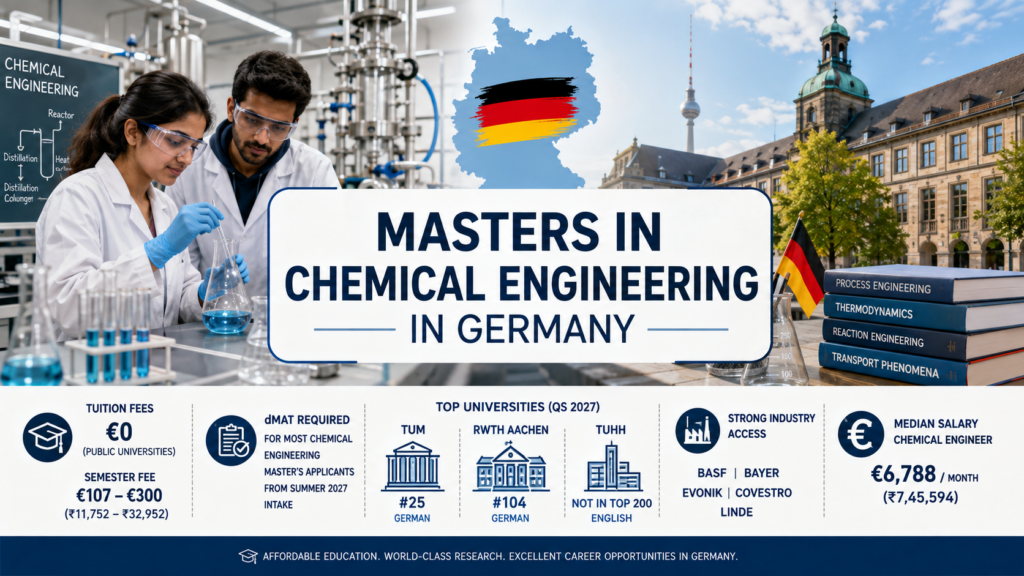
- dMAT is required for most Chemical Engineering master’s applicants from the Summer 2027 intake.
- Most public universities charge no tuition, just a ~€300 semester fee.
- RWTH Aachen (QS #104) and TU Munich (QS #25) are popular choices, but both require German.
- Median chemical engineering salary in Germany: €6,788/month (₹7,45,594).
Why Study Chemical Engineering in Germany?
Germany’s chemical industry is the country’s third-largest, employing around 500,000 people, per the German Chemical Industry Association (VCI). That scale gives a masters in chemical engineering in Germany direct industry access most destinations can’t match.
- Industry access: BASF (the world’s largest chemical producer), Bayer, Evonik, Covestro, and Linde are headquartered in Germany, feeding graduates directly into R&D, production, and plant engineering roles.
- Affordability: Public universities charge no tuition, just a semester contribution of €107-300 (₹11,752-₹32,952).
- Research depth: DFG-funded institutes, Fraunhofer centers, and university-industry partnerships (like RWTH’s Aachener Verfahrenstechnik) give real project exposure, not just coursework.
- Career runway: Engineering sits on Germany’s shortage-occupation list, lowering the EU Blue Card salary bar and speeding up permanent residency (see Career section below).

Choose your dream country
 UK
UK
 USA
USA
 Germany
 Australia
 Ireland
 Canada
 UAE
UAE
 France
 Sweden
 Italy
Italy
 Other
Other
When do you want to study abroad?
What's your highest level of education?
Have you completed Class 12th?
What was your Class 12 CGPA/percentage?
Are you a student or a parent/guardian?
What do you want to study?
Select your current city
How Leap will help you

Personalised University Shortlist

Express Applications with Quicker Admits

End-to-End Application Support
Counselor insight: Students chasing global rankings alone often overlook that Germany's real strength here is industry density, not prestige. A mid-ranked technical university with strong BASF or Bayer placement ties can outperform a "better-ranked" but less industry-connected program elsewhere.
Best Universities for a Masters in Chemical Engineering in Germany
Most public universities in Germany for masters in chemical engineering charge no tuition at all, which is why shortlisting the right one matters more than chasing rankings alone.
| University | QS 2027 Rank | Language | Tuition (non-EU) | Semester Fee |
| Technical University of Munich (TUM) | #25 | German | €6,000/semester (₹6,59,040) | €97/semester (₹10,654) |
| RWTH Aachen University | #104 | German | None (public university) | €300 (₹32,952) |
| Hamburg University of Technology (TUHH), Chemical and Bioprocess Engineering | Not in QS top 200 | English | None (public university) | €300 (₹32,952), similar to other public universities |
| TU Bergakademie Freiberg | Not in QS top 200 | English | None (public university) | €107 (₹11,752) |
| TU Clausthal (Petroleum Engineering) | Not in QS top 200 | English | None (public university) | €230 (₹25,263) |
Currency conversion note (as of August 2026): All INR equivalents in this guide are based on €1 = ₹109.84. INR values are approximate and may vary with exchange rate fluctuations.
Note: RWTH's Chemical Engineering (Verfahrenstechnik) M.Sc. and TUM's Chemical Engineering M.Sc. both require German-language proficiency, per each university's own program pages. TUHH and TU Bergakademie Freiberg are the confirmed English-medium, tuition-free options; verify language of instruction on each program's official page, since aggregators often list German-taught programs as English without checking.
Sources: TUM, official Chemical Engineering M.Sc. page | RWTH Aachen, Chemical Engineering M.Sc. | TUHH, Chemical and Bioprocess Engineering | DAAD, Petroleum Engineering at TU Clausthal | QS World University Rankings 2027
Once you've shortlisted RWTH, dig into its acceptance rate and admission specifics before applying.
Counselor insight: Don't rule out RWTH or TUM because of the German requirement. Many students clear B1/B2 German during their gap year through Goethe-Institut courses while their APS and dMAT processing runs in parallel, keeping the timeline intact.
Chemical Engineering vs Petroleum Engineering in Germany
If your search included "masters in petroleum engineering in Germany," here's the direct answer: TU Clausthal is Germany's only dedicated M.Sc. Petroleum Engineering program, officially DAAD-listed, covering drilling, reservoir management, and deep geothermal systems, at €230/semester (₹25,263).
Most "petroleum engineering" searches actually redirect to general Chemical or Process Engineering programs with an energy elective. If you want an oil-and-gas-specific track, Clausthal is the confirmed program; for broader industry flexibility across BASF, Bayer, or Evonik-type roles, a standard masters in chemical engineering in Germany at RWTH, TUHH, or Freiberg fits better.
Do You Need dMAT for a Masters in Chemical Engineering in Germany (2027 Intake)?
Yes, if all four of these apply to you:
| Condition | Applies to you if |
| Degree level | You're applying for a Master's, not a Bachelor's or PhD |
| Field | Your bachelor's is in Engineering, Commerce, Economics, Finance, Business, or Management |
| Intake | You're targeting Summer Semester 2027 or later |
| APS timing | You started your APS process on or after 29 June 2026 |
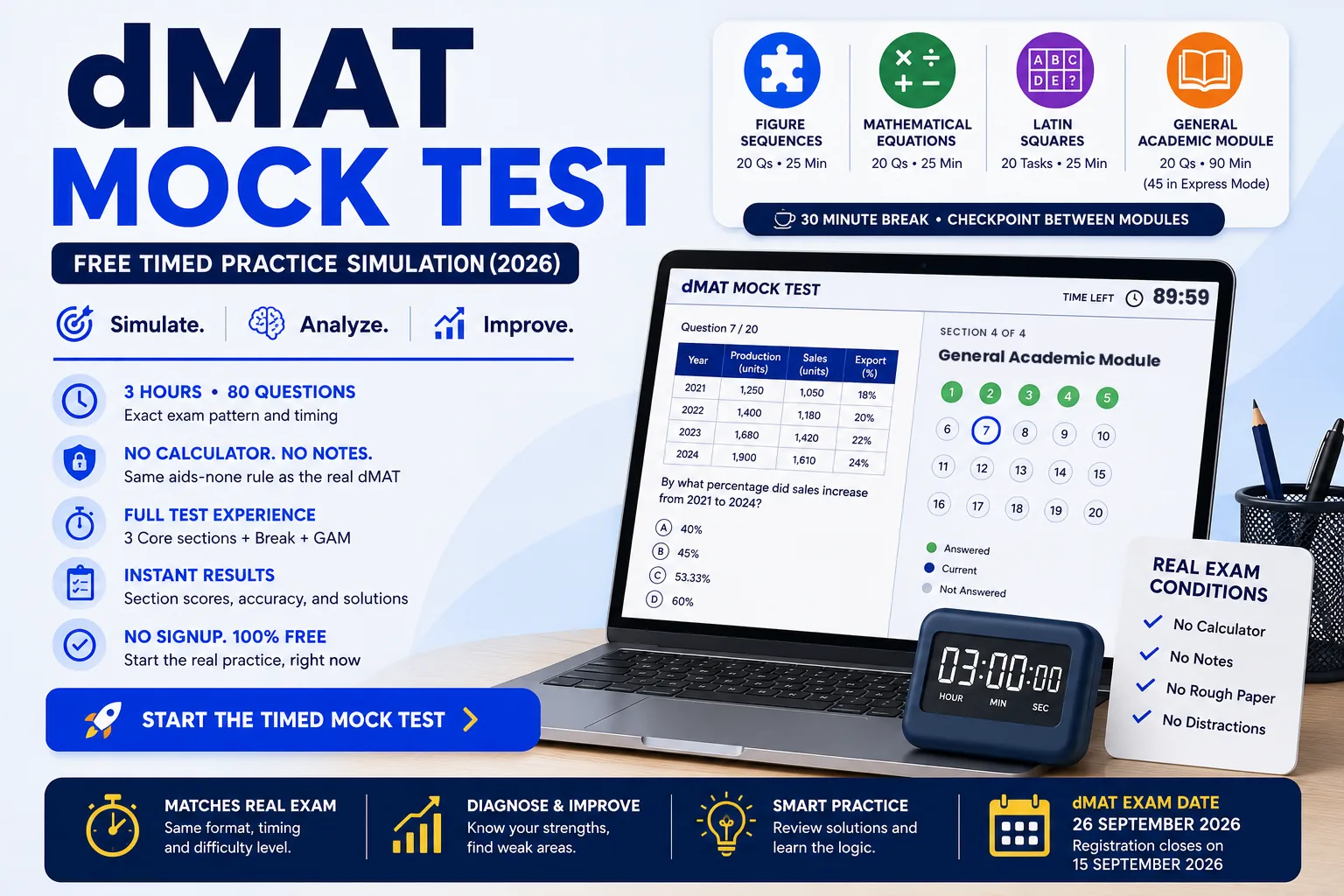
The Digital Master Test (dMAT) became part of APS India's documentation process on 29 June 2026. It costs €150 (₹16,476), was developed by g.a.s.t. (the body behind TestDaF and TestAS), and does not replace APS document verification; it's an additional academic-aptitude layer. The first sitting was 26 September 2026, with certificates issued from 12 October 2026.
If you registered your APS application before 29 June 2026, or you're applying for Winter 2026-27, dMAT does not apply to you.
Sources: APS India, official dMAT information | d-mat.de, official test information
Already paid and need to deregister? See what happens if you deregister or if your window lapsed, and check whether you must pay again to retake it.
Counselor insight: We see students confuse dMAT with the GRE. They're unrelated. dMAT is an APS documentation requirement; GRE is a separate university admissions test some programs still request independently (TUM and RWTH ask for it on select tracks). Clearing one does not remove the other.
Masters in Chemical Engineering in Germany Eligibility, Admission Requirements & Documents
| Document | India-Specific Detail |
| Bachelor's degree certificate | B.Tech./B.E./B.Sc. in Chemical, Petrochemical, Process Engineering, or Biotechnology |
| Academic transcripts | All semester mark sheets, and a provisional certificate if final results are pending |
| APS Certificate | Mandatory for all Indian applicants since October 2022 |
| dMAT Certificate | Required only for Summer 2027+ intake, Engineering-degree applicants (see above) |
| English proficiency | IELTS 6.0-6.5 or TOEFL 88-90 typical for English-taught tracks |
| German proficiency | Required for RWTH and TUM Chemical Engineering specifically |
| Statement of Purpose / Motivation Letter | University-specific format |
RWTH Aachen's official admission policy publishes no fixed GPA cutoff; it evaluates whether your bachelor's coursework covers the required credit points in engineering, math, and natural sciences.
Source: RWTH Aachen University, Admission Requirements for International Master Applicants
For the exact document checklist alongside APS, see what documents and requirements APS and GMAT/BMAT exams call for.
Unsure if your program needs GMAT? Check whether GMAT is required for APS certification.
On English tests, see what English proficiency and APS certification actually require, and for GRE specifically, read whether GRE is required for a masters in Germany.
Counselor insight: Don't submit a weak GRE score "to look thorough" if your target program doesn't list it. It adds nothing and can raise questions if it's inconsistent with your transcript strength.
2027-28 Application Calendar for Masters in Chemical Engineering in Germany
Planning around the right calendar avoids the most common intake mistakes. For a student graduating May-June 2027, targeting Winter Semester 2027-28 (starts October 2027):
| Month | Action |
| Jan-Feb 2027 | Start APS registration; check dMAT applicability |
| Mar-Jun 2027 | Take dMAT if required; prepare IELTS/German certificates |
| Mar 1, 2027 | Deadline: open-admission master's programs, non-EU applicants |
| Jul 15, 2027 | Deadline: restricted-admission (NC) master's programs, non-EU applicants |
| Aug 2027 | Open blocked account (Sperrkonto); fund €11,904 (₹13,07,535) |
| Sep 2027 | Apply for student visa; book VFS Global biometric appointment |
| Oct 2027 | Winter Semester 2027-28 begins |
Source: RWTH Aachen University, International Applicants: Master's Programs. Individual programs may set earlier internal deadlines; always confirm on the specific program page.
Wondering how long APS itself takes after IELTS? See the typical timeline from IELTS clearance to APS certificate.
Before assuming every Indian document needs authentication, check whether a credit transfer certificate is mandatory for the German visa.
Cost of Studying Masters in Chemical Engineering in Germany: Tuition, Living Expenses & Scholarships
Budgeting for a masters in chemical engineering in Germany comes down to three parts: tuition (near-zero at most universities), living costs, and the blocked account your visa depends on:
| Cost Component | Amount | INR |
| Tuition, public universities (RWTH, TUHH, Freiberg, Clausthal) | €107-300/semester | ₹11,752-₹32,952 |
| Tuition, TU Munich (Chemical Engineering M.Sc. specifically) | €6,000/semester | ₹6,59,040 |
| Living costs (RWTH Aachen's own estimate) | €1,100/month or €13,200/year | ₹1,20,824/month or ₹14,49,888/year |
| Blocked account (Sperrkonto), required for student visa | €11,904/year, released at €992/month | ₹13,07,535/year, ₹1,08,961/month |
| DAAD Study Scholarship (master's) | €992/month for 10-24 months | ₹1,08,961/month |
TUM's tuition applies specifically to its Chemical Engineering M.Sc., since that program sits outside TUM's tuition-free track. DAAD's scholarship doesn't cover tuition, which matters for TUM applicants. Don't delay your university application while waiting on a DAAD decision; run both in parallel.
Sources: DAAD, Study Scholarships - Master Studies for All Academic Disciplines | RWTH Aachen International Student Center FAQ, cost estimates
For a full living-cost and blocked-account breakdown by city, see LeapScholar's Cost of MS in Germany guide, and for scholarship options beyond DAAD, see fully funded scholarships in Germany.
Counselor insight: DAAD scholarships are competitive; most programs expect an upper-third academic record and, for EPOS specifically, two years of work experience.
Career and Salary After a Masters in Chemical Engineering in Germany
Aggregator figures for this role contradict each other by up to 50%: Glassdoor cites €60,000/year (₹65,90,400), Payscale €50,800/year (₹55,79,872), ERI €90,900/year (₹99,84,456), none disclose methodology.
The most reliable figure comes from the Bundesagentur für Arbeit's Entgeltatlas (wage atlas), built from actual social security records, not self-reported surveys, for "Ingenieur/in - Chemietechnik" (chemical engineering, highly complex roles):
| Career Stage | Monthly Gross (Official) | Annual | Employers |
| Entry-level (lower quartile) | €5,069 (₹5,56,779) | €60,828/year (₹66,81,356) | BASF, Bayer, Evonik, Covestro |
| Median | €6,788 (₹7,45,594) | €81,456/year (₹89,47,527) | Linde, Boehringer Ingelheim, Siemens Energy |
| Senior (upper quartile, floor value) | >€7,450 (₹8,18,308) | >€89,400/year (₹98,19,696) | BASF, Merck KGaA, Fraunhofer Institutes |
Source: Bundesagentur für Arbeit, Entgeltatlas: Ingenieur/in - Chemietechnik
For post-study work, Germany's EU Blue Card threshold for 2026 is €50,700/year (₹55,68,888) standard, or €45,934.20/year (₹50,45,413) for shortage occupations; engineering qualifies, as do recent graduates within three years. This pathway is covered in detail in LeapScholar's Software Engineering in Germany guide, which walks through the Blue Card, Opportunity Card, and PR timeline that applies to engineering fields broadly.
For the job-seeker route specifically, see the Germany Job Seeker Visa and Opportunity Card guide.
Counselor insight: When comparing offers, ask whether the number quoted is gross (brutto) or net (netto). Aggregator pages blur this distinction, and German payroll deductions (tax, health insurance, pension) typically take 35-40% off your gross figure.
Masters in Chemical Engineering in Germany ROI, Costs & Salary Comparison
Using official cost and salary inputs, here's a simplified two-year cost estimate against the median salary, assuming full-time employment right after graduation and ~35% payroll deductions:
| Metric | Public University (RWTH/TUHH/Freiberg) | TU Munich |
| Tuition (2 years) | ~€1,200 (₹1,31,808) | ~€24,000 (₹26,36,160) |
| Living costs (2 years, RWTH estimate) | ~€26,400 (₹28,99,776) | ~€26,400 (₹28,99,776), national estimate |
| Total estimated cost | ~€27,600 (₹30,31,584) | ~€50,400 (₹55,35,936) |
| Estimated payback period at median salary | ~6 months | ~11-12 months |
This is a simplified estimate from official tuition, living cost, and Entgeltatlas data, not a personalized projection; actual costs vary by city, lifestyle, and job offer.
Which Masters in Chemical Engineering Path in Germany Is Right for You?
- Final-year B.Tech Chemical Engineering, graduating May 2027: Target RWTH Aachen or TUHH for Winter 2027-28. You're in the dMAT-affected window, so this option gives you the standard timeline with room to spare.
- Process Engineering graduate with 2+ years' experience: Go for the DAAD EPOS scholarship track alongside an RWTH/TUHH shortlist. EPOS specifically rewards professional experience.
- Petrochemical Engineering graduate wanting oil-and-gas roles: Choose TU Clausthal's Petroleum Engineering program, Germany's only dedicated option, not a general chemical engineering elective.
What to Do When Things Go Wrong?
- Missed the dMAT registration window: Wait for the next national testing date, there's no on-demand retake. Budget the €150 (₹16,476) fee again.
- APS application delayed or rejected: APS India enforces a mandatory 3-month wait before reapplying; use it to fix the specific gap identified.
- IELTS/TOEFL score below cutoff: Retake before your program's document-submission deadline (August 1 for winter restricted-admission programs).
- Blocked account funds delayed: Outward remittance from India can take 2-3 weeks; start it the moment you get an admission offer.
3 Takeaways for Your Masters in Chemical Engineering in Germany
- Confirm your dMAT status before applying: if your bachelor's is in Engineering and you're targeting Summer 2027 intake or later, budget €150 (₹16,476) and the September testing window into your timeline.
- Public universities mean near-zero tuition, but RWTH's and TUM's Chemical Engineering programs specifically require German proficiency; TUHH and Freiberg are your confirmed English-taught, tuition-free alternatives.
- Anchor your salary expectations to the official Entgeltatlas median of €6,788/month (₹7,45,594), not the wildly inconsistent aggregator figures ranging from €50,000 (₹54,92,000) to €91,000 (₹99,95,440) a year.
Verified by: LeapScholar's Germany counseling team, with hands-on experience guiding Indian engineering graduates through APS, dMAT, and German university admissions.
Have questions about your masters in chemical engineering in Germany application? Book a free session with a LeapScholar counselor.
Frequently Asked Questions About Masters in Chemical Engineering in Germany
-
What is a masters in chemical engineering in Germany?
A masters in chemical engineering in Germany typically runs 1.5 to 2 years. Common specializations include biochemical engineering, energy and process engineering, materials science, and process systems engineering, built around two compulsory modules (reaction engineering and process engineering) and electives in process technology, technical chemistry, or environmental/safety technology.
-
Is Germany good for chemical engineering?
Yes. Germany combines tuition-free public education, direct access to global employers like BASF and Bayer, and an official median chemical-engineering salary of €81,456/year (₹89,47,527). The trade-off: the two highest-ranked universities for this program teach it in German, not English.
-
Which university is best for a masters in chemical engineering in Germany?
There's no single "best"; it depends on your language readiness. RWTH Aachen (QS #104, 2027) is the top-ranked tuition-free option, but it's German-taught. If you need an English-taught program, TUHH's Chemical and Bioprocess Engineering or TU Bergakademie Freiberg are your confirmed, tuition-free routes.
-
Is a masters in chemical engineering in Germany free?
Public universities like RWTH Aachen, TUHH, and TU Bergakademie Freiberg charge no tuition, only a semester contribution of €107-300 (₹11,752-₹32,952). TU Munich charges €6,000/semester (₹6,59,040) for this specific program, so "free" depends on which university you choose.
-
Do I need dMAT for a masters in chemical engineering in Germany?
Yes, if you're applying for Summer 2027 intake or later, your bachelor's is in Engineering, and you started APS on or after 29 June 2026. Winter 2026-27 applicants and those exempted through prior APS registration do not need dMAT.
-
What is the chemical engineering salary in Germany?
The official median is €6,788/month (₹7,45,594), per the Bundesagentur für Arbeit's Entgeltatlas, the most current government wage dataset. Aggregator sites quote €50,000 (₹54,92,000) to €91,000 (₹99,95,440) annually, so anchor to the official number.
-
Can I study petroleum engineering in Germany?
Yes, but only at one university: TU Clausthal offers Germany's sole dedicated M.Sc. Petroleum Engineering program, officially DAAD-listed, at €230/semester (₹25,263).
-
Is the GRE required for a masters in chemical engineering in Germany?
Not universally. Most public university chemical engineering programs don't require it, but select TUM and RWTH engineering tracks do; check your specific program page rather than assuming.
-
What happens if I miss the APS certification deadline?
APS timing doesn't block your university application, but it does block your visa application, since APS is a prerequisite for the German student visa. A delayed APS can push your intake back a full semester if it clears after your program's enrollment deadline.
-
Is Germany good for chemical engineering compared to other countries?
Germany offers zero or low tuition at public universities, direct access to leaders like BASF, Bayer, and Evonik, and a median salary of €81,456/year (₹89,47,527). Whether it beats the US or UK depends on priority: Germany wins on affordability and industry access; the US and UK often pay more but cost more too.
-
Is German mandatory for chemical engineering jobs in Germany?
Not strictly; many multinationals like BASF and Bayer operate in English internally, but German (B1/B2) widens your options outside large multinationals and is often required for client-facing or plant-floor roles.
-
Can I get PR in Germany after a masters in chemical engineering?
Yes. Graduates get an 18-month job-seeker permit to find qualifying work, then move to an EU Blue Card at the €45,934.20 (₹50,45,413) shortage-occupation threshold (engineering qualifies), reaching permanent residency in as little as 21 months with B1 German.







Have Questions? Get Guidance to reach your Dream University
Connect with India's finest counsellors and biggest study abroad community.
Get Guidance