
Quick Read
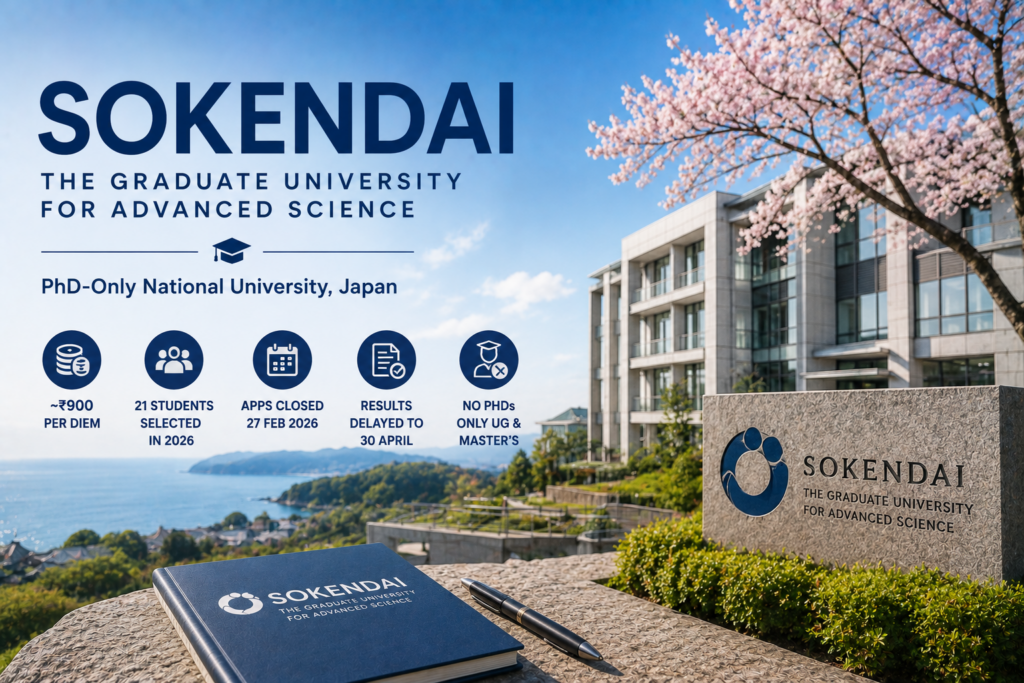
- SOKENDAI is a PhD-only Japanese national university headquartered in Hayama, Kanagawa.
- Its undergraduate research internship provides a per diem of roughly Rs.900 per day.
- The 2025 cycle selected 21 students worldwide, officially confirmed by KEK.
- Applications for 2026 closed on 27 February; results were delayed to 30 April.
- PhD students are not eligible for the summer internship; only undergrads and master’s students are.
- SOKENDAI does not publish an official acceptance rate for its degree programs.
What Is SOKENDAI?
SOKENDAI, formally the Graduate University for Advanced Studies, is one of Japan’s national universities and the country’s first to offer exclusively graduate programs. There’s no undergraduate track here at all.
| Fact | Detail |
|---|---|
| SOKENDAI address | Shonan Village, Hayama, Kanagawa 240-0193, Japan |
| Degree levels | Five-year doctoral course (bachelor’s holders) or three-year doctoral course (master’s holders) |
| Where teaching happens | Mostly at affiliated institutes across Japan, not the Hayama headquarters |
| SOKENDAI astronomy | The Astronomical Science Program, based at the National Astronomical Observatory of Japan (NAOJ) in Mitaka, Tokyo |
If you landed here looking for something shorter than a PhD, you’re likely thinking of one of two separate programs:
- SOKENDAI Asian Winter School: a free, week-long lecture and hands-on series each winter for undergrads, graduate students, and young researchers from across Asia.
- KEK Tsukuba/J-PARC Summer Student Program: an 8-week paid research internship for undergraduates and master’s students, which the rest of this guide covers in detail.
SOKENDAI Admission, Academic Calendar, and Acceptance Rate
If you’re considering a full SOKENDAI PhD rather than the summer internship, here’s what the admission process actually looks like. The SOKENDAI academic calendar generally follows two intakes a year, and SOKENDAI admission decisions depend heavily on supervisor contact made well before you formally apply:
| Aspect | Detail |
|---|---|
| SOKENDAI admission cycles | Most departments run two intakes a year, typically April and October |
| SOKENDAI academic calendar | Entrance exam periods generally fall around July-August and December-January, varying by department |
| Before applying | Contacting your intended supervisor directly is strongly recommended, and required for some tracks |
| SOKENDAI acceptance rate | Not published by SOKENDAI or any official source; treat any specific percentage you see elsewhere online as unverified |
| Funding for Indian applicants | The MEXT Scholarship covers many SOKENDAI PhD admits; NAOJ’s own Junior Fellowship is separate |
This program isn’t the same admission process as the KEK summer internship below, which runs its own separate SOKENDAI application, timeline, and eligibility rules and has no bearing on SOKENDAI acceptance rate figures at all, official or otherwise.
The KEK Tsukuba/J-PARC Summer Student Program
This is SOKENDAI’s answer for students who want research exposure without committing to a PhD. Run jointly by KEK (High Energy Accelerator Research Organization) and SOKENDAI, it’s an 8-week paid placement at KEK’s Tsukuba campus or the Japan Proton Accelerator Research Complex (J-PARC) at Tokai, now in its fifth year in this format.
What’s the Scope of This Internship?
This is a hands-on research placement, not a classroom course and not a guaranteed path into SOKENDAI. You join an active research group, work alongside KEK researchers and sometimes SOKENDAI graduate students, and join sessions with other summer participants. KEK promises nothing beyond the 8 weeks; there’s no automatic scholarship, job offer, or PhD seat afterward. The connection is real on a small scale, though: 2 of 8 participants from the 2017 cohort went on to enroll at SOKENDAI the following year, through their own separate application.
Who Can Apply for the KEK Summer Student Program?
| Eligibility group | Requirement | Skills or profile expected |
|---|---|---|
| Undergraduate students | Latter half of the course (3rd/4th year) | Coursework in dynamics, electromagnetism, or quantum mechanics helps, but isn’t fixed |
| Master’s students | Early part of the programme | Background matching one of the listed research groups |
| PhD students | Not eligible | Not applicable |
| Nationality | Both Japanese and international students | No restriction by country |
| Radiation-controlled areas | Special note | Only students registered as radiation workers at their home institute can work in KEK/J-PARC’s controlled zones |
My insight: The radiation-worker rule is most often a surprise for Indian applicants. If your home university doesn’t already register students for radiation work, some experimental groups may be effectively closed to you regardless of your physics background, so check this rule before picking your research group preference.
KEK Summer Student Program Stipend and Benefits in Rupees
KEK doesn’t pay a single stipend. It covers your costs directly instead: airfare, dormitory, and a daily allowance. The only cash you actually handle day to day is that allowance.
| Benefit | In JPY | In INR |
|---|---|---|
| Airfare (international participants) | Paid directly to travel agency | Fully covered, no cash value |
| Accommodation | Free dormitory stay at KEK/J-PARC | No cost to student |
| Per diem | 1,500 yen/day | Roughly Rs.900/day |
| Full 8-week per diem total | 84,000 yen | Roughly Rs.50,400 |
| Domestic travel (airport to campus) | Covered | No cost to student |
Source: KEK Tsukuba/J-PARC Summer Student Program (official, cited above)
Visa and medical insurance costs are explicitly not covered, and travel reimbursements for Japanese-university participants arrive by bank transfer rather than cash.
For a broader sense of what Rs. 900 a day actually buys in Japan, our cost of living guide is a useful background.
My insight: The per diem won’t stretch far. The dormitory and food are covered, but weekend trips, personal shopping, and anything off campus are your responsibility.
KEK Summer Student Program Application Timeline for 2027
The 2026 cycle has already closed, with results delayed to 30 April due to unexpectedly high demand. KEK hasn’t announced 2027 dates yet, but the deadline has moved slightly earlier each recent cycle:
| Stage | 2026 confirmed dates | 2027 expected pattern |
|---|---|---|
| Registration and recommender arrangement | Before the application deadline | Similarly, arrange your recommender first |
| Application deadline | 27 February, 9:00 AM Japan time | Likely late February |
| Results announced | Delayed to 30 April (from a planned 17 April) | Mid-to-late April |
| Internship period | Mid-June to mid-August (theory group: 4 weeks max) | Same seasonal window expected |
My insight: Arrange your recommender before you even start your registration form. KEK made this mandatory ahead of registration for 2026 specifically because incomplete recommendation letters were a recurring problem in past cycles.
How Competitive Is the SOKENDAI Summer Program?
- KEK officially confirmed 21 students were selected from around the world for the 2025 cycle and planned a similar number for 2026, a rare instance of a research internship actually publishing its intern count.
- No country-wise breakdown exists, so an India-specific acceptance number isn’t available from KEK or any official source.
- Application volume has grown enough that KEK delayed its own 2026 results announcement by nearly two weeks to review the backlog.
- With roughly 20 or so seats worldwide across six broad research fields, treat every part of your application, not just your grades, as consequential.
Documents and Application Process for the SOKENDAI Summer Program
| Document | Requirement | India-specific note |
|---|---|---|
| CV | Standard academic CV | No specific format mandated |
| Official transcript | Original language accepted | Attach an abridged English translation if not in English or Japanese |
| Application form | Official Word document from KEK’s page | Fill and submit as a Word document, not PDF |
| Recommendation letter | At least one, from a supervisor or familiar researcher | Submitted separately by your recommender using your applicant ID |
The process runs in two steps: register first to get an applicant ID, then submit your documents through KEK’s web form, with your recommender submitting their letter separately through their form using that same ID. Every SOKENDAI application for this program follows this exact sequence, with no exceptions for late recommenders.
My insight: Since your recommender submits independently, confirm with them that their letter actually went through, rather than assuming it did. A missing recommendation letter is one of the most common reasons applications are marked incomplete.
How Can Indian Students Win This Internship?
With around 20 seats worldwide, a few habits separate applicants who get shortlisted from those who don’t:
- Name a specific KEK or J-PARC research group, not just “particle physics” broadly, and reference its actual current work.
- Check your home institute’s radiation-worker registration status before applying to a group needing controlled-area access.
- Confirm your recommender understands the separate submission process before you register, since KEK made this the applicant’s responsibility for 2026 onward.
- If your background suits materials or life sciences better than core particle physics, say so plainly rather than stretching your profile.
My insight: Applicants who reference a specific past KEK experiment or J-PARC beamline read as genuinely prepared, compared to those who only mention the institution’s name.
How the SOKENDAI Summer Program Compares to Other Research Internships
| Programme | Duration | Benefits (approx.) | Country | Best for |
|---|---|---|---|---|
| KEK Tsukuba/J-PARC Summer Student Program | Up to 8 weeks | Airfare, dormitory, and Rs.900/day covered | Japan | Physics and accelerator science undergrads and master’s students |
| KAI-X Summer Internship | 7 weeks | Roughly Rs.67,000 airfare, Rs.33,500 dormitory, Rs.40,200 living support | South Korea | Natural science students in six specific fields |
| OIST Research Internship | Varies by term | Stipend and housing vary by cycle | Japan | Broader life sciences and physical sciences |
Your specific research interest should guide your decision between Japan’s two options: KEK’s program, which focuses on particle and accelerator physics, and OIST, which offers a broader range of life and physical sciences, rather than location alone.
Decision Framework: What to Keep in Mind Before You Apply
If you’re a 3rd- or 4th-year physics or engineering undergrad: You fit the core applicant profile. Pick a research group whose actual published work you can speak to, and confirm your home university registers students for radiation work if your group needs it.
If you’re a master’s student with a specific accelerator or particle physics interest: This is a stronger fit than a generalist physics background, since KEK matches you to a group based on specific alignment, not just a broad major.
If you don’t have a physics-heavy background: The material and life sciences or advanced detection systems groups are more flexible on prior coursework than the core particle physics groups, so don’t rule the program out.
My insight: Students who name a specific KEK or J-PARC research group and reference its actual ongoing work in their CV or cover material consistently stand out more than those applying with a generic “interested in physics” framing.
Do I Need a Visa for the SOKENDAI Summer Program?
Since the stay runs up to 8 weeks, most Indian participants travel on a short-term visa rather than a long-stay study visa, though KEK’s own guidance to selected candidates should be treated as authoritative for your specific situation.
| Aspect | Detail |
|---|---|
| Typical visa category | Short-term visa, given the under-90-day stay |
| Insurance | Travel and liability insurance must be arranged independently; it is not covered by the program |
| Remote option | None; physical presence at Tsukuba or Tokai is required |
| Recommended timing | Start visa and insurance arrangements as soon as you’re selected, not closer to June |
Our Japan student visa guide covers the broader visa categories for Japan, a useful background even though this specific program uses a short-term visa rather than a study permit.
My insight: Buy your travel insurance the same week you’re notified, not the week before departure. KEK explicitly makes this the student’s own responsibility, unlike the airfare and dormitory costs it arranges directly.
Why SOKENDAI Summer Program Applications Get Rejected and How to Fix It
| Reason | Why it happens? | How to fix it? |
|---|---|---|
| Missing recommendation letter | The recommender submits separately and it goes unconfirmed | Follow up to confirm submission |
| Application form submitted as PDF | The applicant assumes PDF looks more official | Submit the Word document as instructed |
| Transcript without English translation | The original is in a regional Indian language | Attach an abridged English translation |
| Generic research interest statement | No specific KEK or J-PARC group named | Name a real group and its current focus |
| Registering before arranging a recommender | Order of steps reversed from KEK’s instructions | Confirm your recommender first, then register |
| Ignoring the radiation-worker requirement | Applicant assumes all groups are open to them | Check with your institute before choosing a group |
3 Key Takeaways on SOKENDAI
- Know which SOKENDAI you’re looking for. The PhD admission process, the Asian Winter School, and the KEK summer internship are three genuinely different things with separate timelines and requirements.
- Start the summer internship process early. Arrange your recommender before registering, and confirm your home institute’s radiation-worker status before picking a research group.
- Budget beyond the covered basics. Airfare and dormitory costs are handled, but the Rs.900 daily per diem and your own visa and insurance costs need separate planning.
Verified by: LeapScholar’s East Asia counselling team, with hands-on experience guiding Indian students through Japan study and research internship applications.
Have questions about SOKENDAI or studying in Japan? Book a free session with a LeapScholar counsellor.
Frequently Asked Questions About SOKENDAI
-
What is SOKENDAI?
SOKENDAI, the Graduate University for Advanced Studies, is a Japanese national university offering only graduate degrees, with five-year doctoral programmes for bachelor’s holders and three-year programmes for master’s holders, headquartered in Hayama, Kanagawa.
-
What is SOKENDAI’s address?
The SOKENDAI address is Shonan Village, Hayama, Kanagawa 240-0193, Japan, though most teaching happens at affiliated research institutes across the country, including KEK and NAOJ.
-
Does SOKENDAI have an astronomy program?
Yes, SOKENDAI astronomy refers to its Astronomical Science Program, based at the National Astronomical Observatory of Japan in Mitaka, Tokyo, with both five-year and three-year doctoral tracks.
-
What is the SOKENDAI Asian Winter School?
A free, short lecture and hands-on program for undergraduate, graduate, and early-career researchers across Asia, run each winter, separate from the KEK summer internship.
-
What is SOKENDAI’s academic calendar and admission process like?
Most departments admit twice a year, in April and October, with entrance exams around July-August and December-January. Contacting your intended supervisor beforehand is strongly recommended.
-
What is SOKENDAI’s acceptance rate?
SOKENDAI does not publish an official acceptance rate for its degree programs, and no verified primary source does either. Treat any specific percentage figure you see on other sites as unconfirmed rather than fact.
-
How do I apply for the KEK Tsukuba/J-PARC summer internship?
Register first to receive an applicant ID after arranging your recommender, then submit your CV, transcript, and Word-format application form, while your recommender submits their letter separately using your ID.
-
How much does the KEK summer student program pay in rupees?
It covers airfare and dormitory accommodation fully, plus a per diem of about Rs.900 a day, roughly Rs.50,400 over a full 8-week stay, at today’s rate of Rs.0.60 per yen.
-
Can PhD students apply for the SOKENDAI summer internship?
No, PhD students are explicitly excluded. Only undergraduates in the latter half of their degree and master’s students are eligible, regardless of nationality.







Have Questions? Get Guidance to reach your Dream University
Connect with India's finest counsellors and biggest study abroad community.
Get Guidance