
Quick Read
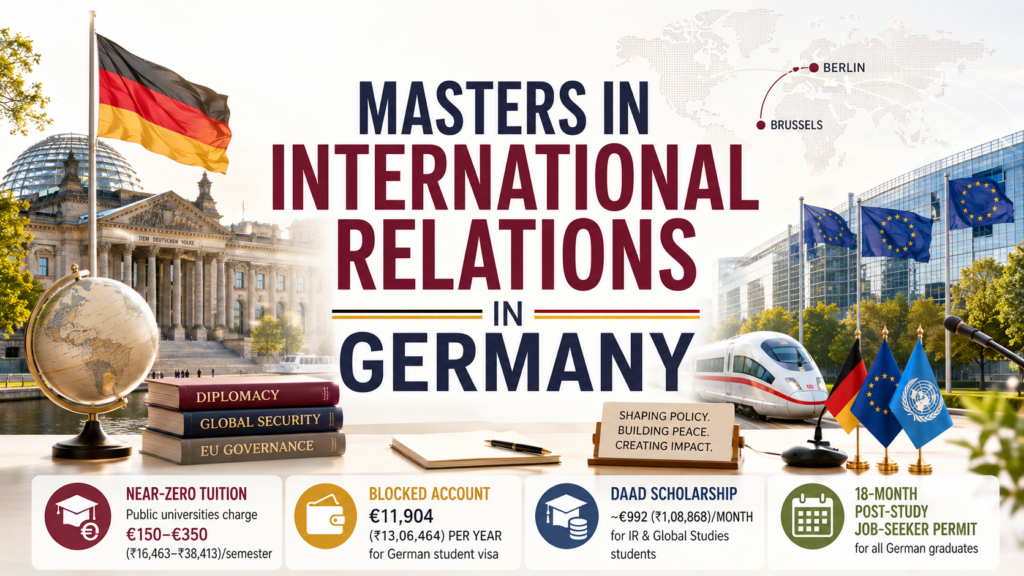
- Hertie School, Heidelberg, and Erfurt offer English-taught Masters in international relations in Germany.
- Public university programs charge no tuition beyond a €150-€350 (₹16,463-₹38,413) semester fee.
- The 2027 dMAT test does not apply to standard international relations or political science bachelor’s degrees.
- A German student visa needs a blocked account of €11,904 (₹13,06,464) for one year.
Why Study a Masters in International Relations in Germany?
Germany is at the heart of EU policymaking, which is where an international relations degree is most valuable. You’re a train ride from Brussels, not reading about it in a textbook. Here’s what makes a Masters in international relations in Germany worth the paperwork:
- Near-zero tuition: Public universities charge no tuition for most Masters programs, so your budget goes toward living costs, not lecture fees.
- Deep DAAD funding: Germany hosts more DAAD-funded seats for Indian applicants than almost any other non-English-speaking destination, and IR falls under DAAD’s broadest funding category.
- Direct policy access: Germany’s foreign policy establishment, from the Auswärtiges Amt to Berlin-based think tanks like SWP and DGAP, actively recruits Masters-level talent, giving graduates a realistic path into government-adjacent work.
- EU proximity: Berlin puts you within a short trip of Brussels, the European Parliament, and dozens of embassies and liaison offices; most IR programs elsewhere only teach about it secondhand.

Choose your dream country
 UK
UK
 USA
USA
 Germany
 Australia
 Ireland
 Canada
 UAE
UAE
 France
 Sweden
 Italy
Italy
 Other
Other
When do you want to study abroad?
What's your highest level of education?
Have you completed Class 12th?
What was your Class 12 CGPA/percentage?
Are you a student or a parent/guardian?
What do you want to study?
Select your current city
How Leap will help you

Personalised University Shortlist

Express Applications with Quicker Admits

End-to-End Application Support
Counselor insight: Students often assume Germany means engineering. For international relations specifically, the real draw is Berlin's density of embassies, EU liaison offices, and policy think tanks within a 20-minute commute of your classroom. That access matters more for an IR career than a university brand name does.
Top Universities Offering a Masters in International Relations in Germany
The English-taught landscape for a Masters in international relations in Germany is smaller and more specialized than for engineering or business, which makes shortlisting easier.
| University | Program | City | Type | Language | Total tuition |
| Hertie School | Master of International Affairs (MIA) | Berlin | Private | English | €38,500 (₹42,25,375) over 2 years, plus ~€300/semester (₹32,925) Studierendenwerk fee |
| Heidelberg University | M.A. International Relations | Heidelberg | Public | English | No tuition; ~€170/semester (₹18,658) social contribution fee |
| University of Erfurt | M.A. Global Public Policy | Erfurt | Public | English | No tuition; €150-€350/semester (₹16,463-₹38,413) semester fee |
| University of Bonn | Strategy and International Security | Bonn | Public | English | No tuition; standard semester fee only |
| TU Dresden | M.A. International Relations | Dresden | Public | Primarily German | No tuition; standard semester fee only |
Exchange rate used: €1 = ₹109.75. This rate moves; verify the live figure before finalizing your budget.
Source: DAAD International Programmes Database, Master of International Affairs at Hertie School
Note: Hertie School is Germany's closest equivalent to a dedicated international affairs graduate school, and MIA graduates qualify for the 18-month post-study job-seeker permit. Heidelberg and Erfurt offer the tuition-free public route with a genuinely English-taught curriculum. Include TU Dresden only if you're comfortable studying primarily in German.
Counselor insight: Don't rule out Erfurt because you haven't heard of it. Global Public Policy programs at smaller public universities routinely place graduates into EU institutions and NGOs precisely because cohorts are small enough for professors to write specific, detailed recommendation letters, something that matters more for policy careers than for corporate ones.
Eligibility: Does the 2027 dMAT/APS Change Apply to You?
From the Summer Semester 2027 intake onward, APS India requires a new Digital Master Test (dMAT) certificate, but only for applicants whose bachelor's degree falls under Engineering, Commerce, Accounting, Finance, Economics, or Business/Management.
If your undergraduate degree is in Political Science, International Relations, History, Sociology, Law, or a comparable humanities/social science field, the dMAT does not apply to you.
One exception: if you completed a BBA, B.Com., or Economics degree and are pivoting into IR, the dMAT is tied to your previous degree, not your intended subject, so it still applies to you.
Beyond dMAT, the standard eligibility for masters in international relations in Germany:
- A recognized bachelor's degree (3-4 years, upper-second class or above)
- IELTS 6.5-7.0 or TOEFL, waivable with a Medium of Instruction (MOI) letter at some universities
- An APS certificate, mandatory for all Indian applicants regardless of dMAT status
- A Statement of Purpose tied to a specific IR concentration (security, EU governance, human rights, diplomacy)
Counselor insight: Start your APS application the moment you have provisional results, not final ones. APS processing during peak season (June-September) regularly runs four to five months, and it is the single longest lead-time item in your entire application, longer than most university decision timelines.
Source: APS India, official dMAT overview and affected subject groups
Cost of a Masters in International Relations in Germany (2027-28)
The budget for a Masters in international relations in Germany splits into three predictable categories.
| Category | Item | Amount (2027-28) |
| Tuition | Public universities (Heidelberg, Erfurt, Bonn, TU Dresden) | €150-€350 (₹16,463-₹38,413) per semester, no tuition |
| Tuition | Private (Hertie School MIA) | €9,625 (₹10,56,344) per semester, €38,500 (₹42,25,375) total over 2 years |
| Visa financial proof | Blocked account | €11,904 (₹13,06,464) per year, released as €992 (₹1,08,868) per month |
| Living costs | Shared flat | €450-€750 (₹49,388-₹82,313) per month |
| Living costs | Food, transport, insurance combined | €300-€450 (₹32,925-₹49,388) per month |
Exchange rate used: €1 = ₹109.75. This rate moves; verify the live figure before finalizing your budget.
Source: Federal Foreign Office, proof of financial resources for studying in Germany. Semester fee ranges are as published by individual universities; confirm each directly since these vary by state and institution.
Scholarships for International Relations and Global Studies Students
The single biggest scholarship here is DAAD's Study Scholarships for Masters Studies in All Academic Disciplines, which explicitly covers Humanities and Social Sciences, including IR.
| Detail | Value |
| Monthly stipend | Approximately €992 (₹1,08,868), matched to the BAföG rate used for the blocked account |
| Coverage | Tuition where applicable, insurance, and a travel allowance |
| Eligibility | Degree completed within 6 years; generally an upper-third academic record |
| Funding starts | Winter 2027-28 cycle begins around October 2027 |
| Application window | Opens roughly 12 months before funding start |
| Visa benefit | A DAAD award letter usually replaces the blocked account as proof of funds |
Counselor insight: DAAD rejects far more IR applicants on a vague research proposal than on a weak GPA. "I want to study international relations because I'm passionate about global politics" tells a reviewer nothing. Name the specific policy question your Statement of Purpose is built around.
Source: DAAD, Study Scholarships - Master Studies for All Academic Disciplines
Which Profile Fits Which Program: A Decision Framework
- If you are a final-year BA Political Science student graduating in May 2027 and targeting Winter 2027-28, your dMAT status is unaffected, and Heidelberg or Erfurt gives you the strongest tuition-free option with enough runway to complete APS before deadlines.
- If you are a working professional with two years of NGO or policy research experience applying to Hertie School's MIA, that experience strengthens a DAAD application, since DAAD favors candidates who can articulate how the degree changes their career trajectory, not just their credentials.
- If you are a B.Com. or Economics graduate pivoting into international relations, you're in the dMAT-affected group because of your previous degree, so register for the test early and build the €150 (₹16,463) fee and September test date into your timeline first.
Documents You’ll Need for APS and University Application
| Document | Requirement | India-specific detail |
| Marksheets, provisional certificate | All semesters, attested copies | Class 10, 12, full UG marksheets needed for APS |
| Degree certificate | Provisional accepted for early APS submission | University-issued, not college-issued |
| APS certificate | Mandatory for all Indian applicants | Apply via aps-india.de; 4-5 months in peak season |
| dMAT certificate | Only if prior degree is Engineering, Commerce, Accounting, Finance, Economics, or Business/Management | €150 (₹16,463) fee to g.a.s.t., separate from APS |
| English proficiency proof | IELTS 6.5-7.0 or MOI letter | MOI accepted if UG was English-medium |
| Statement of Purpose | Tied to IR concentration | Avoid generic "passion for global politics" framing |
| Letters of recommendation | 2; academic preferred | Request 6 weeks ahead of deadlines |
Winter 2027-28 Intake: Month-by-Month Planning Calendar
| Period | What to Do |
| Jan-Feb 2027 | Finalize your shortlist; register for APS as soon as you have provisional Class 12/UG results. This is your longest lead-time item. |
| Mar-Apr 2027 | Submit APS documents; register for dMAT now if your prior degree is Commerce, Economics, Finance, or Business/Management |
| May 2027 | Final-year exams; request provisional marksheets immediately so APS processing isn't stalled by pending final certificates |
| Jun-Jul 2027 | APS processing continues (peak season runs 4-5 months from initial registration); take IELTS or arrange your MOI letter in parallel |
| Jul-Aug 2027 | Submit university applications; most deadlines cluster mid-July to mid-August |
| Aug-Sep 2027 | Track decisions; if targeting DAAD for this cycle, submit your DAAD application alongside your university offer |
| Sep 2027 | Accept your offer, open your blocked account (Expatrio/Fintiba), and book your visa appointment immediately. Mumbai applicants should book earliest, given known backlogs. |
| Late Sep-Early Oct 2027 | Finalize visa, book flights, arrange accommodation |
| Mid-Oct 2027 | Travel to Germany: Winter Semester 2027-28 begins |
What to Do If You Miss a Deadline or Get a Low Score
- Missed the APS deadline: Most public universities run rolling admission for non-restricted programs, so a missed Winter 2027-28 deadline usually means targeting Summer 2028, not losing a full year, though summer IR intakes are less common.
- Low IELTS score: If your degree was fully English-medium, request an MOI letter before retaking IELTS. Several public universities waive the English test entirely with this document.
- Delayed final results: Submit APS with provisional certificates the moment they're issued. APS India can begin verification before your final certificate arrives, so a delayed convocation won't delay your entire visa timeline.
- Visa appointment backlog: Mumbai sees the longest waits among Indian visa centers. If that's your city, start your blocked account and document prep the same week you book your appointment.
Career Outcomes and ROI After a Masters in International Relations in Germany
IR graduates in Germany typically enter policy research, EU institutions, NGOs, or corporate government-affairs teams. German labor agencies don't publish IR-specific salary data, so treat any IR-only figure elsewhere with caution until verified officially.
| Pathway | Typical entry point | Post-study visa route | Timeline to PR |
| Policy research / think tank (SWP, DGAP) | Junior researcher | §20 job-seeker permit (18 months) | Case-by-case, role-dependent |
| EU institutions / NGOs | Program officer | §20 job-seeker permit | Slower, often below Blue Card threshold |
| Corporate government affairs / ESG | Analyst | §20 permit, or Blue Card if threshold met | 21-27 months if Blue Card-eligible |
Note: Most competing content gets this wrong: German university graduates get the 18-month §20 job-seeker permit automatically, separate from the Opportunity Card (Chancenkarte), which is for applicants entering from India without a German degree in hand. Complete your IR Masters in Germany, and you use the §20 permit, not the Opportunity Card.
The EU Blue Card requires a 2026 threshold of €50,700 (₹55,64,325) standard, or €45,934.20 (₹50,41,278) for shortage occupations/recent graduates. IR roles often pay below this threshold, so most graduates reach PR through the standard 5-8 year route rather than Blue Card's fast track. For the full Blue Card and PR mechanics (they apply the same way across fields), see LeapScholar's Software Engineering in Germany guide.
Counselor insight: Don't compare Germany's IR salaries to its tech sector; compare them to Indian policy-sector salaries. A junior policy researcher role in Berlin at €38,000-€45,000 (₹41,70,500-₹49,38,750) is still a meaningful jump from equivalent entry-level roles in Indian think tanks or NGOs.
Sources: BAMF, residence permit for graduates seeking qualified employment; Make it in Germany, Job Search Opportunity Card; Make it in Germany, EU Blue Card
3 Takeaways on Masters in International Relations in Germany
- Confirm your dMAT status first: if your bachelor's degree is Political Science, IR, or a comparable humanities field, the 2027 dMAT rule does not apply to you, and you can proceed with the standard APS timeline.
- Shortlist by structure, not name recognition: Heidelberg and Erfurt for tuition-free public routes; Hertie School if you want Berlin's policy ecosystem and can fund or win a scholarship toward the €38,500 (₹42,25,375) tuition.
- Start APS the day you have provisional results. It is the longest lead-time item in your application, and delaying it is the single most common reason students miss their target intake.
Verified by: LeapScholar's Germany counseling team, with hands-on experience guiding Indian students through DAAD applications, APS certification, and German student visa submissions.
Have questions about your Masters in international relations in Germany application? Book a free session with a LeapScholar counselor.
Frequently Asked Questions About Masters in International Relations in Germany
-
Is a Masters in international relations in Germany worth it for Indian students?
It's worth it if you're targeting policy, EU-adjacent, or research careers rather than corporate finance. Tuition-free public options and DAAD funding keep costs low relative to the UK or US, but policy-role salary ceilings run lower than Germany's tech sector, so weigh career goals against savings.
-
What are the eligibility requirements for an MA in international relations in Germany?
You need a recognized bachelor's degree (generally upper second class or above), IELTS 6.5-7.0 or an MOI waiver, an APS certificate, and a subject-specific Statement of Purpose connecting your background to a concentration like security or governance. Most universities don't publish a fixed GPA cutoff; competitiveness varies by program and intake.
-
Does the dMAT apply to international relations students applying to Germany?
No, not if your bachelor's degree is in Political Science, International Relations, or a comparable humanities/social science field. The dMAT only applies to applicants whose previous degree falls under Engineering, Commerce, Accounting, Finance, Economics, or Business/Management, starting with the Summer Semester 2027 intake.
-
How much does a Masters in international relations in Germany cost?
Public university programs like Heidelberg and Erfurt charge no tuition, just a €150-€350 (₹16,463-₹38,413) semester fee. Hertie School's private MIA program costs €38,500 (₹42,25,375) total over two years. Add the mandatory €11,904 (₹13,06,464) annual blocked account and €450-€750 (₹49,388-₹82,313) monthly living costs on top.
-
Which German universities offer a Masters in international relations in English?
The Hertie School Berlin (MIA), Heidelberg University (M.A. International Relations), and University of Erfurt (M.A. Global Public Policy) are the primary fully English-taught options. TU Dresden's International Relations MA is primarily German-taught, so confirm the language split before applying if you're not planning to learn German first.
-
What is the DAAD scholarship amount for international relations students in Germany?
DAAD's Study Scholarships for Masters Studies in All Academic Disciplines covers IR under Humanities and Social Sciences, paying approximately €992 (₹1,08,868) per month plus insurance and a travel allowance, with funding for the Winter 2027-28 cycle beginning around October 2027.
-
What jobs can I get after a Masters in international relations in Germany?
Common outcomes include policy research roles at think tanks like SWP or DGAP, EU institution and NGO program roles, and corporate government affairs or ESG positions. Entry salaries in policy work run lower than tech or engineering, so most IR graduates use the standard 18-month post-study job-seeker permit rather than an immediate EU Blue Card.
-
What happens if my APS certificate gets delayed before my application deadline?
Submit your university application with your APS registration confirmation and provisional documents where allowed, then follow up with the completed certificate once issued. Most universities process applications with pending APS documentation, but confirm the details directly with your target program since practices vary.
-
Is Germany or the UK better for a Masters in international relations?
Germany is significantly cheaper (near-zero public tuition versus UK fees of £15,000-£30,000) and offers EU proximity that a one-year UK program can't match. The UK is shorter (one year versus Germany's two) with stronger brand recognition for some Indian employers. Choose based on cost and depth versus speed and brand value.







Have Questions? Get Guidance to reach your Dream University
Connect with India's finest counsellors and biggest study abroad community.
Get Guidance