
Quick Read
- Hong Kong tops the QS Asia 2026 rankings, ahead of Peking University.
- Asian university fees range from Rs. 2.6 lakh to Rs. 30 lakh.
- Hong Kong, Singapore, and China hold eight of Asia’s top ten.
- Most Asian countries offer 1 to 2 year post-study work visas.
QS Asia University Rankings 2026: Who Leads the Table
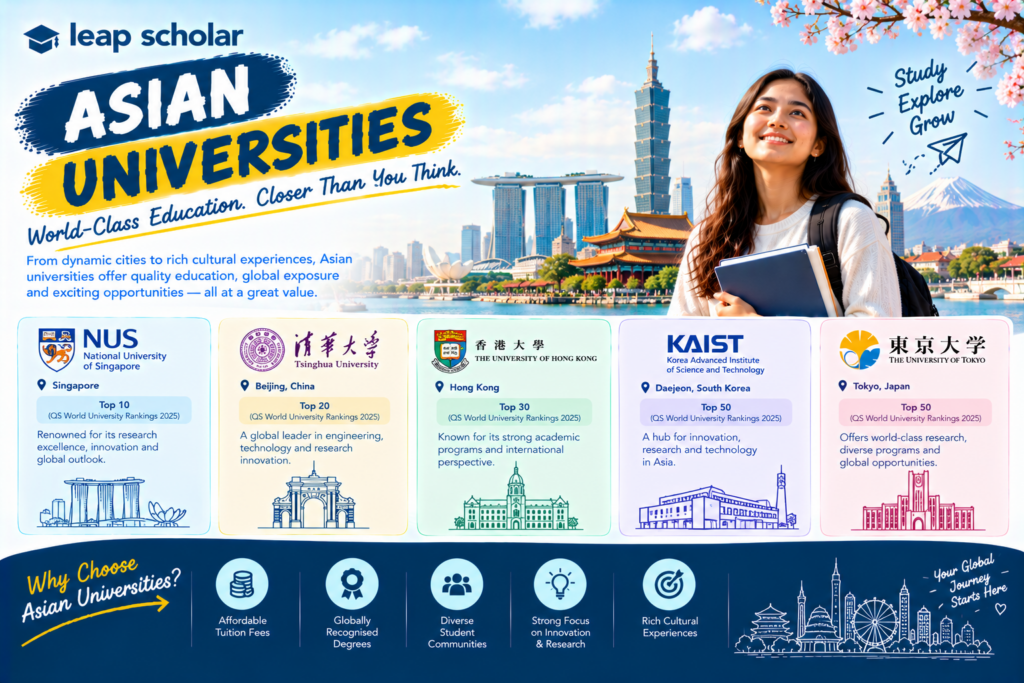
Asian universities have taken over the global rankings conversation. The University of Hong Kong (HKU) took the top spot in the latest Asian universities QS ranking, the QS World University Rankings: Asia 2026, ending Peking University’s three year run at number one. Hong Kong now holds five of Asia’s top ten places, mainland China holds three, and Singapore holds two.
| QS Asia Rank 2026 | University | Country/Region | Overall Score |
| 1 | University of Hong Kong (HKU) | Hong Kong | 100 |
| 2 | Peking University | China | 99.9 |
| =3 | National University of Singapore (NUS) | Singapore | 99.0 |
| =3 | Nanyang Technological University (NTU) | Singapore | 99.0 |
| 5 | Fudan University | China | 98.7 |
| 6 | Chinese University of Hong Kong (CUHK) | Hong Kong | 98.5 |
| =7 | Hong Kong University of Science and Technology (HKUST) | Hong Kong | 98.4 |
| =7 | City University of Hong Kong (CityU) | Hong Kong | 98.4 |
| 9 | Tsinghua University | China | 98.3 |
| 10 | Hong Kong Polytechnic University (PolyU) | Hong Kong | 97.1 |
| 11 | Yonsei University | South Korea | 96.9 |
| 12 | Korea University | South Korea | 96.2 |
| 13 | Shanghai Jiao Tong University | China | 95.9 |
| 14 | Zhejiang University | China | 94.9 |
| 15 | Universiti Malaya (UM) | Malaysia | 94.7 |
| 16 | Sungkyunkwan University (SKKU) | South Korea | 94.2 |
| 17 | Seoul National University | South Korea | 94.0 |
| 18 | POSTECH | South Korea | 93.6 |
| 19 | Nanjing University | China | 93.3 |
| 20 | Hanyang University | South Korea | 93.2 |

Choose your dream country
 UK
UK
 USA
USA
 Germany
 Australia
 Ireland
 Canada
 UAE
UAE
 France
 Sweden
 Italy
Italy
 Other
Other
When do you want to study abroad?
What's your highest level of education?
Have you completed Class 12th?
What was your Class 12 CGPA/percentage?
Are you a student or a parent/guardian?
What do you want to study?
Select your current city
How Leap will help you

Personalised University Shortlist

Express Applications with Quicker Admits

End-to-End Application Support
India has 294 universities in the overall QS Asia 2026 list, with IIT Delhi the highest-ranked Indian institution at =59.
For Indian students, this asian universities ranking matters beyond bragging rights. A university that sits inside the global top 50, such as NUS or HKU, now competes directly with mid-tier UK and Australian universities on reputation while charging a fraction of the fees. That gap is exactly why more counselors are recommending students study in Asia for Indian students who want a strong brand name without a Western-sized fee bill.
A Closer Look at Asia’s Top 5 Universities
1. University of Hong Kong (HKU). Founded in 1912, HKU is Hong Kong's oldest university and reclaimed the number one spot in Asia in 2026 after 15 years, overtaking Peking University. It hosts more than 8,000 international students from over 90 countries, one of the most internationally diverse campuses among top Asian universities, with particular strength in medicine, law, business, and the arts.
2. Peking University. Founded in 1898 as the Imperial University of Peking, PKU is China's first modern national university. It merged with Beijing Medical University in 2000, giving it one of China's strongest medical faculties alongside its traditional strengths in humanities and sciences. Admission is extremely selective, drawing only the top-scoring students from each Chinese province, and the university enrolls international students from more than 100 countries.
3. National University of Singapore (NUS). NUS traces its roots to 1905, when it began as a medical school and took its current form in 1980. It is Singapore's oldest and largest university, with roughly a third of its student body made up of international students from over 100 countries. NUS runs the Duke-NUS Medical School jointly with Duke University, and its alumni include Singapore's current Prime Minister, Lee Hsien Loong.
4. Nanyang Technological University (NTU). NTU's roots go back to Nanyang University, founded in 1955, and it became a full university in 1991. It is globally recognized for engineering and science, with around 31 percent of its students coming from outside Singapore. NTU also hosts autonomous research institutes such as the Earth Observatory of Singapore and the S. Rajaratnam School of International Studies, giving STEM and policy students access to specialized research tracks not available at most other Asian universities.
5. Fudan University. Founded in 1905 in Shanghai, Fudan merged with Shanghai Medical University in 2000 and now carries the largest international student population among China's comprehensive universities, drawing students from around 100 countries and regions. Beyond medicine, Fudan is known for strength in economics, journalism, and international relations and runs an undergraduate research program (FDUROP) that lets students fund and lead their own academic projects.
Why Indian Students Are Choosing Asian Universities Over the US, UK, or Australia
Four forces are pushing more Indian applicants toward top Asian universities instead of the traditional US, UK, or Australia route.
Lower cost, faster ROI. A degree at a well-ranked Asian university typically costs Rs. 3 lakh to Rs. 15 lakh a year in tuition, against Rs. 20 lakh to Rs. 40 lakh a year at comparable US or UK institutions. Students usually recover the cost of an Asian degree within 2 to 3 years of working, compared with 4 to 6 years for a Western degree.
Proximity and comfort. Singapore is about five hours from most Indian metros, and Hong Kong and Malaysia are not far behind. Countries such as Malaysia and Singapore already have large Indian communities, Indian restaurants, and cultural familiarity, which shortens the adjustment period for first-time international students and their families.
Global recognition without the global price tag. Asian universities for international students increasingly carry QS and Times Higher Education rankings on par with Russell Group or mid-ranked American universities, while tuition stays closer to what an Indian student would pay at a private university back home.
Research and technology hubs. Singapore, Hong Kong, and South Korea are now major hubs for technology, semiconductors, and biomedical research, giving STEM students access to internships and labs that rival anything in the US or Europe, often with fewer visa restrictions on practical training.
Counselor insight: Students who shortlist Asian universities purely on QS rank, without checking English-medium course availability or city-specific living expenses, often end up disappointed after arrival. Always confirm the exact program's language of instruction, and not just the university's overall ranking, before you apply.
Top Asian Universities by Country
Hong Kong
Hong Kong holds five of Asia's top ten QS spots in 2026: HKU, CUHK, HKUST, CityU, and PolyU. Tuition for non-local undergraduates runs from HKD 215,000 to HKD 249,000 a year, roughly Rs. 26 lakh to Rs. 30 lakh, among the highest in Asia. In return, graduates can apply for the Immigration Arrangements for Non-local Graduates (IANG) visa, which allows a 2 year stay to work without needing a job offer first, one of the most flexible post-study options among top Asian universities.
China
China holds three places in Asia's top ten: Peking, Fudan, and Tsinghua. Tuition at China's public "Double First-Class" universities runs CNY 20,000 to CNY 40,000 a year, roughly Rs. 2.6 lakh to Rs. 5.3 lakh, with private institutions charging CNY 25,000 to CNY 60,000, roughly Rs. 3.3 lakh to Rs. 7.9 lakh. Many Chinese universities with English programs admit international students through English-taught tracks, particularly in engineering, business, and medicine, and Chinese universities with scholarships such as the China Scholarship Council (CSC) award can cover tuition and a monthly stipend.
Read our detailed China guide and the list of top Chinese universities before shortlisting.
Singapore
NUS and NTU are tied at =3 in QS Asia 2026, both inside the world's top 15. Tuition for international undergraduates runs USD 8,000 to USD 15,000 a year, roughly Rs. 7.5 lakh to Rs. 14.1 lakh. Singapore remains one of the most popular Asian universities for international students choices among Indian families because of its safety record and strong finance and tech job market.
Our Singapore cost breakdown and scholarship guide for Indian students cover SINGA and SIPGA in detail.
South Korea
Yonsei (11) and Korea University (12) lead South Korea's entries, with SKKU, Seoul National University, POSTECH, and Hanyang also in the top 20. General tuition at public universities runs USD 3,000 to USD 10,000 a year, roughly Rs. 2.8 lakh to Rs. 9.4 lakh, while a research-intensive institute such as KAIST charges closer to USD 13,900, roughly Rs. 13.1 lakh. South Korea's strength in technology, entertainment, and semiconductor research has made it one of the fastest-growing picks among students comparing Asian universities for international students.
See our South Korea university list and cost and ROI breakdown.
Japan
Japan's national universities, including the University of Tokyo, charge a government-set tuition of JPY 535,800 a year, roughly Rs. 3.1 lakh, one of the lowest fees among Asian universities for international students, and the fee applies equally to local and international applicants. A few institutions, including Tohoku University, have announced higher international fees starting 2027, so confirm the current year's fee before applying.
Explore Japan's top-ranked universities and the MEXT Scholarship, which covers full tuition plus a monthly stipend.
Malaysia
Malaysia sits outside the QS Asia top ten but remains one of the cheapest Asian countries for international students, with tuition between USD 3,000 and USD 6,400 a year, roughly Rs. 2.8 lakh to Rs. 6 lakh. Universiti Malaya, the country's top-ranked institution, sits at 15 in QS Asia 2026, and several Malaysian campuses run branch programs with UK and Australian universities at a fraction of the home-campus fee.
See our guide to Malaysia's top universities.
Which Asian University Fits Your Goal
Not every strong name on the Asian universities ranking is the right fit for every student. Use your primary goal, not just the QS number, to narrow the shortlist.
| Your priority | Best-fit destination | Why |
| Lowest possible tuition | China or Malaysia | Public tuition from Rs. 2.6 lakh a year, with scholarships that can cut this further |
| Highest global brand recognition | Hong Kong or Singapore | 7 of Asia's top 10 QS spots sit here, close to Russell Group reputation |
| Easiest post-study work visa | Hong Kong or South Korea | IANG and D-10 visas allow job hunting without a prior offer |
| Technology and research exposure | Singapore or South Korea | Strong semiconductor, biomedical, and AI research ecosystems |
| English-medium comfort from day one | Singapore or Malaysia | English is a primary language of instruction and daily life |
| Fully-funded scholarship route | Japan or South Korea | MEXT and GKS can cover tuition plus a monthly stipend |
Students applying to multiple countries should also check documentation overlap. A valid passport, academic transcripts, English proficiency scores such as IELTS or Duolingo, a statement of purpose, and proof of funds are required almost everywhere, though specific thresholds vary by university and program. Keep certified copies ready well before each country's application window opens, since re-attestation can take weeks in India.
Cost Comparison: Studying in Asia vs the West
| Destination | Approximate annual tuition (INR) | QS Asia 2026 presence |
| China (public) | Rs. 2.6 lakh to Rs. 5.3 lakh | 3 universities in top 10 |
| Malaysia | Rs. 2.8 lakh to Rs. 6 lakh | Universiti Malaya at 15 |
| Japan (national) | Rs. 3.1 lakh | None in top 10, strong overall system |
| South Korea | Rs. 2.8 lakh to Rs. 9.4 lakh | Yonsei at 11, Korea University at 12 |
| Singapore | Rs. 7.5 lakh to Rs. 14.1 lakh | NUS and NTU tied at =3 |
| Hong Kong | Rs. 26 lakh to Rs. 30 lakh | 5 universities in top 10 |
| UK (for comparison) | Rs. 20 lakh to Rs. 35 lakh | Not an Asian system |
| US (for comparison) | Rs. 25 lakh to Rs. 45 lakh | Not an Asian system |
These figures cover tuition only and exclude living expenses, which vary widely by city. Fee schedules change every academic year, so confirm the latest published fee on the university's own admissions page before applying, and recheck the INR conversion against the live exchange rate.
Scholarships for Indian Students at Asian Universities
Most top Asian universities run dedicated scholarship tracks that Indian applicants can apply to directly:
- Singapore: SINGA and SIPGA cover tuition and a living stipend for research-track students.
- Japan: the MEXT Scholarship covers full tuition plus a monthly allowance for undergraduate and postgraduate study.
- South Korea: the GKS (Global Korea Scholarship) and university-specific awards such as the KAIST International Graduate Scholarship can cover 30 to 100 percent of tuition.
- China: the China Scholarship Council (CSC) scholarship and provincial-government scholarships reduce or waive tuition for eligible international students.
Apply for these scholarships well ahead of the main university deadline. Most scholarship portals close 2 to 4 months before the university's own application window, so treat the scholarship deadline as your real deadline when you plan to study in Asia for Indian students on a funded seat.
Post-Study Work Options Across Asia
Visa rules change often, so treat this as a starting point and confirm the current policy on the destination country's official immigration site before you commit.
- Hong Kong: the IANG visa allows 2 years to stay and work without a prior job offer.
- South Korea: The D-10 job-seeking visa allows up to 2 years to search for work after graduation.
- Japan: a designated activities visa permits job hunting for up to a year after graduation, extendable in some cases.
- Singapore and Malaysia: graduates generally need a confirmed job offer to convert to a work pass, so start the job search before your student pass expires.
- China: most graduates need an employer-sponsored work visa, and there is no universal post-study grace period.
3 Takeaways on Asian Universities
- Shortlist Asian universities by program-level ranking and English-medium course availability, not the overall university QS rank alone.
- Compare tuition in INR using the live exchange rate, since fee gaps between Hong Kong, Singapore, and China or Malaysia run into lakhs of rupees a year.
- Apply for destination-specific scholarships such as MEXT, GKS, CSC, or SINGA early, since most close well before the main university application deadline.
Not sure if an Asian university beats a UK or US degree for your budget and timeline? Talk to a LeapScholar counselor to shortlist the right Asian universities for your course, fees, and visa goals.
Frequently Asked Questions About Asian Universities
-
Which university is ranked best in Asia for 2026?
The University of Hong Kong tops the QS World University Rankings: Asia 2026, overtaking Peking University, which had held the top spot for three years. Fellow Hong Kong institutions CUHK, HKUST, CityU, and PolyU all sit in the top 10 alongside NUS, NTU, Peking, and Fudan, giving Hong Kong five of Asia's ten strongest entries this year.
-
Is a degree from an Asian university valued globally?
Degrees from well-ranked institutions such as HKU, NUS, NTU, Peking, and Tsinghua are recognized by employers and graduate schools worldwide, and many rank inside the global top 50. Recognition narrows quickly outside the ranked tier, so verify a specific university's accreditation and international standing before enrolling in a lesser-known institution.
-
Which Asian countries are the cheapest for Indian students to study in?
China, Malaysia, and Japan currently offer the lowest tuition among well-ranked Asian universities, generally between Rs. 2.6 lakh and Rs. 6 lakh a year. Hong Kong and Singapore cost significantly more, often Rs. 7.5 lakh to Rs. 30 lakh a year, due to their higher QS rankings and cost of living.
-
Do Chinese universities teach in English?
Many chinese universities with English programs offer full English-taught tracks for international students, especially in engineering, business, medicine, and international relations, often through dedicated international colleges. Confirm the specific program's language of instruction before applying, since not every course at a Chinese university is offered in English.
-
Can Indian students get scholarships at Asian universities?
Several Asian destinations run dedicated scholarship tracks for Indian students, including Singapore's SINGA and SIPGA, Japan's MEXT Scholarship, South Korea's GKS, and China's CSC Scholarship. Most of these cover tuition fully or partially, and several also include a monthly living stipend, making a funded seat realistic for strong applicants.
-
Is NUS or HKU the better choice for Indian students?
Both sit near the top of QS Asia 2026, with HKU at 1 and NUS tied at =3. The better choice depends on your course, budget, and post-study work goals: HKU offers the IANG post-study visa, while NUS gives access to Singapore's wider tech and finance job market. Compare program-level rankings, not just the overall university rank, before deciding.
-
What is the acceptance rate at top Asian universities?
Acceptance rates at Asia's top-ranked universities, including NUS, HKU, and Peking University, are generally below 30 percent for international applicants, comparable to competitive US and UK institutions. Exact rates vary by program, intake, and nationality quota, so check the specific department's published admission statistics rather than relying on a university-wide average.
-
Can I work in the country after graduating from an Asian university?
It depends on the country. Hong Kong's IANG visa and South Korea's D-10 visa allow job searching without a prior offer, giving graduates breathing room. Singapore, Malaysia, and China generally require a confirmed job offer before a work visa or pass can be issued, so start applying for jobs well before your student visa expires.
-
Do application deadlines differ across Asian universities?
Application timelines vary significantly across Asia. China, South Korea, and Japan typically open applications 8 to 12 months before the intake, while Singapore and Malaysia often run rolling or semester-based admissions with shorter lead times. There is no single Asia-wide deadline, so check each shortlisted university's official admissions page, or our country-specific guides, for the exact current cycle.








Have Questions? Get Guidance to reach your Dream University
Connect with India's finest counsellors and biggest study abroad community.
Get Guidance