
Quick Read
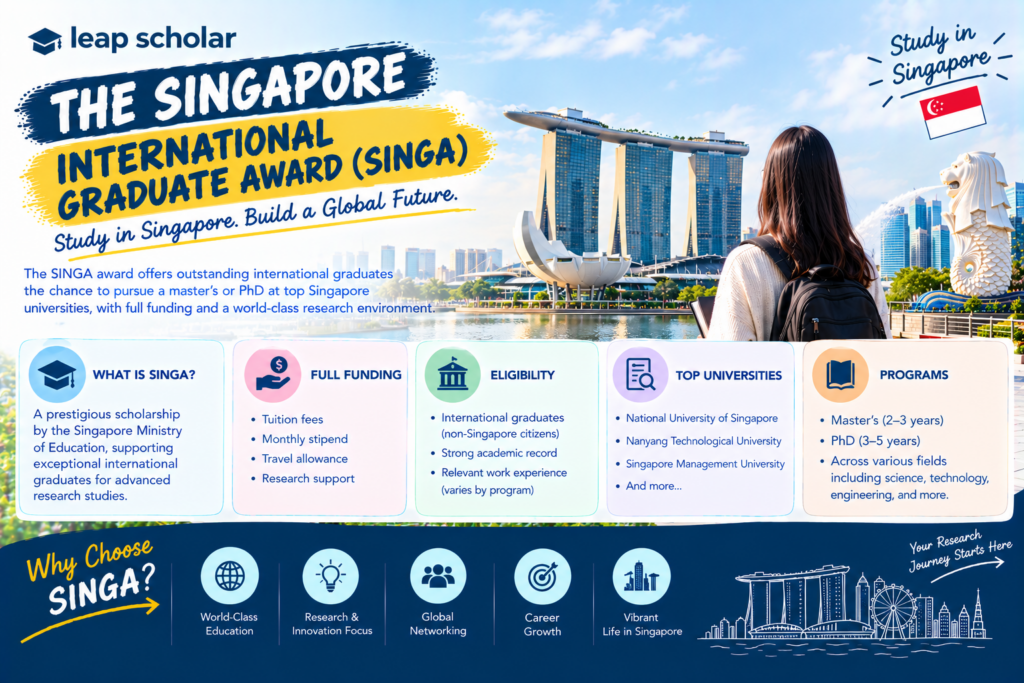
- SINGA 2026 pays a monthly stipend of S$2,700 (about Rs. 2,02,500), rising to S$3,200 after your qualifying exam.
- The next deadline is 1 December 2026, for the August 2027 intake at NUS, NTU, SUTD, SMU, SIT, or A*STAR.
- IELTS or TOEFL is usually not mandatory at the initial stage; GRE is required only for NUS-track applicants.
- SINGA is bond-free: no requirement to work in Singapore after your PhD.
What Is the Singapore International Graduate Award (SINGA)?
The Singapore International Graduate Award (SINGA) is a bond-free scholarship for international students who want to pursue a research PhD or EngD in Singapore. It is jointly run by the Agency for Science, Technology and Research (A*STAR), the National University of Singapore (NUS), the Nanyang Technological University (NTU), the Singapore University of Technology and Design (SUTD), the Singapore Management University (SMU), and the Singapore Institute of Technology (SIT).
SINGA covers Biomedical Sciences, Physical Sciences, Engineering and Technology, and Computing and Information Sciences. You train in English at A*STAR research institutes or at one of the five partner universities, working alongside internationally recognized scientists. Since it is bond-free, you are not required to work in Singapore after completing your PhD.
SINGA 2026 Stipend and Benefits (in INR)
SGD, the Singapore Dollar, is Singapore’s official currency. Here is what the SINGA scholarship pays, converted at approximately 1 SGD = Rs. 75 (check the live rate closer to your application, since it moves):
| Benefit | Amount (SGD) | Approx. Amount (INR) |
| Monthly stipend, before qualifying exam | S$2,700 | Rs. 2,02,500 |
| Monthly stipend, after qualifying exam | S$3,200 | Rs. 2,40,000 |
| One-time settling-in allowance | S$1,000 | Rs. 75,000 |
| One-time airfare grant | Up to S$1,500 | Up to Rs. 1,12,500 |
| Tuition fees | Fully covered | Fully covered |
The award runs for up to four years of PhD study. Your stipend moves from the lower band to the higher band once you clear your qualifying examination, usually 12 to 18 months into the program.
Partner Institutions: Where You Can Apply
| Institution | Degree Offered |
| National University of Singapore (NUS) | PhD |
| Nanyang Technological University (NTU) | PhD |
| Singapore University of Technology and Design (SUTD) | PhD, EngD |
| Singapore Management University (SMU) | PhD, EngD |
| Singapore Institute of Technology (SIT) | EngD |
| A*STAR Research Institutes | PhD (research attachment) |
If you are still deciding between a master’s and a direct PhD route, our guide to MS in Singapore for Indian students and our broader study in Singapore overview can help you compare.
Eligibility Criteria for SINGA 2026
- Open to international graduates of any nationality, including Indians, with a passion for research
- Not open to Singapore citizens, Singapore Permanent Residents, or international students who have already studied in Singapore on another scholarship
- A strong Bachelor’s and/or Master’s academic record
- Good written and spoken English
- Strong reports from academic referees
Is IELTS required for SINGA? Not usually, at least not at the initial application stage. The host university may ask for IELTS or TOEFL scores later as part of admission, but it is not a mandatory SINGA document upfront.
Is GRE mandatory for SINGA? The GRE is only required if you are applying to an NUS supervisor or project. For NTU, SUTD, SMU, and SIT applications, GRE is not compulsory, though a university may request it during the admission process.
Documents You Will Need for SINGA
- Official Bachelor’s and/or Master’s transcripts
- Degree certificate, or a letter from your university confirming your candidature if the degree has not yet been conferred
- Two letters of recommendation, submitted online by your referees
- GRE scores, if applying to an NUS supervisor or project
- A valid passport
- A recent passport-size photograph in .jpeg or .png format
Do not mail physical copies of any documents. Everything is submitted through the online portal.
SINGA 2026 Deadline and Application Timeline
SINGA runs two intake cycles a year:
| Intake | Application Window | Deadline |
| January | 2 December to 1 June | 1 June |
| August | 2 June to 1 December | 1 December |
Applications for the January 2027 intake closed on 1 June 2026. The window that is currently open is for the August 2027 intake, closing 1 December 2026. If you are reading the information after that date, check the official SINGA page for the next window rather than assuming the same dates repeat exactly, since A*STAR reviews terms periodically.
How to Apply for SINGA
- Visit the SINGA official website and browse the list of available PhD research projects by field.
- Register on the A*STAR Scholarship Applicant Portal and select “Singapore International Graduate Award (SINGA)” as your scholarship type.
- Shortlist up to three research projects or supervisors that match your background, since SINGA is project-based, not open-topic.
- Upload transcripts, your degree certificate or candidature letter, two recommendation letters, GRE scores if applicable, your passport copy, and your photograph.
- Follow up with your two referees to make sure their letters are submitted online before the deadline.
- Submit before 11:59 pm, Singapore time, on the closing date. Incomplete or unfinalized drafts are auto-rejected once the deadline passes.
SINGA vs SIPGA: What Is the Difference?
Students often confuse SINGA with SIPGA, A*STAR’s shorter research award. Here is how they differ:
| SINGA | SIPGA | |
| Purpose | Full PhD or EngD | Short-term research attachment |
| Duration | Up to 4 years | 2 to 6 months |
| Monthly stipend | S$2,700 to S$3,200 | S$2,000 |
| Who it suits | Students ready to commit to a PhD | Students testing research fit before a PhD |
If you are keen to explore a Singapore lab before committing to a full PhD, read our guide to the Singapore International Pre-Graduate Award (SIPGA).
Counselor insight: A common mistake Indian applicants make is applying to all five partner universities with the same generic research statement. Reviewers can tell. Pick the one or two institutions whose labs genuinely match your research interest, and write your statement around that specific lab’s ongoing work.
3 Takeaways on SINGA
- Apply only to the one or two institutions whose research projects genuinely match your background, since SINGA is project-based and generic applications stand out for the wrong reason.
- Mark 1 December 2026 for the August 2027 intake, and start your referee follow-ups at least a month earlier so recommendation letters are not the reason you miss the deadline.
- Budget using the INR figures in this guide, roughly Rs. 2,02,500 to Rs. 2,40,000 a month, but verify the live SGD to INR rate before making any financial commitments.
Apply for SINGA 2026 before 1 December 2026 to start your fully funded PhD in Singapore. Talk to a LeapScholar counselor to check your eligibility and build a strong research proposal before you submit.
Frequently Asked Questions About SINGA
-
What is the Singapore International Graduate Award (SINGA)?
SINGA is a fully funded scholarship from A*STAR, NUS, NTU, SUTD, SMU, and SIT for international students pursuing a research PhD or EngD in science and engineering in Singapore. It covers tuition, a monthly stipend, a settling-in allowance, and an airfare grant, and carries no service bond.
-
Is IELTS required for the SINGA scholarship?
IELTS or TOEFL is generally not a mandatory document at the initial SINGA application. Your host university may request it Later during the admission process, check the specific requirements for the university and project you are targeting.
-
Is GRE compulsory for SINGA?
GRE is mandatory if your SINGA application is for an NUS supervisor or project. For NTU, SUTD, SMU, and SIT, it is usually optional unless the specific program asks for it.
-
How much is the SINGA stipend in Indian rupees?
At roughly 1 SGD, equal to Rs. 75, the S$2,700 monthly stipend works out to about Rs. 2,02,500, rising to about Rs. 2,40,000 once the stipend increases to S$3,200 after your qualifying exam.
-
When is the SINGA 2026 application deadline?
The January 2027 intake closed on 1 June 2026. The next open window is for the August 2027 intake, with applications due by 1 December 2026.
-
What is the difference between SINGA and SIPGA?
SINGA funds a full PhD or EngD for up to four years with a monthly stipend of S$2,700 to S$3,200. SIPGA is a shorter, 2- to 6-month research attachment at an A*STAR institute, with a S$2,000 monthly stipend meant to test research fit before committing to a PhD.
-
Is there a service bond after SINGA?
No. SINGA is a bond-free award. You are not required to work in Singapore after completing your PhD, though many scholars do go on to research or industry roles there.
-
Can I apply for SINGA if I already hold a PhD?
No. SINGA is meant for graduates moving into a research-based PhD or EngD program. If you already hold a PhD, you are not eligible to apply.
-
Who do I contact for Singapore student visa questions after I am selected?
Once you accept a SINGA offer, your host university’s international student office typically guides you through the Student’s Pass process. For broader visa queries, the High Commission of Singapore in New Delhi is the official point of contact for Indian applicants.













Have Questions? Get Guidance to reach your Dream University
Connect with India's finest counsellors and biggest study abroad community.
Get Guidance