
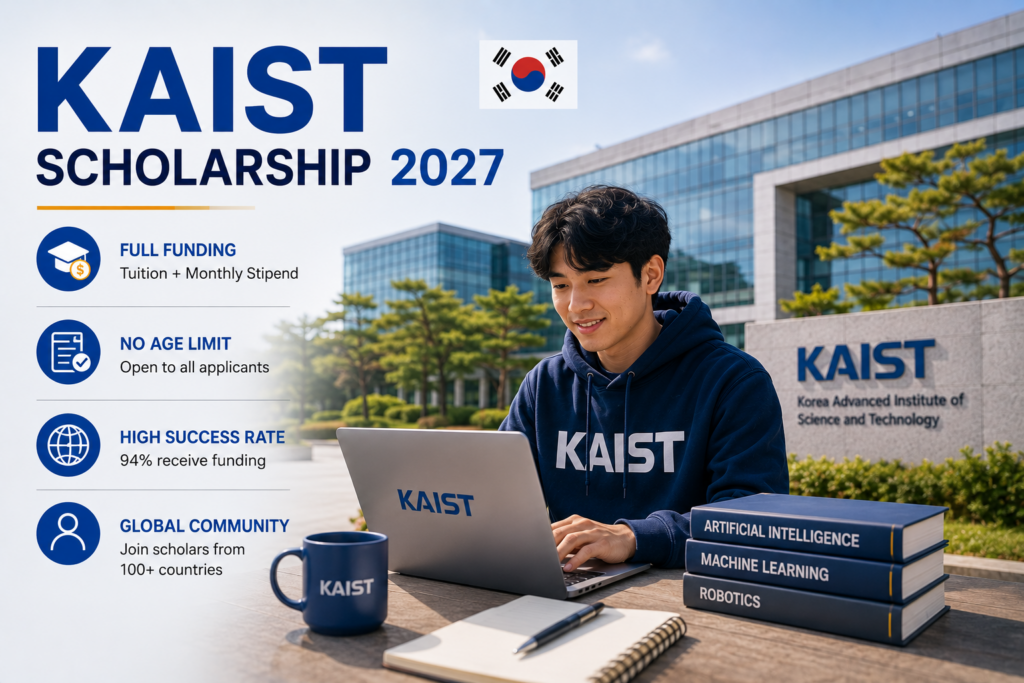
Quick Read
- KAIST Scholarship covers full tuition plus a monthly stipend.
- No separate application exists; you apply for admission first.
- There is no KAIST scholarship age limit for any applicant.
- The application fee is KRW 80,000, about Rs 5,360.
- Indian students need IELTS 6.5 or TOEFL iBT 83 to qualify.
- 94% of admitted international students receive KAIST funding.
What Is the KAIST Scholarship?
- A financial aid program built into KAIST’s own graduate admission process, not a separate scholarship you apply for on its own.
- Covers full tuition and a monthly stipend for admitted international students, funded by KAIST itself rather than the Korean government.
- Different from the Global Korea Scholarship (GKS), which is a Korean government award you can apply for through KAIST or your local Korean embassy.
- Different again from the undergraduate KAIST Scholarship, which funds bachelor’s degrees and works on a separate calendar with no Spring intake.
- Master’s, Master’s-PhD Integrated, and PhD applicants who select “KAIST Scholarship” as their funding source are automatically considered for higher-value tiers like the KAIST Global Presidential Scholarship (KGPS), based on their program and department.
My insight: Students often assume the KAIST scholarship name refers to one single award. In practice it is a funding label you select during your admission application, and KAIST sorts you into whichever tier your department and program qualify for. There is no separate scholarship form to fill out.
KAIST Scholarship Eligibility for Indian Students
| Criterion | Requirement | Note for Indian Applicants |
|---|---|---|
| Degree held | Bachelor’s degree (or expected) for Master’s/Integrated; Master’s degree (or expected) for PhD | Final-year students can apply if they finish before the semester starts |
| Citizenship | Must not hold Korean citizenship, including dual citizenship | Indian passport holders qualify with no restriction |
| English proficiency | TOEFL iBT 83, IELTS 6.5, TOEIC 720, or TEPS 326 | Scores must be valid and submitted before the online deadline; some programs like GDI-ITTP skip this requirement |
| KAIST scholarship age limit | None published | KAIST places no age restriction on any applicant, unlike some government scholarships that cap age at 40 |
| Faculty contact | Master’s applicants: name up to 3 faculty members with overlapping research interests. PhD applicants: name one advisor | Reaching out to a professor before applying genuinely helps your file |
KAIST Scholarship Amount: What It Actually Pays
| Scholarship Tier | Who Gets It | Monthly Stipend | Tuition | In INR |
|---|---|---|---|---|
| KAIST Scholarship (standard) | Most admitted international students, 94% of the international student body | 350,000-400,000 KRW, varies by college and research involvement | Full waiver | Roughly Rs 23,450-26,800/month |
| KAIST Global Presidential Scholarship (KGPS) | Master’s and Integrated applicants selected for the top tier | 1,000,000 KRW for 4 regular semesters | Full waiver | Roughly Rs 67,000/month |
| KAIST Prestige Scholarship (KPS) | PhD and Integrated applicants in College of Engineering departments, chosen through a department recommendation | 300,000 KRW for 8 regular semesters | Full waiver | Roughly Rs 20,100/month |
| KAIST CoE PhD Fellowship | Top PhD and Integrated applicants in College of Engineering, needs a department recommendation and dean’s approval | 2,500,000 KRW for 4 academic years | Full waiver | Roughly Rs 1.68 lakh/month |
| KAIST MBA Scholarship | Selected MBA applicants, usually with 2+ years of work experience | 500,000 KRW/month | Full or partial for 2 years | Roughly Rs 33,500/month |
| Application fee | Every applicant | Not applicable | KRW 80,000 (about $80) | Roughly Rs 5,360 |
Sources: KAIST Scholarship Financial Support Page, KAIST College of Business Scholarship Programs
KPS and the CoE Fellowship are specific to College of Engineering PhD and Integrated applicants, and you can’t select them directly. They’re awarded through a department recommendation and, for the CoE Fellowship, a dean’s final approval. If you’re applying to a College of Engineering PhD program, ask your target department how these tiers actually get allocated each cycle rather than assuming you’ll qualify.
For a full cost picture beyond the scholarship, our guide on the cost of studying in South Korea breaks down rent, food, and dormitory costs in Daejeon.
My insight: Don’t treat the KAIST scholarship amount as fixed income to plan a budget around. The stipend depends on your college and how much you get involved in a professor’s research, and the rupee-won rate moves. Use these figures as a floor, not a promise.
KAIST Scholarship vs GKS vs the Undergraduate Track
People often use “KAIST scholarship” as a catch-all term, but it can mean three genuinely different programs depending on your degree level and who’s funding you. Here’s how they actually differ:
| Detail | KAIST Scholarship (Graduate) | Global Korea Scholarship (GKS) | KAIST Undergraduate Scholarship |
|---|---|---|---|
| Who funds it | KAIST | Korean government | KAIST |
| Degree level | Master’s, Integrated, PhD | Bachelor’s, Master’s, PhD | Bachelor’s only |
| Extra benefits | Stipend, tuition waiver | Airfare, 1 year Korean language training, settlement allowance | Stipend, tuition waiver |
| How you apply | Select it as your funding source in your KAIST admission application | Apply through KAIST or your nearest Korean embassy separately | Automatic once admitted, no separate form |
If GKS looks like a better fit for your profile, our GKS Graduate Scholarship guide walks through its timeline and benefits in detail.
KAIST Scholarship Application Form and Required Documents
| Document | What It Involves | Note for Indian Applicants |
|---|---|---|
| Online application form | Personal details, program choice, and your KAIST scholarship application form submission | Filled out entirely on KAIST’s own portal, not a separate scholarship form |
| Statement of purpose | Explains your research interests and fit with a department | A well-structured statement of purpose for a Master’s format works well here |
| Two recommendation letters | From professors or supervisors who know your academic work | A properly formatted letter of recommendation for a PhD applies to Master’s applicants too |
| Transcripts and degree certificates | Academic record from your bachelor’s (or master’s for PhD) | Get documents translated and notarized if not issued in English |
| English proficiency test report | TOEFL, IELTS, TOEIC, or TEPS score | Must be valid on the date KAIST specifies each cycle |
| Statement of financial resources | Confirms how you’ll cover costs if not fully funded | Select KAIST Scholarship here if you want to be considered for funding |
| Passport copy | Proof of identity and non-Korean citizenship | A clear, valid scan is required |
KAIST Scholarship Application Fee, Fee Waiver and Application Portal
| Item | Details |
|---|---|
| KAIST scholarship application fee | KRW 80,000, roughly $80 or about Rs 5,360 at today’s rate. Paid online once you finish your application, which triggers your application number and automatic recommendation-letter requests |
| KAIST scholarship application fee waiver | A short window opens before most cycles, usually about a week, restricted to applicants from specific backgrounds such as least developed countries. Dates change every cycle |
| KAIST scholarship application portal | gradapply.kaist.ac.kr is the only official portal. Your application form, documents, and fee payment all go through this one site, and nowhere else. |
| KAIST scholarship and welfare team contacts | The Graduate Admissions Team handles pre-admission scholarship and application queries. KAIST’s Student Welfare Team handles post-enrollment matters like dormitory fees and registration once you’re a student |
My insight: We’ve seen students pay the application fee on a third-party site by mistake. KAIST’s own portal is the only place where we officially record your payment and documents. If a link doesn’t end in kaist.ac.kr, don’t enter your payment details.
KAIST Scholarship Application Deadline
KAIST runs one main international graduate intake, with an additional Fall Early Track for some departments. Exact dates shift by a few days every year, so confirm the live KAIST scholarship application deadline on the official admissions site before you finalize your recommenders’ timelines.
| Milestone | Typical Timing (based on the last several cycles) |
|---|---|
| Online application period | Mid-to-late August through early September for Spring entry; early December for Fall Early Track; early March for Fall Regular Track |
| Recommendation letter deadline | About one week after the application period closes |
| Decision announcement | Roughly 3-4 months after the application deadline |
| The semester begins | February/March (Spring) or September (Fall) |
My insight: Indian applicants often lose two or three weeks waiting for transcript attestation. Start that process the same week you decide to apply, not after you’ve written your statement of purpose, since attestation turnaround in India can run longer than KAIST’s own application window.
KAIST Scholarship Acceptance Rate: How Competitive Is It?
- KAIST does not publish an official KAIST scholarship acceptance rate, which surprises many applicants.
- What KAIST does confirm: the scholarship supports 94% of its international student body, so once you’re admitted to a graduate program, receiving some tier of funding is the norm rather than the exception.
- The real bottleneck is getting into the graduate program itself, not winning the scholarship separately.
- KAIST doesn’t release official admission statistics either. Independent estimates for international graduate applicants suggest a range of roughly 15% to 20%, but this figure is not an official KAIST scholarship acceptance rate, and the university has never confirmed it publicly.
- Treat any acceptance rate figure you see online, including this one, as a rough estimate rather than a fact.
What Happens If You Miss the Deadline or Don’t Get Funded?
- If you miss the application window for this intake: You’ll need to wait for the next cycle. KAIST runs Spring and Fall intakes, so the gap is usually a matter of months, not a full year.
- If you’re admitted but not given the top scholarship tier: You still receive the standard KAIST Scholarship covering tuition and a stipend in most cases, since 94% of international students get some level of funding.
- If KAIST funding doesn’t come through at all: Look into GKS (the Global Korea Scholarship covered earlier) or broader South Korean scholarships for Indian students, since KAIST is not the only fully funded route to Korean graduate study.
Key Takeaways on KAIST Scholarship Application
- There is no separate KAIST scholarship application. You select it as your funding source inside your regular graduate admission application, and your program admission determines your funding outcome.
- Confirm the current cycle’s exact KAIST scholarship application deadline on the official admissions site before you plan your recommenders’ timeline, since dates shift by a few days every year.
- Getting into the graduate program is the real competition, not the scholarship itself, since 94% of admitted international students receive some level of KAIST funding.
Verified by: LeapScholar’s South Korea counseling team, with hands-on experience guiding Indian students through KAIST and other Korean university applications.
Have questions about your own KAIST application timeline? Book a free session with a LeapScholar counselor.
Frequently Asked Questions About KAIST Scholarship
-
What is the KAIST scholarship application form?
There is no separate scholarship form. You select “KAIST Scholarship” as your financial resource inside the regular graduate admission application, and the university automatically considers you for it alongside your program application.
-
Where do I submit the KAIST scholarship application?
Everything goes through the official KAIST scholarship application portal at gradapply.kaist.ac.kr. This is the only site where your documents and payment are officially recorded.
-
Is there a KAIST scholarship application fee?
Yes. The fee is KRW 80,000, roughly $80 or about Rs 5,360. It’s paid online once you complete your application form, before your recommenders are contacted.
-
Does KAIST offer a KAIST scholarship application fee waiver?
Yes, for a limited window before most cycles, typically restricted to applicants from specific countries or backgrounds. The dates vary each cycle, so check the current notice on the admissions site rather than assuming last year’s dates apply.
-
What is the KAIST scholarship acceptance rate?
KAIST has not published an official acceptance rate for the scholarship itself. It has confirmed that 94% of admitted international students receive some level of KAIST funding, which means admission to the program is the real hurdle, not a separate scholarship competition.
-
Is there a KAIST scholarship age limit?
No. KAIST has no published age restriction for the scholarship, at the graduate or undergraduate level. The real constraint is your degree timeline, not your age.
-
What is the KAIST scholarship amount?
The standard tier covers full tuition plus a stipend of 350,000 to 400,000 KRW a month, while the top Master’s level, KGPS, pays 1,000,000 KRW a month. At today’s rate, that’s roughly Rs 23,450 to Rs 67,000 a month depending on your tier.
-
When is the KAIST scholarship application deadline?
KAIST runs Spring and Fall intakes each year, with the Spring window typically opening in mid-to-late August and closing in early September. Always confirm the current cycle’s exact dates on the official admissions site, since they shift slightly every year.
-
Who handles KAIST scholarship and welfare team queries after I’m admitted?
Once you’re enrolled, KAIST’s Student Welfare Team handles campus-level scholarship administration, dormitory fees, and registration matters. Before admission, the Graduate Admissions Team handles scholarship and application queries instead.









Have Questions? Get Guidance to reach your Dream University
Connect with India's finest counsellors and biggest study abroad community.
Get Guidance