
Quick Read
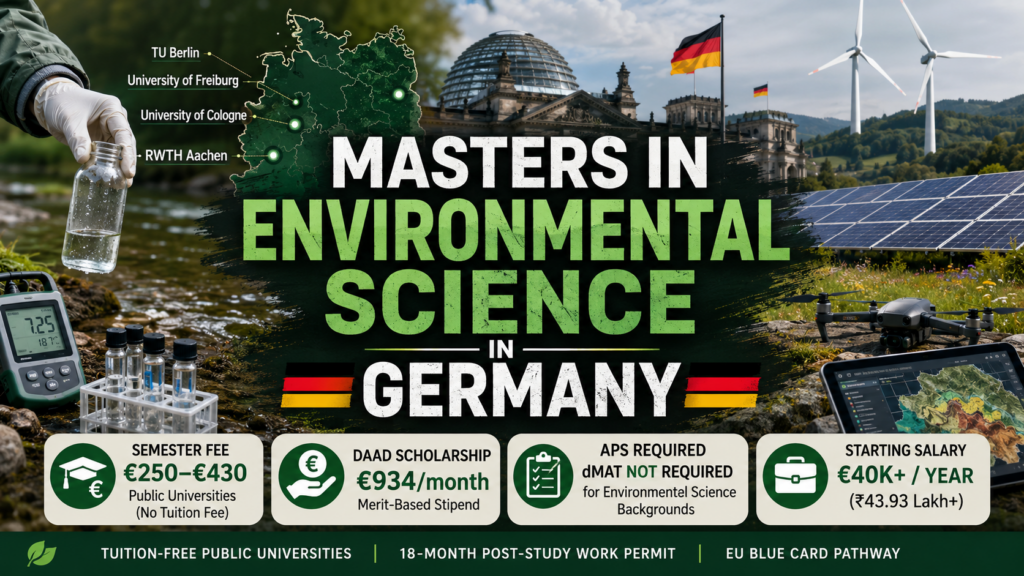
- A masters in environmental science in Germany costs just €250–€430 (₹27,460–₹47,231) per semester.
- APS is mandatory, but dMAT doesn’t apply to environmental science.
- DAAD’s master’s stipend is €934/month (₹1,02,611).
- Entry-level salaries start near €40,000/year (₹43,93,600), rising with experience.
Why Study a Masters in Environmental Science in Germany?
- Affordability: Public universities charge no tuition. You pay only a semester contribution of €250-€430 (₹27,460-₹47,231). A two-year MSc here can cost less than a single year abroad elsewhere.
- Research access: Programs route students through Fraunhofer, Helmholtz, and DFG-funded projects. This gives you lab and fieldwork exposure that most coursework-only degrees don’t offer.
- Industry demand: Germany’s GreenTech and renewable-energy sector is a major employer of environmental science graduates. Demand is driven by the Energiewende policy and EU sustainability targets.
- Global employers on your doorstep: Siemens Energy, RWE, and BASF recruit directly from German MSc programs. So do environmental consultancies like Ramboll and ERM, plus government bodies like the Umweltbundesamt (UBA).
- Career prospects: An 18-month post-study work permit and a direct EU Blue Card pathway make long-term residency realistic after your masters in environmental science in Germany.
See what our counselors say on whether Germany is the best first-priority country for your course and career scope before you commit to a shortlist.

Choose your dream country
 UK
UK
 USA
USA
 Germany
 Australia
 Ireland
 Canada
 UAE
UAE
 France
 Sweden
 Italy
Italy
 Other
Other
When do you want to study abroad?
What's your highest level of education?
Have you completed Class 12th?
What was your Class 12 CGPA/percentage?
Are you a student or a parent/guardian?
What do you want to study?
Select your current city
How Leap will help you

Personalised University Shortlist

Express Applications with Quicker Admits

End-to-End Application Support
Universities in Germany for Masters in Environmental Science
Germany offers 25+ English-taught programs in masters in environmental science and related MSc environmental science tracks. QS doesn't publish a subject-specific Environmental Sciences ranking, so the table below uses each university's overall QS World University Ranking 2027 (released June 2026) alongside the latest official fee data for 2026-27.
| University | Program | QS World Ranking 2027 (Overall) | Semester Fee (2026-27, latest official) |
| Technical University of Berlin | MSc Environmental Science and Technology | #158 globally (8th in Germany) | €380–€430 (₹41,739–₹47,231) |
| University of Freiburg | MSc Environmental Sciences | #245 globally (14th in Germany) | €250–€300 (₹27,460–₹32,952) |
| University of Cologne | International Master Environmental Sciences (IMES) | Ranked, top-700 band | €250–€618 (₹27,460–₹67,880) |
| Trier University | MSc Environmental Sciences (ES) | Not in QS top-1,500 (specialist program) | €380 first semester, €360 thereafter (₹41,739 / ₹39,542) |
| University of Hohenheim | MSc Environmental Science: Soil, Water & Biodiversity | Not in QS top-1,500 (specialist program) | €1,500 non-EU surcharge in Baden-Württemberg (₹1,64,760) + standard fee |
| RPTU Kaiserslautern-Landau | MSc Environmental Sciences | Not in QS top-1,500 (specialist program) | €300–€350 (₹32,952–₹38,444) |
| RWTH Aachen | MSc Ecotoxicology / Environmental Engineering tracks | #104 globally | €250–€300 (₹27,460–₹32,952) |
Sources: QS World University Rankings 2027 · DAAD International Programmes Database · Hochschulkompass
Exchange rate used throughout this article: 1 EUR = ₹109.84 (August 2026). Exchange rates fluctuate daily. Confirm the live rate before transferring funds.
Note: Several strong specialist programs (Trier, Hohenheim, and RPTU Landau) sit outside the QS top 1,500 because QS ranks the whole institution, not the specific program. RWTH Aachen doesn't publish an official acceptance rate either; see our RWTH Aachen acceptance rate guide for how Numerus Clausus actually works there.
Counselor insight: Students chasing the highest-ranked university sometimes end up at TU Berlin or RWTH Aachen with a program that's engineering-heavy, when their background fits better at a specialist school like Trier or Hohenheim. Match the curriculum to your bachelor's field before you match the university brand.
Eligibility for Masters in Environmental Science in Germany
To qualify, you typically need:
- A relevant bachelor's degree (Environmental Science, Biology, Geography, Environmental/Civil Engineering, or related field) with at least 180 ECTS credits. A 3-year Indian bachelor's usually needs credit mapping; confirm with the university.
- English proficiency at IELTS 6.0-6.5 or C1-equivalent; some universities accept a Medium of Instruction (MOI) letter instead.
- For soil/water/biodiversity specializations (like Hohenheim's), provide coursework evidence in at least two of the following: Chemistry, Biology, or Earth Sciences.
- No GRE requirement for most programs; it's typically optional except for select TU9 engineering-flavoured tracks.
Read expert answers on English proficiency and APS certification requirements for studying in Germany and whether the GRE is required for a masters in Germany before finalising your test-prep plan.
Decision Framework: Which Situation Applies to You?
- Pure Environmental Science or Environmental Engineering bachelor's: You're the most direct fit. Target research-heavy programs like Freiburg or Trier, with minimal bridging coursework in semester one.
- Biology or Geography bachelor's: You'll likely qualify for programs like Cologne's IMES, which explicitly welcomes this background. You may need at least 12 ECTS in environment-related coursework, so highlight GIS, ecology, or field-survey modules from your degree.
- Civil, Mechanical, or Chemical Engineering bachelor's: You're a stronger match for environmental engineering-flavoured programs (TU Berlin, RWTH Aachen) than pure environmental science tracks. Expect admissions committees to check for environmental electives or projects in your transcript.
APS Certificate and dMAT for a Masters in Environmental Science in Germany
Every applicant needs an APS (Akademische Prüfstelle) certificate before the university application and visa process can move forward. It verifies that your Indian academic documents are genuine.
Here's what we overlook: APS India's June 2026 update introduced a Digital Master Test (dMAT). It applies ONLY to Master's applicants whose bachelor's degrees are in Engineering, Commerce, Economics, Finance, Business, or Management, starting Summer Semester 2027.
If your bachelor's is in Environmental Science, Biology, Geography, or a related natural science field, the dMAT DOES NOT apply to you. You still need standard APS document verification, but you do not need to take the extra test.
- The other update, the 70% Class XII eligibility rule, applies only to Bachelor's admissions from Winter Semester 2026/27 onward, not at the Master's level.
- German universities instead set their own CGPA cutoffs for Master's admission (typically 60-75% or a 6.5/10 CGPA).
- The APS certificate fee is ₹18,000, non-refundable, with standard processing from New Delhi taking 4-8 weeks.
Read expert answers on whether you still need APS after IELTS and GMAT for a Germany masters, whether GMAT is needed for the 2027 intake, and dMAT retake fees if you're double-checking your specific test requirements.
Source: APS India official site
Counselor insight: We've had Environmental Science students delay their APS registration by weeks, assuming dMAT applied to them after reading about it in Germany-related forums. Check your bachelor's field against the official affected-fields list first. You'll likely save both time and the €150 (₹16,476) dMAT fee you don't need to pay.
Is an MSc Free in Germany? Cost of a Masters in Environmental Science (2026-27, INR Breakdown)
Asking "Is an MSc free in Germany?" is really asking about semester fees versus tuition. Tuition is genuinely zero at public universities; the semester contribution below is what you actually pay.
| Cost Item | Amount | INR Equivalent |
| Semester fee (most public universities) | €250-€430 | ₹27,460-₹47,231 |
| Baden-Württemberg non-EU surcharge (e.g. Hohenheim) | +€1,500/semester | +₹1,64,760 |
| Blocked account (Sperrkonto): annual | €11,904 | ₹13,07,647 |
| Blocked account: monthly withdrawal cap | €992 | ₹1,08,969 |
| APS certificate fee | Flat fee | ₹18,000 |
| Visa application fee | €75 | ₹8,238 |
| Health insurance (approx., per month) | €120-€150 | ₹13,181-₹16,476 |
The blocked account figure of €11,904/year (€992/month) is the current officially confirmed amount, unchanged since September 2024. A BAföG-linked increase has been proposed for later intakes.
The Federal Foreign Office hasn't published a confirmed revised figure for Winter 2027-28 yet, so reconfirm with your consulate closer to your visa appointment.
For a full breakdown, see the blocked account requirements for Germany and the cost of an MS in Germany for Indian students.
Read expert answers on the total fee and payment structure for a masters course in Germany if you're building a semester-by-semester budget.
Sources: DAAD: Studying in Germany · Federal Foreign Office
ROI Snapshot: Masters in Environmental Science in Germany
| Item | 2-Year Total |
| Tuition (semester fees × 4) | €1,000-€1,720 (₹1,09,840-₹1,88,925) |
| Living costs (blocked-account basis × 2 years) | €23,808 (₹26,15,294) |
| Total program cost (excl. Baden-Württemberg surcharge) | ~€25,000-€26,000 (₹27,46,000-₹28,55,840) |
| Expected entry-level starting salary | €40,000-€54,490/year (₹43,93,600-₹59,85,182) |
| Approx. payback period | Under 12 months of your first full-time salary |
Note: This figure is an indicative estimate built from the verified figures above, not a single official "ROI" publication. Actual payback depends on your university, city, and job offer.
Scholarships for Masters in Environmental Science in Germany
These three funding routes cover most Indian applicants for a masters in environmental science in Germany, from merit-based stipends to activism-linked grants.
| Scholarship | Monthly Stipend | Eligibility Notes |
| DAAD Study Scholarships (STEM) / EPOS | €934 (₹1,02,611); select 2026 EPOS calls pay up to €1,400 (₹1,53,776) | Figure confirmed on daad.de; check the exact scholarship line in the DAAD database |
| Deutschlandstipendium | €300 (₹32,952) | Awarded by the host university post-admission; no separate application portal |
| Heinrich Böll Foundation | €992 (₹1,08,969) | Requires B2-level German; favors applicants with environmental activism or civic engagement background |
For reference, DAAD's PhD/doctoral stipend sits at €1,300/month (₹1,42,792), higher than any master's-level scholarship above.
For full details and application steps, see the scholarships for masters in Germany.
Source: DAAD Scholarship Database
Documents Checklist for a Masters in Environmental Science in Germany Application
| Document | India-Specific Detail |
| Bachelor's degree certificate | A provisional certificate with registrar letter accepted if final degree is pending |
| Individual semester marksheets | Consolidated marksheets are rejected by APS; request semester-wise originals |
| APS certificate | Mandatory: apply as early as your provisional certificate allows |
| English proficiency proof | IELTS 6.0-6.5, or an MOI letter if your bachelor's was taught in English |
| Motivation letter / SOP | Should explicitly connect your bachelor's coursework to the specific MSc specialisation |
| Two academic references | From bachelor's faculty, German universities weight these more than professional references |
| Blocked account confirmation | Required only at the visa stage, not for university application |
Planning Calendar for Masters in Environmental Science in Germany (Winter 2027-28)
| Month | Action |
| November 2026 | Shortlist universities and specialisations; confirm ECTS/subject-matching requirements |
| December 2026 | Register for APS at aps-india.de; courier documents if outside Delhi |
| January-February 2027 | Attend APS interview; final-year students use provisional certificates |
| March 2027 | Receive APS certificate; submit university applications via Uni-Assist or direct portals |
| April-May 2027 | Respond to offers and open blocked account (Expatrio or Fintiba) |
| June 2027 | Book VFS visa appointment; peak demand is May-August |
| July 2027 | Attend visa interview; finalise health insurance |
| August-September 2027 | Receive visa; book flights and accommodation |
| October 2027 | Winter Semester 2027-28 begins |
What to Do If Your Masters in Environmental Science in Germany Application Goes Wrong
- Missed the APS registration window: Register immediately for the next slot and consider the Summer Semester intake at select universities rather than waiting a full year.
- Bachelor's field doesn't cleanly match Environmental Science: Contact the university's admissions office directly with your transcript. Several programs (Cologne's IMES, for instance) evaluate Biology and Geography backgrounds case by case.
- APS interview didn't go well: You'll get written feedback and can reapply after three months. Use the wait to revise your core undergraduate subjects, since most rejections are about subject knowledge, not documents.
- Visa delayed past your intended semester start: Contact the university's international office with proof of your visa appointment date; some universities allow a one-semester deferral if confirmed in writing before your enrollment deadline.
Full process: Germany study visa for Indian students.
Career Scope: Environmental Science Jobs in Germany After Your Masters
So what can you do with a masters in environmental science in Germany, and is a masters in environmental science worth it once you factor in real salaries? Career paths split across four broad tracks, each with different employers and pay bands.
| Industry | Common Employers | Indicative Avg. Salary (2026) | Common Roles |
| Environmental Consulting | Ramboll, ERM, TÜV Rheinland | €45,000-€65,000 (₹49,42,800-₹71,39,600) | Environmental Consultant, EIA Specialist |
| Government / Regulatory | Umweltbundesamt (UBA), state environment ministries | €40,000-€58,000 (₹43,93,600-₹63,70,720) | Policy Analyst, Compliance Officer |
| Research Institutes | Fraunhofer, Helmholtz Centres, Max Planck Institutes | €42,000-€60,000 (₹46,13,280-₹65,90,400) | Research Associate, PhD Researcher |
| Corporate Sustainability/ESG | Siemens Energy, RWE, BASF | €50,000-€77,000+ (₹54,92,000-₹84,77,680+) | Sustainability Manager, ESG Analyst |
Note: Entry-level roles overall (1-3 years) start around €40,000-€54,490/year (₹43,93,600-₹59,85,182); experienced professionals (8+ years) reach €77,000-€87,000/year (₹84,57,680-₹95,55,080).
Graduates get an 18-month post-study job-seeker residence permit to find qualifying work. The EU Blue Card threshold is €50,700/year (₹55,68,888) for standard roles or €45,934.20/year (₹50,45,413) for shortage occupations and recent graduates, under the latest official 2026 figures. Meet it, and you can convert directly to a Blue Card, putting you on a path to permanent residency in 21-27 months.
Read more on the Germany Opportunity Card if you're weighing the job-search visa route instead of a direct offer. If you're also comparing STEM-adjacent tracks, our Software Engineering in Germany guide breaks down that field's own salary bands and Blue Card path in detail.
Sources: PayScale: Environmental Scientist Salary, Germany (2026) · SalaryExpert: Environmental Scientist Salary, Germany (2026) · EU Blue Card salary thresholds 2026
Counselor insight: Environmental science graduates sometimes undersell themselves in salary negotiations because the field has a "mission-driven, not money-driven" reputation. German employers still benchmark against Blue Card thresholds. Don't accept an offer below €45,000 without first asking whether it qualifies as a shortage-occupation role.
3 Takeaways on Masters in Environmental Science in Germany
- A masters in environmental science in Germany stays genuinely low-cost: semester fees only, no tuition. But independently confirm that dMAT does not apply to your bachelor's field before assuming any extra APS steps.
- Budget in INR using the current blocked account figure of ₹13,07,647/year and reconfirm before your Winter 2027-28 visa appointment, since a BAföG-linked revision is proposed but not yet officially published.
- Match your bachelor's background (pure Environmental Science, Biology/Geography, or Engineering) to the right program type before chasing university rankings. Curriculum fit affects both admission odds and career outcomes more than overall QS position does.
Verified by: LeapScholar's Germany counseling team, with hands-on experience guiding Indian students through APS certification, DAAD applications, and German university admissions.
Have questions about a masters in environmental science in Germany? Book a free session with a LeapScholar counselor.
Frequently Asked Questions About Masters in Environmental Science in Germany
-
Is an MSc free in Germany for environmental science?
Public universities don't charge tuition. You pay a semester contribution of €250-€430 (₹27,460-₹47,231), except in Baden-Württemberg, where non-EU students pay an additional €1,500/semester (₹1,64,760).
-
Can I apply for a masters in environmental science in Germany with a biology degree?
Yes. Several programs, including Cologne's International Master of Environmental Sciences, explicitly accept Biology and Geography bachelor's graduates, though you may need at least 12 ECTS in environment-related coursework.
-
Do I need to take the dMAT test for a masters in environmental science in Germany?
No. The dMAT requirement introduced in June 2026 applies only to applicants with a bachelor's in Engineering, Commerce, Economics, Finance, Business, or Management. Environmental science backgrounds are not affected.
-
Is a masters in environmental science worth it in terms of salary?
Entry-level salaries start around €40,000-€54,490/year (₹43,93,600-₹59,85,182), rising to €77,000+ (₹84,57,680+) with experience. Whether it's "worth it" depends on your target role: consulting and corporate sustainability roles offer the strongest ROI.
-
What can you do with a masters in environmental science in Germany after graduating?
Common paths include environmental consulting, government/regulatory roles, corporate sustainability positions, and research roles that often lead into a PhD.
-
What happens if my APS certificate is delayed beyond my intake deadline?
Email info@aps-india.de with your university deadline attached; APS cannot always expedite, but a documented deadline sometimes moves your case up the queue. Consider the Summer Semester intake at select universities as a fallback.
-
Which universities in Germany offer a masters in environmental science taught in English?
TU Berlin, University of Freiburg, University of Cologne (IMES), Trier University, University of Hohenheim, and RPTU Kaiserslautern-Landau all offer English-taught MSc in environmental science tracks in Germany, among 25+ programs nationally.
-
Is Germany good for a masters in environmental science compared to other countries?
Yes, primarily because of the tuition-free structure and direct research-institute access through Fraunhofer and Helmholtz. The trade-off is that salaries in this specific field are moderate compared to Germany's engineering or CS sectors.
-
Do I need German language skills for a masters in environmental science in Germany?
Not for admission to English-taught programs. However, basic German (A2/B1) significantly improves your chances of getting environmental science jobs in Germany after graduation, since many employers use German in their daily work.







Have Questions? Get Guidance to reach your Dream University
Connect with India's finest counsellors and biggest study abroad community.
Get Guidance