
Quick Read
- TUM, RWTH Aachen, and Stuttgart lead Germany’s aerospace engineering masters programs.
- RWTH Aachen and TU Berlin charge no tuition, only a semester contribution.
- Engineering applicants targeting Summer 2027 intake or later must clear the dMAT test.
- APS certificate verification for Indian applicants takes 3-4 weeks, longer in peak season.
Why a Masters in Aerospace Engineering in Germany Makes Sense
Germany is home to Airbus, the German Aerospace Center (DLR), MTU Aero Engines, and Lufthansa Technik, so a masters in aerospace engineering in Germany puts you inside the supply chain of the companies that build the aircraft. The German government allocates about EUR 1 billion annually for aerospace research, which is why lab access and industry-linked thesis projects are easier to secure here than in most other European destinations.
Cost is the other advantage, but it is not uniform across states. RWTH Aachen and TU Berlin charge no tuition to non-EU students, only a semester contribution. TUM (Bavaria) and Baden-Württemberg universities like Stuttgart and KIT charge non-EU tuition on top of that. Your final cost depends heavily on which state you shortlist in, which is why the breakdown below matters more than a single average figure.

Choose your dream country
 UK
UK
 USA
USA
 Germany
 Australia
 Ireland
 Canada
 UAE
UAE
 France
 Sweden
 Italy
Italy
 Other
Other
When do you want to study abroad?
What's your highest level of education?
Have you completed Class 12th?
What was your Class 12 CGPA/percentage?
Are you a student or a parent/guardian?
What do you want to study?
Select your current city
How Leap will help you

Personalised University Shortlist

Express Applications with Quicker Admits

End-to-End Application Support
Counselor insight: Most students assume TU9 universities are the only serious option for aerospace engineering courses in Germany. We have seen equally strong outcomes from students who chose applied sciences universities (FH/HAW) with a defined aerospace focus, since smaller cohorts meant faster access to DLR-linked project work.
Top Universities for a Masters in Aerospace Engineering in Germany
| University | State | QS World Ranking 2027 | Non-EU Tuition | Semester Contribution | Known For |
| TU Munich (TUM) | Bavaria | #25 | Rs.6,54,000 (€6,000)/semester | Rs.9,265-16,350 (€85-150) | Flight system design, propulsion |
| RWTH Aachen | North Rhine-Westphalia | #104 | None | Rs.32,700-41,965 (€300-385) | Aeronautical engineering, lightweight structures |
| KIT Karlsruhe | Baden-Württemberg | #110 | Rs.1,63,500 (€1,500)/semester | Rs.16,459-20,056 (€151-184) | Mechanical and aerospace systems, DLR partner |
| TU Berlin | Berlin | #158 | None | Rs.43,491 (€399) | Space Engineering MSc |
| University of Stuttgart | Baden-Württemberg | #318 | Rs.1,63,500 (€1,500)/semester | Rs.16,350-28,340 (€150-260) | Aircraft design, sustainable aviation |
FH Aachen and Hochschule Bremen also appear on most shortlists, offering practical, industry-linked programs with easier entry and a faster path to a Werkstudent role.
For a broader view of where these sit among Germany's engineering schools overall, see our guide to the top engineering universities in Germany.
Counselor insight: Don't shortlist on brand name alone. RWTH Aachen and TU Berlin charge zero tuition; TUM's Aerospace MSc charges Rs.6,54,000 (€6,000) per semester for non-EU students. If cost outweighs brand, RWTH Aachen is the stronger fit.
Eligibility and Admission Requirements for Masters in Aerospace Engineering in Germany
Most universities expect a four-year BTech or BE in aerospace, aeronautical, or mechanical engineering for a masters in aerospace engineering in Germany, with a grade equivalent to the German 2.5 scale (roughly 65-70% in Indian grading). English proficiency at B2/C1 via IELTS 6.5+ or TOEFL 90+ is standard, and German universities generally skip the GRE, which keeps application costs down.
A three-year Indian BSc or diploma-to-BTech route usually needs a bridge course since Germany counts total study duration in years. TUM and RWTH Aachen also expect prior coursework in fluid dynamics, thermodynamics, or structural mechanics, so check the module list before applying.
Counselor insight: A mechanical or ECE background can pivot into aerospace engineering courses in Germany if your final-year project or electives show clear aerodynamics, propulsion, or controls content. A generic mechanical degree with no relevant electives is less competitive.
For a closer look at the mechanical route specifically, see our Masters in Mechanical Engineering in Germany guide.
The dMAT Requirement for Engineering Applicants (New for 2027)
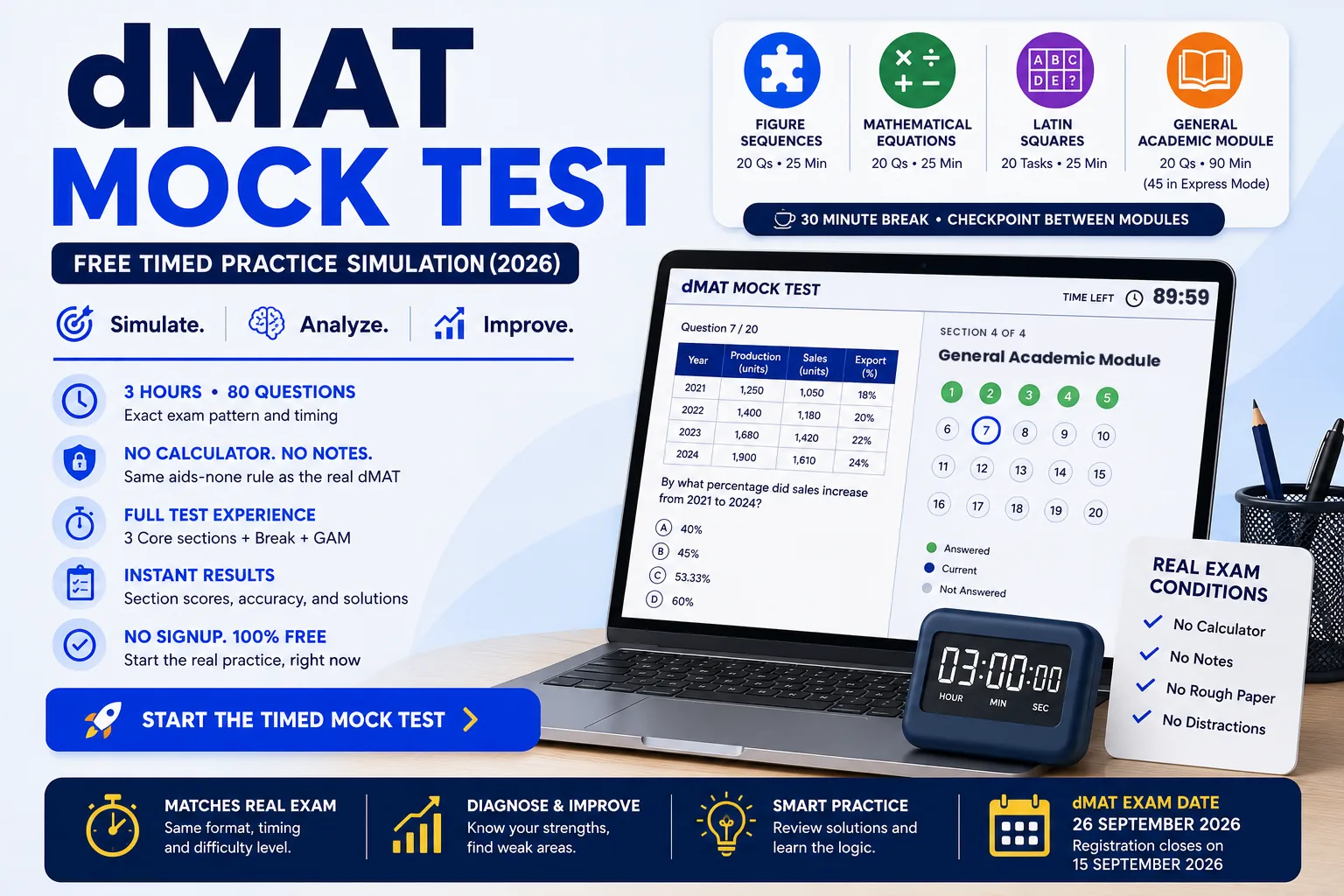
If your target intake is Summer 2027 or later, check the dMAT (Digital Master Test) before finalizing your timeline. APS India introduced this aptitude test in 2026 for Master's applicants in Engineering, Commerce, Accounting, Finance, Economics, Business and Management. It does not apply to Bachelor's or PhD applicants.
You are exempt if you registered for APS, shipped your documents, or already hold an APS certificate from before 29 June 2026 or if your intake is Winter 2026/27. Winter 2027/28, the main cycle most Indian aerospace applicants target, falls after that cutoff, so it applies unless your APS was already in motion. The test runs about 3.5 hours (Core Module + Subject Module), is computer-based and in English, and costs Rs.16,350 (€150), paid separately from your Rs.18,000 APS fee.
Counselor insight: dMAT doesn't replace IELTS and isn't optional for affected profiles. Treat the registration date as seriously as your APS submission, since a missed window can delay your intake by a full semester.
Fees and Cost of Living for a Masters in Aerospace Engineering in Germany
Tuition is not uniform, and this is what Indian applicants get wrong most often. RWTH Aachen and TU Berlin charge zero tuition. TUM's Aerospace MSc charges Rs.6,54,000 (€6,000) per semester. Stuttgart and KIT, both in Baden-Württemberg, charge Rs.1,63,500 (€1,500) per semester under a state law in place since 2017. Confirm current tuition on each university's own program page, since state rules can change between intakes.
Living costs sit on top: budget Rs.87,200 to Rs.1,30,800 (€800-1,200) a month for rent, food, transport, and insurance, with Munich and Stuttgart at the higher end.
The biggest upfront cost is the blocked account: Rs.12,97,536 (€11,904) for the first year, unlocked at Rs.1,08,128 (€992) a month. The full process is explained in our Germany student visa guide.
Counselor insight: Visa officers check the deposit date against your visa appointment date, so a late top-up is one of the most common reasons applications get sent back for review. Don't underfund your account and then hope to top it up later.
Documents Checklist for a Masters in Aerospace Engineering in Germany
| Document | Purpose | India-Specific Detail |
| APS Certificate | Verifies your degree is genuine | Fee: Rs.18,000; 3-4 weeks, up to 8-10 weeks in peak season (May-August) |
| Academic transcripts (all semesters) | uni-assist evaluation | Missing even one semester freezes your APS file |
| Bachelor's degree certificate | Confirms eligibility | Provisional certificate accepted for final-year students |
| IELTS/TOEFL scorecard | English proficiency | IELTS 6.5+ or TOEFL 90+ for most aerospace programmes |
| Statement of Purpose | Explains fit | Name the specific research group or professor, not generic interest |
| Letters of recommendation (2) | Academic/industry reference | From professors who taught your core aerodynamics/thermodynamics subjects |
| Blocked account confirmation | Proof of funds for visa | Rs.12,97,536 (€11,904) deposited before your visa appointment |
| Health insurance confirmation | Mandatory for enrolment | Roughly Rs.11,990 (€110) per month |
| dMAT scorecard (if applicable) | Mandatory for Engineering Master's, Summer 2027 intake onward | Fee: Rs.16,350 (€150), separate from APS |
Counselor insight: APS is the step students delay most because it feels administrative. Start it the moment your provisional degree is issued. A delayed APS is the single most significant reason students miss the July 15 winter intake deadline.
Planning Calendar for Winter Intake
| Month (Winter 2027 Intake) | Action |
| December 2026 | Shortlist 6-8 universities |
| Jan-Feb 2027 | Start APS if you are graduating by May. Check dMAT registration, since this intake falls after the Summer 2027 cutoff |
| Feb-Mar 2027 | Take IELTS/TOEFL; complete dMAT if not exempt |
| Apr-May 2027 | Register on uni-assist and begin applications |
| Jun-Jul 2027 | Submit before the July 15 deadline |
| August 2027 | Receive offers and fund your blocked account |
| September 2027 | German student visa appointment |
| October 2027 | Fly, complete Anmeldung, enrol |
Scholarships and Funding for a Masters in Aerospace Engineering in Germany
The DAAD EPOS scholarship is the strongest fully funded route for engineering postgraduates, but it requires 2+ years of professional experience after your bachelor's. It pays Rs.1,08,128 (€992) a month plus insurance. Fresh graduates should instead look at university-specific merit scholarships and the Deutschlandstipendium.
Counselor insight: Don't rule yourself out of DAAD assuming the 2-year rule is flexible. It isn't. But it opens a real second path: work two years in an engineering role, then apply for funding instead of self-funding straight after your bachelor's.
Which Path Fits You, and What to Do If Things Go Wrong
Not every applicant needs the same masters in aerospace engineering in Germany strategy. Match your profile to one of these:
Final-year, strong CGPA, IELTS done: apply directly to TUM or RWTH Aachen for the next winter intake. Your provisional certificate is enough to start APS now. If cost decides between the two, RWTH is tuition-free; TUM charges Rs.6,54,000 (€6,000) per semester.
Mechanical/ECE background, 60-65% aggregate, no aerospace electives: target FH Aachen or Hochschule Bremen first. A broader entry profile allows you to build aerospace-specific coursework before applying to a TU9 university later.
2+ years of work experience: build your timeline around the DAAD EPOS cycle instead of a standard intake, since its deadlines run separately.
If things go wrong: a missed APS deadline means shifting to the next intake, not rushing an incomplete file. A low CGPA or backlog means applying to FH-tier universities first or a Studienkolleg bridge year (which needs its own APS). A delayed visa appointment usually allows a one-semester deferral if you inform the university before the semester starts. No admits from TU9 schools means widening your list to TU Berlin's Space Engineering track or Brandenburg University of Technology, both lower volume for Indian applicants.
Counselor insight: A rejection is rarely about a weak profile. It is far more often about applying to 2-3 universities instead of the 6-8 we recommend, given how selective TU9 seats are.
Career Scope and Salary After a Masters in Aerospace Engineering in Germany
Entry-level roles pay Rs.49,05,000 to Rs.56,68,000 (€45,000-52,000) a year. The median sits around Rs.63,78,680 (€58,520), and senior specialists at Airbus or MTU Aero Engines can reach Rs.92,65,000 to Rs.1,19,90,000 (€85,000-1,10,000).
You can work Rs.1,515 (€13.90) an hour part-time, up to 140 full days a year. After graduation, Germany's 18-month job-seeker visa gives you room to convert this opportunity into an EU Blue Card or PR pathway.
Get PR in 21 months with the EU Blue Card, no lottery. Read more about it in our exhaustive guide for Software Engineering in Germany.
Counselor insight: Aerospace roles concentrate around Munich, Hamburg, Bremen, and Stuttgart, where Airbus and DLR are based. Factor such considerations into your city choice, since networking during your thesis often converts into your first offer.
3 Key Takeaways on Masters in Aerospace Engineering in Germany
A masters in aerospace engineering in Germany still costs less than comparable US or UK programs, but the exact number depends on the state: RWTH Aachen and TU Berlin are tuition-free, while TUM, Stuttgart, and KIT charge non-EU tuition on top of living costs.
Start your APS certificate the moment your provisional degree is issued. APS delays, not weak profiles, are the most common reason applicants miss their intended intake.
If you have 2+ years of engineering experience, build your timeline around the DAAD EPOS scholarship cycle instead of self-funding a standard intake.
Planning a masters in aerospace engineering in Germany? Book a free session with a LeapScholar counselor.
Frequently Asked Questions About Masters in Aerospace Engineering in Germany
-
Is Germany a good place to study aerospace engineering?
Germany is home to Airbus, DLR, and MTU Aero Engines, providing direct industry access that most other countries cannot match. TUM ranks QS #25 globally, and RWTH Aachen and TU Berlin charge zero tuition to non-EU students. For research depth and cost, Germany holds up well against the US, UK, and Canada.
-
What is the cost of aerospace engineering in Germany?
Cost depends on the state. RWTH Aachen and TU Berlin charge no tuition, only a semester contribution of roughly Rs.32,700-43,500. TUM charges Rs.6,54,000 (€6,000) per semester for non-EU students, while Stuttgart and KIT charge Rs.1,63,500 (€1,500) per semester. Add the Rs.12,97,536 (€11,904) blocked account and Rs.87,200-1,30,800 (€800-1,200) a month in living costs on top.
-
What is the salary of an Aerospace Engineer in Germany?
Entry-level aerospace engineers in Germany earn Rs.49,05,000 to Rs.56,68,000 (€45,000-52,000) a year. The median sits around Rs.63,78,680 (€58,520), and senior specialists at firms like Airbus or MTU Aero Engines can cross Rs.92,65,000 (€85,000).
-
Can I do a master's in aerospace engineering in Germany in English?
Most TU9 aerospace and aeronautical Master's programs, including those at TUM and RWTH Aachen, teach fully in English. Bachelor's-level programs are still mostly in German, so English-taught tracks are largely a Master's-level advantage.
-
Which public universities in Germany offer aerospace engineering?
TUM, RWTH Aachen, KIT, TU Berlin, and the University of Stuttgart lead the list for public universities offering aerospace and aeronautical engineering. FH Aachen and Hochschule Bremen are strong applied-sciences alternatives with an easier entry profile.
-
Is it better to study a master's in aeronautical engineering in India or Germany?
India's IITs and IIST cost less but offer fewer industry-linked labs and less international exposure. Germany provides direct access to Airbus, DLR, and MTU Aero Engines, plus tuition-free options at RWTH Aachen and TU Berlin. If global industry access matters more than staying close to home, Germany is the stronger pick.
-
Can I study aerospace engineering in Germany for free?
At RWTH Aachen and TU Berlin, tuition is zero for non-EU students, and you pay only a semester contribution of roughly Rs.32,700-43,500. TUM, Stuttgart, and KIT charge non-EU tuition on top of that, so "free" depends entirely on which state you apply to.







Have Questions? Get Guidance to reach your Dream University
Connect with India's finest counsellors and biggest study abroad community.
Get Guidance