
Quick Read
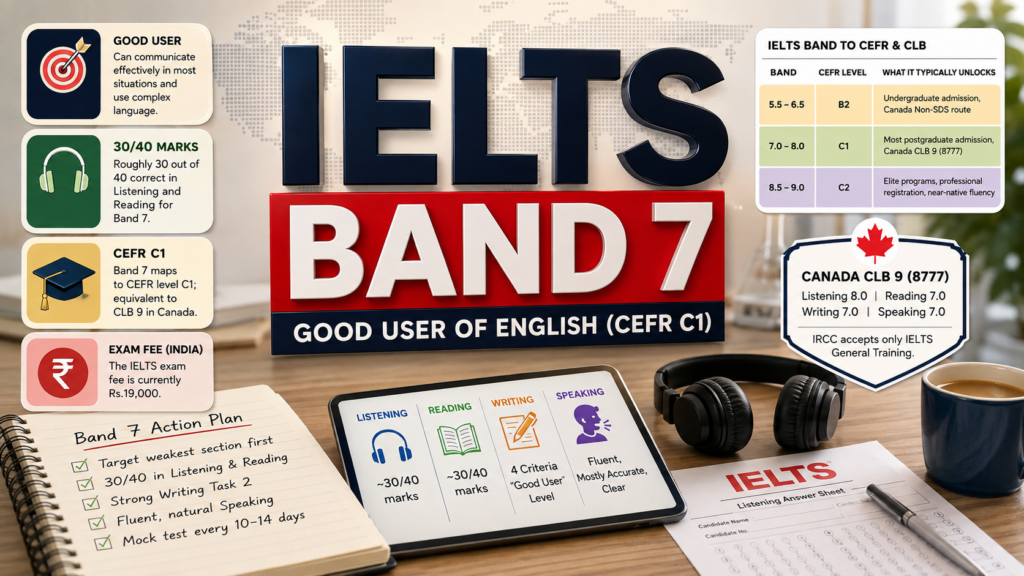
- IELTS Band 7 means “good user,” equal to CEFR level C1.
- You need roughly 30 out of 40 in Listening and Reading.
- The IELTS exam fee in India is currently Rs.19,000.
- CLB 9 needs Listening 8.0; flat Band 7 falls short.
What Does IELTS Band 7 Mean for Indian Students?
IELTS Band 7 means you are a “good user” of English. You can communicate effectively in most situations, use complex language, and follow detailed arguments. You may still make occasional mistakes or misunderstandings, especially in unfamiliar situations, but these generally do not affect your ability to communicate clearly. It is a strong level of English, though not the same as native-level fluency.
- It’s the fourth-highest of the nine IELTS bands, above “competent user” (Band 6) and below “very good user” (Band 8).
- Most Indian test-takers first struggle to reach Band 7 between Band 6.5 and Band 7, not between Band 5 and Band 6.
- It’s the score where the exam stops testing survival English and starts testing whether you can study, argue a position, and write academically in English.
Counselor insight: Students who cleared Class 12 through a state board and studied in a regional-medium school often score higher in Reading than in Speaking and Writing, because their exposure to written English through textbooks is stronger than their exposure to spoken, argumentative English. If that’s your profile, put extra practice time into Speaking and Writing specifically, not equal time across all four sections.
What IELTS Band 7 Gets You: University and Visa Requirements
An overall IELTS Band 7 clears the requirement for the large majority of postgraduate programs in the UK, Canada, Australia, and the US and is the standard threshold for professional registration in regulated fields like nursing and engineering in several countries. Most undergraduate programs ask for only 6.0 to 6.5, so Band 7 comfortably exceeds most undergraduate bars too.
If you’re weighing whether you even need IELTS for your specific route, see:
- Do I Need IELTS for Master’s Admission in Ireland or UK?
- IELTS Waiver Explained for cases where a Class 12 English score or MOI letter can substitute for the test entirely.

Excel in IELTS with India’s Top Online Coaching
Leap has helped more than 1 Lakh students achieve 7+ IELTS band.
3 Things to Know Before Targeting IELTS Band 7 as Your Maximum Score
- A handful of competitive postgraduate programs (law, medicine, journalism) specify 7.5 as their minimum, sometimes with no individual section below 7.0, a harder bar than a 7.0 average.
- For Canada’s Express Entry, IRCC accepts only IELTS General Training, not Academic, so a Band 7 on Academic does nothing for your immigration application on its own.
- Oxford and Cambridge don’t accept PTE at all. If either is on your list, IELTS is not optional.
Read: Is PTE Easier Than IELTS for a UK Student Visa?
Is Band 7.5 worth chasing instead of Band 7?
Only if your specific program or visa route names it. Both scores sit inside CEFR C1, so 7.5 doesn’t unlock a different proficiency tier; it mainly widens your list of eligible programs and, for Canada, can help push a weaker section up to protect your overall CLB level.
Counselor insight: We tell students not to over-prepare past their actual target. If your shortlisted universities all ask for 7.0, spending another two months chasing 7.5 is time better spent on your Statement of Purpose or scholarship applications.
Excel in IELTS with India’s Top Online Coaching
Leap has helped more than 1 Lakh students achieve 7+ IELTS band.
IELTS Band 7 CEFR Level and CLB Equivalent Explained
IELTS Band 7 maps to CEFR level C1, according to the official IELTS-CEFR comparison published by the test’s governing body. Bands 7 and 8 both fall under CEFR C1, which is the level most widely accepted for university admission in English-speaking countries. Band 7.5 also sits inside C1, not C2. You need roughly Band 8.5 before you’re considered CEFR C2.
| IELTS Band | CEFR Level | What it typically unlocks |
| 5.5 to 6.5 | B2 | Undergraduate admission, Canada Non-SDS route |
| 7.0 to 8.0 | C1 | Most postgraduate admission, Canada CLB 9 with 8777 |
| 8.5 to 9.0 | C2 | Elite programs, professional registration, near-native fluency |
For Canada-bound applicants, IELTS Band 7 across all four sections lines up with Canadian Language Benchmark (CLB) 9. The Express Entry minimum for the Federal Skilled Worker program is CLB 7, which needs only 6.0 in each section, so Band 7 clears the baseline comfortably and pushes you into a higher, points-earning bracket. The specific combination of Listening 8.0, Reading 7.0, Writing 7.0, and Speaking 7.0 (written as “8777”) is the benchmark most Canada-focused counselors reference for reaching CLB 9, because it clears the highest-value immigration tier while keeping the Listening target realistic.
See the full walkthrough for how to score 8777 in IELTS.
Counselor insight: Don’t try to average your way to a CLB target. IRCC and most universities look at your weakest individual section, not just your overall Band 7. A student who scores 8.5, 8.5, 5.5, and 7.5 still fails a “no band below 6.5” requirement even with a high overall average.
Source: IELTS and the CEFR, official comparison
IELTS Band 7 Requirements in Each Section
Listening and Reading are scored out of 40 raw marks and converted to a band. Writing and Speaking are graded directly by certified examiners against four public criteria, each worth 25% of that section’s score.
| Section | What Band 7 needs | India-specific note |
| Listening | Roughly 30 out of 40 correct | Indian test-takers most often lose marks in the academic-vocabulary sections 3 and 4 |
| Reading | Roughly 30 out of 40 correct (Academic) | General Training requires more correct answers for the same band |
| Writing | Task Response, Coherence, Lexical Resource, and Grammar all near “good user” level | Task 2 carries twice the weight of Task 1 and is the most common Indian bottleneck |
| Speaking | Flexible vocabulary, mostly accurate grammar, mostly clear pronunciation | Filler words and memorised answers cap most Indian candidates at 6.5 |
Your overall Band 7 is the average of these four scores, rounded to the nearest half band. If your average works out to 6.75, it rounds up to 7.0. If it works out to 6.25, it rounds up to only 6.5, not 7.0. This is why a targeted improvement in your weakest section often moves your overall band more than spreading effort evenly across all four.
If vocabulary and sample structure are what’s holding your Writing back, the IELTS Writing Band Score guide breaks down sample Task 2 responses at different band levels.
Counselor insight: In our sessions, the single biggest score jump we see comes from students who stop treating Speaking Part 2 as a memorised script. Examiners are trained to spot rehearsed answers, and a flat, memorised response caps Fluency and Coherence marks even when grammar is accurate.
How to Get an IELTS Band 7: Section-by-Section Action Plan
- Listening: Do full 40-minute practice tests under exam timing, not isolated clips. Focus specifically on Sections 3 and 4, where Indian candidates lose the most marks to academic vocabulary and inference questions, not basic comprehension.
- Reading: Practice True/False/Not Given and matching-headings questions separately, since these are the two types that cost the most time. Build to finishing all three passages within 60 minutes, with 10 minutes left to transfer answers.
- Writing: Get every Task 2 essay scored against the four official criteria (Task Response, Coherence and Cohesion, Lexical Resource, and Grammatical Range) separately, not as one overall guess. Fix whichever single criterion is lowest before writing more essays.
- Speaking: Record yourself answering unscripted Part 2 and Part 3 questions, then listen back for filler words and repeated sentence patterns. Fluency, not vocabulary size, is what typically holds Indian candidates at 6.5.
- Across all sections: Take one full mock test every 10 to 14 days to track whether your targeted practice is actually moving your weakest section, rather than relying on how confident you feel.
Counselor insight: The students who move fastest from 6.5 to Band 7 are the ones who stop preparing “generally” and instead spend two focused weeks on a single weak criterion at a time. Preparing all four skills equally every day usually means none of them improve fast enough to matter.
Is IELTS Band 7 Hard to Get From Band 6.5?
The jump from 6.5 to Band 7 is widely considered the hardest half-band gap on the whole scale, and it isn’t really about vocabulary size. At 6.5, most candidates already know enough words and grammar structures. What’s missing is flexibility: using a wider range of sentence types instead of the same three patterns and developing an idea across two or three sentences instead of stating it once and moving on.
- From Band 5.5: typically three to four months of consistent, focused preparation.
- From Band 6.5: typically four to ten weeks of section-specific practice, provided that practice targets the exact criterion holding the score down.
- Generic revision across all four skills is the biggest time-waster at this stage; targeted practice on your weakest criterion is more effective.
Counselor insight: We ask every student stuck at 6.5 to get feedback broken down by the four official Speaking and Writing criteria separately, not just an overall band guess. A student who thinks their “grammar is the problem” is often actually being held back by Lexical Resource, and fixing the wrong thing wastes weeks.
IELTS Band 7 Decision Framework: What Should You Actually Aim For?
- Final-year BTech student targeting a UK master’s for the 2027-28 intake: aim for an overall Band 7 with no section below 6.5. Most UK postgraduate STEM programs sit at this threshold; a few Russell Group departments push to 7.0 in every section, so check your department’s page directly.
- Working professional applying through Canada’s Express Entry: aim for the 8777 combination (Listening 8.0, Reading 7.0, Writing 7.0, Speaking 7.0) on IELTS General Training, not Academic. This reaches CLB 9, unlocking significantly more Comprehensive Ranking System points than a lower CLB tier.
- Class 12 student applying for an Australian undergraduate program starting in 2027: an overall Band 7 is almost certainly more than you need. Most Australian undergraduate courses accept 6.0 to 6.5, so aiming for Band 7 without a specific requirement means over-investing time better spent on your Statement of Purpose.
Month-by-Month IELTS Band 7 Preparation Calendar for the 2027-28 Intake
| Timeline (for 2027-28 intake) | Focus |
| 8 to 10 months before intake | Diagnostic mock test, identify the weakest section |
| 6 to 8 months before | Section-specific practice, especially Writing Task 2 and Speaking Part 2 |
| 4 to 5 months before | First real Band 7 attempt |
| 3 months before | Retake or One Skill Retake if one section fell short |
| 1 to 2 months before university deadlines | Score reporting to universities, buffer for a second retake if needed |
Indian students applying for a September 2027 intake should aim to sit their first attempt by March or April 2027, leaving a full retake window before most university deadlines close. For UK, New Zealand, or Ireland intakes specifically, see When to Take IELTS for January 2027 UK, NZ, or Ireland? for intake-specific timing.
What to Do If You Score Below IELTS Band 7
- If only one section pulled your average down: IELTS One Skill Retake costs around Rs.12,650 in India, versus roughly Rs.19,000 for a full retake, and lets you resit just that one section within 60 days.
More on this topic, including when an Enquiry on Results (EOR) remark beats a retake, in What RO Means in IELTS Results.
- If your overall score genuinely isn’t moving in time: several universities in Canada, the UK, Australia, and the US accept scores below 6.5 through foundation years or pathway diplomas, at the cost of extra time and fees.
See What to Do If Your IELTS Score Is Low for the full list of fallback options.
Counselor insight: We always check the exact skill breakdown before recommending a retake strategy. A student who is 6.5, 6.5, 6.5, and 7.0 needs an entirely different retake plan than a student who is 8.0, 8.0, 5.0, and 7.0, even though both average to roughly the same overall band.
Source: IELTS exam fee, IDP India
3 Takeaways on IELTS Band 7
- Confirm your target university’s or visa route’s exact section-wise IELTS Band 7 requirement, including whether it needs Academic or General Training, before assuming an overall 7.0 average is enough.
- If you’re starting from Band 6.5, budget four to ten weeks of criterion-specific Writing and Speaking practice rather than general revision.
- If you fall short in only one section, use IELTS One Skill Retake instead of resitting the full exam.
Verified by: LeapScholar’s IELTS counseling team, with hands-on experience guiding Indian students through score-target planning and university applications.
Have questions about your specific IELTS Band 7 target? Book a free session with a LeapScholar counselor.
Frequently Asked Questions About IELTS Band 7
-
What does IELTS Band 7 mean?
It means you are a “good user” of English with operational command of the language, despite occasional inaccuracies. You handle complex language well and understand detailed reasoning, though you may still misunderstand some things in unfamiliar situations. It is the fourth-highest of the nine IELTS bands.
-
Is Band 7 a good score?
Yes. An overall Band 7 clears the entry requirement for most postgraduate programs worldwide and is the common threshold for professional registration in several regulated fields. It comfortably exceeds most undergraduate requirements, which typically sit at 6.0 to 6.5.
-
How to get IELTS Band 7?
Target your weakest of the four sections first, not general revision. You need roughly 30/40 in Listening and Reading, and criterion-specific practice (not just more mock tests) in Writing and Speaking. From 6.5, the process usually takes four to ten focused weeks.
-
Is it hard to achieve IELTS Band 7?
It depends on your starting point. From Band 5.5, expect three to four months of consistent preparation. From Band 6.5, four to ten weeks of targeted, criterion-specific practice is usually enough. The 6.5 to 7.0 jump is the hardest plateau on the scale.
-
What CEFR level does it correspond to?
This score corresponds to CEFR level C1, per the official IELTS-CEFR comparison. Bands 7 and 8 both fall under C1. You need approximately Band 8.5 to be considered CEFR C2.
-
What do I need in each section to achieve an overall Band 7?
Roughly 30 out of 40 correct answers in both Listening and Reading, plus Writing and Speaking performance that meets the “good user” descriptor across all four official assessment criteria in each section.
-
Is Band 7.5 significantly better?
Not in proficiency tier, since both are in CEFR C1. The higher score mainly widens the list of programs you qualify for and can help protect your overall CLB level for Canada if one section is weaker than the rest.
-
What is the IELTS Band 7 equivalent to CLB?
A Band 7 in every section corresponds to CLB 9, which is significantly higher than the CLB 7 minimum required by most Express Entry programs. IRCC only accepts IELTS General Training for this purpose, not Academic. The “8777” combination is the benchmark most commonly targeted to secure CLB 9.
-
What is an IELTS Band 7 writing template?
There isn’t one fixed template; examiners penalize visibly memorized structures. Aim for a clear position in your introduction, one idea developed per body paragraph with an example, and a short conclusion.
-
What does IELTS Band 7 Speaking mean?
It means fluent, mostly natural speech with only occasional hesitation, a flexible vocabulary range, mostly accurate grammar, and pronunciation that stays clear throughout. Rehearsed, memorized answers typically cap candidates at 6.5, not 7.
-
How long does it take to go from Band 6.5 to Band 7?
Most candidates need four to ten weeks of focused practice, provided that practice targets the specific criterion holding their weakest section down rather than general, unfocused revision across all four skills.
-
What happens if I score below it?
If only one section falls short, IELTS One Skill Retake lets you resit that section within 60 days at a lower cost than a full retake. If your overall score doesn’t improve in time, several universities offer foundation years or pathway programs that accept lower scores while you build up to your target.





Have Questions? Get Guidance to reach your Dream University
Connect with India's finest counsellors and biggest study abroad community.
Get Guidance