
Quick Read
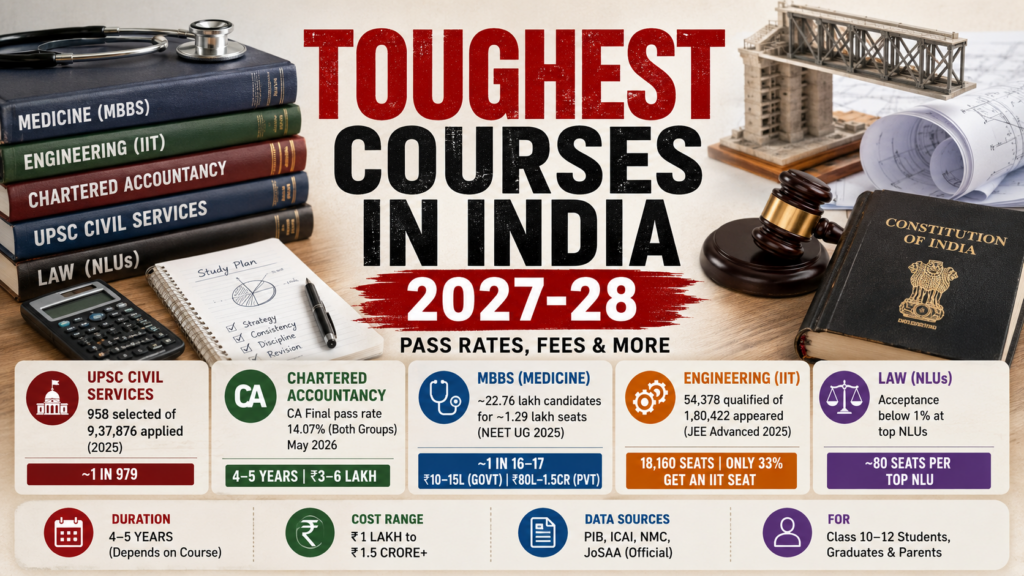
- CA Final pass rate stood at 14.07% for both groups (latest official ICAI data, May 2026 attempt).
- NEET UG 2025 had roughly 22.76 lakh candidates for about 1.29 lakh MBBS seats.
- UPSC Civil Services 2025 recommended 958 candidates out of 9,37,876 who applied (PIB data).
- JEE Advanced 2025 qualified 54,378 candidates for 18,160 IIT seats.
- CA coaching, registration, and articleship together typically run Rs.3-6 lakh over 4-5 years.
- Private MBBS in India can cost Rs.80 lakh to Rs.1.5 crore (USD 83,848-157,215) for the full course.
What Actually Makes a Course the Toughest Course in India?
A course counts among the toughest courses in India based on four measurable factors: the entrance exam’s selection rate; the seat-to-applicant ratio; total duration, including mandatory practical training; and workload once enrolled.
By this measure, some assumed “toughest” courses in India are tough mainly at the entry gate (JEE Advanced, NEET), while others (CA, UPSC) stay tough at every stage for years. Both deserve the label, but a student needs to know which type of tough they’re signing up for.

Choose your dream country
 UK
UK
 USA
USA
 Germany
 Australia
 Ireland
 Canada
 UAE
UAE
 France
 Sweden
 Italy
Italy
 Other
Other
When do you want to study abroad?
What's your highest level of education?
Have you completed Class 12th?
What was your Class 12 CGPA/percentage?
Are you a student or a parent/guardian?
What do you want to study?
Select your current city
How Leap will help you

Personalised University Shortlist

Express Applications with Quicker Admits

End-to-End Application Support
Counselor insight: Students often confuse exam difficulty with course difficulty. JEE Advanced is brutal to clear, but the workload inside an IIT is manageable for most. CA is the opposite: entry is comparatively easy, but every stage after that filters people out for years.
Toughest Courses in India Ranked by Pass Rate and Seat Ratio
| Course | Entrance Exam | Pass/Selection Rate | Seat Ratio | Duration | Approx. Cost (INR) |
| UPSC Civil Services | CSE Prelims + Mains + Interview | 958 selected of 9,37,876 applied (latest official data, 2025 cycle) | Roughly 1 in 979 | 1.5-4 years prep | Rs.1-3 lakh |
| Chartered Accountancy | CA Foundation, Inter, Final | 14.07% both-groups pass rate (latest official ICAI data, May 2026) | Multi-level filter | 4-5 years incl. articleship | Rs.3-6 lakh |
| MBBS (Medicine) | NEET UG | Roughly 1 in 16-17 appeared candidates gets an MBBS seat | ~22.76 lakh candidates, ~1.29 lakh seats (latest official data, 2025-26) | 5.5 years incl. internship | Rs.10-15 lakh govt, Rs.80 lakh-1.5 crore private |
| Engineering (IIT) | JEE Main + JEE Advanced | 54,378 qualified of 1,80,422 appeared (latest official data, 2025) | 18,160 IIT seats; only 33% of qualifiers get one | 4 years | Rs.8-10 lakh |
| Law (NLUs) | CLAT | Acceptance below 1% at top NLUs | ~80 seats per top NLU | 5 years integrated | Rs.10-15 lakh |
| Architecture | NATA + JEE Paper 2 | Highly selective at SPA, CEPT, IIT Kharagpur | Limited seats nationally | 5 years | Rs.6-12 lakh |
Sources, each figure traced to the issuing body directly: PIB, Government of India, Civil Services Examination 2025 Result Highlights for the UPSC figure, ICAI, CA Final May 2026 official result for the CA pass percentage, National Medical Commission seat matrix, reported via Careers360 for the MBBS seat count, JoSAA official seat matrix for the IIT seat figure.
For the 2027-28 intake cycle, expect these seat matrices and fees to shift slightly as NMC, JoSAA, and ICAI publish updated notifications; the ratios above reflect the direction of competition rather than a fixed target.
For a broader view, the same CA and MBBS numbers hold up among the toughest degrees in the world, not just in India.
Is CA the Toughest Course in India, or Is That a Myth?
Yes, CA is genuinely one of the toughest courses in India, and the data backs the reputation. CA Final's May 2026 attempt (latest official ICAI data) cleared 14.07% of candidates across both groups, with Group I at 12% and Group II at 20.49%. CA Foundation the same session passed 20.09%, and CA Intermediate passed 8.47%. Filter that across three levels plus a mandatory articleship, and most students need two to four attempts to qualify.
Counselor insight: Most CA Final failures aren't knowledge gaps. They come from time misallocation in the exam hall and from underestimating how much the syllabus shifts as tax and accounting rules change. Students who fail once and repeat their old study plan without adjusting tend to fail again.
Compared to engineering, CA is arguably tougher by the numbers. JEE Advanced filters hard at the gate but becomes a fixed four-year program once inside. CA keeps filtering at every level for four to five years, with real financial and emotional costs at each attempt.
If you already hold a CA and want a global upgrade for the 2027-28 admission cycle, ACCA after CA is the most common route Indian CAs take into international finance, since ICAI mutual recognition agreements fast-track several papers.
Related read: What is the fee range for a one-year MBA compared to a two-year MBA in the UK if you're weighing CA against an MBA route instead.
What Do These Toughest Courses in India Actually Cost?
Every toughest course in India carries a real INR cost that reputation-based rankings skip.
- CA: ICAI registration and exam fees across all three levels add up to roughly Rs.60,000-90,000. Coaching for Foundation, Inter, and Final together usually costs Rs.1.5-3 lakh, and articleship stipends are low or unpaid for most of the three-year training period, a real opportunity cost, not just a fee.
- MBBS: A government medical college seat costs roughly Rs.10-15 lakh for the full 5.5-year program, including internship. A private MBBS seat runs Rs.80 lakh to Rs.1.5 crore (USD 83,848 to USD 157,215) depending on the state and college, since private capitation fees vary sharply.
- Engineering: An IIT B.Tech through government fee structures costs around Rs.8-10 lakh total, including hostel and mess, but JEE coaching before that (Class 11-12) often adds another Rs.2-4 lakh.
- UPSC: Coaching for CSE preparation ranges from free (self-study using NCERT and Public Administration resources) to Rs.1.5-2 lakh for structured Mains and interview guidance across multiple attempts.
Currency rate used: 1 USD = ₹95.41 as of August 2026. Verify the current rate before finalizing your budget, since private college fees and exchange rates both shift.
Considering a loan for a private MBBS or an abroad alternative? Can I apply for an education loan up to Rs.30-40 lakh? It covers the financing side directly.
Official sources for the figures above: PIB, Government of India for the UPSC CSE 2025 applicant appeared and selected figures, ICAI for the CA Foundation, Inter, and Final pass percentages, NMC for the MBBS seat matrix 2025-26, JoSAA for the JEE Advanced 2025 seat allotment.
Counselor insight: Families almost always budget for the sticker cost of one attempt, not the compounding cost of the attempts that usually follow. A CA aspirant who fails Inter once doesn't just lose six months, they pay a fresh registration fee, often re-enroll in coaching because the syllabus has shifted, and lose a year of articleship stipend timing. The same applies to UPSC, where most successful candidates clear on their third or fourth attempt, not their first. When a student asks us to compare "the cost of CA" against "the cost of an MBA abroad," we always ask them to price in two to three attempts for CA, not one, before the comparison is fair.
Toughest Courses in India: After 12th vs After Graduation
Some of India's toughest courses lock a student in right after Class 12; others allow a later attempt with a graduate degree already in hand.
NEET and JEE must be attempted directly after Class 12 (or a drop year), since both assume recent PCM or PCB preparation. CLAT for law and NATA for architecture follow the same pattern.
CA can start right after Class 12 through Foundation or after graduation through Direct Entry. The UPSC CSE and CAT for MBA can only be attempted after a bachelor's degree.
Students who decide medicine or engineering isn't the right fit after 12th can look at high-salary courses after 12th science or, specifically for computing, high-salary courses after 12th in computer science.
Which Toughest Course in India Fits Your Profile?
1. If you are a Class 12 PCM student with a JEE Main rank inside the top 2.5 lakh but outside the top 20,000, an IIT branch through JEE Advanced is a genuine reach, since only 33% of 2025's 54,378 qualifiers secured an IIT seat.
Weigh a strong NIT in a core branch, or engineering abroad with a data science or AI focus after your bachelor's, against a repeat attempt.
2. If you are a B.Com graduate deciding between CA and CMA, remember CA's final pass rate sits around 14% per attempt with a three-year, low-stipend articleship.
For a faster, more predictable qualification, the US CMA route typically takes 12-18 months against CA's four-to-five-year minimum.
3. If you are a Class 12 PCB student who didn't clear NEET on the first attempt, a drop year is one option but not the only one. BDS, B.Pharm, and BSc Nursing lead to legitimate healthcare careers without an all-or-nothing single exam.
MBBS abroad is worth comparing against a second NEET attempt on cost and timeline.
4. If you're a B.Tech graduate from a Tier-2 or Tier-3 college weighing an MS abroad instead of a domestic toughest-course grind, pursuing an MBA abroad after a B.Sc. or B.Tech. is a real alternative to a second attempt at a "tougher" domestic exam.
Documents and Eligibility Checklist for Toughest Courses in India
| Course | Minimum Eligibility | Entrance Exam | Key India-Specific Documents |
| MBBS | Class 12 PCB, 50% aggregate (general category) | NEET UG | 10th and 12th marksheets, NEET admit card, category certificate, domicile certificate for state quota |
| Engineering (IIT/NIT) | Class 12 PCM, 75% aggregate or top 20 percentile | JEE Main then JEE Advanced | 12th marksheet, JEE Main scorecard, category/PwD certificate, income certificate for EWS |
| CA | Class 12 pass (any stream) for Foundation, or graduate for Direct Entry | ICAI Foundation exam | 12th or graduation marksheet, ICAI registration ID, articleship agreement |
| UPSC CSE | Bachelor's degree, any stream | CSE Prelims + Mains + Interview | Graduation certificate, age and category proof, medical fitness certificate |
| Law (NLU) | Class 12, 45% aggregate (general category) | CLAT | 12th marksheet, CLAT scorecard, category certificate |
Planning Calendar for Toughest Courses in India: 2027-28 Cycle
- January-March 2027: CA Foundation and Intermediate January-attempt results expected; JEE Main Session 1 for the 2027-28 intake typically held; CA registration opens for the May 2027 cycle.
- April-June 2027: Class 12 boards conclude; NEET UG is usually held in May; JEE Advanced follows for JEE Main qualifiers; CA Final and Intermediate May attempts are held.
- July-September 2027: NEET and JEE counseling rounds run through July-August; UPSC CSE Prelims are typically held in this window, with Mains following in August-September.
- October-December 2027: UPSC Mains results and interviews arrive; CLAT is usually held in early December for 2028-29 admission; students starting a NEET or JEE drop year for 2028 begin coaching in this quarter.
Exact 2027 dates will be confirmed by NTA, ICAI, UPSC, and the CLAT Consortium closer to each cycle; treat the above as a planning guide, not a fixed notification.
What to Do If You Don’t Clear the Toughest Course in India on Your First Attempt
- Missed NEET cutoff: A drop year is common and not a setback if paired with a revised strategy. Compare your rank against the previous cycle's government college cutoff for your category and state before choosing between a second attempt, BDS/B.Pharm, or MBBS abroad.
- Failed CA Foundation or Intermediate: ICAI allows unlimited attempts with no age cap, but each failed attempt costs a session's fee and six months. Check whether your failure came from one weak paper or a structural time-management issue across all papers.
- Missed JEE Advanced cutoff after qualifying JEE Main: A second attempt the following year is allowed, but so is a strong NIT or private engineering college in a core branch, which often gives a comparable career outcome without repeating a year.
- Did not clear UPSC Prelims or Mains: Track your remaining attempts by category. Many candidates clear CSE only on their third or fourth attempt, so reassess your optional subject and answer-writing practice before the next cycle rather than assuming one miss ends the path.
3 Takeaways on Toughest Courses in India
- Toughness among India's hardest courses is measurable through pass rate, seat ratio, and duration, not reputation alone, and CA, UPSC, MBBS, and IIT engineering each top the list for different structural reasons.
- Match the course to your actual stream, rank range, and financial runway before chasing prestige, since a "tougher" course that doesn't fit your profile costs years, not just effort.
- Decide your funded fallback (a second attempt, an alternate course, or a study-abroad route) before committing to a multi-year attempt cycle, not after a first setback.
Verified by: LeapScholar's academic counseling team, with hands-on experience guiding Indian students through course selection, entrance-exam planning, and study-abroad alternatives.
Have questions about which path fits your rank and stream? Book a free session with a LeapScholar counselor.
Frequently Asked Questions About the Toughest Courses in India
-
Which is the toughest course in India?
There's no single answer, since toughness depends on what's measured. By selection rate, UPSC Civil Services is the toughest, with only 958 candidates recommended out of 9,37,876 who applied (latest official data, 2025 cycle). By sustained multi-year difficulty, CA and MBBS rank just as demanding since filtering continues well past the entrance exam.
-
Is CA the toughest course in India?
CA is widely considered one of the toughest courses in India because of consistently low pass rates across all three levels. The CA Final both-groups pass rate was 14.07% in the latest official May 2026 attempt, and most students need two to four attempts to qualify fully.
-
Is CA tougher than engineering?
By pass rate and duration combined, CA is arguably tougher, since it filters candidates at every level for four to five years, while JEE Advanced filters hard once at entry and becomes a fixed four-year program.
-
What is the toughest exam in India?
The UPSC Civil Services Examination is generally the toughest exam in India, selecting under 0.2% of registered candidates. JEE Advanced and CA Final rank close behind on pure selectivity.
-
Which are the toughest courses in India after 12th?
MBBS through NEET UG and engineering through JEE Main and JEE Advanced are the toughest courses that must be attempted directly after Class 12. CLAT for law and NATA for architecture follow closely.
-
What is the easiest course in India by comparison?
Courses like BA, BCom, and BBA are generally less academically demanding than engineering, medicine, or CA, relying more on theory-based learning than intensive mathematics or high-stakes entrance exams.
-
Is UPSC the toughest exam in the world, not just in India?
The UPSC Civil Services is frequently cited among the world's most selective exams by selection ratio, though direct global comparisons vary by methodology.
-
Which is tougher, CA (Chartered Accountant) or CS (Company Secretary)?
CA is generally considered tougher than CS, since CA's syllabus is broader and final-level pass rates tend to run lower, though both institutes revise syllabi periodically, so current-cycle pass rates should be checked directly with ICAI and ICSI.
-
What happens if I fail NEET or JEE on my first attempt?
A drop year with a revised study plan is common, paired with a realistic look at your rank trend and category cutoff. Comparing your rank against BDS, B.Pharm, private engineering, or MBBS abroad before committing a second year is worth the time.







Have Questions? Get Guidance to reach your Dream University
Connect with India's finest counsellors and biggest study abroad community.
Get Guidance