
Quick Read
- Canada has 30 universities in the QS World University Rankings 2027, with McGill, Toronto, and UBC in the global top 50.
- Tuition at these top universities in Canada ranges from roughly CAD 34,000 to CAD 68,000 a year (₹22.8 lakh to ₹45.6 lakh at ₹67/CAD).
- Acceptance rates among the top 10 universities in Canada run between 43% and 80%, so a high QS rank does not always mean a low admit rate.
- All study permit applications for these universities now go through IRCC’s standard stream: a GIC (around CAD 10,000) alongside your SOP and proof of funds is the current route, since the Student Direct Stream closed in November 2024.
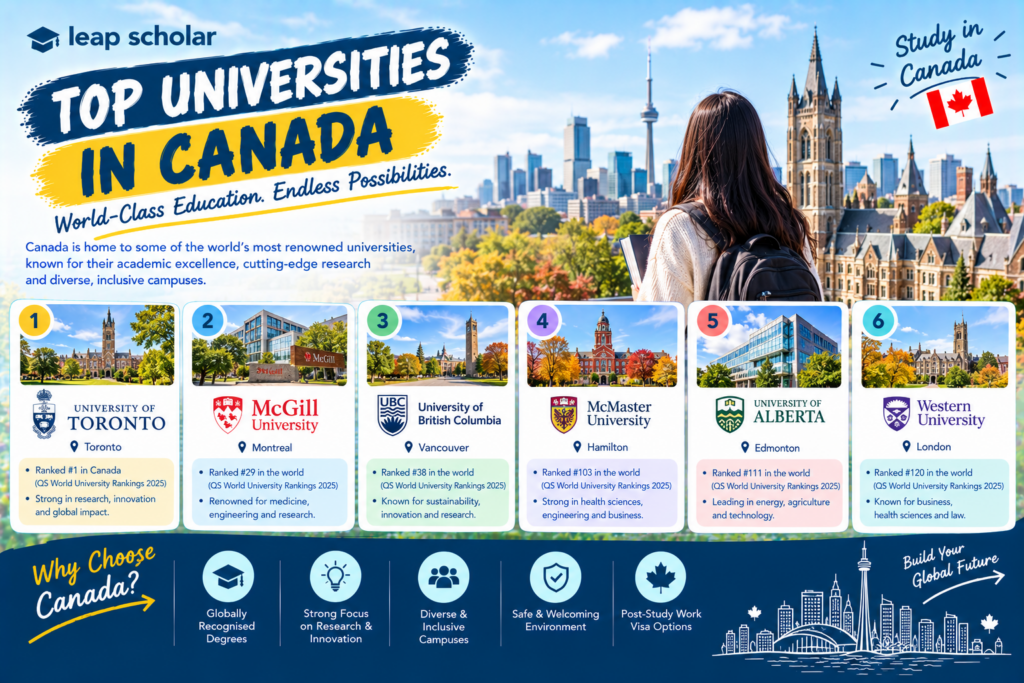
Top 20 Universities in Canada (QS World University Rankings 2027)
The QS World University Rankings 2027, released in June 2026, is the most current independent ranking for comparing the top universities in Canada. Here is where all 30 ranked Canadian institutions place, narrowed to the 20 that Indian students most often shortlist when researching the top universities in Canada for international students.
| Rank in Canada | University | QS World Rank 2027 | Province |
| 1 | McGill University | 30 | Quebec |
| 2 | University of Toronto | 32 | Ontario |
| 3 | University of British Columbia | 45 | British Columbia |
| 4 | University of Alberta | 96 | Alberta |
| 5 | University of Waterloo | =113 | Ontario |
| 6 | Western University | =142 | Ontario |
| 7 | Université de Montréal | =162 | Quebec |
| 8 | McMaster University | =174 | Ontario |
| 9 | Queen’s University at Kingston | =179 | Ontario |
| 10 | University of Ottawa | =228 | Ontario |
| 11 | University of Calgary | 249 | Alberta |
| 12 | Dalhousie University | 298 | Nova Scotia |
| 13 | Simon Fraser University | 312 | British Columbia |
| 14 | York University | =322 | Ontario |
| 15 | University of Victoria | =370 | British Columbia |
| 16 | University of Saskatchewan | =411 | Saskatchewan |
| 17 | Concordia University | =497 | Quebec |
| 18 | University of Windsor | =537 | Ontario |
| 19 | University of Guelph | =546 | Ontario |
| 20 | University of Manitoba | =560 | Manitoba |

Choose your dream country
 UK
UK
 USA
USA
 Germany
 Australia
 Ireland
 Canada
 UAE
UAE
 France
 Sweden
 Italy
Italy
 Other
Other
When do you want to study abroad?
What's your highest level of education?
Have you completed Class 12th?
What was your Class 12 CGPA/percentage?
Are you a student or a parent/guardian?
What do you want to study?
Select your current city
How Leap will help you

Personalised University Shortlist

Express Applications with Quicker Admits

End-to-End Application Support
University of Ottawa is the only new entrant to Canada's QS top 10 this year, replacing the University of Calgary. About two-thirds of Canadian universities dropped a few places compared to the previous QS edition, so a small year-on-year shift in rank is normal and not a sign of declining quality.
Counselor insight: Don't read a one-year drop as a quality signal. McGill, Toronto, and UBC all fell in this edition purely because QS's weighting shifted toward employability metrics this cycle, not because teaching or research quality changed. Compare universities based on the 3-year rank trend, not just the single latest number.
The Top 5 Universities in Canada: A Closer Look
Acceptance rates below are the most consistent figures across published aggregator and admissions data; most Canadian universities don't release a single official rate, so treat these as current estimates and confirm specifics with the admissions office for your intended program.
1. McGill University
McGill holds Canada's top spot for the second year running, climbing in academic reputation even as its overall global rank slipped from 27 to 30. Its acceptance rate sits around 46%, moderate by Canadian standards, though Medicine and Law admits far fewer applicants. International undergraduate tuition runs close to CAD 47,000 a year (₹31.7 lakh), rising to about CAD 66,000 (₹44.4 lakh) for Engineering. McGill is bilingual (English-medium instruction, French-speaking city) and draws students from over 150 countries, with particular strength in medicine, law, and the arts.
2. University of Toronto
Toronto scores highest in Canada for academic and employer reputation, and it's also the country's largest university by enrollment, with over 100,000 students across three campuses. Its acceptance rate is the lowest among the top 10 universities in Canada at around 43%. International tuition is among the steepest nationally: roughly CAD 61,700 a year (₹41.3 lakh) for Arts and CAD 67,400 (₹45.1 lakh) for Engineering. Toronto's strongest pull for Indian students is its downtown campus's direct pipeline into Bay Street finance and the GTA's tech sector.
3. University of British Columbia
UBC slipped five places this year, from 40th to 45th globally, part of the broader decline across Canadian universities in this QS edition, but it holds onto Canada's top 3 and a global top-50 spot. Its acceptance rate, around 52%, is noticeably more accessible than Toronto's or McGill's. Tuition for international students commonly falls in the CAD 35,000–60,000 band depending on faculty. UBC's two campuses (Vancouver and Kelowna) are known specifically for sustainability, forestry, and environmental sciences, alongside a lifestyle that mixes coursework with hiking and skiing.
4. University of Alberta
Alberta is the only Canadian university besides the top 3 to sit inside the QS global top 100, at 96th. Its acceptance rate, around 58%, makes it one of the more reachable options among the top 10 universities in Canada for a strong but not exceptional profile. International tuition for Arts starts near CAD 34,000 (₹22.8 lakh), rising to about CAD 45,500 (₹30.5 lakh) for Engineering. Edmonton's energy sector gives Alberta graduates in engineering and geosciences a direct, well-documented path to industry jobs.
5. University of Waterloo
Waterloo is ranked lower globally (=113) than the four universities above it, but it's the single most searched name among Indian applicants researching computer science and engineering in Canada, largely because of its co-op program, the largest of its kind in the world. Its acceptance rate is around 53%, though computer science specifically is far more selective than that headline number suggests. Waterloo does not publish a single blended international tuition figure; by program, Engineering and CS run toward the higher end of Canada's CAD 45,000–68,000 band for these fields.
Counselor insight: A lower QS rank doesn't mean a weaker outcome. Waterloo sits well below McGill, Toronto, UBC, and Alberta on this list, yet its co-op placements into Canadian and US tech firms are a bigger factor in Indian applicants' final decisions than its global rank. Weigh program reputation and placement record alongside QS position, not instead of it.
Top Universities in Canada for Engineering
If engineering is your reason for shortlisting Canada, the QS Subject Rankings (Engineering & Technology) put four of these same names on top: University of Toronto (#17 globally), University of British Columbia (#29), University of Waterloo (#38), and McGill University (#41), with University of Alberta (#103) close behind. Waterloo's co-op structure and Toronto's research output are the two most commonly cited reasons Indian engineering applicants shortlist Canada over other destinations.
Admission Requirements for the Top Universities in Canada
Admission criteria differ by program, but across most of the top universities in Canada for Indian students, applicants typically need:
- A minimum of 80–85% (or a GPA of 3.0–3.5) in Class 12 or a relevant bachelor's degree for postgraduate programs, higher for Engineering, Medicine or competitive Business programs.
- IELTS (usually 6.5–7.0 overall) or TOEFL; a few of these universities waive the requirement if your prior education was in English or you clear their internal language pathway.
- A Statement of Purpose, academic transcripts, and 2 letters of recommendation.
- For undergraduate applicants, note that not every university on this list accepts a 3-year Indian bachelor's degree directly into a master's program; check this before you shortlist, since it affects whether you need a 4-year degree or a qualifying year first.
Cost of Studying at the Top Universities in Canada
For Indian students, the headline number is tuition, and it varies more by program than by university rank. Statistics Canada's most recent weighted-average figure for international undergraduate tuition is about CAD 40,115 a year, which works out to roughly ₹26.9 lakh at ₹67 per CAD. In practice, costs at the top universities in Canada for international students split roughly like this:
- Arts, Social Science, and Commerce programs: CAD 34,000–62,000/year (₹22.8–₹41.5 lakh)
- Engineering, Computer Science, and Business: CAD 45,000–68,000/year (₹30.2–₹45.6 lakh)
- Living costs (rent, food, transport): CAD 15,000–20,000/year (₹10.1–₹13.4 lakh), higher in Toronto and Vancouver than in Waterloo, Edmonton, or Kingston
These figures are drawn from each university's most recently published fee schedule (2024-25 for most, since several hadn't released 2026-27 numbers at the time of writing); confirm the current year's exact figure on the university's official admissions page before budgeting, since fees are revised annually. All INR conversions in this article use ₹67 = 1 CAD; check the live rate before you finalize a budget, as it moves daily.
Counselor insight: Don't budget off the headline tuition figure alone. Application fees, health insurance, and a one-time study permit/GIC outlay add CAD 2,000–3,000 in year one that first-time applicants often miss in their initial cost estimate.
If budget is your primary filter rather than rank, LeapScholar's definitive guide to cheap universities in Canada for international students lists top universities in Canada with low tuition fees well below this range.
How to Choose Among These Universities
A QS ranking alone shouldn't decide your shortlist, and neither should acceptance rate on its own, since some of these top universities in Canada are far easier to get into than others. Before you lock in a choice, weigh:
- Program strength over overall rank: a university ranked 150th might still be top 5 in Canada for your specific subject.
- Acceptance rate against your profile: apply to a realistic mix rather than only the three hardest names on this list.
- City and cost of living: Toronto and Vancouver offer the most internships but the highest rent; Waterloo, Edmonton, and Kingston cost less and still place students well.
- Co-op and post-study work access: the Post-Graduation Work Permit (PGWP) applies regardless of which of these universities you choose, but co-op-heavy programs (Waterloo especially) get you working, paid experience before you even graduate.
3 Takeaways on Top Universities in Canada
- Shortlist by program fit and acceptance rate first, and QS rank second: a lower-ranked university can still be the stronger choice for your specific subject and budget.
- Budget in INR using the current CAD rate, not a fixed assumption, since tuition at the top universities in Canada spans roughly ₹22.8 lakh to ₹45.6 lakh a year depending on program.
- Apply to a realistic spread across this list rather than only the three hardest-to-enter names, since acceptance rates among these top 10 universities in Canada range from 43% to 80%.
Not sure which Canadian university fits your profile and budget? Talk to a LeapScholar counselor to shortlist universities and create your application plan.
Frequently Asked Questions About the Top Universities in Canada
-
What are the top 10 best universities in Canada?
By the QS World University Rankings 2027, the top 10 are McGill, Toronto, UBC, Alberta, Waterloo, Western, Université de Montréal, McMaster, Queen's, and Ottawa, in that order. Ottawa is new to this list this year, replacing Calgary.
-
What are the top 5 hardest universities to get into in Canada?
Among the top 10 universities in Canada, the lowest acceptance rates belong to Toronto (43%), McGill (46%), Queen's (50%), UBC (52%), and Waterloo (53%). Specific programs like computer science or medicine are considerably more selective than these headline, institution-wide figures.
-
What is the biggest university in Canada?
The University of Toronto is Canada's largest university by enrollment, with over 100,000 students across its St. George, Mississauga, and Scarborough campuses for the 2024-25 academic year.
-
Which university in Canada is easiest to get into?
Among the top 10 universities in Canada, the University of Ottawa has the highest acceptance rate, reported near 80%, making it comparatively more accessible than McGill or Toronto for a similar profile.
-
Are Canadian universities harder than US universities?
Not at the institution-wide level: acceptance rates at Canada's top universities (43–60%) are far higher than at US Ivy League schools (often under 10%), though competitive Canadian programs like engineering, computer science, and medicine are just as selective as their US counterparts.
-
Which university in Canada has the best campus?
This is a matter of personal preference rather than something that can be ranked. UBC's Vancouver campus is known for its oceanfront and mountain setting, McGill for its heritage downtown Montreal architecture, and Queen's for its historic limestone buildings on Lake Ontario.
-
What is the average tuition fee in Canada?
Statistics Canada's most recent data puts average international undergraduate tuition at about CAD 40,115 a year, roughly ₹26.9 lakh at ₹67/CAD. At the top 10 universities in Canada, actual fees run from about CAD 34,000 to CAD 68,000, depending on the program.
-
What are the cheapest universities in Canada?
Smaller public universities outside Toronto and Vancouver, and universities in Atlantic Canada and the Prairies, generally charge lower international tuition than the top-ranked names on this list. See our dedicated guide to cheap universities in Canada for international students for current, program-wise figures.
-
How is a 3-year Indian bachelor's degree treated by these universities?
Policies vary by university and program. Some of the top universities in Canada on this list accept a 3-year Indian bachelor's degree directly into a master's program, while others require either a 4-year degree or an additional qualifying year first. Confirm this directly with each university's graduate admissions office before you shortlist, since it changes your application timeline.
-
Can I apply to these universities without IELTS?
Some of these top universities in Canada waive IELTS if your previous education was conducted in English or if you clear their internal English-language pathway program; the policy varies by university and program, so confirm it directly on the admissions page before you apply.








Have Questions? Get Guidance to reach your Dream University
Connect with India's finest counsellors and biggest study abroad community.
Get Guidance