
Quick Read
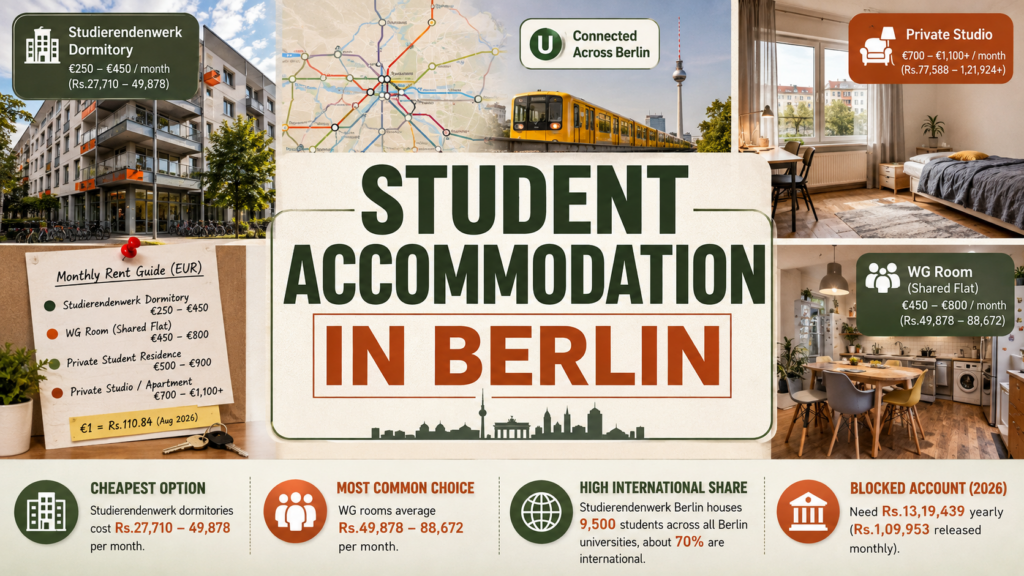
- Studierendenwerk dormitories cost Rs.27,710 to Rs.49,878 monthly, the cheapest option.
- WG rooms average Rs.49,878 to Rs.88,672 monthly, the common choice.
- Studierendenwerk Berlin’s citywide dormitories house 9,500 students across all Berlin universities, about 70% international.
- Blocked accounts need Rs.13,19,439 yearly, released at Rs.1,09,953 monthly.
Universities in Berlin, Germany for International Students
Berlin hosts several major universities for international students, and your admission to one of them determines which Studierendenwerk quota and neighborhoods are most relevant for you.
- Technical University of Berlin (TU Berlin): strong in engineering, computer science, and management; centrally located with 9,500 Studierendenwerk rooms available citywide.
- Freie Universität Berlin (FU Berlin) and Humboldt-Universität zu Berlin (HU Berlin): two of Germany’s most prestigious research universities, both routing new students through the same Studierendenwerk Berlin system.
- HTW Berlin, HWR Berlin, and other applied science institutions: popular for business, engineering, and design, with internal housing forums supplementing the official Studierendenwerk route.

Choose your dream country
 UK
UK
 USA
USA
 Germany
 Australia
 Ireland
 Canada
 UAE
UAE
 France
 Sweden
 Italy
Italy
 Other
Other
When do you want to study abroad?
What's your highest level of education?
Have you completed Class 12th?
What was your Class 12 CGPA/percentage?
Are you a student or a parent/guardian?
What do you want to study?
Select your current city
How Leap will help you

Personalised University Shortlist

Express Applications with Quicker Admits

End-to-End Application Support
All of these route students to the same official housing body, Studierendenwerk Berlin, rather than each running fully independent halls.
Types of Student Accommodation in Berlin and What They Actually Cost
| Accommodation Type | Monthly Rent (EUR) | Monthly Rent (INR) | Availability |
| Studierendenwerk dormitory | €250-€450 | Rs.27,710-Rs.49,878 | Waiting period 2-3 semesters (up to 18 months for some halls) |
| Private student residence (Neon Wood, Studentendorf) | €500-€900 | Rs.55,420-Rs.99,756 | Higher quality, faster availability than public dorms |
| WG (shared apartment) room | €450-€800 | Rs.49,878-Rs.88,672 | Most common for international students |
| Private studio or single apartment | €700-€1,100+ | Rs.77,588-Rs.1,21,924+ | Widely available, priciest option |
National Studierendenwerk average (all of Germany): Rs.33,917 (€306) per month, including ancillary costs.
Exchange rate used: Rs.110.84 per EUR as of August 2026. Verify the current rate before finalizing your budget.
Sources: Deutsches Studierendenwerk - Wohnen, Dormitories - TU Berlin
- Studierendenwerk dormitories (student dormitories in Berlin): the cheapest, most structurally supported option, run by the official student services body.
- Private student residences (student residences in Berlin): operators like Neon Wood, Studentendorf Schlachtensee, and Berlinovo offer higher-quality, all-inclusive rooms with on-site management, priced between Studierendenwerk and the open market.
- Shared apartments (WG, Wohngemeinschaft): the most common choice for Indian students who don't secure a dormitory spot.
- Private studios and single apartments: full independence at the highest cost, depending on district.
Counselor insight: TU Berlin's own housing page confirms roughly 70% of hall residents are international students, so a Studierendenwerk room is not a long shot the way it can feel in Munich. Still apply the same day you accept your offer; the difference in Berlin is that your odds are meaningfully better if you do.
Is Berlin Expensive for Students? Comparing Average Rent Across Germany
Is Berlin expensive for students compared to Munich or the national average? Less than Munich, but more than most other German cities, and the gap has narrowed recently.
| City | Average Student Rent (EUR/month) | Average Student Rent (INR/month) |
| Munich | €600-€1,100 (WG), €750 avg private | Rs.66,504-Rs.1,21,924 |
| Berlin | €450-€800 (WG), €306 avg. dormitory | Rs.49,878-Rs.88,672 |
| Leipzig, Aachen (smaller cities) | €350-€550 | Rs.38,794-Rs.60,962 |
Exchange rate used: Rs.110.84 per EUR as of August 2026. Verify the current rate before finalizing your budget.
What is the average rent in Berlin compared to Munich specifically?
Berlin runs roughly 20-30% cheaper for equivalent WG rooms, though both cities now sit well above Germany's national average. Student expenses in Germany overall, and the cost of student accommodation in Germany nationally, remain a poor proxy for Berlin budgeting; the city has caught up with much of Western Europe on rent even though it retains a reputation as the "affordable capital."
How to Apply for Studierendenwerk Halls of Residence in Berlin?
Follow these steps once you've been admitted; applying out of order or too early is the most common mistake Indian students make.
- Get your admission letter and pay your semester fee. Studierendenwerk applications aren't accepted before the deadline; your Zulassungsbescheid and paid semester fee are prerequisites, not formalities.
- Register on Studierendenwerk Berlin's housing portal. Search using filters for location, room type, and hall, and submit your application directly through the portal.
- Check if your university has a reserved quota. Several universities, including TU Berlin, hold a limited allotment of rooms for exchange and international students through their own international office; apply there in parallel if one exists for you.
- Apply as early as your enrollment status allows. Expect a waiting period of 2-3 semesters for standard applications, though some halls run closer to 18 months, so early application is the only real lever you control.
- Have a fallback plan if you're still waiting. If you're declined or your semester is approaching with no offer, contact Studierendenwerk's InfoCenter Wohnen directly for guidance on remaining options.
Sources: Dormitories - TU Berlin, Housing - studierendenWERK BERLIN
Private Student Residences in Berlin: A Middle Ground
Private student residences in Berlin, sometimes called student apartments in Berlin, Germany, sit between Studierendenwerk dormitories and the open WG market, and most competing guides skip this category entirely.
- Neon Wood is Berlin's largest private student housing provider, with over 2,000 units, offering all-inclusive rents, on-site management, and organized community events.
- Studentendorf Schlachtensee eG manages over 1,300 residential units across two Berlin locations plus an international scholars' centre, with a specific mission to house domestic and international students together.
- Berlinovo, a Berlin state-owned company, also operates student residences supplementing Studierendenwerk's own stock, with new buildings completing through 2026.
- These operators typically have shorter waiting times than Studierendenwerk since they price closer to the private market but still well below fully independent studio rents.
Counselor insight: Students researching student accommodation in Berlin, Germany, online often assume "private" automatically means "expensive." Private student residences are a genuine middle-cost option, worth comparing directly against a WG room, especially if you want guaranteed housing before you land rather than gambling on the WG interview process from abroad.
That gamble is real. Titixa Kamani, a Master's student at Hochschule Rhein-Waal who contributed to LeapScholar's Germany guide, describes her own WG search: "Used platforms like WG-Gesucht, sending personalised templates with proof of enrolled status and finances. Out of 50 requests, I received only 3 replies."
Student Accommodation Near BSBI
Berlin School of Business and Innovation (BSBI) is a popular choice among Indian students, with its main campus at Alte Post, Karl Marx Straße 97-99, in the Neukölln district.
- No on-campus housing: BSBI doesn't provide or guarantee accommodation itself.
- Accommodation partners: The university works with Spotahome, Uniplaces, and Erasmusu to help students find verified listings.
- Edge Student Hub: BSBI students get exclusive access to this private residence in Zossen, just outside the city, a quieter, purpose-built option for students who prefer that over central Berlin.
- The neighborhood: Neukölln is multicultural, comparatively affordable, and well-served by public transport, so WG rooms and private residences here are realistic alongside BSBI's own partners.
If you're specifically searching for student accommodation in Berlin near BSBI, start with BSBI's own accommodation advisors before booking independently.
Sources: BSBI Accommodation - Berlin School of Business and Innovation
Finding Private WG Housing in Berlin
- Kaltmiete vs Warmmiete: Advertised rent is usually Kaltmiete (basic rent, excluding utilities); Warmmiete includes these costs. Always confirm which figure you're being quoted, and budget separately for GEZ, Germany's mandatory broadcast fee of Rs.2,035 (€18.36) per month.
- Where to search: WG-Gesucht and university-specific internal forums (such as HTW's "Home Sweet Home") are more reliable than open social media groups for first-time international tenants.
- Verification first: Never transfer a deposit or rent before viewing a room in person or via verified video call; scams targeting international students specifically through Facebook and WhatsApp groups are common in Berlin.
- Rent check: Berlin's residential rent index (Mietspiegel) lets you verify whether an asking rent is excessively high for the district and building type before signing.
- Timing: Start searching at least 3-6 months before your semester begins; competition peaks in August and September alongside the Studierendenwerk waiting list surge.
Sources: Housing - Hertie School, Living in Berlin - HTW Berlin
For a full Germany-wide cost comparison beyond just rent, see our cost of living in Germany guide, and compare against student accommodation in Munich if you're still deciding between the two cities.
Documents Required to Rent Private Student Accommodation in Berlin
Landlords and WG flatmates in Berlin typically ask for the same core set of documents, regardless of whether you're renting a room, a studio, or a private apartment.
| Document | India-Specific Detail |
| Passport | Valid for your full intended stay in Berlin |
| Admission letter (Zulassungsbescheid) | Confirms your enrollment status to the landlord |
| Proof of financial means | Blocked account confirmation (Sperrkonto) or an education loan sanction letter from an Indian bank |
| Semester fee payment receipt | Often requested alongside your admission letter as proof you're a registered student |
| Schufa credit report | It's uncommon for first-time international tenants, but some private landlords request one; student-focused platforms and WGs rarely require it |
| Guarantor or deposit (Kaution) | One to three months' basic rent upfront if no German guarantor is available |
| Wohnungsgeberbestätigung (landlord confirmation) | Needed later for Anmeldung and your residence permit; confirm your landlord will provide this before signing |
Counselor insight: The Schufa report is the one document Indian students most often assume they need and then can't get in time, since it requires a German address history most newcomers don't have. In practice, most WGs and student-focused private residences accept your blocked account confirmation and admission letter as sufficient proof instead, so don't let a missing Schufa report stop you from applying.
Student Accommodation in Berlin and Your Blocked Account: How the Numbers Connect
| Requirement | Amount (2026) | INR Equivalent | Covers |
| Blocked account, annual | €11,904 | Rs.13,19,439 | Full year of living costs, released monthly |
| Blocked account, monthly release | €992 | Rs.1,09,953 | Rent, food, insurance, transport combined |
| National visa fee | €75 | Rs.8,313 | One-time visa application fee |
Exchange rate used: Rs.110.84 per EUR. Verify the current rate and blocked account figures directly with your provider (Fintiba, Expatrio) before finalizing your visa paperwork.
Source: Study.eu - Germany blocked bank accounts for students
Counselor insight: Unlike Munich, where the blocked account's monthly release genuinely falls short of typical rent, Berlin's Rs.1,09,953 monthly release comfortably covers a Studierendenwerk room or a mid-range WG. Only students targeting the pricier private studio bracket need to plan additional family funds or part-time work specifically for Berlin.
Decision Framework: Which Berlin Accommodation Fits Your Situation
- Admitted to TU Berlin, arriving for Winter Semester 2027-28: Apply to Studierendenwerk immediately after acceptance; with roughly 70% of residents being international students, your odds are genuinely reasonable if you apply on time rather than after arrival.
- Admitted to FU Berlin or HU Berlin with a tight budget: Target Studierendenwerk first; if the wait is too long, a private student residence like Neon Wood or Studentendorf offers a faster, still-affordable fallback before you resort to the open WG market.
- Arriving without confirmed housing and a tighter timeline: Book 2-4 weeks of temporary furnished housing rather than committing to the first WG listing under pressure; Berlin's scam risk for international students searching desperately online is well-documented.
Berlin Accommodation Application Calendar for Winter Semester 2027-28
| Month | Action |
| April - May 2027 | Accept your university offer and pay semester fee to unlock Studierendenwerk eligibility |
| June 2027 | Submit Studierendenwerk application; begin parallel WG and private residence search |
| July 2027 | Open your blocked account; confirm visa appointment |
| August 2027 | Sign a WG or private residence lease if a dormitory isn't confirmed |
| September 2027 | Travel to Berlin, complete Anmeldung, activate blocked account withdrawals |
| October 2027 | The semester begins |
Source: Dormitories - TU Berlin
What to Do If You Arrive in Berlin Without Confirmed Accommodation
- No dormitory and no WG yet? Book 2-4 weeks of temporary furnished housing rather than rushing into a long lease; this buys time to view rooms in person.
- Struggling with WG interviews? A short, personal introduction message and flexibility on move-in dates improve your odds significantly; generic template messages are easy for German flatmates to spot and skip.
- Blocked account timing feels tight? Contact Studierendenwerk's InfoCenter Wohnen directly, and check private residence operators for faster-turnaround options while you continue your WG search.
For broader troubleshooting on settling in Germany, this Q&A on common challenges Indian students face in Germany covers similar early-arrival friction points.
Registering Your Address and the Residence Permit Connection
Your accommodation choice directly affects your German residence permit, not just your budget.
- Complete Anmeldung (address registration) at your local Bürgeramt within 14 days of moving in.
- Your landlord must provide a Wohnungsgeberbestätigung (landlord confirmation), a document informal WG arrangements sometimes fail to provide, causing residence permit delays.
- Your residence permit appointment needs this registered address, so an unregistered or informal sublet can stall your entire timeline.
For visa financing details beyond accommodation, check what documents Germany's APS process requires, German language requirements, the visa process, and whether a low GPA still allows German student visa approval with a strong SOP.
Is Berlin Safe for International Students?
Yes. Berlin scores a safety index of around 55.4, placing it mid-pack among European capitals, safer than Paris or Rome, below cities like Amsterdam. Violent crime is rare; the realistic concerns are petty theft and pickpocketing concentrated in known hotspots (parts of Neukölln, Görlitzer Park, Kottbusser Tor, and Alexanderplatz), not entire districts.
- Choose accommodation in well-connected, well-lit neighborhoods close to your university; this matters more for daily safety than any single city-wide statistic.
- Standard precautions apply: avoid unfamiliar parks after dark, secure valuables on public transport, and use registered ride-hailing apps late at night.
- Berlin's large, well-integrated international student population across TU Berlin, FU Berlin, HU Berlin, and Charité means you're rarely navigating the city alone as a newcomer.
This safety profile is a large part of why Berlin remains a genuinely good place to study abroad for Indian students, alongside its lower cost of living relative to Munich and dense concentration of English-taught programs.
Sources: Is Berlin safe? A guide for students - HousingAnywhere
Student Life in Berlin Beyond Housing
Student life in Berlin extends well past your address, and Berlin's transport system works differently from Munich's.
- Transport: Berlin and Brandenburg students receive the Deutschland-Semesterticket bundled into their mandatory semester contribution at roughly Rs.4,189 (€37.80/month as of winter 2025/26), covering the entire BVG network (U-Bahn, S-Bahn, trams, buses) and nationwide regional trains, unlike Munich, where the equivalent ticket is an optional add-on.
- Culture and cost of living: Student ID cards unlock discounts at museums, cinemas, and cultural institutions citywide; budget separately for the mandatory GEZ broadcast fee of Rs.2,035 (€18.36) per month, often overlooked by first-time renters.
- Community: Private residences like Neon Wood and Studentendorf actively organize resident events, a genuine advantage for international students building a social network without relying entirely on university orientation programs.
Sources: HWR Berlin - Semester ticket, Cost of Living in Berlin - Uniplaces
3 Takeaways on Student Accommodation in Berlin
- Studierendenwerk dormitories are the cheapest student accommodation in Berlin at Rs.27,710-Rs.49,878 per month, and with roughly 70% of hall residents being international students, your odds are better here than in Munich if you apply on time.
- Private student residences (Neon Wood, Studentendorf, and Berlinovo) are a genuine middle-cost option most competing guides ignore, worth comparing against a WG room before you commit to either extreme.
- Berlin's blocked account release of Rs.1,09,953 per month comfortably covers dormitory or mid-range WG rent, unlike Munich, so budget the difference toward savings or a slightly better location instead of assuming a shortfall.
Verified by: LeapScholar's Germany counseling team, with hands-on experience guiding Indian students through TU Berlin, FU Berlin, and HU Berlin admissions, housing applications, and blocked account documentation.
Have questions about accommodation or your German student visa? Book a free session with a LeapScholar counselor.
Frequently Asked Questions About Student Accommodation in Berlin
-
How much does student accommodation in Berlin cost for Indian students?
Student accommodation in Berlin ranges from Rs.27,710 per month for a Studierendenwerk dormitory to over Rs.1,21,924 per month for a private studio. Most Indian students who don't secure a dormitory end up in a WG room costing Rs.49,878 to Rs.88,672 monthly.
-
Is student accommodation in Berlin cheaper than Munich?
Yes, it is generally 20-30% cheaper for equivalent WG rooms. Berlin retains its reputation as Germany's more affordable major city, though it is no longer dramatically cheaper than Munich the way it was a decade ago.
-
How hard is it to get Studierendenwerk housing in Berlin?
It's competitive but more achievable than in Munich. TU Berlin's own data shows about 70% of Studierendenwerk hall residents are international students, and waiting periods run 2-3 semesters for most applicants, shorter than Munich's typical wait.
-
What documents do I need to rent private student accommodation in Berlin?
You typically need a passport or ID, proof of university enrollment, proof of financial means such as your blocked account confirmation, and occasionally a Schufa credit report or guarantor, though this is less commonly required for first-time international tenants renting through student-focused platforms.
-
Are there private student residences in Berlin besides Studierendenwerk halls?
Yes, operators like Neon Wood, Studentendorf Schlachtensee, and Berlinovo run private and semi-private student residences across the city, typically priced between Studierendenwerk rates and the open WG market, with faster availability and more amenities.
-
Does the German blocked account cover Berlin rent?
Generally yes. Berlin's rent levels sit comfortably within the blocked account's Rs.1,09,953 (€992) monthly release for dormitory and mid-range WG options, unlike Munich, where the release can fall short. Only students targeting pricier private studios may need additional funds.
-
What is the average rent in Berlin for a student?
The national Studierendenwerk average is Rs.33,917 (€306) per month for dormitory housing, while WG rooms average Rs.49,878 to Rs.88,672 (€450-€800) per month on the open market, depending on district and room quality.
-
Which Berlin universities offer the best access to Studierendenwerk housing?
Access to Studierendenwerk housing for TU Berlin, FU Berlin, and HU Berlin depends more on when you apply than on which university you attend, as all three universities route through the same Studierendenwerk Berlin system. TU Berlin's specific exchange-student quota is one of the more structured allocation processes among Berlin universities.
-
What happens if I don't get Studierendenwerk housing before my semester starts?
You aren't left without options. Private student residences and the open WG market both remain available, and Studierendenwerk's InfoCenter Wohnen can advise on interim solutions while your application remains active on the waiting list.
-
Can I find student accommodation in Berlin for 350 euro a month?
Yes, within the Studierendenwerk dormitory category specifically. Cheap student accommodation in Berlin: 350 euro listings are realistic for public dormitory housing but not for a WG room or private studio, where Berlin's average rent runs considerably higher.
-
How much does it cost to rent an apartment in Berlin as a student?
A private studio or single student apartment in Berlin typically costs Rs.77,588 to Rs.1,21,924+ (€700-€1,100+) per month, well above dormitory or WG options. Student expenses in Germany overall, and average expenses in Germany for students specifically, are usually lower than this figure since most students choose dormitory or WG housing over private apartments.
-
Is Berlin a good place to study abroad for Indian students?
es, Berlin combines a strong concentration of English-taught programs, a comparatively affordable cost of living relative to Munich, a large international student community, and a safety profile that sits mid-range among European capitals. Cheap accommodation in Germany for international students is more achievable in Berlin than in Munich or Frankfurt.
-
Are there student hostels in Berlin I can use temporarily?
Yes, student hostels in Berlin, Germany, are commonly used for a 2-4 week bridge period while finalizing longer-term housing, similar to their role in other German cities. Book through established hostel networks rather than informal short-term sublets to avoid scams targeting arriving international students. For students specifically comparing student housing in Berlin, Germany, against cheap student accommodation in Berlin, Germany, more broadly, a hostel bridge period is a sensible way to view rooms in person before committing.





Have Questions? Get Guidance to reach your Dream University
Connect with India's finest counsellors and biggest study abroad community.
Get Guidance