
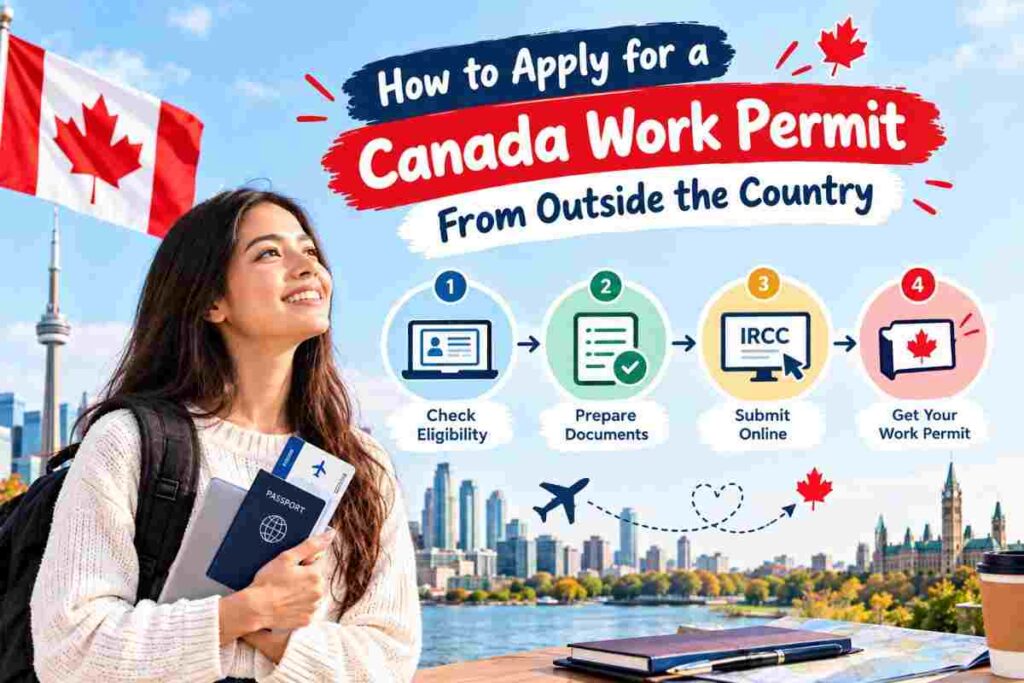
Indians with a Canadian job offer don’t need to be inside Canada to apply for a work permit, IRCC’s standing process lets you apply from India directly before you travel. This isn’t a new rule; it’s an existing, long-running Immigration, Refugees and Citizenship Canada (IRCC) service, most recently updated on March 31, 2026, and worth a clear explainer since eligibility and document requirements trip up many first-time applicants.
The Two Main Canada Work Permit Types
- Employer-specific work permit: ties you to one named employer, job, and location. Generally requires a valid job offer backed by either a positive Labour Market Impact Assessment (LMIA) from Employment and Social Development Canada (ESDC) or an LMIA-exempt offer of employment submitted by the employer through IRCC’s Employer Portal.
- Open work permit: lets you work for almost any employer in Canada, without needing a specific job offer or an LMIA. Open work permits are generally reserved for specific categories: spouses/common-law partners of certain workers or students, some permanent residence applicants, refugee claimants, and international graduates eligible for the Post-Graduation Work Permit.
Source: IRCC: Guide 5487: Applying for a Work Permit outside Canada
What You’ll Generally Need

Choose your dream country
 UK
UK
 USA
USA
 Germany
 Australia
 Ireland
 Canada
 UAE
UAE
 France
 Sweden
 Italy
Italy
 Other
Other
When do you want to study abroad?
What's your highest level of education?
Have you completed Class 12th?
What was your Class 12 CGPA/percentage?
Are you a student or a parent/guardian?
What do you want to study?
Select your current city
How Leap will help you

Personalised University Shortlist

Express Applications with Quicker Admits

End-to-End Application Support
- A valid passport.
- For an employer-specific permit: either a positive LMIA and LMIA file number from your employer or an LMIA-exempt offer of employment number (starts with the letter "A" followed by 7 digits), generated once your employer submits the offer through IRCC's Employer Portal.
- Proof you meet the job's requirements: relevant qualifications, skills, and experience for the specific role.
- Proof of sufficient funds to support yourself (and any dependents) during your stay.
- No serious criminal or medical inadmissibility: some jobs and source countries require a medical exam or police certificate.
- A Quebec Acceptance Certificate (CAQ) is required if you will be working a paid job in Quebec for more than 30 days.
Source: IRCC: Forms and document requirements for applications outside Canada
Fees
- Work permit processing fee: CAD $155 (~₹9,570 at CAD 1 = ₹61.74, September 2026), unless you qualify for a fee exemption.
- Open work permit holder fee: an additional CAD $100 (~₹6,174), applicable if you're getting an open work permit specifically.
- Biometrics: typically an additional CAD $85 (~₹5,248).
- Employer-side costs (not paid by you): the LMIA application fee is CAD $1,000, paid by the employer; it is illegal for an employer to pass this cost on to you.
The Application Steps
- Confirm you need a permit, and which type: most foreign nationals need one; a small list of specific job categories (athletes/coaches, clergy, on-air news reporters, military personnel, and a few others) are exempt.
- Secure your job offer's supporting document: either the LMIA from your employer or confirm your open work permit eligibility category.
- Gather your documents: passport, offer/LMIA details, proof of funds, and proof you meet the job's requirements.
- Apply online through your IRCC account, upload documents, and pay the applicable fees.
- Complete biometrics and any required medical exam.
- Wait for a decision: processing times vary significantly by country and permit type; check IRCC's current processing times before planning your travel around a specific date.
- Arrive in Canada with your approval letter and required documents; your actual work permit is issued at the border.
- After you arrive: apply for a Social Insurance Number (SIN); you need this in addition to your work permit to actually work and access government programs and benefits.
Why It Matters for Indian Students and Graduates
This process is directly relevant if you're an international graduate who's exhausted your Post-Graduation Work Permit and secured a new job offer, or if you're applying from India for a fresh Canadian job opportunity without having studied there first. The most common stumbling block isn't the paperwork itself; it's confirming upfront whether your specific job offer is LMIA-backed or LMIA-exempt, since that single distinction determines your entire document checklist and, often, your realistic processing timeline.
If you're weighing this option against staying in Canada on an existing study or work permit to transition instead, our Post-Graduate Work Permit Canada guide and PTE Accepted Universities in Canada guide cover the adjacent parts of that decision.
Have questions about whether your specific job offer qualifies for an LMIA-exempt work permit? Book a free session with a LeapScholar counselor.
Metadata
Primary Keyword: Canada work permit from outside the country
<title>: Canada Work Permit From Outside the Country: Eligibility & Steps
og:title:








Have Questions? Get Guidance to reach your Dream University
Connect with India's finest counsellors and biggest study abroad community.
Get Guidance