
Quick Read
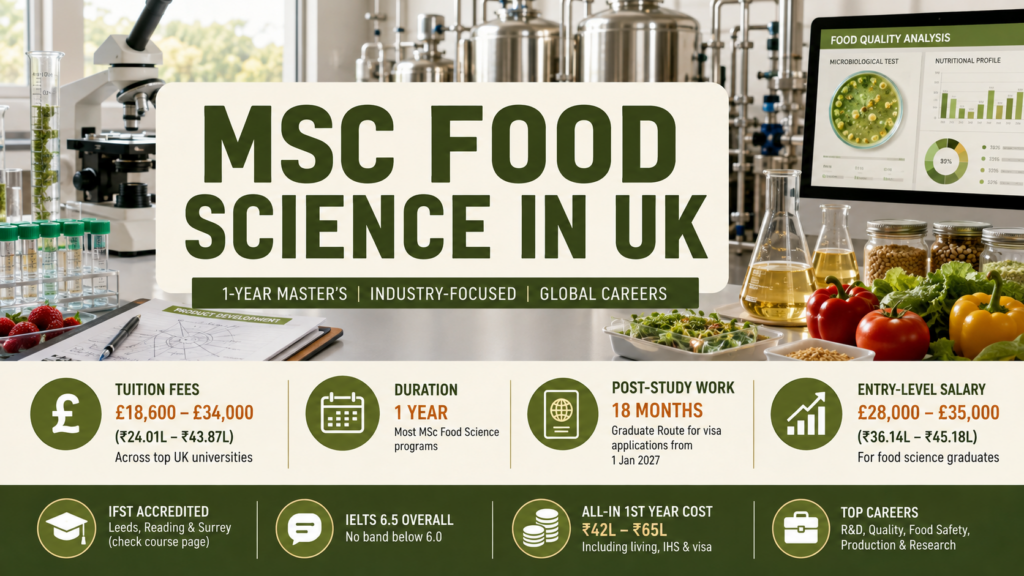
- University of Leeds charges GBP 34,000 (Rs.43.87L) total for its IFST-accredited MSc Food Science.
- Most programs run for one year, with IELTS 6.5 and no band below 6.0 as the standard threshold.
- Graduate Route will drop from 2 years to 18 months for visa applications starting 1 January 2027.
- Entry-level food scientist salaries in UK typically start around GBP 28,000-35,000 (Rs.36.14L-45.18L).
Best Universities for MSc Food Science in UK: IFST Accreditation & QS 2027 Rankings
Not every MSc Food Science course in UK carries professional accreditation, and this matters more here than in most fields: the Institute of Food Science & Technology (IFST) is the field’s recognized UK qualifying body, and accredited status signals your degree meets an industry-vetted standard.
| University | Program (Official Name) | QS World Rank 2027 | IFST Accreditation | Overseas Tuition Fee (2026/27) |
| University of Leeds | MSc Food Science | #77 | Yes (Confirmed) | GBP 34,000 total (Rs.43.89L) |
| University of Reading | MSc Food Science | #196 | Yes (Confirmed) | GBP 31,650/year (Rs.40.86L) |
| University of Surrey | MSc Food Science | Not in QS Top 300 | Yes (Confirmed) | GBP 18,600/year (Rs.24.01L) |
| University of Nottingham | Food Innovation and Management MSc (2027 Entry) | #97 | Not stated | GBP 34,800 total (Rs.44.92L) |
| University of Birmingham | MSc Food Safety, Hygiene and Management | #68 | Not stated | Not disclosed |
| Queen’s University Belfast | MSc Advanced Food Safety | #199* (2026 World, most recent published) | Not stated | Not disclosed |

Choose your dream country
 UK
UK
 USA
USA
 Germany
 Australia
 Ireland
 Canada
 UAE
UAE
 France
 Sweden
 Italy
Italy
 Other
Other
When do you want to study abroad?
What's your highest level of education?
Have you completed Class 12th?
What was your Class 12 CGPA/percentage?
Are you a student or a parent/guardian?
What do you want to study?
Select your current city
How Leap will help you

Personalised University Shortlist

Express Applications with Quicker Admits

End-to-End Application Support
Exchange rate used: Rs.129.08 per GBP as of August 2026. Verify the current rate before finalizing your budget.
Sources: University of Leeds Food Science MSc official course page, University of Reading MSc Food Science official course page, University of Surrey Food Science MSc official course page, QS World University Rankings 2027
University of Leeds is the one program in this table with IFST accreditation explicitly confirmed on its own official course page. For every other university, check the specific program page directly before assuming accreditation, since it can change between intakes and vary by specific course name (Food Science vs. Food Science and Nutrition vs. Food Safety are often accredited differently even at the same institution).
Counselor insight: Families often treat "food science" and "food technology in UK" programs as interchangeable when shortlisting, but IFST accreditation status, work-placement structure, and even QS subject-specific rank can differ meaningfully between a plain MSc Food Science and an MSc Food Science and Nutrition at the same university. Read the specific course page, not just the university's general reputation.
MSc Food Science in UK Fees: Full Cost Breakdown in INR
Tuition varies more than threefold across ranked programs, and living costs add a substantial second line to your budget.
| Cost Head | Amount (GBP) | Amount (INR) | Notes |
| Tuition (range across universities above) | GBP 18,600-34,000 | Rs.24.01L-43.87L | Total or annual depending on programme structure, see table above |
| Cost of living (12 months, outside London) | GBP 10,800-14,400 | Rs.13.94L-18.59L | Accommodation, food, transport, utilities |
| Immigration Health Surcharge (IHS) | GBP 776/year (approx. GBP 1,035 for a typical 16-month student visa) | Rs.1,00,166/year (approx. Rs.1,33,598 total) | Paid upfront with visa application |
| Visa application fee | GBP 558 | Rs.72,003 | Student Visa, standard rate (effective 8 April 2026) |
| CAS deposit (varies by university) | GBP 3,000-4,500 | Rs.3.87L-5.81L | Required as part of visa process at several universities, including Nottingham |
Exchange rate used: Rs.129.08 per GBP. Verify the current rate before finalizing your budget.
Sources: UK Home Office, Immigration Health Surcharge guidance, UKCISA, international student fee guidance
A realistic all-in first-year cost for a masters in food science in UK at a mid-cost university like Surrey lands around Rs.42-48L including living costs and visa charges, while a program at the higher end like Leeds can run Rs.60-65L for the full one-year course plus living costs.
For a full city-wise living cost breakdown, see LeapScholar's Cost of Studying in UK for Indian Students and Cost of Masters in UK guides.
Counselor insight: Students often focus only on tuition and are surprised by the CAS deposit, which several universities (including Nottingham) now require before visa documents are issued. Confirm this specific requirement with your target university the moment you accept an offer, not after you've booked your visa appointment.
Eligibility & IELTS Requirements for MSc Food Science in UK
Eligibility
- You'll need a relevant Bachelor's degree, typically a 2:2 or above (UK equivalent), in Food Science, Food Technology, Biology, Chemistry, Biochemistry, Biotechnology, Microbiology, or a closely related Life Sciences field.
- Don't have work experience yet? That's fine. It's not mandatory for direct entry after a Bachelor's degree, though relevant food industry experience will strengthen your application if you have it.
- Here's some good news: GRE and GMAT aren't typically required. Most programs care more about your academic transcripts, your Statement of Purpose (SOP), and your references.
IELTS Requirement
- IELTS Academic: 6.5 overall, with no component below 6.0, is the standard requirement across most programs.
- Some universities also accept Duolingo English Test or PTE Academic as alternative English-language proficiency tests.
For English-proficiency alternatives and conditional-offer routes, see LeapScholar's Q&A on studying in the UK without IELTS and IELTS requirements for UK Master's admission.
Counselor insight: University of Surrey's entry requirements list a notably wide range of accepted undergraduate backgrounds, including forensic science and medicine alongside the expected biology and chemistry routes. If your Bachelor's degree sits in an adjacent science field rather than food science specifically, don't assume you're ineligible; check the exact accepted-subjects list on the official course page before ruling a university out.
Understanding the Course Titles
These three course names often appear interchangeably on university websites and aggregator pages, but they lead to different career paths.
- MSc Food Science focuses on the underlying chemistry, microbiology, and physics of food: composition, safety, and how processing affects nutritional and sensory properties. This degree is the closest fit if your goal is R&D, product development, or a food scientist role.
- MSc Food Technology leans more toward manufacturing, processing systems, and quality assurance, preparing graduates for production management and roles as food safety officers.
- MSc Food Science and Nutrition blends food science with human nutrition and health, useful if your career goal sits closer to nutrition consulting, public health, or R&D with a health-outcomes focus.
If your interest leans toward the agricultural and food-systems side rather than the lab-based food chemistry route, compare this against LeapScholar's MSc in Agriculture in the UK guide before finalizing your shortlist.
Decision Framework: Which Path Fits Your Profile?
- If you're a fresh food technology or food science graduate targeting a research-heavy program: Leeds is your strongest pick given its confirmed IFST accreditation and dedicated School of Food Science and Nutrition. Budget Rs.60-65L for the full year, including living costs.
- If you're a biotechnology, chemistry, or microbiology graduate pivoting into food science without a food-specific undergraduate degree: Surrey's wider accepted-subjects list and lower overseas fee (GBP 18,600) make it a strong entry point, though note that September 2026 entry is now closed to visa-requiring applicants; target September 2027 instead.
- If you're a working professional with 2-3 years in food QA/QC or a related industry role targeting a program with strong placement or industry-project components: Look specifically at course pages mentioning industry placement modules or consultancy-style projects (Leeds' MSc Food Science includes an industry placement module) rather than assuming any "food science" listing includes one.
Documents & Application Checklist for MSc Food Science in UK
| Document | India-Specific Detail |
| Bachelor's degree certificate and mark sheets | Attested English translation if not already in English |
| Statement of Purpose | Tailored per university, explaining your specific interest in food science over adjacent fields |
| Letters of Recommendation (2) | Academic references preferred; professional references acceptable if you have relevant work experience |
| IELTS/TOEFL/Duolingo scorecard | Valid within 2 years of application |
| CV/Resume | Highlighting any lab work, food industry internships, or relevant projects |
| CAS letter | Issued after you accept your offer; required for visa application |
| Financial proof for visa | Tuition plus GBP 1,020-1,529/month depending on location, per current UKCISA guidance |
| Passport | Valid well beyond your intended one-year stay |
MSc Food Science Course in UK: Application Calendar for 2027 Intake
| Month | Action |
| August-September 2026 | Shortlist universities, confirm IFST accreditation status directly with each course page, book and take IELTS |
| October-December 2026 | Draft SOP, request LORs, prepare application documents |
| January-March 2027 | Submit applications; several universities close visa-required applications well before their general deadline (as seen with Surrey's 2026 cycle), so apply as early as your target university's window opens |
| April-June 2027 | Receive admission decisions |
| June-July 2027 | Accept offer, pay deposit, receive CAS letter |
| July 2027 | Book visa appointment, arrange financial proof, pay IHS |
| August 2027 | Arrange accommodation, finalise travel |
| September 2027 | The program begins |
Counselor insight: The University of Surrey closes its September 2026 visa-required applications well before the general application deadline, which is a pattern worth remembering: several UK universities cap international visa-route places earlier than their headline deadline once they're full. Apply in the first available window for your target intake rather than waiting until a stated final date.
What to Do If You Miss a Deadline or Fall Short on IELTS
- Missed the current intake's visa-application window (as with Surrey's September 2026 cycle): Target the same university's next intake, or check whether a January start is offered at an alternative university.
- IELTS score below 6.5 or a component below 6.0: Look for universities offering a conditional offer route via pre-sessional English courses or retake with focused preparation on your weakest component.
- Undergraduate background outside the typical accepted subjects list: Check each university's specific list individually since acceptance criteria vary; some programs, like Surrey's, explicitly accept a wider range of science backgrounds than others.
- Budget shortfall after fees are confirmed: Reconsider Surrey or a similarly priced program over Leeds if the gap is significant, rather than underfinancing a more expensive option.
Scholarships for MSc Food Science in UK
| Scholarship | Type | Benefit |
| Chevening Scholarship | Merit-based, government-funded | Full tuition, living stipend, and travel costs; requires 2+ years' work experience and a return-to-India commitment |
| Commonwealth Masters Scholarships | Merit-based | Full tuition fees, airfare, and living allowance |
| GREAT Scholarships | Partial, university-specific | GBP 10,000+ (Rs.12.9L+) tuition waiver at participating universities via the British Council |
| University-specific scholarships | Varies | Partial to full tuition waivers; check each university's postgraduate scholarships page directly |
Sources: Chevening Scholarship official eligibility, Commonwealth Scholarship Commission official site
Counselor insight: Chevening requires a 2-year return-to-India commitment after your program ends. If you're weighing this option against staying in the UK on the Graduate Route post-study, decide which path matters more to you before applying, not after you've been awarded funding.
Visa & Graduate Route: The 2027 Shift for a One-Year MSc
Since most MSc Food Science in UK programs run for one year starting in September, the timing of the Graduate Route policy shift matters directly to your planning:
- Graduate Route (Post-Study Work) before the shift: 2 years' stay-back permission for visa applications submitted on or before 31 December 2026.
- Graduate Route from 1 January 2027: 18 months' stay-back permission for Bachelor's and Master's graduates.
- A September 2026 starter completing in September 2027 will apply for their Graduate Route visa after the 1 January 2027 cutoff and will receive 18 months, not 2 years.
- PhD graduates are unaffected; they still receive 3 years regardless of their application date.
Sources: UK Visas and Immigration, Graduate Route policy, UKCISA, Student Visa guidance
Salary & Career Outcomes After MSc Food Science in UK
| Job Sector | Typical Roles | Approximate Salary (GBP/INR) |
| Research and Development | Food Scientist, Food Technologist | GBP 28,000-70,000 (Rs.36.14L-90.36L) |
| Food Safety and Quality | Food Safety Officer, Quality Assurance Specialist | GBP 26,000-55,000 (Rs.33.56L-70.99L) |
| Food Production Management | Production Manager, Quality Control Manager | GBP 30,000-60,000 (Rs.38.72L-77.45L) |
| Nutrition and Dietetics (with relevant accreditation) | Nutritionist | GBP 24,000-50,000 (Rs.30.98L-64.54L) |
| Academia and Research | Research Scientist, Lecturer | GBP 30,000-55,000 (Rs.38.72L-70.99L) |
Exchange rate used: Rs.129.08 per GBP. Verify the current rate before finalizing your budget.
Graduates typically move into companies including Unilever, Nestlé, PepsiCo, Mondelez International, and Tate & Lyle, spanning R&D, quality assurance, and production management roles.
Counselor insight: Entry-level salary ranges in food science span a wide band because the sector includes everything from lab-based R&D roles to production-floor quality management. When comparing job offers, check whether the figure quoted is for a graduate scheme role (typically at the lower end) versus a specialist technical position (which commands the higher end even at entry level).
3 Takeaways on MSc Food Science in UK
- Confirm IFST accreditation directly on each university's specific course page before shortlisting; only Leeds is confirmed as accredited among the programs compared here, and status varies by exact course name.
- Budget realistically: Overseas tuition alone spans Rs.24-44 lakh across ranked programs, before living costs, IHS, and visa fees are added.
- If you start in September 2026, plan for an 18-month Graduate Route window after graduation, not the older 2-year figure that many pages still quote.
Verified by: LeapScholar's UK counseling team, with hands-on experience guiding Indian students through UK postgraduate applications, IELTS preparation, CAS issuance, and Student Visa approval.
Have questions about your MSc Food Science in UK application? Book a free session with a LeapScholar counselor.
Frequently Asked Questions About MSc Food Science in UK
-
What is the cost of an MSc Food Science in UK?
It depends on the university. Tuition for an MSc Food Science in UK ranges GBP 18,600-34,000 (Rs.24.01L-43.89L), with University of Surrey at the lower end and University of Leeds at the higher end among the programmes covered here.
-
Which universities offer IFST-accredited MSc Food Science in UK?
University of Leeds, University of Reading, and University of Surrey all have IFST accreditation confirmed directly on their official MSc course pages. For any other university offering an MSc food science and technology in UK, check the specific program page yourself, since accreditation status varies by course name and level and it can change between intakes.
-
What is the difference between MSc Food Science and MSc Food Technology in UK?
MSc Food Science focuses on the chemistry, microbiology, and safety of food itself, which suits R&D and product development roles. Master of Food Technology in UK programs lean more toward manufacturing and processing systems, better suited to production and quality assurance careers. If you're also weighing an MSc Food Science and Nutrition in UK, that route blends both with human nutrition and health.
-
Do I need GRE or work experience for a master of Food Science in UK?
No. Most food science courses in UK don't require GRE, and coming straight from your Bachelor's degree without prior work experience is standard. Relevant industry exposure helps your application, but it isn't a dealbreaker if you don't have it.
-
What is the IELTS requirement for MSc Food Science in UK?
Most programs, including MSc food science and technology courses in UK, ask for IELTS Academic 6.5 overall with no component below 6.0, though some accept Duolingo or PTE instead.
-
Is a masters in food science worth it for Indian students?
For students targeting R&D, quality assurance, or technical roles in the food industry, yes. A food science masters in UK comes with strong industry connections (Unilever, Nestlé, and PepsiCo are common recruiters) and a one-year format that keeps your total cost and time lower than a two-year alternative elsewhere.
-
What can you do with a masters in food science?
MSc food and science technology job opportunities include Food Scientist, Food Technologist, Quality Assurance Specialist, Food Safety Officer, Production Manager, and Research Scientist roles across food manufacturing, safety regulation, and academic research. If you go the MSc Food Science and Nutrition in UK route instead, MSc Food Science and Nutrition jobs also open up in public health, nutrition consulting, and dietetics-adjacent roles.
-
Does MSc Food Science with placement in UK guarantee an industry placement?
No. Only programs that explicitly list a placement or industry-project module, such as Leeds' MSc Food Science, actually include one. Confirm placement inclusion on the specific course page rather than assuming every MSc Food Technology university in UK offers it by default.
-
How does the 2027 Graduate Route change affect a one-year MSc Food Science in UK?
Since most master of food science in UK programs run one year starting in September, a September 2026 starter graduates in September 2027. That puts your Graduate Route application after the 1 January 2027 cutoff, meaning 18 months of post-study work rights instead of 2 years.





Have Questions? Get Guidance to reach your Dream University
Connect with India's finest counsellors and biggest study abroad community.
Get Guidance