
Quick Read
- LSE admitted roughly 1,900 undergraduates from 30,000 applications in 2025.
- MSc Finance had 1,704 applications for 160 places in 2025.
- Undergraduate applications for 2027 entry close on 13 January 2027.
- Indian Class 12 applicants need 85 to 95 percent averages.
- Indian graduates need GRE or GMAT for finance MScs.
- MSc Economics typically expects GRE Quant of at least 164.
What Is the LSE Acceptance Rate for 2027-28 Entry?
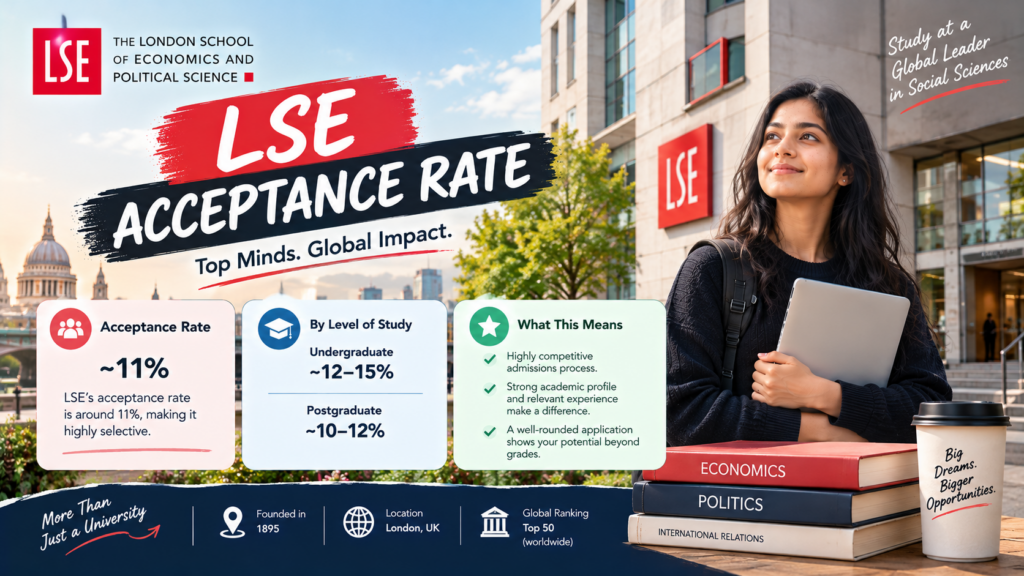
The LSE acceptance rate for undergraduates is about 6%. LSE says it received approximately 30,000 applications for roughly 1,900 places in 2025, which works out to about 6.3%. LSE’s own statement is the safest anchor for the overall LSE acceptance rate.
Two terms get mixed up online. The offer rate counts applicants who received an offer. The acceptance (entrant) rate counts applicants who actually enrolled. Most LSE offers are conditional on final exam results, and some applicants choose another university, so the entrant rate is always lower than the offer rate. Secondary sources put the 2025 undergraduate offer rate near 16%.

Choose your dream country
 UK
 USA
 Germany
 Australia
 Ireland
 Canada
 UAE
 France
 Sweden
 Italy
 Other
When do you want to study abroad?
What's your highest level of education?
Have you completed Class 12th?
What was your Class 12 CGPA/percentage?
Are you a student or a parent/guardian?
What do you want to study?
Select your current city
How Leap will help you

Personalised University Shortlist

Express Applications with Quicker Admits

End-to-End Application Support
For master's programs, LSE does not publish one overall rate. Each program page lists applications and intake. This guide divides intake by applications to get an entrant rate for each course, using the figures LSE labels "2025". Treat it as a measure of competition, not a promise of an offer.
Counselor insight: Indian applicants often quote the 6% figure for every course. Your course matters far more than the headline, as the next two sections show.
LSE Acceptance Rate by Undergraduate Program
The LSE acceptance rate varies sharply by degree, from 4.5% to 7.5% in the table below. Figures come from LSE program pages for 2027-28 entry. All undergraduate courses start on 27 September 2027.
| Program | Applications | Intake | Applicants per place | Entrant rate |
|---|---|---|---|---|
| BSc Finance | 1,526 | 69 | 22:1 | 4.5% |
| BSc Accounting and Finance | 2,849 | 156 | 18:1 | 5.5% |
| LLB Bachelor of Laws | 3,102 | 193 | 16:1 | 6.2% |
| BSc Mathematics and Economics | 896 | 60 | 15:1 | 6.7% |
| BSc Management | 2,407 | 163 | 15:1 | 6.8% |
| BSc Economics | 2,885 | 217 | 13:1 | 7.5% |
BSc Finance is the tightest of these six. BSc Economics looks easier on paper, but it has the largest applicant pool, and the TMUA maths test is mandatory.
Counselor insight: A lower rate does not mean an easier course. Choose the degree you can argue for in your personal statement, then check the rate.
LSE Acceptance Rate by Master’s Program
The LSE acceptance rate for master's courses ranges from 3.6% to 19.0%. The finance family is far tougher than economics or accounting. Data is from LSE's graduate program pages.
| Program | Applications | Intake | Applicants per place | Entrant rate |
|---|---|---|---|---|
| MSc Finance and Private Equity | 528 | 19 | 28:1 | 3.6% |
| MSc Financial Mathematics | 540 | 24 | 23:1 | 4.4% |
| MSc Finance and Economics | 800 | 44 | 18:1 | 5.5% |
| MSc Data Science | 669 | 54 | 12:1 | 8.1% |
| MSc Finance (full-time) | 1,704 | 160 | 11:1 | 9.4% |
| MSc Management and Strategy | 713 | 85 | 8:1 | 11.9% |
| MSc Accounting, Organisations and Institutions | 455 | 54 | 8:1 | 11.9% |
| MSc Public Policy and Administration | 460 | 55 | 8:1 | 12.0% |
| MSc International Relations | 1,044 | 153 | 7:1 | 14.7% |
| MSc Economics (one-year) | 874 | 136 | 6:1 | 15.6% |
| MSc Accounting and Finance | 1,046 | 168 | 6:1 | 16.1% |
| MSc Economics (two-year) | 291 | 54 | 5:1 | 18.6% |
| MSc Econometrics and Mathematical Economics | 331 | 63 | 5:1 | 19.0% |
MSc Finance and MSc Finance and Private Equity are identical programs except for one mandatory course. LSE says to select only your preferred one, not both.
Counselor insight: Roughly one in three of these programs sits below 10%. If you apply to several finance MScs, include at least one course from the higher-rate end of the table.
Why Sources Disagree on the LSE Acceptance Rate
You will see 6.3%, 8.9%, 12.2% and even "89%" for the LSE acceptance rate. Four things explain the gap:
- some sites quote offer rate, others entrant rate
- some mix undergraduate and master's applicants
- some use old cycles
- some contain typos
Use LSE's own pages whenever you can. If a site gives one number without saying which type and which year, treat it with caution.
LSE Entry Requirements for Indian Students
LSE's entry requirements for Indian undergraduates depend on your Class 12 marks. LSE accepts CBSE and CISCE only, mapped to A-level grades:
| A-level standard | CBSE/CISCE equivalent |
|---|---|
| A*AA | Overall 95% or above, three subjects at 95%+, two at 90%+ |
| AAA | Overall 90% or above, five subjects at 90%+ |
| AAB | Overall 85% or above; some subjects may need 90%+ |
Where a course needs A-level Maths, Standard Maths is required and Applied Maths is not accepted. A mark of 95% in Maths stands in for an A* and 90% for an A. LSE welcomed 173 Indian undergraduates in 2025.
Undergraduate tests: BSc Economics requires the TMUA. The LLB requires the LNAT, which you must sit by 31 December 2026 for fair consideration.
| Document | India-specific detail |
|---|---|
| Class 12 marksheet | CBSE or CISCE only; predicted marks at application, final marks later |
| UCAS application and personal statement | Submitted through UCAS, not directly to LSE |
| Teacher reference | From your school |
| TMUA or LNAT result | Needed for BSc Economics or LLB, respectively |
| Master's: degree transcripts | Indian university marksheets |
| Master's: two academic references | Preferably from professors |
| Master's: CV and statement of academic purpose | Tailored to the specific program |
| GRE or GMAT scores | Needed for many programs (next section) |
| English proof | Not needed at application; may be needed later |
Counselor insight: Standard Maths versus Applied Maths trips up many CBSE students. Check your subject combination before you choose a course.
GRE and GMAT for LSE: Program-Wise Rules
Most Indian master's applicants need GRE or GMAT because they lack a UK undergraduate degree. Undergraduate applicants need neither. Rules below are from LSE program pages for 2027-28:
| Program | Rule |
|---|---|
| MSc Finance | GMAT or GRE required; GMAT strongly preferred |
| MSc Accounting and Finance | GMAT or GRE required |
| MSc Finance and Economics | GMAT or GRE required; strong quant needed |
| MSc Economics (one-year) | GRE required; typically at least 164 Quant |
| MSc Econometrics and Mathematical Economics | GRE required; typically at least 166 Quant |
| MSc Economics (two-year) | GRE required; typically 164+ Quant |
| MSc Management and Strategy | GMAT or GRE required from all (alumni exemptions) |
For the economics MScs, your GRE must be no more than five years old on 1 October 2027 and show full and percentile scores for all three sections. LSE sets no fixed cut-off, but a higher score counts in your favour. Not sure which test to take? See LeapScholar's answers on the GMAT and the GRE for UK programs and whether a high score helps with scholarships.
Counselor insight: A Quant score near the guide does not guarantee an offer, and a slightly lower one does not rule you out. Aim to hit or beat the guide before you submit.
LSE Deadlines for 2027-28 Entry
The LSE acceptance rate story is also a timing story. Undergraduate applications close on 13 January 2027. Most master's courses admit on a rolling basis and close when full.
| Item | Date |
|---|---|
| UCAS deadline, all undergraduate courses | 13 January 2027 |
| LNAT sitting (LLB) | 1 September to 31 December 2026 |
| Master's (most programs) | Rolling, no fixed deadline |
| Needs-based funding (MSc Finance, MSc Accounting and Finance) | 22 April 2027 |
| MSc Finance (part-time) rounds | 15 Jan, 9 Apr, 18 Jun, 6 Aug 2027 |
| MSc Finance deposit | 15% of fee; for offers by 30 April 2027, 10% due in 28 days and 5% by 1 June 2027 |
Planning calendar for Indian applicants
| Month | Undergraduate | Master's |
|---|---|---|
| Now to Nov 2026 | Shortlist courses; register for TMUA or LNAT (check dates) | Book GRE or GMAT; draft statement |
| Dec 2026 | Finish LNAT by 31 Dec | Apply early; scholarships are awarded on a rolling basis |
| Jan 2027 | Submit UCAS by 13 Jan | Continue applications |
| Apr 2027 | Await decisions | Funding deadline 22 Apr |
| May to Jun 2027 | Board results (typically May); meet conditions | Pay deposit on time |
| Aug 2027 | Apply for your Student visa; arrange accommodation and travel | Introductory courses begin late August |
| 27 Sep 2027 | Courses start | Courses start (some earlier) |
Counselor insight: Rolling admissions reward early, complete applications. Waiting for one more GRE attempt can cost you a place.
LSE Fees in INR for 2027-28
LSE's overseas fees for 2027-28 sit between Rs.47,68,875 (£37,500) and Rs.68,16,312 (£53,600) a year.
| Course | Fee (INR first) |
|---|---|
| MSc Finance / Finance and Private Equity | Rs.68,16,312 (£53,600) |
| MSc Accounting and Finance | Rs.57,48,084 (£45,200) |
| MSc Economics / Econometrics | Rs.54,81,027 (£43,100) |
| BSc Economics | Rs.53,28,423 (£41,900) |
| BSc Finance / Accounting and Finance / Mathematics and Economics | Rs.49,97,781 (£39,300) |
| LLB / BSc Management | Rs.47,68,875 (£37,500) |
Exchange rate used: Rs.127.17 per £1. Verify the current rate before finalising your budget.
For MSc Finance, the 15% non-refundable deposit is Rs.10,22,447 (£8,040). That splits into Rs.6,81,631 (£5,360) and Rs.3,40,816 (£2,680). The Finance department's scholarships are worth up to Rs.31,79,250 (£25,000) and are awarded on a rolling basis from November. Plan living costs separately; see LeapScholar's guides on the cost of studying in the UK and the 2026-27 budget.
Should You Apply to LSE? Three Scenarios
If you are a CBSE Class 12 student scoring around 92% overall with Standard Maths, you meet the AAA-level mapping. BSc Economics has a 7.5% entrant rate and a mandatory TMUA, so start maths preparation early.
If you are a final-year BCom or BTech student with no UK degree, aiming for MSc Finance, expect GMAT or GRE and a 9.4% entrant rate. LSE says most admitted students previously held first-class degrees or equivalent. Add a higher-rate course as a backup.
If you are an economics graduate eyeing MSc Economics, aim for GRE Quant of at least 164. The 15.6% entrant rate is much friendlier than the finance MScs, so lead with your strongest maths evidence.
What to Do If Your LSE Application Goes Wrong
You miss the UCAS deadline. LSE gives equal consideration to applications received by the January deadline. Do not assume late applications are treated the same. Contact LSE undergraduate admissions through its knowledge base before deciding.
Your GRE is below the Quant guide. LSE sets no fixed mark and considers references and marks too. If time allows, retake before applying, because rolling programs fill.
Your results arrive late. Offers are often conditional on final results. Keep your referees and LSE updated, and check the offer conditions.
The program is full. Rolling master's courses close when full. Apply early and keep a second-choice course.
Funding is uncertain. You must hold an offer before applying for needs-based awards, and competition is strong. Do not pay the deposit without a funding plan.
3 Takeaways on LSE Acceptance Rate
The LSE acceptance rate is about 6% overall, but your course decides your odds. Three actions matter:
- Pick your program using the tables, and keep a higher-rate backup.
- Book your GRE, GMAT, TMUA or LNAT early so you can apply well before the 13 January 2027 UCAS deadline or the rolling master's deadlines.
- Confirm your Class 12 marks and Standard Maths against LSE's India table, and build your Rs. budget at Rs.127.17 per £1.
Verified by: LeapScholar's UK counselling team, with hands-on experience guiding Indian students through UK admissions.
Have questions about LSE acceptance rate? Book a free session with a LeapScholar counselor.
Frequently Asked Questions About LSE Acceptance Rate
-
What is the LSE acceptance rate?
LSE reports about 30,000 applications for roughly 1,900 undergraduate places in 2025, around 6%. Master's rates vary by program from 3.6% to 19.0% when calculated as intake divided by applications.
-
How much does LSE cost in rupees?
Overseas fees for 2027-28 range from Rs.47,68,875 (£37,500) for the LLB and BSc Management to Rs.68,16,312 (£53,600) for MSc Finance, at Rs.127.17 per £1.
-
What GRE score does LSE expect?
LSE sets no fixed cut-off. For MSc Economics, it typically expects at least 164 in Quant, and 166 for MSc Econometrics and Mathematical Economics.
-
What if I miss the LSE deadline for 2027 entry?
Undergraduate applicants should contact LSE admissions before assuming anything about late applications. Most master's courses are rolling, so apply as soon as a program is open.
-
Do Indian students need GRE or GMAT for LSE?
For most master's programs, yes, if you have no UK undergraduate degree. Undergraduate applicants need neither, though BSc Economics requires the TMUA and the LLB requires the LNAT.
-
What is the LSE MSc Finance acceptance rate?
MSc Finance had 1,704 applications and 160 places in 2025, about 9.4%. MSc Finance and Private Equity is tougher at 3.6%.
-
Is the LSE acceptance rate the same as the offer rate?
They differ. The offer rate counts offers made. The acceptance rate counts students who enroll. Conditional offers and applicants choosing other universities make the entrant rate lower.
-
What Class 12 percentage do I need for LSE?
Standard offers map to 85% overall (AAB), 90% (AAA) or 95% (A*AA), depending on the course. Applied Maths is not accepted for A-level Maths requirements.
-
What is the LSE acceptance rate for Indian students?
LSE does not publish a separate figure for Indian applicants. The program-wise tables above are the most useful guide. LSE welcomed 173 Indian undergraduates in 2025.








Have Questions? Get Guidance to reach your Dream University
Connect with India's finest counsellors and biggest study abroad community.
Get Guidance