
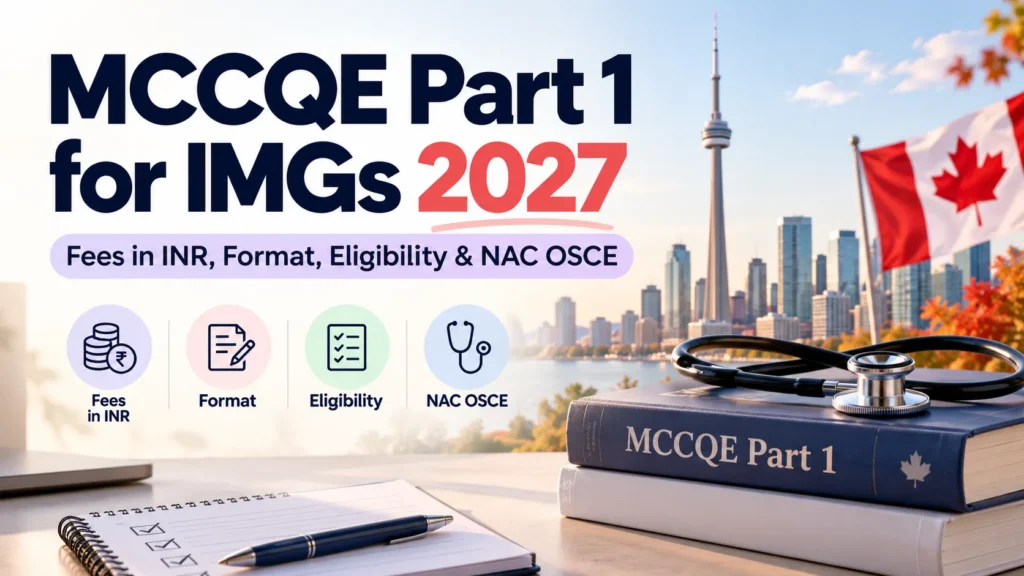
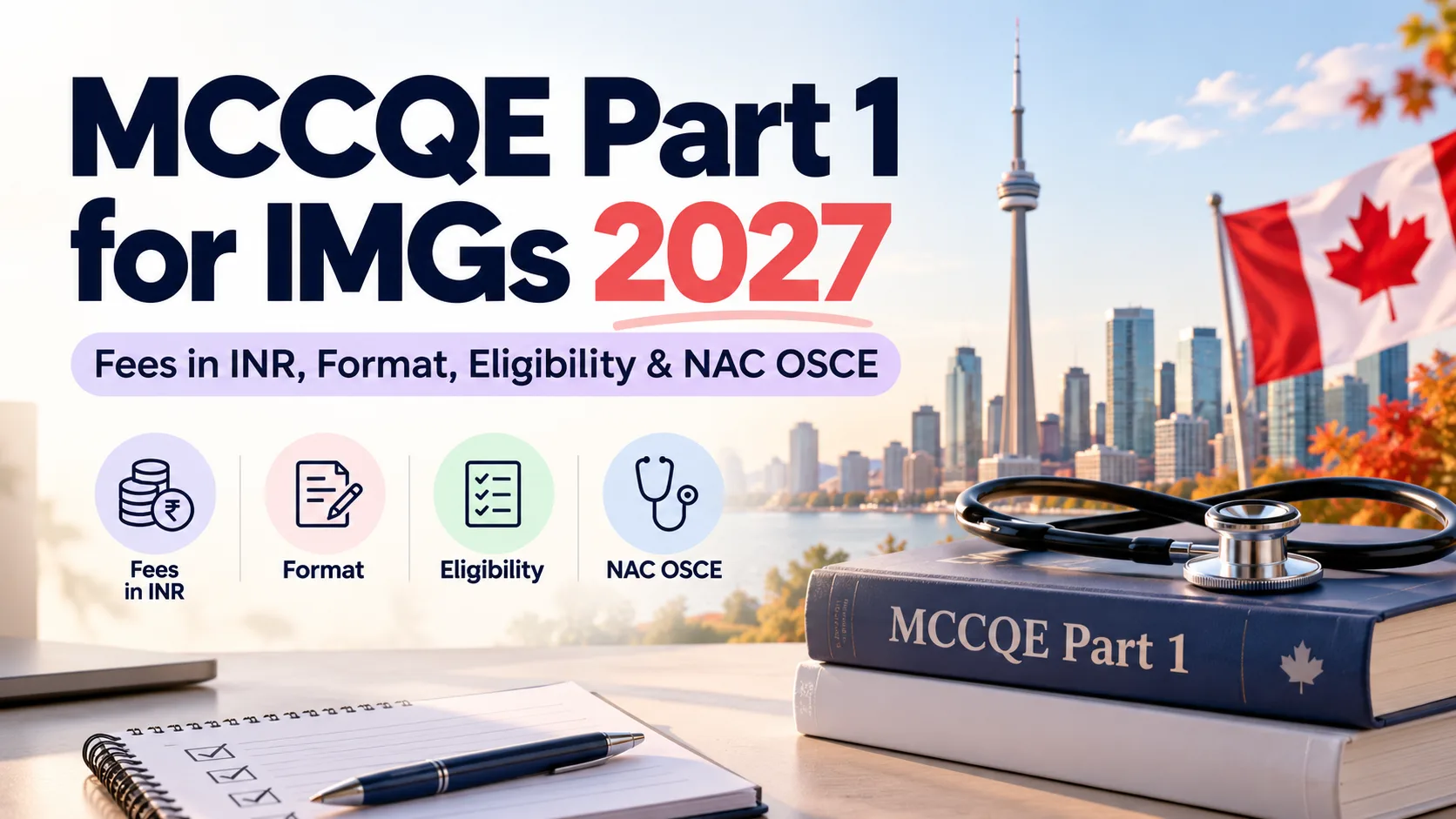
Quick Read
- MCCQE Part 1 costs about INR 1.01L (CAD 1,500) per attempt.
- The exam has 230 multiple-choice questions in two timed sections.
- Indian MBBS graduates need a recognized school and degree verification first.
- The NAC OSCE is next held on 1 May 2027.
Is MCCQE Part 1 Realistic for an Indian Doctor?
Can you take the MCCQE Part 1 with an Indian MBBS, and will it let you practice in Canada?
Yes, if your school qualifies, but it is a knowledge test, not a license. The Medical Council of Canada (MCC), which runs it, requires a pass from international medical graduates (IMGs, doctors trained outside Canada and the US) who apply for residency.

Choose your dream country
 UK
 USA
 Germany
 Australia
 Ireland
 Canada
 UAE
 France
 Sweden
 Italy
 Other
When do you want to study abroad?
What's your highest level of education?
Have you completed Class 12th?
What was your Class 12 CGPA/percentage?
Are you a student or a parent/guardian?
What do you want to study?
Select your current city
How Leap will help you

Personalised University Shortlist

Express Applications with Quicker Admits

End-to-End Application Support
Residency is paid specialist training after MBBS. You apply through CaRMS (the Canadian Resident Matching Service). It asks for MCCQE Part 1, the NAC OSCE, which is a live clinical exam covered below, and Canadian citizenship or permanent residence, or PR, which is the right to live and work in Canada without a time limit. Some exceptions apply.
In December 2025, Canada announced a doctor-specific category of Express Entry, its online PR system, and said it would reserve 5,000 federal spaces for provinces to nominate licensed doctors with job offers. That targets doctors who are already licensed and have a job offer, so for most applicants it comes after the exams, not instead of them.
Counselor insight: Check your PR route before you pay for both exams, because the exams do not change the CaRMS citizenship rule.
Canada Opens 5 PR Pathways for Foreign Doctors, But Licensing Remains the Real Hurdle for Indians, explains which doctor-specific PR routes exist and why licensing is still the hardest part.
Sources: CaRMS: R-1 eligibility criteria
What is MCCQE Part 1, and Where Does it Fit on the Road to a Canadian License?
MCCQE is the MCC's qualifying exam, a computer-based test of medical knowledge and clinical decision-making. The MCC now writes "MCCQE" and says "formerly MCCQE Part I," so both names mean the same exam. It is not the residency match, a license, or a visa. Here is the order of the road:
- Verify your degree: an SVR (source verification request) asks your university to confirm your MBBS.
- MCCQE Part 1: the knowledge exam, which is taken in Canada or abroad at a test centre.
- NAC OSCE: the National Assessment Collaboration exam, a live clinical test, which can be taken in either order with the MCCQE.
- Residency or PRA: CaRMS residency, or a PRA (Practice-Ready Assessment), which is a provincial workplace assessment for doctors who practiced abroad.
- Credential: the LMCC (Licentiate of the Medical Council of Canada) is a credential some provincial regulators ask for.
- License: the provincial regulatory authority is the body that licenses doctors in each province.
After you qualify, see Cost of Living in Canada for Indians, Jobs in Canada for Indians, and Average Salary in Canada (2027-28) in Indian Rupees: By Province, Job, and Take-Home Pay.
Sources: MCC: MCCQE overview
How Do You Register for MCCQE Part 1 From India, Step-By-Step?
Start with the paperwork, because the slowest step is your university, not the exam booking. There is no application deadline, since the MCC accepts applications on an ongoing basis.
- Check your school: it must be in the World Directory of Medical Schools, the global list of recognized schools, with a Canada Sponsor Note and a flag showing Canada accepts it.
- Open an account: physiciansapply.ca is the MCC's portal for applications, verification, and results. The one-time fee is in the cost table below.
- File the SVR: the MCC will contact your university. Replies can take 3 months or longer, so follow up once your status reads "Sent for source verification."
- Gather documents: upload what your account asks for. The MCC may request new or additional documents, so please respond promptly.
- Apply and pay: allow up to 4 weeks for processing. Test accommodation requests take up to 9 weeks.
- Book at Prometric: Prometric is the company that runs the test centres. Book only after acceptance, up to 5 months before a session, on a first-come, first-served basis, and in person.
- Sit the exam: read your result only in your account. The MCC never gives results by phone or email.
The MCC delivers the exam in Canada and over 70 countries. The booking page shows which centres are open to you.
Sources: MCC: source verification of credentials
How Much Does MCCQE Part 1 Cost in INR?
You pay in Canadian dollars (CAD) by credit card, so budget in rupees with the table below. Read each row as a separate, non-refundable charge unless it says otherwise. The totals assume you verify one degree. The eligibility window is the 12 months you get to book and sit the exam once the MCC accepts you.
| MCCQE Part 1 fee item | What it pays for | Cost in INR (CAD) |
|---|---|---|
| physiciansapply.ca account, one time | opens your MCC account | INR 10,100 (CAD 150) |
| Source verification request, per degree | MCC checks your MBBS with your university | INR 15,700 (CAD 232) |
| MCCQE Part 1 application | the exam itself | INR 1.01L (CAD 1,500) |
| Total to sit MCCQE Part 1 | the three fees above | INR 1.27L (CAD 1,882) |
| NAC OSCE application | the clinical exam | INR 2.24L (CAD 3,320) |
| Total with the NAC OSCE | both exams | INR 3.51L (CAD 5,202) |
| Eligibility window extension | one extra 12 months | INR 8,100 (CAD 120) |
| MCCQE Part 1 withdrawal fee | deducted from your refund if you withdraw | INR 50,700 (CAD 750) |
Fees are converted at 1 CAD = INR 67.57 as of October 2026 and will shift with the exchange rate, so check the latest rate before budgeting.
Sources: MCC: examination and service fees
Cost of Living in Canada in 2027: What Indian Students Actually Pay covers the rest of a Canada budget beyond the exam fees.
Travel, preparation material, and the NAC trip are not in these totals, and the MCC can change fees without notice. The MCC takes credit cards but not Visa or MasterCard debit cards or Interac, so check your card first.
Counselor insight: Add up both exams before paying either, because each fee is separate and refunds are partial at best.
What is the MCCQE Part 1 Format and Pass Mark?
How does it compare with NEET PG? The MCC does not publish a comparison. It says the exam tests critical medical knowledge and clinical decision-making, all through multiple-choice questions (MCQs, where you pick the best answer from several options), on a computer, in one day at a test centre.
- Questions: 230 MCQs, split into two sections of 115.
- Time: up to 2 hours 40 minutes per section, with an optional break between them.
- Score: reported on a 300 to 600 scale, with a pass score of 439. Scores before 2025 used another scale.
- Prepare: the exam follows the MCC's published exam objectives, and the MCC lists free sample questions and a study guide, plus paid preparatory exams and exam orientations.
- Delivery: the MCC does not offer remote exams at present, so sit at a Prometric test centre.
Sources: MCC: MCCQE results and score, MCC: resources to help with exam prep
Who Can Sit for MCCQE Part 1? Eligibility for Indian Graduates
Your Indian MBBS counts if your school is on the right list, because the MCC checks the school, not your marks or years of experience.
- Schools: for most Indian graduates, the school must be listed in the World Directory and have a Canada Sponsor Note.
- Final-year students: you may apply up to 15 months before your expected graduation date.
- Eligibility window: extend it once, by 12 months, within 60 days of expiry.
- Attempts: a maximum of 4. No retake after a pass. Wait one year after the third attempt.
- Language: the MCCQE application does not ask for a language test, but your provincial regulator may.
Ask first, then see IELTS requirements for Canada and IELTS exam fees in India if you need a test.
Sources: MCC: MCCQE eligibility and application
What is the NAC OSCE, and Do You Need it Alongside MCCQE Part 1?
Yes, you also need a clinical exam if you want CaRMS. The NAC OSCE is a live test where you rotate through short stations, meeting trained actors who play patients while a physician examiner scores you. OSCE stands for Objective Structured Clinical Examination. You do not need to pass MCCQE Part 1 first.
- Format: 12 stations (2 unscored pilot), 11 minutes each, 2 minutes between, plus 2-3 wait stations.
- Who may apply: graduates or students within 15 months of graduating from a World Directory school with a Canada Sponsor Note.
- Attempts: a maximum of 3, never in consecutive sessions. Only your latest result stays valid, with no expiry.
- Where: designated centres in Canada, so you must travel. Plan the trip and your passport paperwork early.
- How: SVR first, then apply in your account and choose up to 3 centres. Processing takes up to 4 weeks. Test accommodation documents are due 5 January 2027.
Sources: MCC: NAC Examination, MCC: NAC eligibility and application
Counselor insight: The NAC runs twice a year while MCCQE Part 1 has four sessions, so fix the NAC date first, then place MCCQE Part 1 around it.
Which MCCQE Part 1 and NAC OSCE Dates You Must Attend
There is no application deadline for MCCQE Part 1. The dates that bind you are the session you book, your 12-month window, and the NAC application window. Dates marked closed have passed. The table lists every confirmed date.
| MCCQE Part 1 and NAC OSCE date | What happens | Status |
|---|---|---|
| No fixed deadline | applications are rolling | Open |
| 19 August to 21 October 2026 | combined MCCQE session | Closed on 21 October 2026 |
| 19 January to 11 February 2027 | MCCQE January session | Open for booking |
| 27 April to 1 June, 10 August to 7 September, and 5 to 26 October 2027 | MCCQE April, August, and October sessions | Booking opens 5 months before each |
| 12 months from acceptance | eligibility window, one extension within 60 days of expiry | Applies to you |
| 18 November to 9 December 2026 | NAC OSCE application window for 1 May 2027 | Not open yet |
| 5 January 2027 | last day to withdraw from the NAC OSCE for a partial refund | Upcoming |
| 1 May 2027 | NAC OSCE results late June 2027 | Upcoming |
More NAC OSCE dates for 1 May 2027:
- 5 January 2027: test accommodation documents due.
- 12 January 2027: last day to change your centre choice.
- 28 January 2027: scheduling request deadline.
- End of March 2027: centres assigned.
- 19 and 20 September 2026: the earlier NAC OSCE sitting, closed.
MCCQE Part 1 results arrive 4 weeks after the last day of the January, August, and October sessions and 5 weeks after April. Sessions after October 2027 are not published yet.
The NAC centres are Edmonton, Winnipeg, Hamilton, London, Ottawa, Toronto, Windsor, and Saskatoon.
Sources: MCC: MCCQE scheduling, MCC: NAC scheduling
Counselor insight: Work backwards from the result date you need, because the 4- to 5-week result lag, the 12-month window, an SVR of 3 months or longer, and the NAC window all stack. Start the SVR before choosing a session.
How Does the MCCQE Part 1 Route Differ for Doctors, Nurses, and Canadian Graduates?
Your first step depends on who you are: a final-year student, an MBBS graduate, an MD or MS doctor, a nurse or a Canadian-trained doctor. Read each row as your starting point, then the extra step beside it.
| Who you are | MCCQE Part 1 route | What else do you need? |
|---|---|---|
| Final-year Indian MBBS student | apply up to 15 months before graduating | student attestation form from your school, then SVR after you graduate |
| Indian MBBS graduate | SVR first, then application | NAC OSCE, PR or citizenship |
| Indian MD or MS doctor | same exam, used by some PRA programs | ask the province's PRA program |
| Indian nurse | not an MCC exam, see NCLEX Exam Guide 2026: Application, Format, and Cost for Indian Nurses | nursing regulator in the province |
| Canadian-trained doctor | graduate or final-year student of a Canadian medical school accredited by CACMS (the body that accredits them) | see studying medicine in Canada and medical colleges in Canada |
Most readers of this page sit in the second row: verify your degree first, then apply.
PLAB Exam 2027: Fees in INR, Eligibility & Dates, and How to Become a Doctor in UK from India: UKMLA, GMC & NHS Guide 2026 cover the UK route if Canada is not settled.
PG in Australia After MBBS: Your 2026 Guide to the AMC Pathway, How Indian Students Can Become Doctors in the USA in 2025-26, and Study in Canada for Indian Students cover the other routes.
What Can You do if Something Goes Wrong With MCCQE Part 1?
What if your university is slow, you miss your slot, or you fail? Each problem has an official route, and most have a deadline.
- Verification is slow: follow up with your university once the status reads "Sent for source verification." The ECFMG, a US credential body, resends requests after 2 months, up to 3 times.
- Documents rejected: the MCC may ask you to upload new or additional documents in your account.
- Cancelling: cancel with Prometric, then withdraw in your account more than 120 hours before. Inside 120 hours, you will be marked absent and will lose the full fee.
- Extenuating circumstances: send documents to the MCC within 15 days of the exam date for a possible partial refund.
- Exam-day problem: report it to the MCC within 7 days. Ask for reconsideration within 15 calendar days of your result, and appeal within 30 days of the decision.
- Fail: check the attempt limits above, then plan the retake around your window.
- No PR yet: the exams alone do not unlock CaRMS. Speak to a counselor about your route.
Canada PR: Complete Guide to Permanent Residency for Indian Students and Professionals (2026) explains the routes to permanent residence if you do not have PR yet.
Sources: MCC: withdrawing from the MCCQE, MCC: reconsideration and appeal
3 Takeaways on MCCQE Part 1
- Start the degree verification now, as it is the slowest step, and there is no application deadline for MCCQE Part 1.
- Budget about INR 3.51L for both exams: the MCCQE Part 1 and the NAC OSCE together, and apply for the NAC OSCE between 18 November and 9 December 2026.
- Settle your PR route alongside the exams: CaRMS asks for both exams and citizenship or PR.
Talk to a Leap Scholar counselor to plan your MCCQE Part 1 and NAC OSCE dates and your Canada PR route.
Frequently Asked Questions About MCCQE Part 1
-
What is MCCQE Part 1, and is it compulsory for IMGs?
MCCQE Part 1 is the Medical Council of Canada's qualifying exam, 230 multiple-choice questions on medical knowledge and decision-making. Passing it is required for international medical graduates applying to a Canadian residency program, but it is not a license on its own.
-
How much does MCCQE Part 1 cost in INR?
The application fee is INR 1.01L (CAD 1,500) per attempt and is non-refundable. The one-time account fee and the degree verification fee come on top, so budget about INR 1.27L before travel and preparation material at the October 2026 rate.
-
How many times can you take MCCQE Part 1?
You may sit it up to 4 times in total. You cannot retake it after passing, and you must wait one year after the third attempt before the fourth. Because the limit is fixed, book only when you feel ready.
-
What is the MCCQE Part 1 pass mark?
The MCC reports scores on a 300 to 600 scale, and the pass score is 439. Your result appears only in your physiciansapply.ca account, never by phone or email, so check your account on result day rather than waiting for a message.
-
Can you take MCCQE Part 1 from India?
Yes, the MCC delivers the exam in Canada and over 70 countries, including India, in person at Prometric test centres. The MCC does not offer remote exams at present. The booking page shows which centres are open to you, and seats are first-come, first-served.
-
What is the NAC OSCE, and do you need it?
The NAC OSCE is a half-day clinical exam of 12 short stations, held twice a year at designated centres in Canada. International medical graduates need it to apply to CaRMS. You may take it before or after MCCQE Part 1, in whichever order you prefer.
-
When is the next MCCQE Part 1 session?
The next session runs 19 January to 11 February 2027, then 27 April to 1 June 2027. You can book up to 5 months before a session starts, and the MCC accepts applications on an ongoing basis, with no fixed deadline.
-
Does passing MCCQE Part 1 let you practice in Canada?
Passing MCCQE Part 1 alone does not license you; it is just one step in the process, not the end. A provincial regulatory authority issues the license, and CaRMS also asks for the NAC OSCE and Canadian citizenship or PR, with some exceptions, before it considers you for residency.






Have Questions? Get Guidance to reach your Dream University
Connect with India's finest counsellors and biggest study abroad community.
Get Guidance