
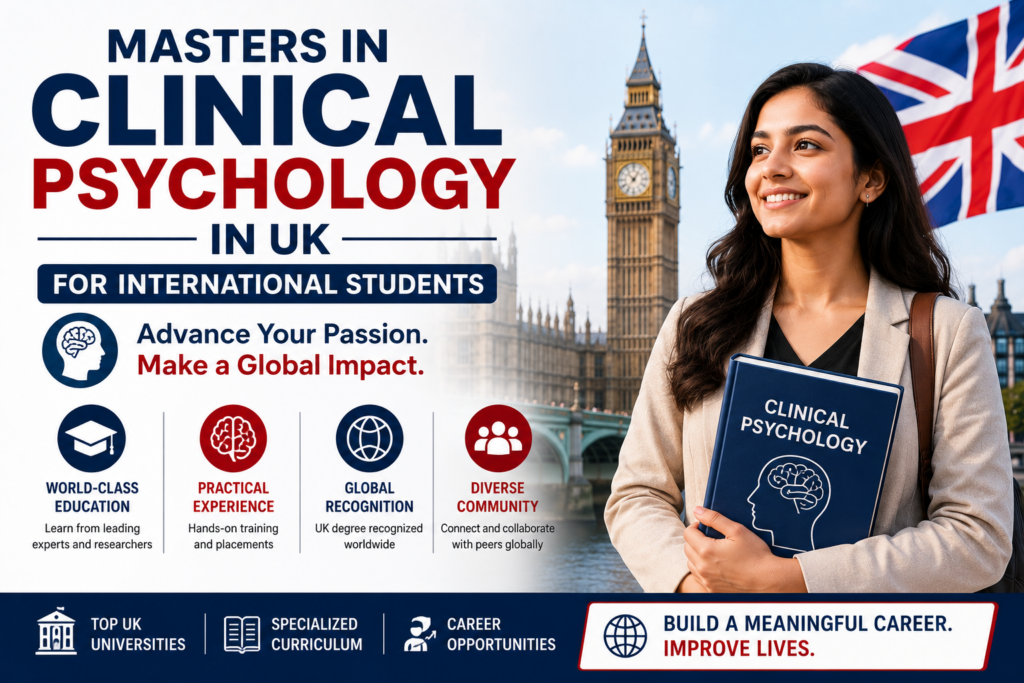
Quick Read
- UK MSc in Clinical Psychology is 1 year full-time for international students.
- Tuition fees: Rs. 40.1 lakh (GBP 30,900) to Rs. 55.4 lakh (GBP 42,700) depending on university.
- You need a 2:1 degree (60% aggregate) and IELTS 6.5 minimum.
- Chevening covers tuition and living costs but has a 1–2% India acceptance rate. Verify your specific MSc is Chevening-eligible before applying.
- An MSc does not qualify you to practise as a clinical psychologist in the UK the DClinPsy is required for HCPC registration.
What Indian students are asking right now: “Pathways into clinical psychology as an international student” an active thread on r/ClinicalPsychologyUK covering the MSc-to-DClinPsy route, BPS GBC eligibility, and NHS work visa options for non-UK graduates.
What an MSc in Clinical Psychology in the UK Does and Does NOT Qualify You to Do
An MSc in Clinical Psychology is not a practitioner qualification. It does not grant HCPC registration and does not qualify you to use the protected title “Clinical Psychologist” in the UK or India.
To practice as a clinical psychologist in the UK, you must complete the Doctorate in Clinical Psychology (DClinPsy), a 3-year NHS-funded programme with approximately 600 places nationally per year and an acceptance rate of less than 30%. The average applicant applies multiple times before securing a place.
An MSc is valuable as
- Preparation for DClinPsy applications: Assistant psychologist experience gained post-MSc is essential
- Entry into research, academic, and policy roles in mental health
- Qualification for adjacent roles such as Assistant Psychologist or Psychological Wellbeing Practitioner
If your goal is practicing clinical psychology in the UK, plan your MSc as Step 1 of a 5–7 year pathway, not the endpoint.
Why Study Masters in Clinical Psychology in UK for Indian Students?
The UK offers specific advantages that other destinations do not match for this discipline:
- NHS placement access: Many MSc programs include optional clinical placements inside NHS mental health settings real patient-facing experience you cannot replicate in a classroom.
- BPS-accredited credential: A programme that confers Graduate Basis for Chartered Membership (GBC) puts you on the HCPC registration pathway and makes you eligible for the Doctorate in Clinical Psychology (DClinPsy).
- 1-year structure: Most countries run a 2-year MSc. Completing in 12 months saves Rs. 15–20 lakh in living expenses compared to the USA or Australia.
- Graduate Route visa: Students applying for the Graduate Route by 31 December 2026 will receive 2 years of post-study work authorization in the UK.
- India’s mental health sector is growing fast: Even if you return home, a UK MSc is well-regarded by corporate wellness teams, private hospital networks, and NGOs. India currently has fewer than 1 psychiatrist per 100,000 people, creating strong demand for trained postgraduates at every level.
Counselor insight: The NHS placement is the single biggest differentiator students overlook. Prioritize programs with an optional placement module. Manchester, Exeter, and Bath all offer this option. That one module can be the deciding factor on a future DClinPsy application.
Top Universities for Masters in Clinical Psychology in UK for International Students in 2026-27
| University | Program | QS Subject Rank (Psychology) 2026 | Tuition Fees (GBP/INR) | IELTS Minimum | BPS Accredited |
|---|---|---|---|---|---|
| University of Manchester | MSc Clinical and Health Psychology | Top 100 | Rs. 43.5 lakh (GBP 33,600) | 6.5 | Yes |
| UCL | MSc Clinical Mental Health Sciences | 5th globally | Rs. 55.4 lakh (GBP 42,700) | 7.0 | Yes |
| University of Bath | MSc Applied Clinical Psychology | 132nd globally | GBP 30,900 Rs. 40.1 lakh (GBP 30,900) | 6.5 | GBC required |
| University of Exeter | MSc Clinical Psychology | 82nd globally | Rs. 40.1 lakh (GBP 30,900) | 6.5 | Yes |
| King’s College London | MSc Health Psychology | 15th globally | Rs. 52.4 lakh (GBP 40,450) | 7.0 | Yes |
Source: Fees are sourced from official university admissions pages | QS World University Rankings by Subject 2026
Note on UCL’s rank: UCL is ranked 9th globally (QS World 2026 overall) and 5th globally in the QS Psychology Subject Rankings 2026. The column above uses the subject rank, which is the relevant measure for programme comparison.
Note for Indian students: If you are applying to Bath, check first whether your Indian degree carries the BPS Graduate Basis for Chartered Membership (GBC). It is a specific requirement for their MSc. Not all Indian psychology degrees meet this requirement. Confirm on the BPS website before you apply.
What Do You Study in an MSc Clinical Psychology in the UK?
Most one-year programs share a common core with optional specializations. Here is what to expect:
| Core Module | What It Covers |
|---|---|
| Psychopathology and Diagnosis | Mental disorder classification, DSM-5 / ICD-11, diagnostic practice |
| Psychological Assessment and Testing | Standardised tests, neuropsychological assessment, clinical interviews |
| Research Methods and Statistics | Quantitative and qualitative methods, SPSS/R, dissertation foundation |
| Therapeutic Interventions | CBT, psychodynamic therapy, ACT evidence-based approaches |
| Ethics in Clinical Practice | BPS code of ethics, confidentiality, safeguarding, professional standards |
| Dissertation / Research Project | Independent supervised research, 15,000–20,000 words |
| Clinical Placement (optional) | Supervised hours in an NHS or partner mental health setting |
Common specialisations: Child and Adolescent Psychology · Neuropsychology · Forensic Psychology · Health Psychology · CBT · Trauma and Crisis Intervention · Addiction Psychology.
Counselor insight: If you plan to return to India, Health Psychology and CBT are the most transferable specializations. India’s corporate wellness sector actively hires graduates with CBT training. If you plan to stay in the UK for the DClinPsy, choose a programme with an NHS clinical placement module; it is a real differentiator at the Doctorate application stage.
Eligibility Requirements for Masters in Clinical Psychology in UK for International Students
Most programs ask for a 2:1 honors degree in Psychology. For Indian students, that works out to a roughly 60% to 65% aggregate, or a CGPA of 7.0 to 8.0 on a 10-point scale. A few universities will look at a 2:2 if your clinical or research experience is solid, but the application is assessed individually.
English language scores:
- IELTS: 6.5 overall with no band below 6.0 at most universities; 7.0 at UCL and KCL
- TOEFL iBT: 88 to 100 depending on the university
Documents Indian applicants need:
| Document | What to note? |
|---|---|
| Academic transcripts | Attested marksheets for every semester |
| Degree certificate | A provisional certificate works at application stage; the final one is needed before enrollment |
| Statement of Purpose | 500 to 1,000 words; write a tailored one for each university |
| Letters of Recommendation | Two academic references from professors familiar with your research |
| English test scorecard | It must be valid within 2 years of your course start date |
| Passport copy | Valid for the full program duration |
| CV | Include research projects, mental health internships, and relevant volunteer work |
Counselor insight: Indian universities often take 6 to 9 months to issue a final degree certificate after graduation. Don’t wait until the end; start the process as soon as your exams are over. Some universities won’t confirm enrollment until they receive it.
Does Your Indian Degree Qualify for BPS GBC? Check This Before You Apply
Most competitive MSc programs, including Manchester, Bath, and UCL, require Graduate Basis for Chartered Membership (GBC) before entry or graduation. It is also the starting credential for the DClinPsy pathway.
- Search the BPS accredited degree database for your undergraduate institution and graduation year.
- If listed: apply for GBC directly through the BPS portal (fee applies).
- If not listed: apply for an individual overseas assessment; allow 6 to 8 weeks. Manchester recommends submitting by June 1 of your entry year due to processing delays.
- If your degree does not qualify: a 1-year BPS-accredited conversion MSc at Plymouth, Coventry, or Anglia Ruskin gives you GBC before you apply to a clinical programme.
Southampton and Plymouth do not require GBC at entry but do not confer it automatically either. If NHS progression or the DClinPsy is your goal, choose a GBC-eligible programme.
Cost of Living: Masters in Clinical Psychology in UK for International Students
Living expenses are separate and depend on where you study. Here is what a typical student spends each month in the UK:
1. Monthly Cost of Living in UK
| Category | Approx. Monthly Cost (GBP) | Approx. Monthly Cost (INR) |
|---|---|---|
| Accommodation | GBP 500 to GBP 1,000 | Rs. 64,790 to Rs. 1.30 lakh |
| Food and groceries | GBP 150 to GBP 300 | Rs. 19,437 to Rs. 38,874 |
| Local transport | GBP 30 to GBP 200 | Rs. 3,887 to Rs. 25,916 |
| Utilities and internet | GBP 70 to GBP 120 | Rs. 9,071 to Rs. 15,550 |
| Personal and leisure | GBP 80 to GBP 150 | Rs. 10,366 to Rs. 19,437 |
| Total per month | GBP 830 to GBP 1,770 | Rs. 1.08 lakh to Rs. 2.29 lakh |
2. Cost of Living Comparison: Top 3 UK Cities
The range above shifts significantly based on your city. Here’s how the three main MSc clinical psychology hubs compare:
| City | Monthly Cost (INR / GBP) | Annual Cost Estimate (INR) |
|---|---|---|
| London | Rs. 1.72–2.29 lakh (GBP 1,330–1,770) | Rs. 20.7 lakh to Rs. 27.5 lakh |
| Manchester | Rs. 1.13–1.56 lakh (GBP 870–1,200) | Rs. 13.5 lakh to Rs. 18.7 lakh |
| Exeter | Rs. 1.01–1.36 lakh (GBP 780–1,050) | Rs. 12.1 lakh to Rs. 16.3 lakh |
Counselor insight: Students often focus only on the tuition while comparing UCL and Exeter. London living costs range between Rs. 7 lakh and Rs. 11 lakh per year even before the visa fee and health surcharge. Both universities prepare you equally well for a clinical career. Let your budget decide, not just the name.
For the full city-wise breakdown, read our Cost of Living in the UK guide.
Scholarships for Masters in Clinical Psychology for International Students
| Scholarship | What It Covers | Key Requirement | Deadline |
| Chevening Scholarship | Full tuition, living costs, return airfare, visa fee | 2+ years post-graduation work experience; verify your MSc is on the Chevening eligible courses list before applying | Opens August; closes early November each year |
| Commonwealth Shared Scholarship | Full tuition, living costs, return airfare | Financial need, 2:1 degree, Indian citizenship | January (track the CSC website for 2027-28 dates) |
| UCL Global Masters Scholarship | Rs. 19.4 lakh (GBP 15,000) toward tuition | Academic merit and financial need | 2026-27 cycle closed May 7, 2026. Next cycle opens early in 2027. |
Counselor insight: Chevening has approximately a 1–2% acceptance rate from India. Around 50 awards go to Indian applicants from a large pool each year; it is worth applying, but do not build your financial plan around receiving it. Have an education loan running in parallel. Chevening essays are evaluated on leadership potential, not grades. Start drafting in June for the August opening.
For more options, see Top Scholarships in UK for Indian Students and Masters in Psychology Abroad with Scholarship.
Education Loan for Masters in Clinical Psychology in UK for Indian Students
- Public sector banks (SBI Global Ed-Vantage, Bank of Baroda Baroda Scholar): Up to Rs. 1.5 crore for recognized UK universities. No collateral is required for loans up to Rs. 7.5 lakh. Processing time: 4–8 weeks.
- Private NBFCs (Auxilo, Avanse, Credila): Approve against a confirmed offer letter in 10–15 working days. Slightly higher interest rates but faster and more predictable timelines.
Counselor insight: Start loan documentation the moment you receive a conditional offer, not the unconditional one. A delayed sanction letter can push your visa and accommodation booking into a compressed window. Full lender comparison: Education Loan for Studying in UK.
UK Student Visa 2026: Key Updates for Masters in Clinical Psychology for International Students
- Graduate Route: Apply by 31 December 2026 to receive 2 years of post-study work authorization. From 1 January 2027, it drops to 18 months. Your application date, not your graduation date, determines your entitlement. Full breakdown: UK September Intake 2026.
- No dependents: Taught MSc students cannot bring a spouse or children. That option is only open to PhD students.
- Visa and IHS costs: Visa fee: Rs. 72,305 (GBP 558). The IHS is charged at GBP 1,035 per year for a 16-month MSc student visa, the upfront IHS is approximately Rs. 2.16 lakh (GBP 1,668). Use the UK government’s IHS calculator for your exact amount before applying.
Source: UK Visas and Immigration, gov.uk.
Full step-by-step guide: UK Student Visa Guide for Indian Students.
What to Expect after Masters in Clinical Psychology in UK for International Students?
After the MSc, most graduates start as assistant psychologists. The Doctorate in Clinical Psychology (DClinPsy) is what leads to full clinical practice.
Here is what each stage earns, based on NHS Agenda for Change 2026/27 rates:
| Role | NHS Band | Annual Salary (GBP + INR) | Monthly Salary (INR) |
|---|---|---|---|
| Assistant Psychologist (post-MSc) | Band 4 to 5 | Rs. 35–45.4 lakh (GBP 27,000–35,000) | Rs. 2.9 lakh to Rs. 3.8 lakh |
| Trainee Clinical Psychologist (during DClinPsy) | Band 6 | Rs. 48.4–58.3 lakh (GBP 37,338–44,962) | Rs. 4 lakh to Rs. 4.9 lakh |
| Newly Qualified Clinical Psychologist | Band 7 | Rs. 62–70.9 lakh (GBP 47,810–54,710) | Rs. 5.2 lakh to Rs. 5.9 lakh |
The DClinPsy is NHS-funded for home students. International students are generally self-funded.
Counselor insight: Most students expect a Band 7 salary right after the MSc. That’s not how it works. The MSc gets you to the assistant psychologist level. The DClinPsy is the qualification that allows you to reach Band 7. Build this timeline into your plan, not as a surprise, but as something you knowingly sign up for.
After Your MSc: The DClinPsy Pathway and What Indian Students Need to Know
The DClinPsy is the only route to HCPC registration as a practitioner clinical psychologist in the UK. Here is the reality of the pathway:
- Approximately 600 NHS-funded places are available nationally per year across all UK universities. Fewer than 30% of applicants are successful in any given cycle. Most successful applicants apply 2–3 times before securing a place.
- Applications go through the Leeds Clearing House, not directly to universities. The Clearing House opens in September each year with a mid-November deadline.
- For international students: Most DClinPsy places are NHS-funded and reserved for home-fee applicants. A small number of UK universities, including UCL, Bath, Manchester, and Exeter, accept self-funded international applicants. Overseas fees are approximately GBP 31,200–GBP 38,300 per year (Rs. 40.5–49.7 lakh) for a 3-year programme. Oxford, Sheffield, Newcastle, and several others do not accept international self-funded applicants.
- What makes a DClinPsy application stronger: 1–2 years as an NHS assistant psychologist after your MSc, a strong research dissertation, and clear evidence of diverse clinical experience.
Source: Leeds Clearing House for Postgraduate Courses in Clinical Psychology | Aspiring Clinical Psychologist International DClinPsy Guide.
Counselor insight: Indian students often ask, “Can I go straight from my MSc to the DClinPsy?” The honest answer is rarely. Most successful DClinPsy applicants have 1–2 years of NHS assistant psychologist experience after their MSc. Budget an extra 1–2 years into your UK timeline before you are competitive for a DClinPsy place.
Returning to India After a UK MSc in Clinical Psychology: What You Need to Know
A UK MSc is not automatically recognized by the Rehabilitation Council of India (RCI) for clinical practice. You must go through RCI’s equivalence assessment after returning. Check current requirements at rehabcouncil.nic.in.
For non-clinical roles, corporate wellness, private hospitals, mental health NGOs, and academic research, RCI registration is not required, and a UK MSc is actively preferred over a domestic postgraduate degree by many employers.
Counselor insight: Know which track you want to pursue before you choose your programme. Clinical practice in India needs RCI equivalence; corporate and research roles do not. The two paths require different planning.
Is Masters in Clinical Psychology in UK Right for You?
Scenario 1: Final-year BSc student graduating in May 2026
The September 2026 intake is still possible, but the timeline is tight. Get your IELTS done by March. Your provisional certificate works for the application. Chase your final degree certificate from your university the moment results are out; some programs won’t confirm your enrollment until it arrives.
Scenario 2: Completed your degree and heading back to India
You don’t need to map out the DClinPsy route. Pick programs with strong research or placement components, like UCL or Manchester, that work well. The UK MSc is well recognized in India’s growing mental health space, across private hospitals, corporate settings, and research roles.
Scenario 3: You hold a BA Pass degree, not Honours
Most programs specifically require a 2:1 honors degree. If your degree doesn’t qualify, consider a BPS-accredited conversion program first, and UCL’s Psychological Sciences MSc is one route. It adds a year but gives you the GBC status many clinical programs require before they’ll consider your application.
For intake planning, see UK Intakes 2026-27
How to Apply for Masters in Clinical Psychology in UK for International Students
| Period (Sep 2027 Cycle) | What to Do? |
|---|---|
| June–August 2026 | Obtain IELTS or TOEFL; shortlist 3 to 5 programs related to your field; apply to Chevening before early November. |
| Sep–October 2026 | Request LORs from professors and draft your SOP |
| Oct 2026–Jan 2027 | Submit applications; many programs close in January or February |
| Feb–April 2027 | Receive offers, accept the one you want, and pay the deposit |
| May–July 2027 | Apply for UK Student Visa; sort accommodation |
| September 2027 | Arrive in UK; the program begins. |
What to Do When Things Go Wrong?
What if your IELTS score falls below the minimum?
Ask the university about a conditional offer with a pre-sessional English course. INTO Exeter and UCL’s Centre for Languages both run these courses. Six to 10 weeks is usually enough if you’re close.
What if your application gets rejected?
Ask for feedback. The most common reasons are weak SOP or vague references. Wait for the 2027-28 cycle instead of rushing into a second attempt.
What to do if your visa is refused?
Usually, the issue is with financial documentation. UKVI requires GBP 12,006 held in your account for London, or GBP 9,207 held outside London for at least 28 consecutive days.
3 Key Takeaways from the blog
Three things to hold on to before you apply.
First, check BPS GBC eligibility for your Indian degree before shortlisting universities. Finding out late costs you an entire application cycle.
Second, budget the full picture at Rs. 50–75 lakh all-in. Tuition is only part of it. City choice alone shifts living costs by Rs. 7–11 lakh a year.
Third, the MSc is Step 1 of a longer path. In the UK, the DClinPsy is required for full clinical practice plan for a 5 to 7 year pathway, not a 1-year one. If you are returning to India, clarify the RCI equivalence process before you apply. Both paths are valid; go in with open eyes.
Have questions about studying Masters in clinical psychology in UK? Book a free session with a LeapScholar counselor.
FAQs About MSc Clinical Psychology in UK for International Students
-
Can an Indian clinical psychologist work in the UK?
Yes, but not directly. You need a BPS-accredited qualification and HCPC registration to practice as a clinical psychologist in the UK. An Indian degree alone does not qualify most Indian graduates to complete a UK MSc first and then apply for the DClinPsy to achieve full registration.
-
Which university is best for clinical psychology in the UK?
UCL (5th globally for Psychology, QS 2026) and the University of Manchester are the strongest for research and NHS connections. For value and BPS accreditation with lower living costs than London, the University of Exeter and University of Bath are strong choices.
-
Is a UK MSc valid in India?
For clinical practice, not automatically. The Rehabilitation Council of India (RCI) requires an equivalence assessment before you can practice clinically. For corporate wellness, research, NGO, and private hospital roles, you do not need RCI registration, and many employers actively prefer a UK MSc.
-
Can you be a clinical psychologist with a Masters in the UK?
No. A Masters qualifies you for assistant psychologist roles at NHS Band 4–5. To use the protected title “Clinical Psychologist” and practice independently in the UK, you must complete the 3-year Doctorate in Clinical Psychology (DClinPsy) and register with the HCPC.
-
Are clinical psychologists in demand in the UK?
Yes. The NHS has a well-documented shortage of clinical psychologists, and demand has grown significantly post-pandemic. Assistant psychologist and trainee roles are competitive, but NHS trusts and private practices actively recruit qualified clinical psychologists at Band 7 and above.
-
How much does it cost to do a Masters in Psychology in the UK?
Tuition for international students runs from Rs. 40.1 lakh (GBP 30,900) at Bath and Exeter to Rs. 55.4 lakh (GBP 42,700) at UCL. Add living expenses, and the all-in budget for one year is Rs. 50–75 lakh depending on the city. London adds Rs. 7–11 lakh in living costs compared to other cities.
-
Do I need IELTS for UK Masters?
Yes. Most UK universities require an overall IELTS score of 6.5, with no band below 6.0. UCL and King’s College London require 7.0. Some universities accept TOEFL iBT (88–100) or PTE as alternatives; check the specific programme page before booking your test.
-
Is it difficult to become a clinical psychologist in the UK?
Very competitive. The MSc itself is manageable with a strong application. The bottleneck is the DClinPsy; only around 600 training places are available nationally each year, and the average applicant applies 3–4 times before securing a place. NHS assistant psychologist experience significantly strengthens your application.
-
Which is better, MA or MSc in clinical psychology?
For clinical psychology specifically, an MSc is the stronger choice. It is research-based, statistically rigorous, and more widely recognized for the DClinPsy pathway and NHS roles. An MA in psychology is typically more theoretical and less common in clinical settings. If BPS, GBC, and DClinPsy eligibility are your goals, always choose an MSc.
-
What is the salary of a clinical psychologist in the UK in Indian rupees?
Post-MSc assistant psychologists earn Rs. 2.9–3.8 lakh per month (GBP 27,000–35,000 per year). After completing the DClinPsy, a newly qualified clinical psychologist at NHS Band 7 earns a gross salary of Rs. 5.2–5.9 lakh per month (GBP 47,810–54,710 per year). Take-home is roughly 25–30% lower after UK tax and National Insurance.








Have Questions? Get Guidance to reach your Dream University
Connect with India's finest counsellors and biggest study abroad community.
Get Guidance