
Quick Read
- A masters in psychology abroad takes 1 year in the UK, about 2 years in Germany and the US, and 1 to 2 years in Canada.
- Most universities have dropped the GRE, though some competitive US clinical programs still ask for it.
- A foreign clinical psychology masters alone does not give you RCI registration to practice in India.
- Germany works out cheapest overall, the UK sits in the middle, and the US is the most expensive.
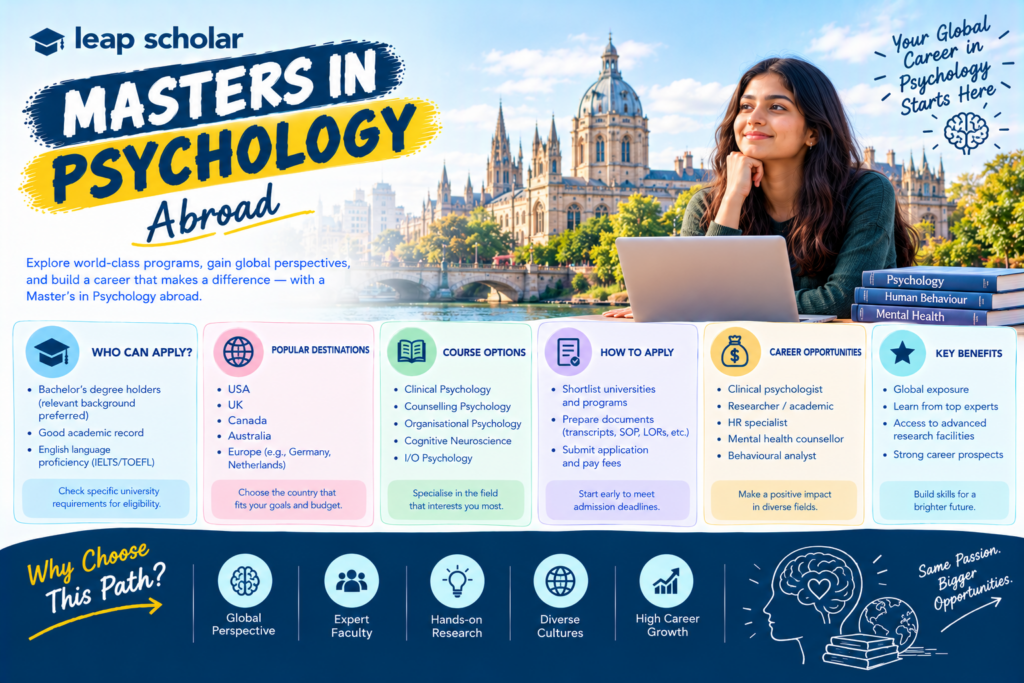
Masters in Psychology Abroad: Specializations and How to Choose
A masters in psychology abroad is not one degree with one outcome. The specialization you pick decides your career path, your licensing requirements back in India, and how competitive the program will be.
- Clinical psychology: assessment, diagnosis, and treatment of mental health conditions. This is the most regulated specialization and the one students most often misunderstand when planning to practice in India (more on this below).
- Counselling psychology: talk therapy, wellbeing and guidance work, usually in schools, colleges or private practice. Counselling psychology is less regulated in India than clinical psychology.
- Forensic psychology: psychology applied to courts, law enforcement, and offender rehabilitation.
- Industrial-organizational (I-O) psychology: workplace behavior, HR analytics, leadership, and people strategy. Strong fit for students who want a corporate path after a masters in psychology abroad.
- School and educational psychology: learning difficulties, child development, and classroom intervention.
- Health and sports psychology: behavior change in medical and athletic settings.
- Research or academic psychology (MSc by research): for students planning a PhD after their masters in clinical psychology abroad or another specialization.

Choose your dream country
 UK
 USA
 Germany
 Australia
 Ireland
 Canada
 UAE
 France
 Sweden
 Italy
 Other
When do you want to study abroad?
What's your highest level of education?
Have you completed Class 12th?
What was your Class 12 CGPA/percentage?
Are you a student or a parent/guardian?
What do you want to study?
Select your current city
How Leap will help you

Personalised University Shortlist

Express Applications with Quicker Admits

End-to-End Application Support
If you are choosing between a masters in counselling psychology abroad and a masters in clinical psychology abroad, the honest answer is counselling psychology is faster to enter and less regulated in India, while clinical psychology opens more clinical roles abroad but needs extra licensing steps to practice back home.
Eligibility for a Masters in Psychology Abroad
Masters in psychology abroad eligibility depends heavily on whether your undergraduate degree was in psychology.
With a psychology background:
- A Bachelor's degree in psychology (BA or BSc) with a good academic record, typically 60% or above or an equivalent GPA, is required.
- You will also need an English proficiency score (IELTS 6.5+ or TOEFL 90+ for most programs; higher for competitive UK and US universities).
- You will need to submit a statement of purpose, 2 to 3 letters of recommendation, and a CV or resume.
Without a psychology background:
- Several UK universities (notably conversion MSc programs in psychological science) accept graduates from any discipline, provided you clear foundational coursework or a bridging module in your first term.
- US and Canadian clinical and counselling programs are stricter and usually expect prior psychology coursework or a related social science degree.
- A GRE Psychology Subject Test score, where you have it, strengthens a non-psychology application significantly.
This is one of the clearest gaps between India and study-abroad eligibility for a masters in psychology abroad: Indian undergraduate psychology syllabi are broad and generalist, while foreign masters programs expect more specialization depth at entry.
Counselor insight: if your undergraduate psychology exposure was thin, lead with research experience, internships, or volunteering in mental health settings in your application rather than grades alone.
Is GRE Required for a Masters in Psychology Abroad?
For most Indian students, no. The large majority of psychology masters programs, including in the US, have made the GRE General Test optional or removed it entirely since 2021. Canada and the UK rarely ask for it at the masters level.
Where it still matters:
- A handful of competitive US clinical and counselling psychology programs continue to require or strongly recommend the GRE General Test.
- The GRE Psychology Subject Test (now computer-delivered, roughly 2 hours) still exists and can help applicants without a strong psychology background stand out, even where it is not mandatory.
- Always verify the current requirement on the specific program page before you drop GRE prep from your plan.
See our comparison of GRE vs IELTS if you are deciding which test to prioritize, and our guide to masters in the USA without GRE for a country-specific list.
Best Countries for a Masters in Psychology Abroad
| Country | Typical Duration | GRE | Who It Suits |
| USA | 2 years | Optional at most programs, required at some clinical tracks | Widest specialization choice, strong research funding |
| UK | 1 year | Rarely required | Fastest and most affordable route, good conversion MSc options |
| Canada | 1 to 2 years | Sometimes required | Clear PR pathway after graduation |
| Germany | 2 years (public universities) | Not required | Lowest tuition, but German language helps for clinical placements |
Top Universities for a Masters in Psychology Abroad
| Country | Top Universities | Known For | Country Guide |
| USA | Columbia University, University of Pennsylvania, New York University | Counselling psychology, applied positive psychology, I-O psychology | Masters in Psychology in the USA |
| UK | UCL, University of Oxford, University of Manchester | Conversion MSc for non-psychology graduates, psychological research, and health psychology | MSc in Clinical Psychology in the UK |
| Canada | University of Toronto, University of British Columbia, McGill University | Clinical psychology, counselling psychology, research psychology | Masters in Psychology in Canada |
| Germany | University of Mannheim, Humboldt University of Berlin, LMU Munich | English-taught research psychology, low tuition at public universities | Masters in Psychology in Germany |
This list is a starting shortlist by specialization strength, not a ranking. Confirm each program's current entry requirements and English-taught module list directly on the university's admissions page before applying.
Masters in Psychology Abroad Cost: INR Breakdown by Country
All figures below are converted at Rs. 95/USD, Rs. 125/GBP, Rs. 106/EUR, and Rs. 66/CAD. Exchange rates move constantly, so confirm the live rate before you pay any university fee.
| Country | Tuition (per year) | Living Cost (per year) | Total Program Cost (approx.) |
| USA | 20,000-40,000 (Rs. 19-38 lakh) | 15,000-20,000 (Rs. 14.3-19 lakh) | Rs. 68 lakh-1.14 crore for 2 years |
| UK | £15,000-£22,000 (Rs. 18.75-27.5 lakh) | £12,000-£15,000 (Rs. 15-18.75 lakh) | Rs. 33.75-46.25 lakh for 1 year |
| Canada | CAD 20,000-30,000 (Rs. 13.2-19.8 lakh) | CAD 15,000-18,000 (Rs. 9.9-11.9 lakh) | Rs. 23.1-31.7 lakh per year |
| Germany | €150-€350 per semester at public universities (Rs. 16,000-37,000) | €11,000-€12,000 (Rs. 11.7-12.7 lakh) | Rs. 11.9-13.1 lakh per year, tuition included |
A masters in psychology abroad is, on cost alone, the cheapest in Germany and most expensive in the US across two years. UK programs sit in between but finish in a single year, which keeps total spending lower than the headline per-year fee suggests.
Does a Masters in Psychology Abroad Let You Practice in India?
This is the single most overlooked part of planning a masters in psychology abroad, and it catches students out after they have already graduated.
In India, the Rehabilitation Council of India (RCI) regulates who can register and practice as a Clinical Psychologist or Rehabilitation Psychologist. RCI registration requires a master's degree from an RCI-recognized institution, followed in most cases by an RCI-recognized M.Phil in Clinical Psychology and a supervised internship. A taught masters in clinical psychology abroad, however well-ranked the university, does not automatically count as RCI-recognized and does not by itself grant you the title "Clinical Psychologist" in India. RCI does recognize some foreign qualifications on a case-by-case basis, so check your specific program against the current RCI norms before assuming either way. (Source: Rehabilitation Council of India)
What this process means practically:
- If your goal is to practice clinically in India, you will likely need to pursue the RCI route through an Indian M.Phil program after your masters abroad, or build your career abroad instead.
- Counselling, I-O, school, and research psychology roles are far less regulated in India, so a masters in counselling psychology abroad or a masters in industrial psychology abroad translates more directly into Indian job titles without an additional licensing step.
- If you plan to settle and work abroad after your masters in psychology abroad, this issue does not apply in the same way; check the licensing body of your destination country instead (for example, state licensing boards in the US or the HCPC in the UK).
Scholarships and Funding Options for a Masters in Psychology Abroad
Dedicated masters in psychology abroad scholarships are limited compared to engineering or business, so most Indian students fund their degree through a mix of university merit aid, a fellowship, and an education loan.
- University-specific merit scholarships: most US and UK universities offer partial tuition waivers to strong applicants; check each program's funding page directly, since award amounts change every cycle.
- Fulbright-Nehru Master's Fellowships: open to Indian graduates across disciplines, including psychology, for study in the US.
- Country-specific scholarships: the UK and Canada run broader, non-subject-specific funding programs that psychology applicants can apply to alongside other disciplines.
- Education loans for study abroad: the most common funding route for a masters in psychology abroad, given how few subject-specific scholarships exist.
Career Outcomes After a Masters in Psychology Abroad
A masters in psychology abroad opens roles across clinical settings, schools, HR and people-analytics teams, market and user research, and academic research assistantships, depending on your specialization. I-O psychology graduates often move into HR, talent, and organizational-development roles at multinational companies, while clinical and counselling graduates typically continue into supervised practice or further licensing in their country of study.
3 Key Takeaways on Masters in Psychology Abroad
- Match your specialization to your India plan first: clinical psychology abroad needs an extra RCI-recognized M.Phil steps into practice in India, while counselling and I-O roles do not.
- Shortlist by total cost and duration together, not just tuition alone. A 1-year UK masters can cost less overall than a 2-year US program with a lower annual fee.
- Fund the degree through a mix of university merit aid, a broader fellowship like Fulbright-Nehru, and an education loan, since subject-specific psychology scholarships are rare.
Talk to a LeapScholar counselor to find the right country and specialization for your masters in psychology abroad, with an eligibility-ready application plan.
Frequently Asked Questions About Masters in Psychology Abroad
-
Which country is best for a psychology masters?
The UK works best for a quick, affordable route; the US suits students who want depth and a wide range of specializations; Canada adds a clear post-study work advantage. The right country depends on your career plan, not rankings alone.
-
Which field of psychology is the highest paid?
Industrial-organizational psychology is the highest-paid specialization in the US, with a median annual wage of $193,950 as of May 2025. (Source: US Bureau of Labor Statistics) Clinical psychologists in hospital or private practice settings also earn well once fully licensed.
-
Is a master's in psychology worth it?
A master's in psychology abroad is worthwhile if you are aiming for clinical, counselling, HR, or research roles that require postgraduate training. It is a weaker investment if you expect returns without any further licensing or specialization.
-
What can I do if I get my master's in psychology?
Common paths include counselling, HR and people-analytics roles, school psychology, market research, and academic research assistantships. Clinical practice almost always needs an additional licensing step in your country of work.
-
Will AI replace psychologists?
AI tools already help with screening, scheduling, and parts of assessment scoring, but they are not replacing psychologists. Therapy and clinical judgment rely on a human relationship that current AI tools cannot replicate.
-
Can I do a masters in psychology abroad without IELTS?
Several universities accept TOEFL, PTE, or the Duolingo English Test instead of IELTS, and some waive the English test entirely for students from an English-medium undergraduate program. Check each university's language policy directly, as waiver rules can vary widely.
-
Are there scholarships for a masters in psychology abroad?
Dedicated psychology scholarships are rare, so most students combine university merit aid with broader fellowships such as Fulbright-Nehru and country-specific funding programs. An education loan usually fills any remaining gap.
-
Can I do a masters in psychology abroad without a psychology background?
It is possible, particularly through UK conversion MSc programs designed for graduates of any discipline, with a bridging module in the first term. US and Canadian clinical and counselling programs are stricter and usually expect prior psychology or related social science coursework before admission.
-
What is the difference between an MA and an MSc in psychology abroad?
An MA in psychology abroad leans toward counselling, social, or applied practice, while an MSc leans toward the scientific and research side of the field, including clinical and cognitive psychology. Course content often overlaps more than the degree title suggests.
-
Can I do a masters in psychology abroad online?
A small number of universities offer online or hybrid masters in psychology, mainly in counselling or organizational tracks. Clinical psychology programs almost always require in-person supervised practicum hours, so a fully online masters in clinical psychology abroad is uncommon.










Have Questions? Get Guidance to reach your Dream University
Connect with India's finest counsellors and biggest study abroad community.
Get Guidance