
Quick Read
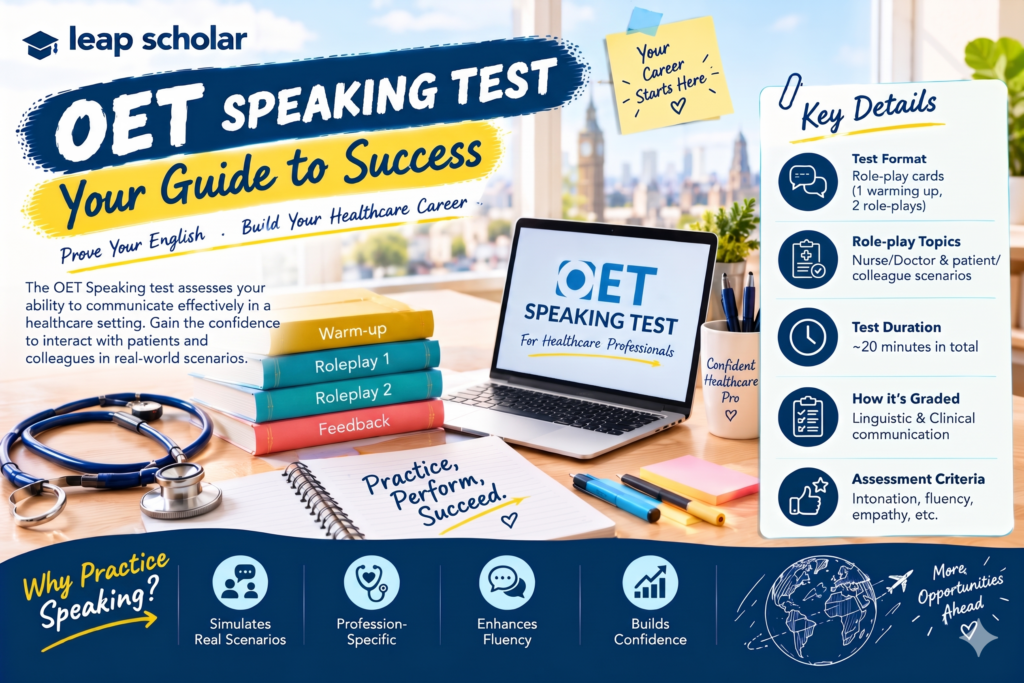
- Indian nurses and doctors sit two profession-specific role-plays, about five minutes each.
- Two assessors mark the recording on four linguistic and five clinical criteria.
- Ahpra now asks 360 in Speaking for tests from 23 April 2026.
- In 2025, Indian-nationality candidates averaged 370 in OET Speaking.
Can OET Speaking test role play samples help if talking to a stranger scares you?
OET Speaking test role play samples help most when the fear is the format, because Speaking is two short role-plays of about five minutes each, set for your profession. OET (the Occupational English Test) is an English test for health professionals, and our OET exam guide covers its fees, dates, and pattern.
A few terms will help before you start:

Choose your dream country
 UK
 USA
 Germany
 Australia
 Ireland
 Canada
 UAE
 France
 Sweden
 Italy
 Other
When do you want to study abroad?
What's your highest level of education?
Have you completed Class 12th?
What was your Class 12 CGPA/percentage?
Are you a student or a parent/guardian?
What do you want to study?
Select your current city
How Leap will help you

Personalised University Shortlist

Express Applications with Quicker Admits

End-to-End Application Support
- Sub-test: a sub-test is one of OET's four parts; the Speaking sub-test is where you talk.
- Role-play: a role-play is an acted conversation where you play yourself, the nurse, or doctor.
- Interlocutor: the interlocutor is the person who plays your patient.
- Role card: the role card is the card that sets the scene and lists your tasks.
Notes on the card are allowed, and unfinished tasks carry no penalty.
How does the OET Speaking test work from warm-up to the second role-play?
OET Speaking takes about 20 minutes, and each of its two role-plays runs about five minutes. The warm-up is a short, unassessed chat at the start to help you relax.
An assessor is an official OET marker, and two of them score your recording. Read the table in the order you'll meet each step:
| Step | What happens | What it means for you |
| Warm-up | A few questions to help you relax | Settle in; it carries no marks |
| Role card | Set for your profession; notes allowed; handed back at the end | Glance at it anytime |
| Preparation time | Think about which tasks need more explaining | Pick the task needing most care |
| Two role-plays | About 5 minutes each; the interlocutor signals the end if needed | Two separate chances, with different language |
| Recording | Recorded, then marked by two OET assessors | The audio is what's judged |
What this process means for you: OET says you may meet anxious or angry patients, patients who misunderstand their situation, or have limited time to explain, and it calls that tension a normal part of real life. Its materials draw on real healthcare scenarios, including the kind of talk that takes place in NHS roles (the NHS is the UK's National Health Service).
Sources: OET Speaking page
How are the OET Speaking tests delivered on paper, on a computer, and on OET@Home?
OET delivers Speaking in three modes, paper, computer, and OET@Home, and your mode decides where you sit and how you meet the interlocutor. Read across each row for one mode:
| Mode | How Speaking is delivered | What to know |
| OET on paper | At the test venue, face to face in a private room | You meet the interlocutor in person |
| OET on computer | At home via a secure platform, or at a venue in select countries | You meet the interlocutor via Zoom |
| OET@Home | Through the OET Speaking platform with a live interlocutor | A real person talks with you online |
A regulator is the official body that registers nurses or doctors in a country and decides which English proof it accepts. OET@Home has limits, and not every regulator accepts it, so check your regulator's mode rules before you book. Then practice OET Speaking test role play samples in the mode you'll sit in.
Sources: OET test on paper, OET test on computer, OET@Home page
How are OET Speaking test role play samples marked?
Two OET assessors mark the recording of your role-plays. Criteria are the headings your Speaking is scored under, and OET's criteria document lists two groups.
Linguistic criteria (each scored out of 6):
- Intelligibility: how easily a listener follows your pronunciation, stress, and rhythm.
- Fluency: a steady flow of speech, neither rushed nor stop-start.
- Appropriateness of Language: words and tone that fit the patient, using lay terms for technical matters.
- Resources of Grammar and Expression: the range and accuracy of your grammar and vocabulary.
Clinical communication criteria (five categories, each scored out of 3):
- Relationship Building: opening the talk well and showing empathy.
- Understanding and Incorporating the Patient's Perspective: drawing out the patient's ideas, concerns, and expectations.
- Providing Structure: signposting when you change topics.
- Information Gathering: open questions first, then closed ones, and no leading or compound questions.
- Information Giving: finding out what the patient already knows, then checking they've understood.
Grade B is one of OET's letter grades, and it starts at 350. OET says candidates at Grade B score predominantly 5 out of 6 on each linguistic criterion and 2 out of 3 on the clinical communication criteria.
OET's page gives no weighting between these nine criteria (four plus five), so neither does this page: don't assume any one criterion counts more than another.
My insight: If time is short, fix the habits you can change this week first (an open question, a signpost, or a check on understanding), then pronunciation and fluency with a listener: Grade B rewards a spread of 5s and 2s, not one strong area.
Which Speaking grade do regulators ask for, and how did Indian candidates score?
Your regulator, not OET, sets the Speaking number you need. The NMC (Nursing and Midwifery Council) registers UK nurses and midwives, the NMBI (Nursing and Midwifery Board of Ireland) does so in Ireland, and Ahpra (the Australian Health Practitioner Regulation Agency) registers Australian health workers. One row per regulator:
| Regulator | Speaking minimum |
| NMC (UK) | Grade B (350 or above) |
| NMBI (Ireland) | Grade B (350 or above) |
| Ahpra (Australia), tests on or after 23 April 2026 | 360 |
| Nursing Council of New Zealand | 350 |
If you plan on nursing in the UK, Grade B is your line. For nursing in Australia, it's 360. On the doctor route to the UK, read your regulator's English page for its number.
A mean is a group's average score, not a pass mark or a promise. The median grade is the middle grade in order, and the mode grade is the most common one. Nationality is self-reported (candidates entered it themselves), and only groups of 100 or more are listed.
In OET's 2025 statistics, Indian-nationality candidates had a Speaking mean of 370, a median grade of B, and a mode grade of B. Speaking was the highest of the four sub-test means for them (Listening 322, Reading 313, Writing 343, and Speaking 370).
An average isn't your score: check your regulator's minimum before you book, and time yourself against it using the samples below.
Sources: NMC OET page, NMBI English language requirements, Ahpra accepted tests, Nursing Council of New Zealand, OET test statistics
OET Speaking test role play samples, example 1: a fictional nurse role play
This 5-task nurse scenario takes place in a clinic that is running late. Real OET role-plays are set for your profession, so treat these OET Speaking test role play samples as a method, not a wording.
Fictional example written for practice, not an official OET sample or clinical guidance.
Candidate card (fictional, our own layout): Nurse
- Setting: outpatient clinic, afternoon
- Patient: Ms. K. Sample, 34, booked for a routine check
- Background: an urgent case has delayed the clinic; she has waited long and wants to leave.
- Tasks:
- Greet her and acknowledge how she feels.
- Explain the delay.
- Find out why leaving matters today.
- Offer options and agree on one.
- Check that she's happy with the plan.
Model exchange (practice advice)
> Nurse: Good afternoon, Ms Sample. I'm the clinic nurse, and I'm sorry you've waited so long.
> Patient: I'm about ready to go home.
> Nurse: I understand, that's frustrating. May I explain what's happened?
> Patient: Go on.
> Nurse: Another patient needed urgent care, so the doctors are behind. Is something making today's wait hard?
> Patient: I have to collect my son from school.
> Nurse: Thank you for telling me. You could wait a little longer, or I can book you a new time this week.
> Patient: I'd rather rebook.
> Nurse: Of course. I'll find a time that fits the school run. Does that work for you?
Why it works (practice advice, not a grade):
- Relationship Building: an apology and a named feeling open the talk.
- Understanding and Incorporating the Patient's Perspective: one open question finds the real concern.
- Information Giving: the reason comes before the options, and then agreement is checked.
- Appropriateness of Language: plain words, no jargon.
OET Speaking test role play samples, example 2: a fictional doctor role play
This 5-task doctor scenario features a patient who has missed 2 follow-up visits. Like the first of these OET Speaking test role play samples, it practices communication only.
Fictional example written for practice, not an official OET sample or clinical guidance.
Candidate card (fictional, our own layout): Doctor
- Setting: hospital outpatient clinic, morning
- Patient: Mr. D. Sample, 52, here for a follow-up visit
- Background: he has missed his last two follow-up visits and seems embarrassed.
- Tasks:
- Welcome him and explain why you're meeting.
- Find out, without blame, why he missed them.
- Explain in general terms why follow-up matters.
- Agree on a plan around his working hours.
- Check he has understood.
Model exchange (practice advice)
> Doctor: Good morning, Mr Sample. I'd like to talk about your follow-up visits. Is that all right?
> Patient: Fine. I know I've missed some.
> Doctor: Please don't worry, I'm not here to blame you. What's made it hard to come?
> Patient: My shifts changed and I can't get time off.
> Doctor: That sounds stressful. What do you already know about why these visits matter?
> Patient: Not much, really.
> Doctor: They let us see how you're doing and adjust your care early. Would an early morning slot suit you?
> Patient: Yes, that would work.
> Doctor: Let me summarize: an early visit, and we'll call if it moves. Have I missed anything?
Why it works (practice advice, not a grade):
- Relationship Building: "I'm not here to blame you" keeps the tone non-judgmental.
- Information Gathering: an open question comes first, then a summary that invites corrections.
- Information Giving: the doctor asks what the patient already knows before explaining.
- Providing Structure: "Let me summarize" signals the close.
How do you practice with OET Speaking test role play samples?
OET offers a free Speaking sample test and suggests one practice test every 2 to 3 weeks, with language work in between. The steps below are my practice advice:
- Start official: take OET's free Speaking sample test to see the timing and layout.
- Swap roles: read the two fictional cards above with a partner, then record yourself.
- Listen back: check the recording against the criteria names, one at a time.
- Train one habit per session: an open question, a signpost, or a check on understanding.
- Get feedback: a trained teacher or a partner hears what you can't.
Mistakes to avoid and also practice advice:
- Reciting a memorized script: it hurts Fluency and skips Information Gathering.
- Listing facts first: ask what the patient already knows (Information Giving).
- Rushing every card task: unfinished tasks carry no penalty, though covering more gives more evidence.
- Missing the patient's cue: answer the worry they raise.
OET warns that unofficial material on social media may misrepresent the test, so stick to OET Speaking test role play samples from OET itself or clearly labeled practice ones like these.
My insight: Record one role-play a week and listen for only one criterion each time; you'll catch more than if you try to judge everything at once.
Sources: OET sample tests
What if your mind goes blank, you mishear the card, or your Speaking score is low?
You get two role-plays and no penalty for unfinished card tasks, so one stumble doesn't end your test.
My counselor's advice:
- Your mind goes blank: pause, look at the role card, and ask an open question.
- A line slips past you: ask the interlocutor to repeat it, or check it back in your own words.
- A score looks wrong: a remark is a second marking of a sub-test; request it within 72 hours of your results.
- You need to sit again: OET's listed test fee is INR 39,300 (AUD 587).
The fee is converted at 1 AUD = INR 66.93 as of October 2026 and will shift with the exchange rate, so check the latest rate before you pay.
Combining scores means using two sittings to meet the minimums: the NMC and Ahpra allow two within 12 months, the NMBI needs one result, and New Zealand counts scores within 12 months of your first sitting. The NMC also accepts IELTS Academic, which is another English test, but won't mix it with OET; our OET vs IELTS comparison helps if your regulator takes both, and IELTS Speaking practice trains a different task.
Contact OET support for remarks, your regulator for score rules, and your counselor for the plan. Between sittings, keep practicing the habits your score points to.
This is general information, not legal or registration advice; check your regulator's page before you decide.
Sources: OET results and scoring
3 Takeaways on OET Speaking Test Role Play Samples
- Know the format: two profession-specific role-plays, marked on four linguistic criteria and five clinical communication categories.
- Use samples for method: fictional OET Speaking test role play samples teach habits; OET's free sample test shows the real format.
- Check your number first: read your regulator's Speaking minimum and combining rule before paying for another sitting.
Talk to a Leap Scholar counselor to plan your Speaking practice around your regulator's score and test date.
Frequently Asked Questions About OET Speaking Test Role Play Samples
How long is the OET Speaking test?
OET Speaking takes about 20 minutes. Inside it, you do two role-plays set for your profession, each lasting about five minutes, and the short warm-up chat at the start isn't marked. The whole sub-test is recorded, and two OET assessors mark it.
Can I retake only the OET Speaking subtest?
A single sub-test retake for Speaking is possible, but only through OET on Paper and only after you've already sat the full test once. It costs around AUD 315 (about Rs. 21,000 at current rates) against AUD 587 (about Rs. 39,300) for the full test, and it isn't offered in the USA. OET on Computer and OET@Home always requires all four sub-tests, so confirm your mode and your regulator's rules before booking a retake.
How is OET Speaking marked?
Two OET assessors score your recording on four linguistic criteria, each out of 6, and five clinical communication categories, each out of 3. OET describes Grade B as predominantly 5 of 6 and 2 of 3. It publishes no weighting between the criteria and categories, so you should practice them all.
What happens in the OET Speaking warm-up?
The interlocutor starts with a few questions to help you relax, and this part isn't assessed. Use it to settle your voice and get used to the room or the screen. OET doesn't state a length for the warm-up, so don't plan around one.
Can I write on the OET Speaking role card?
You can make notes on the role card and look at it at any time during the role-play. You must hand it back to the interlocutor at the end. Use the preparation time to mark which tasks will need the most explaining.
What if I don't finish all the tasks in an OET Speaking role-play?
There's no penalty for leaving card tasks unfinished, though covering more gives more evidence of your spoken English. The interlocutor signals the end if the talk hasn't closed by itself. Good OET Speaking test role play samples show a calm close.
How do nurses and doctors prepare for OET Speaking role-plays?
Each profession gets its own cards, so practice with scenarios from your field. Take OET's free sample test, then follow its advice of one practice test every 2 to 3 weeks. Record yourself and check each take against the criteria names.
What Speaking score do I need for the NMC or Ahpra?
The NMC asks nurses for Grade B (350 or above) in Speaking. Ahpra requires a score of 360 on tests taken on or after 23 April 2026. Other regulators, such as the NMBI, publish their own numbers, so read your regulator's English page before booking.













Have Questions? Get Guidance to reach your Dream University
Connect with India's finest counsellors and biggest study abroad community.
Get Guidance