
Quick Read
- Global employers project 170 million new roles by 2030.
- Renewable energy roles top the US fastest-growing occupations list.
- Global electric car sales crossed 20 million in 2025.
- Healthcare is the fastest-growing employment sector in America.
- India employed 1.28 million people in renewable energy.
What Careers of Tomorrow Actually Mean in 2026-27
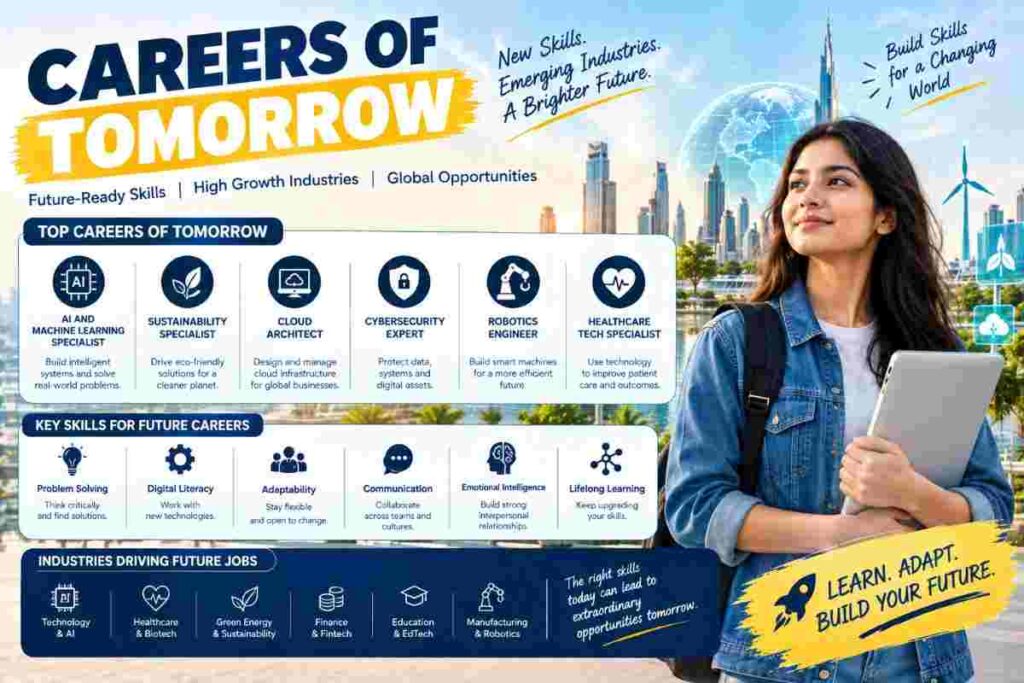
Careers of tomorrow are the roles employers say they will be hiring for by 2030, not the ones that sound futuristic. The World Economic Forum’s Future of Jobs Report 2025 puts the number at 170 million new roles created and 92 million displaced by 2030, a net gain of 78 million.
That churn is not spread evenly. Four clusters carry most of it, and this guide covers all four: climate and energy, electric vehicles and batteries, technology and AI, and health and care work.

Choose your dream country
 UK
UK
 USA
USA
 Germany
 Australia
 Ireland
 Canada
 UAE
UAE
 France
 Sweden
 Italy
Italy
 Other
Other
When do you want to study abroad?
What's your highest level of education?
Have you completed Class 12th?
What was your Class 12 CGPA/percentage?
Are you a student or a parent/guardian?
What do you want to study?
Select your current city
How Leap will help you

Personalised University Shortlist

Express Applications with Quicker Admits

End-to-End Application Support
The timeline matters for you specifically. If you are in Class 12 in 2026-27, you graduate from an undergraduate degree around 2030 and from a master's around 2032. The careers of tomorrow in this article are the ones being staffed exactly when you arrive.
If you are weighing an international degree, the study abroad after Class 12 route changes, which of these markets can you enter?
Careers of Tomorrow Compared: Sector, Strongest Markets, and Entry Degree
Here is the honest version of the comparison, including what each field costs you if it goes wrong.
| Sector | Fastest-growing roles | Where demand is strongest | Entry degree | Honest risk |
|---|---|---|---|---|
| Climate and energy | Wind turbine technician, solar PV installer, renewable energy engineer, grid integration engineer, ESG analyst | US, Germany, Denmark, Netherlands, India | B.Tech Electrical or Mechanical, B.Sc Environmental Science, MS Renewable Energy | Pay varies sharply by technology; installation work is project-based |
| EV and battery | Battery pack engineer, power electronics engineer, testing and validation engineer, charging infrastructure planner | China, Europe, India | B.Tech Electrical, Mechatronics or Automotive, MS in battery or automotive engineering | Sales growth is policy-dependent and can reverse within a year |
| Technology and AI | AI and ML specialist, big data specialist, fintech engineer, security management specialist, data scientist | US, EU (25+ countries report shortages), India | B.Tech CS, BCA plus specialisation, MS in AI or Data Science | Entry-level generalist roles are crowded; clerical and data-entry work is shrinking |
| Health and care | Nurse practitioner, physician assistant, home health and personal care aide, mental health professional | US, Germany, UK, Sweden, Canada | MBBS, B.Sc Nursing, Psychology, allied health degrees | Licensing and registration abroad is slow and country-specific |
On pay, use verified figures rather than the round numbers circulating on career blogs. In the US, Bureau of Labor Statistics data reported by CNBC puts 2024 median pay at roughly Rs.60.02 lakh ($62,580) for wind turbine technicians, Rs.49.74 lakh ($51,860) for solar PV installers and Rs.1.24 crore ($129,210) for nurse practitioners.
Exchange rate used: 1 USD = Rs.95.91. Verify the current rate before finalising your budget.
Climate and Energy Careers of Tomorrow Around the World
Renewable energy now employs at least 16.6 million people globally, according to the IRENA and ILO Renewable Energy and Jobs Annual Review 2025, published in January 2026. India accounts for 1.28 million of those jobs, placing it among the five largest renewable energy employers in the world.
The demand signal in the US is unusually clear. The two fastest-growing occupations in the entire American economy through 2034 are both renewable roles: wind turbine service technicians at 49.9 percent growth and solar PV installers at 42.1 percent.
Europe has the same shortage. A European Commission and Cedefop policy brief published in July 2026 found that 92 percent of EU firms are acting to cut emissions while 79 percent report skills shortages as a barrier to investment.
India's own build-out is large. As on 31 March 2026, non-fossil installed capacity stood at 283.46 GW, against a target of 500 GW by 2030, with 55.3 GW added in FY 2025-26 alone. India now ranks third globally in renewable capacity.
Now the part the listicles skip. The European Environment Agency reported in September 2026 that wages in the heat pump sector run around 40 percent below wind, the best-paid of the clean energy sectors. Operations and maintenance roles offer stable employment and training. Construction and installation roles are project-based and carry more physical risk. Choosing "green energy" is not one decision. It is several, with very different outcomes.
Counselor insight: Students apply to climate programs with an environmental science background and then discover the hiring is in electrical and power systems engineering. If your target is a plant or grid role, an electrical engineering base opens more doors than an environmental one. A Masters in Renewable Energy in Germany usually assumes engineering credits you must already hold at the bachelor's stage, so this is a Class 12 decision, not a post-graduation one.
EV and Battery Careers of Tomorrow in Global Auto Markets
Electric vehicles moved from niche to mainstream in one year. The IEA's Global EV Outlook 2026 reports that global electric car sales grew 20 percent in 2025 to exceed 20 million, meaning one in four new cars sold worldwide was electric. Sales are projected at roughly 23 million in 2026. Europe was the strongest performer among major markets, with sales rising over 30 percent.
Where the work sits geographically is the thing to understand before you pick a country. China accounted for over 80 percent of battery cell production in 2025, and nearly all battery cells used worldwide come from companies headquartered in China, Korea or Japan. Europe is scaling manufacturing but from behind. That shapes which EV careers of tomorrow are available to an Indian graduate in each market: Europe and India hire heavily in vehicle engineering, testing, power electronics and charging infrastructure, while cell chemistry manufacturing remains concentrated in East Asia.
In India, the PM E-DRIVE scheme carries an outlay of Rs.10,900 crore, including Rs.4,391 crore for roughly 14,000 electric buses and Rs.2,000 crore for fast chargers. The government plans support for around 72,000 public charging stations along 50 national highway corridors. Industry projections reported in trade press put EV sector job creation at 30 to 40 million by 2030, with only 10 to 15 percent of that direct employment. Treat that as a projection, not a government figure.
The honest risk is real and recent. IEA data shows global electric car sales in the first quarter of 2026 were 8 percent below the same period in 2025, driven by policy changes in China and the United States. Indian industry reporting also suggests 40 to 50 percent of EV hiring begins as contract or flexi-staffing before converting to permanent roles.
Counselor insight: Mechanical engineering students often assume an EV career means switching fields entirely. It usually does not. The shortage is in testing, validation and quality engineering, which sit close to a standard mechanical or electrical syllabus. Adding power electronics and battery management coursework does more for your application than changing branch. Germany's universities of applied sciences and its automotive and mechatronics programs are built around exactly this profile.
Tech and AI Careers of Tomorrow: What Grows and What Shrinks
Technology roles remain the fastest-growing careers of tomorrow in percentage terms. The WEF jobs outlook lists big data specialists, fintech engineers, AI and machine learning specialists and software developers at the top, with security management specialists close behind.
The same report is blunt about the other direction. Clerical and secretarial workers, including cashiers and administrative assistants, face the largest decline in absolute numbers, alongside postal clerks, bank tellers and data entry clerks. In the US, BLS projections show retail trade losing more jobs than any other sector.
India's own AI demand is well documented. A NASSCOM and Deloitte assessment projects the Indian AI talent pool growing from 600,000 to 650,000 in 2022 to over 1.25 million by 2027, with the AI market growing faster than the talent supply.
So is computer science finished? Not remotely. Undifferentiated computer science is what is under pressure. A degree with no specialisation, no deployment experience and no domain now competes with a very large pool. A degree paired with security, data engineering, applied ML or a domain such as energy or health does not.
Counselor insight: The most common mistake is chasing the job title rather than the layer beneath it. Students target "AI engineer" and skip data engineering, which is where a large share of actual hiring sits and where the supply is thinner. If you are comparing programs, look at the course list rather than the title of the degree. Our guides on MS abroad and high salary courses after 12th computer science break this down by country.
Health and Care Careers of Tomorrow, the Cluster Everyone Skips
Healthcare is the single fastest-growing employment sector in the United States. BLS projections for 2024-34 put healthcare and social assistance growth at 8.4 percent, adding roughly 2 million jobs, driven by an ageing population and rising chronic disease. Nurse practitioners are the fastest-growing healthcare occupation at 40.1 percent, and home health and personal care aides are projected to add more jobs than any other single occupation in the economy.
Europe has the same gap. Healthcare shortages are reported across a large majority of EU countries, with Germany, France, Sweden and Belgium among the deepest.
Indian students systematically under-weight this cluster because it does not carry the prestige of engineering. That is a scoring error, not a market signal.
Counselor insight: The obstacle here is never demand, it is licensing. Nursing and allied health registration abroad involves country-specific exams and credential recognition that can take a year or more after graduation. Students who plan for that timeline from Class 12 do fine. Students who discover it after landing struggle. Check the registration route before the university shortlist, not after. Our list of high salary courses after 12th science covers the allied health options most students miss.
Qualifications and Documents Checklist
| Requirement | Why it matters | India-specific detail |
|---|---|---|
| Class 12 marksheet and transcripts | Primary academic evidence | CBSE, ICSE and state board formats differ; some universities require attestation |
| English proficiency score | Admission and visa | IELTS 6.5 to 7.0 is typical for engineering; book 3 to 4 months ahead |
| APS certificate | Mandatory for German applications | Indian applicants must complete this separately; allow 6 to 8 weeks |
| Uni-Assist VPD | Required by many German universities | Apply well before the university deadline, not alongside it |
| Statement of Purpose | Explains your field choice | Name the specialisation, not just the sector |
| Financial proof or loan sanction | Visa requirement | Sanction letter timing often controls the whole application; start early |
| Passport | Everything downstream | Renew if under 12 months validity |
3 Takeaways on Careers of Tomorrow
The careers of tomorrow are not a mystery list. They are four documented hiring markets with public data behind them. Three things to do now:
- Pick two clusters, not five. Choose based on your stream and budget, then compare the specific specialisations inside them rather than the sector name.
- Check the entry degree before the university. Most of these fields are entered through electrical, mechanical, computer science or health degrees, so the decision happens at Class 12 or final-year UG, not later.
- Build one transferable skill this semester. Power electronics, data engineering or a language. It protects you if the market you chose shifts before you graduate.
Verified by: LeapScholar's study abroad counselling team, with hands-on experience guiding Indian students through course selection, university shortlisting and visa applications across Germany, the US, Canada and Australia.
Have questions about the careers of tomorrow? Book a free session with a LeapScholar counselor.
Frequently Asked Questions About Careers of Tomorrow
-
What are the careers of tomorrow for Indian students?
The four clusters with the strongest verified demand are climate and energy, electric vehicles and batteries, technology and AI, and health and care work. Global employers project 170 million new roles by 2030 across these areas. The right one for you depends on your stream, your budget, and whether you plan to work in India or abroad.
-
What if I pick one of these fields and the market turns?
Build skills that transfer across clusters rather than tying yourself to one sector. Power electronics applies to both EVs and grid systems. Data engineering applies to tech, energy and healthcare. Global EV sales dipped 8 percent in early 2026 on policy changes, which shows why transferable skills matter more than picking the single hottest field.
-
Which country hires most for these roles?
It differs by sector. The US leads on healthcare and renewable installation roles. Germany, Denmark, and the Netherlands lead on European clean energy and EV engineering. China dominates battery cell manufacturing. India is hiring across renewables and EVs domestically.
-
I took PCB and feel locked out of these fields. What are my options?
Healthcare is the fastest-growing employment sector in the US, and nurse practitioners are its fastest-growing occupation. Allied health, biomedical technology, public health, and mental health all sit inside the careers of tomorrow. Plan the licensing route early, because registration abroad often takes a year after graduation.
-
Are green jobs real careers or just NGO work?
Green roles are mainstream engineering and operations jobs. Renewable energy employed 16.6 million people worldwide in 2024, and the two fastest-growing occupations in the entire US economy are wind turbine technicians and solar installers. Pay varies significantly by technology, with wind among the best-paid clean energy sectors.
-
How many jobs will India's EV sector create?
Industry projections put it at 30 to 40 million by 2030, but only 10 to 15 percent of that is direct employment. The rest sits in components, servicing, logistics, and finance. Treat the headline number as an industry estimate rather than a government figure, and note that a large share of hiring begins as contract work.
-
Which jobs will be in demand in 2030?
Employers surveyed by the World Economic Forum name big data specialists, fintech engineers, AI and machine learning specialists, and software developers as the fastest-growing roles in percentage terms. Renewable energy engineers, environmental engineers, and electric vehicle specialists also feature in the top 15, driven by the energy transition.
-
Is computer science still worth studying?
Computer science remains strong, but a general degree with no specialization now faces heavy competition. The roles growing fastest are specialized: data engineering, security, applied machine learning and fintech. Pair your degree with a domain such as energy, health or finance, and build deployment experience rather than only coursework.
-
Do careers of tomorrow require studying abroad?
Many do not. India's renewable and EV sectors are hiring domestically at scale. An international degree helps most when you want to work in that country afterwards or when the specialization is not available in India. Decide based on where you want to work, not on prestige.





Have Questions? Get Guidance to reach your Dream University
Connect with India's finest counsellors and biggest study abroad community.
Get Guidance