
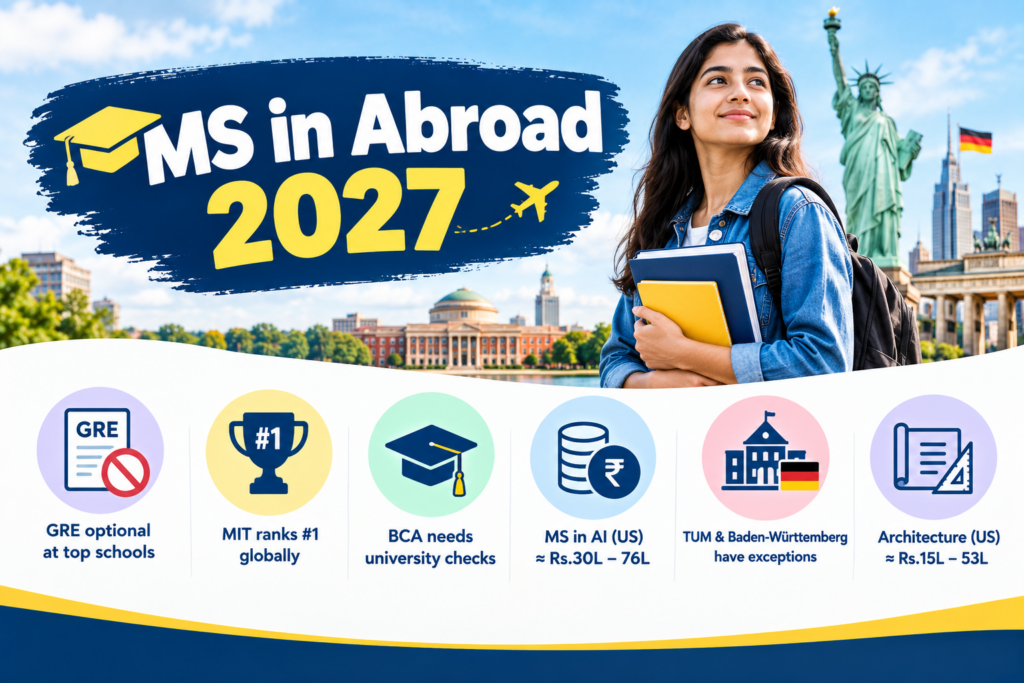
Quick Read
- GRE is now optional at MIT, Stanford, and several top CS programs.
- QS World University Rankings 2027 places MIT first globally again.
- A three-year Indian BCA degree needs university-specific equivalency checks.
- MS in AI abroad in the US costs roughly Rs.30L to Rs.76L total.
- Germany’s tuition-free rule now has real exceptions: TUM and Baden-Württemberg.
- Masters in Architecture abroad costs Rs.15L to Rs.53L a year in the US.
Best Countries and Top Universities for MS in Abroad by Specialization
Every top-ranking guide to MS in foreign countries treats the US, UK, Germany, Canada, and Australia as one interchangeable list. In practice, the right country depends on what you’re studying. If you’re exploring MS in foreign options broadly, cost and specialization fit are a faster filter than country reputation alone.
| Specialization | Best-fit countries | Typical total cost (INR) | GRE trend | Typical duration |
|---|---|---|---|---|
| Engineering (Mechanical, Civil, Electrical) | Germany, USA, Canada | Rs.9L to Rs.70L | Often optional in Germany, mixed in the US | 1.5 to 2 years |
| Computer Science / AI | USA, UK, Canada | Rs.30L to Rs.76L | Increasingly optional at top US schools | 1 to 2 years |
| Data Science / Analytics | USA, UK, Canada | Rs.25L to Rs.65L | Mixed; several UK programs waive it | 1 to 2 years |
| Architecture (M.Arch) | USA, UK, Canada | Rs.15L to Rs.53L | Rarely required; portfolio matters more | 2 to 3 years |
| Business Analytics (MSc) | UK, USA | Rs.20L to Rs.55L | GMAT/GRE are often optional in the UK | 1 year (UK), 1.5 to 2 years (US) |

Choose your dream country
 UK
UK
 USA
USA
 Germany
 Australia
 Ireland
 Canada
 UAE
UAE
 France
 Sweden
 Italy
Italy
 Other
Other
When do you want to study abroad?
What's your highest level of education?
Have you completed Class 12th?
What was your Class 12 CGPA/percentage?
Are you a student or a parent/guardian?
What do you want to study?
Select your current city
How Leap will help you

Personalised University Shortlist

Express Applications with Quicker Admits

End-to-End Application Support
Top-ranked universities for MS in abroad (QS World University Rankings 2027):
| University | Country | QS World Rank 2027 |
|---|---|---|
| Massachusetts Institute of Technology (MIT) | USA | #1 |
| Imperial College London | UK | #2 (tied) |
| Stanford University | USA | #2 (tied) |
| University of Oxford | UK | #4 |
| Harvard University | USA | #5 |
| Technical University of Munich (TUM) | Germany | #25 (#1 in Germany) |
| University of Toronto | Canada | Top 30 globally |
| University of Melbourne | Australia | Top 20 globally |
If you're still deciding which of these routes fits your background, our breakdown of the best country for your Masters walks through visa work rights and post-study stay periods for each destination.
Counselor insight: Students fixate on the QS number one spot and forget it's an institution-wide score; MIT's AI program and Oxford's architecture program aren't competing on the same axis at all. Rank by department reputation for your specific field, not the university's overall QS position.
MS in Abroad After Engineering: Eligibility Requirements
Eligibility for an MS in abroad after engineering usually comes down to four things: your degree, your GPA, your English score, and whether the program still wants a GRE.
| Requirement | Typical benchmark | Notes |
|---|---|---|
| Bachelor's degree | 4-year BTech or BE in a related engineering discipline | 3-year engineering diplomas are evaluated case by case |
| GPA / percentage | 60% or a CGPA of 6.5 and above (varies by university) | Competitive programs often expect 75% or higher |
| IELTS / TOEFL | IELTS 6.5+ or TOEFL 90+ | Some universities waive this for English-medium engineering colleges |
| GRE | Optional at MIT, Stanford, UC Berkeley, Columbia, and Carnegie Mellon for select programs | Still required at most mid-tier and public universities |
| Work experience | Not mandatory for most MS programs | A relevant internship or research project helps a weaker profile |
Documents Required
| Document | India-specific detail |
|---|---|
| Marksheets and provisional certificate | Needed for BTech, BCA, and B.Arch alike; get English-attested copies early |
| Statement of Purpose (SOP) | Tailor separately per program; generic SOPs are a common rejection reason |
| Letters of Recommendation (LOR) | Brief Indian professors on the exact format overseas universities expect |
| GRE/GMAT scorecard | Optional at several top US schools; confirm per program, not per country |
| IELTS/TOEFL scorecard | Most universities want scores valid within 2 years of application |
| APS certificate (Germany only) | Mandatory for Indian degree verification before processing; selected programs now also require a dMAT score as part of APS from Summer 2027 intake |
| Bank statement or loan sanction letter | Needed at the visa stage; amount varies by destination |
Counselor insight: The financial proof document trips up more families than any admission requirement does. Start gathering bank statements and a loan sanction letter if you need one, at least two months before your visa appointment.
MS in Abroad After BCA or BTech: What Changes for You
Not every applicant for MS in abroad comes from a four-year engineering degree, and universities abroad handle this differently.
If you're a final-year BTech student graduating in May 2027
Your four-year degree is accepted at face value almost everywhere, including Germany, the US, the UK, and Canada. Your main task is locking in GRE-optional programs early if you want to skip the exam, since not every department has dropped it.
If you completed a three-year BCA and are targeting the US or Germany
Expect closer scrutiny. US universities generally evaluate a three-year BCA holistically, and a strong GRE quantitative score, ideally 160 or higher, can offset the degree-length gap. German universities are stricter and usually ask for an APS certificate to verify your record before processing your application, and for select disciplines applying from Summer 2027 onward, APS now also requires a dMAT (Digital Master Test) score.
If you're choosing between the UK, Ireland, and Australia instead
You're in an easier position. All three commonly accept a three-year Indian bachelor's degree without a bridging year, which is why many BCA graduates shortlist these destinations first.
Counselor insight: The APS certificate step for Germany is the one Indian BCA applicants forget most often, and it can add four to six weeks to your timeline. Start APS verification the moment you decide on Germany, not after you've already shortlisted universities.
MS in AI Abroad vs Masters in Architecture Abroad
Two specializations are frequently searched alongside MS in AI abroad, but they are rarely compared directly. They run on almost opposite admissions logic.
| Detail | MS in AI Abroad | Masters in Architecture Abroad |
|---|---|---|
| What matters most for admission | GRE (where required), coding/math background | Design portfolio |
| Typical total cost (US) | Rs.30L to Rs.76L | Rs.15L to Rs.53L a year |
| Typical total cost (UK/Europe) | Comparable to US at top schools | Rs.19L to Rs.48L a year |
| Typical total cost (Canada) | Rs.20L to Rs.45L | Rs.6L to Rs.30L a year |
| Duration | 1 to 2 years | 2 to 3 years |
| Post-study work in US | 3-year STEM OPT (12 months plus a 24-month extension, no lottery for OPT itself) | Standard 12-month OPT; architecture isn't always STEM-designated, so confirm per program |
| Common mistake | Assuming GRE-optional means test scores don't matter for funding | Underpreparing the SOP because the portfolio takes all the attention |
Sources: Columbia Engineering, Graduate Tuition and Fees, Harvard University Fact Book, Graduate Tuition
You can see a full university-by-university fee breakdown for a Masters in Architecture in the USA if this is your route.
Counselor insight: Architecture applicants often spend so much time on their portfolio that they underprepare their SOP, and admissions committees read both closely.
Popular Intakes and the MS in Abroad Application Calendar for Fall 2027
Most MS in abroad programs admit students through one of three intakes: Fall (August to October start, the largest intake across the US, UK, Canada, and Australia), Spring (January to February start, smaller and with fewer course options), and Winter (October start, specific to Germany's academic calendar).
Spring 2027 deadlines have largely closed by now, so Fall 2027 is the realistic target if you're starting your research today. Here's the calendar working forward from where we are:
| Period | What to do |
|---|---|
| September to November 2026 | Shortlist universities, register for GRE/IELTS, and start SOP drafts |
| December 2026 to February 2027 | Take the GRE/IELTS, request LORs, and start the APS process if Germany is on your list |
| March to May 2027 | Most Fall US and UK deadlines fall here; submit applications. |
| June to July 2027 | Interviews where required, decision releases, confirm your offer |
| July to August 2027 | Arrange financing, complete your visa application, prepare to travel |
This window compresses further for final-year students, since results often land close to visa deadlines.
For country-specific deadlines, our guides to the Fall Intake in the USA, UK Intakes, Fall Intake in Canada, and Australia Intakes go into more detail.
Costs and Funding for MS in Abroad
Tuition is only one line in the budget. Between rent, food, insurance, and the one-off costs nobody warns you about, an MS in abroad usually ends up costing more than the fee page suggests. Here's what each piece actually looks like and where the money to cover it can come from.
Tuition Fees for MS in Abroad
Tuition varies enormously by country and, within a country, by university. The table below uses one reference university from each major destination in this guide.
| University | Country | Tuition (as published) | Approx. INR |
|---|---|---|---|
| MIT | USA | USD 66,720/year (standard grad tuition, 2026-27) | Rs.63.0L/year |
| TUM | Germany | EUR 4,000-6,000/semester (non-EU Master's) | Rs.8.8L-13.2L/year |
| University of Toronto | Canada | CAD 25,000-45,000/year (varies by program) | Rs.17.1L-30.7L/year |
| University of Melbourne | Australia | AUD 49,500-56,480/year (Master of Engineering) | Convert at current AUD/INR rate |
Cost of Living for MS in Abroad
Rent is usually the biggest swing factor, and it depends more on the city than the country. The figures below are for the city where each reference university above actually sits, not a national average, which is why Boston and Munich look pricier than most students expect.
| City (reference) | Country | Approx. monthly cost, excl. rent | Approx. INR |
|---|---|---|---|
| Boston | USA | USD 1,450-1,500 | Rs.1.37L-1.42L |
| Munich | Germany | EUR 1,300-2,000 (TUM's own estimate, incl. rent) | Rs.1.43L-2.19L |
| Toronto | Canada | CAD 1,500-1,800 | Rs.1.02L-1.23L |
| London (UK reference) | UK | GBP 825 | Rs.1.05L |
Sources: Numbeo, Cost of Living in Boston, 2026, Numbeo, Cost of Living in Munich, 2026, Numbeo, Cost of Living in Toronto, 2026, Numbeo, Cost of Living in London, 2026
Scholarships for MS in Abroad
Scholarships rarely fund an entire degree, but they can cut your loan size meaningfully. Three of the four below are tied to one specific university; the fourth works no matter which university accepts you.
| Scholarship | Type | Coverage |
|---|---|---|
| Knight-Hennessy Scholars | University-specific (Stanford) | Full funding, up to 3 years, any Stanford graduate program, including MS |
| Clarendon Fund | University-specific (Oxford) | Full tuition and college fees, plus a living grant of at least GBP 18,622/year |
| TUM Tuition Fee Waivers | University-specific (TUM) | Waives the non-EU tuition fee for two semesters for eligible applicants |
| Inlaks Shivdasani Foundation Scholarship | Common, any university (UK/USA/Europe) | Up to USD 120,000 for tuition, living costs, healthcare, and one-way airfare |
If scholarships don't close the gap, most families combine self-funding with an education loan. Our comparison of education loan options for study abroad covers interest rates and collateral across major Indian lenders.
If Your MS in Abroad Application Goes Wrong
Not every application goes to plan, and that's fine as long as you know your next move.
- Missed your GRE target? Check whether your shortlisted programs have gone through GRE-optional first. If not, most Indian test centres offer retakes within three to four weeks.
- GPA below the cutoff? A strong SOP explaining an upward grade trend, plus relevant work or research experience, can still get you shortlisted at holistic-review universities.
- BCA rejected outright in Germany? The UK, Ireland, and Australia don't carry the same three-year equivalency issue.
- Visa delayed or refused? Contact your university's international office as soon as possible. Many US and UK universities allow a deferral to the next intake without a fresh application, though you usually need to ask within a set window.
3 Key Takeaways on MS in Abroad
- Confirm GRE requirements at the individual program level, not the university or country level. This one check changes your entire test-prep timeline.
- If you hold a three-year BCA, decide your target country before you start the APS or equivalency process. Germany's requirements are stricter than the UK's, Ireland's, or Australia's.
- Budget your total cost, tuition plus living expenses plus one semester's buffer, in INR before you commit to a specific university, and double-check whether your target German university falls under the new Bavaria or Baden-Württemberg fee rules.
Verified by: LeapScholar's Masters Abroad counseling team, with hands-on experience guiding Indian engineering, BCA, AI and architecture applicants through the MS in abroad process.
Have questions about your own MS in abroad shortlist? Book a free session with a LeapScholar counselor.
Frequently Asked Questions About MS in Abroad
-
What is the difference between an MS in abroad and an MBA abroad?
They're built for different people at different stages. An MS is a technical, subject-specific degree you can start right after your bachelor's, with little or no work experience expected. An MBA assumes you've already worked for a few years and wants to build on that with general management skills rather than depth in one technical area.
-
Which are the best countries for MS abroad in 2026-27?
It really depends on what you're optimizing for. Germany is the most affordable option if you stay outside Bavaria and Baden-Württemberg. The US still has the deepest bench for AI and research-heavy programs. And if you'd rather finish in a year and get back to the job market, the UK's one-year format is the practical pick.
-
Can I do an MS in abroad after a three-year BCA degree?
Yes, but the university you apply to will determine how much friction you encounter. The UK, Ireland, and Australia accept a three-year Indian degree without extra hoops. In the US, a strong GRE quant score can help a BCA applicant significantly. Germany is the one country that actually asks you to prove degree equivalency through an APS certificate before your application even gets reviewed.
-
What is the real cost of MS in abroad after engineering?
In the US, the budget is Rs.42L to Rs.73L all-in for a two-year program once tuition and living costs are added together. Germany is different, especially outside Bavaria and Baden-Württemberg, where tuition is nearly free and total costs are closer to Rs.13L to Rs.20L.
-
Is the GRE compulsory for MS in abroad in 2026-27?
It is no longer a blanket requirement. MIT, Stanford, UC Berkeley, Columbia, and Carnegie Mellon have all dropped it for select programs, but plenty of other universities still ask for it. Check the specific program page rather than assuming your target school falls into either camp.
-
What does an MS in AI abroad typically cost?
In the US, total tuition for an MS in AI typically ranges from Rs. 30L to Rs. 76L, depending on whether you attend a public or private research university. For many applicants, the deciding factor is not the fee; it is the three-year STEM OPT window that follows graduation.
-
How much does a Masters in Architecture abroad cost?
In the US, tuition costs range from Rs.15L to Rs.53L per year, while in the UK and Europe, they range from Rs.19L to Rs.48L. Canada is noticeably cheaper, with costs between Rs.6L and Rs.30L. What's unusual here is that none of these figures are decided by a test score. Your portfolio does the talking.
-
What documents do I need for MS in abroad applications?
The core list barely changes across universities: marksheets, a provisional certificate, an SOP, two or three LORs, and an English test score. Add a GRE scorecard if your program still asks for one, and an APS certificate if Germany's on your list.
-
What happens if I miss my GRE or IELTS score cutoff for MS in abroad?
First, check whether the program has actually gone GRE-optional, since a lot of applicants don't realize theirs has. If the score is genuinely required, most Indian test centres can slot you in for a retake within three to four weeks. If you're out of time for that, consider applying to programs with slightly later deadlines instead of sending in a weak score and hoping for the best.





Have Questions? Get Guidance to reach your Dream University
Connect with India's finest counsellors and biggest study abroad community.
Get Guidance